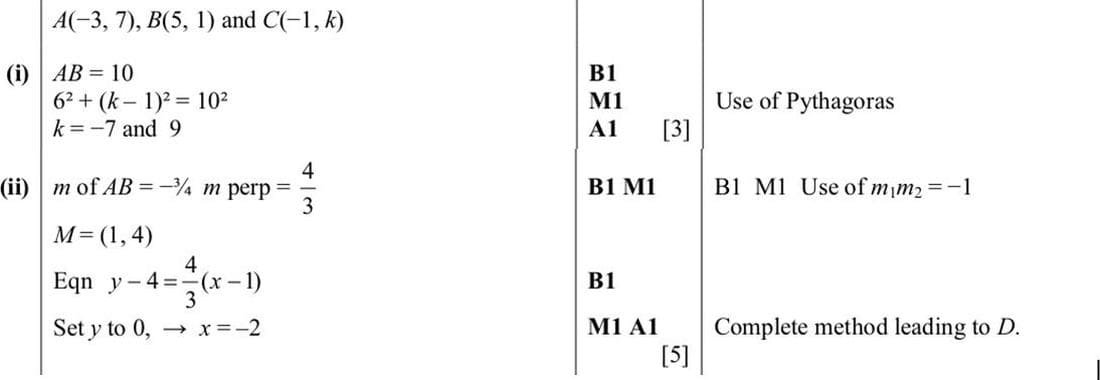
(i) Calculate the distance AB:
\(AB = \sqrt{(5 - (-3))^2 + (1 - 7)^2} = \sqrt{8^2 + (-6)^2} = \sqrt{64 + 36} = 10\)
Calculate the distance BC:
\(BC = \sqrt{(5 - (-1))^2 + (1 - k)^2} = \sqrt{6^2 + (k - 1)^2}\)
Given AB = BC, set the equations equal:
\(10 = \sqrt{36 + (k - 1)^2}\)
Square both sides:
\(100 = 36 + (k - 1)^2\)
Simplify:
\(64 = (k - 1)^2\)
Take the square root:
\(k - 1 = \pm 8\)
So, \(k = 9\) or \(k = -7\).
(ii) Find the midpoint M of AB:
\(M = \left( \frac{-3 + 5}{2}, \frac{7 + 1}{2} \right) = (1, 4)\)
Calculate the slope of AB:
\(m_{AB} = \frac{1 - 7}{5 - (-3)} = \frac{-6}{8} = -\frac{3}{4}\)
The slope of the perpendicular bisector is the negative reciprocal:
\(m_{\text{perp}} = \frac{4}{3}\)
Equation of the perpendicular bisector:
\(y - 4 = \frac{4}{3}(x - 1)\)
Set \(y = 0\) to find the x-intercept:
\(0 - 4 = \frac{4}{3}(x - 1)\) \(-4 = \frac{4}{3}(x - 1)\) \(-12 = 4(x - 1)\) \(-12 = 4x - 4\) \(-8 = 4x\) \(x = -2\)
Thus, the coordinates of D are \((-2, 0)\).