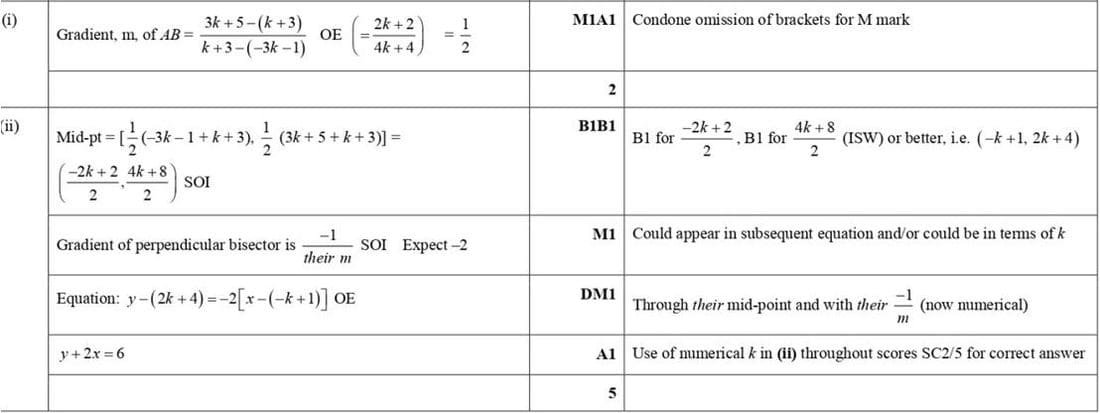
(i) To find the gradient of line \(AB\), use the formula:
\(m = \frac{y_2 - y_1}{x_2 - x_1}\)
Substitute the coordinates of \(A(-3k - 1, k + 3)\) and \(B(k + 3, 3k + 5)\):
\(m = \frac{(3k + 5) - (k + 3)}{(k + 3) - (-3k - 1)} = \frac{2k + 2}{4k + 4}\)
Simplify:
\(m = \frac{2(k + 1)}{4(k + 1)} = \frac{1}{2}\)
The gradient is \(\frac{1}{2}\), independent of \(k\).
(ii) To find the equation of the perpendicular bisector, first find the midpoint of \(AB\):
\(\text{Midpoint} = \left( \frac{-3k - 1 + k + 3}{2}, \frac{k + 3 + 3k + 5}{2} \right) = \left( \frac{-2k + 2}{2}, \frac{4k + 8}{2} \right)\)
Simplify:
\(\left( -k + 1, 2k + 4 \right)\)
The gradient of the perpendicular bisector is the negative reciprocal of \(\frac{1}{2}\):
\(-2\)
Using the point-slope form of a line equation:
\(y - (2k + 4) = -2(x - (-k + 1))\)
Simplify:
\(y - 2k - 4 = -2(x + k - 1)\) \(y - 2k - 4 = -2x - 2k + 2\) \(y + 2x = 6\)