Past Exam Questions
← Back0606 P21 - Nov 2019 - Q4 - 5 marks
Do not use a calculator in this question.
Solve the simultaneous equations, giving your answers for both \(x\) and \(y\) in the form \(a+b\sqrt2\), where \(a\) and \(b\) are integers.
\(2x+y=5,\)
\(3x-\sqrt2y=7.\)

0606 P11 - Jun 2018 - Q1 - 5 marks
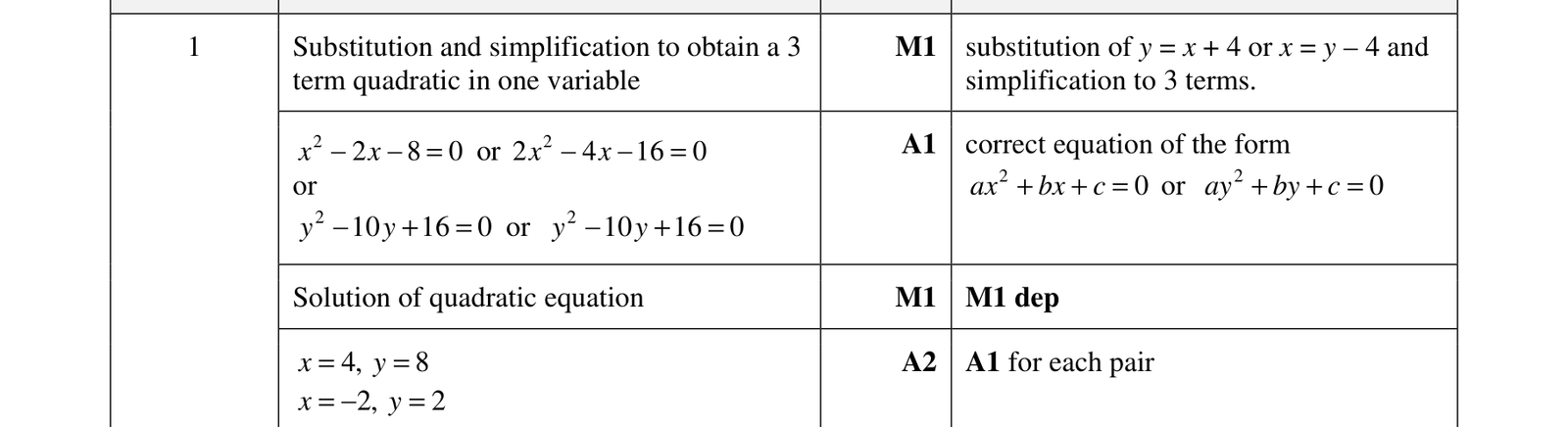
Solve the equations
\(y-x=4, \qquad x^2+y^2-8x-4y-16=0.\)
0606 P13 - Jun 2018 - Q1 - 5 marks
Solve the equations
\(y-x=4, \qquad x^2+y^2-8x-4y-16=0.\)

0606 P21 - Nov 2017 - Q4 - 5 marks
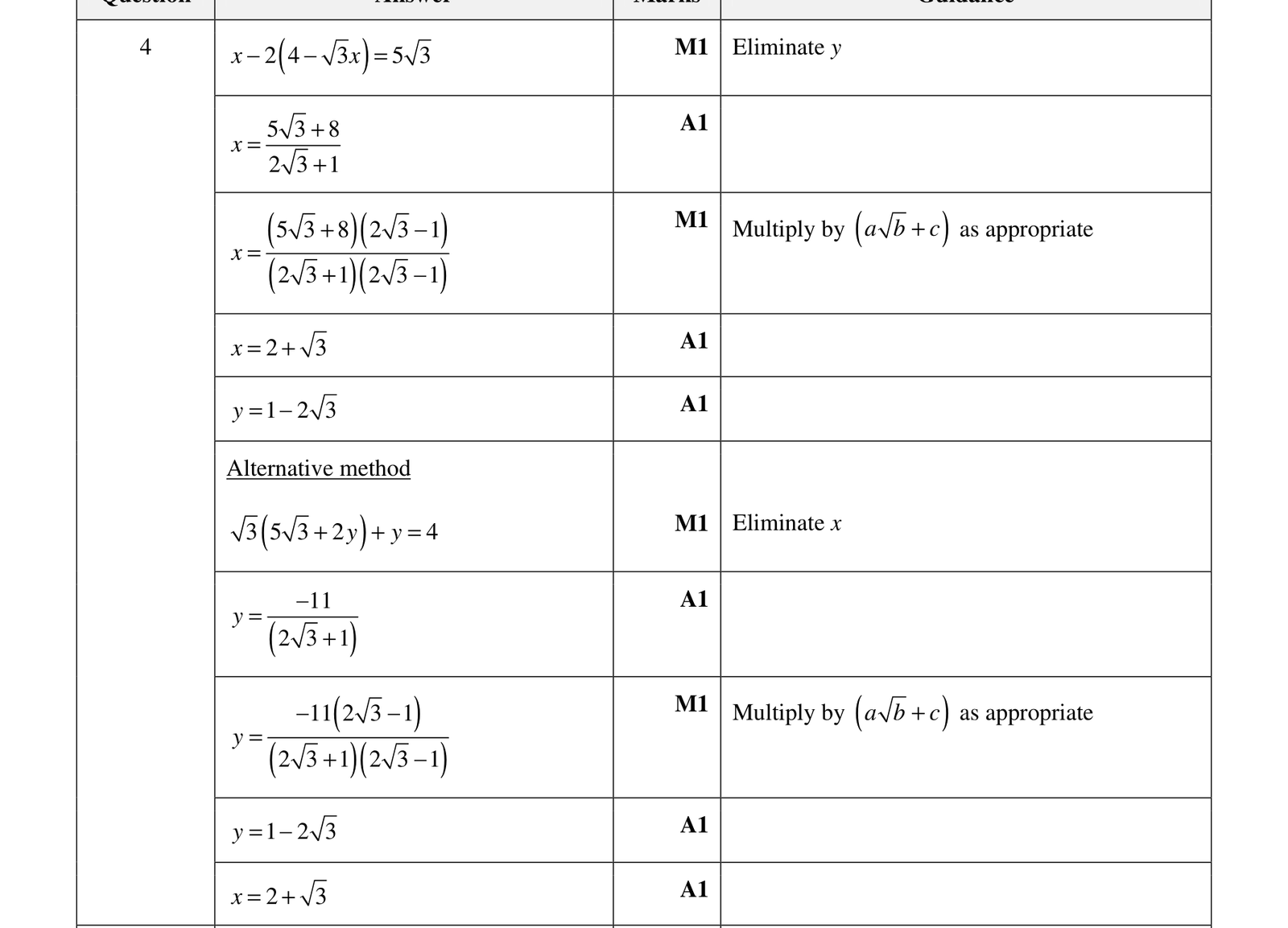
Solve the simultaneous equations for \(x\) and \(y\), giving each answer in its simplest surd form.
\(\sqrt3x+y=4\)
\(x-2y=5\sqrt3\)
0606 P21 - Jun 2025 - Q1 - 5 marks
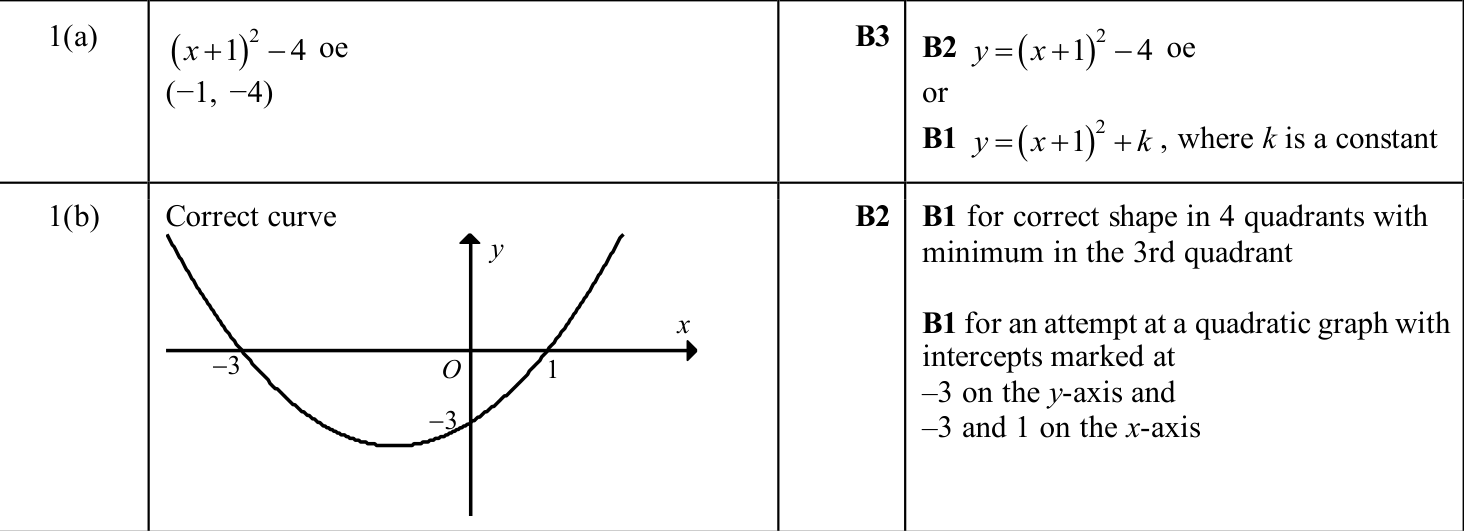
A curve has equation \(y=x^{2}+2 x-3\). (a) Use the method of completing the square to find the coordinates of the stationary point on the curve.
(b) On the axes, sketch the curve, stating the intercepts with the coordinate axes.
0606 P21 - Jun 2024 - Q2 - 4 marks
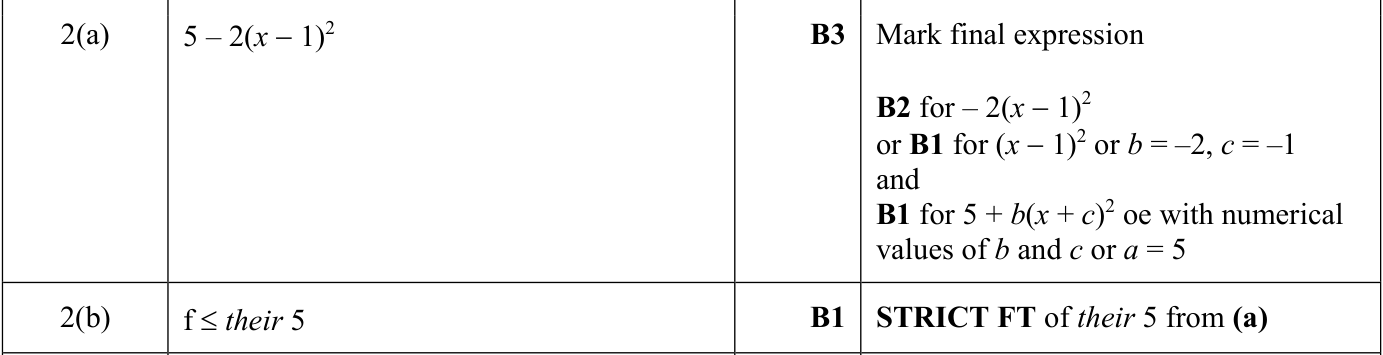
(a) Write \(3+4 x-2 x^{2}\) in the form \(a+b(x+c)^{2}\), where \(a, b\) and \(c\) are integers. (b) Hence write down the range of the function \(\mathrm{f}(x)=3+4 x-2 x^{2}\), where \(x \in \mathbb{R}\).
0606 P21 - Nov 2023 - Q1 - 9 marks
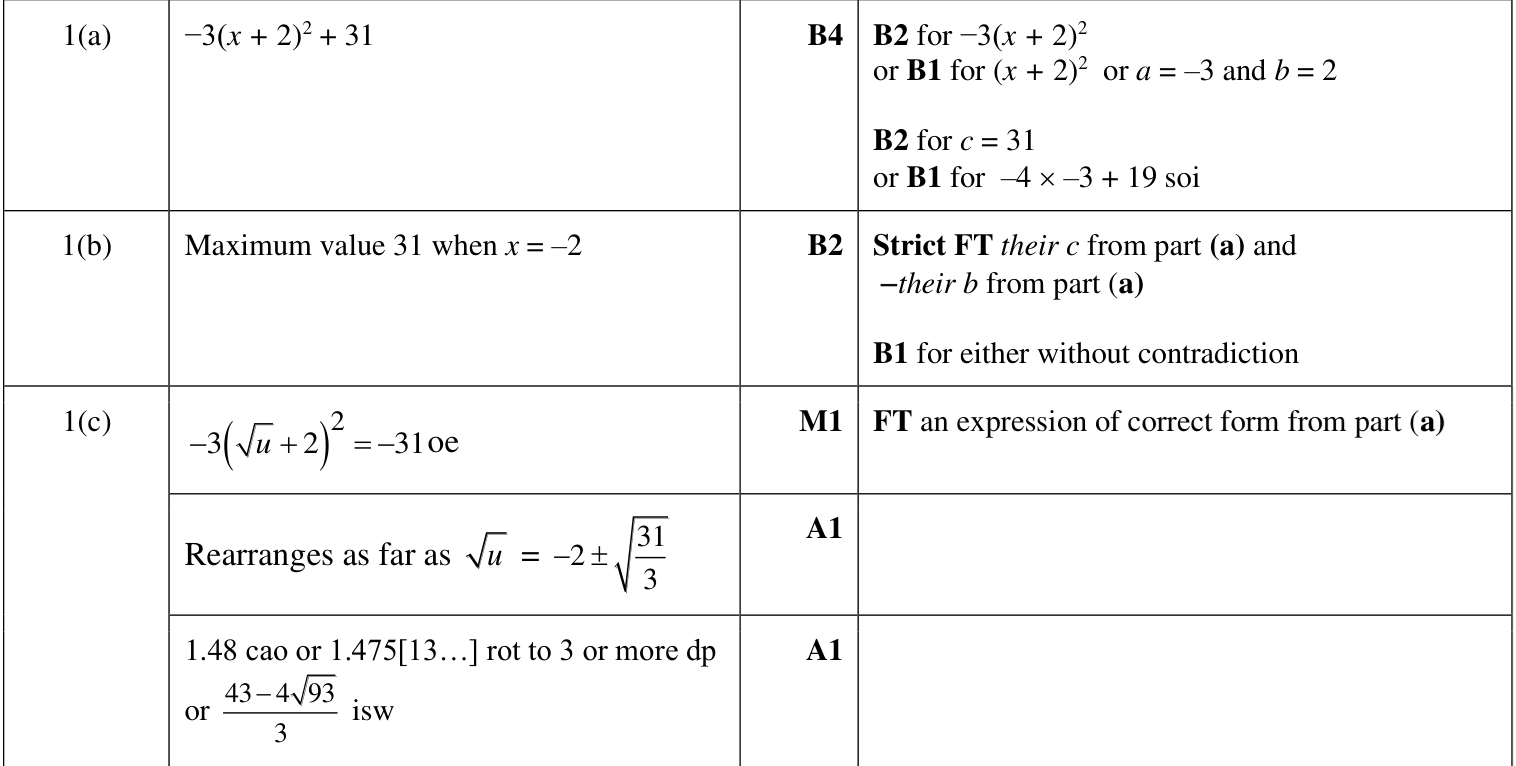
(a) Write \(19-12x-3x^2\) in the form \(a(x+b)^2+c\), where \(a\), \(b\) and \(c\) are integers.
(b) Hence find the maximum value of \(19-12x-3x^2\) and the value of \(x\) at which this maximum occurs.
(c) Use your answer to part (a) to solve the equation \(19-12\sqrt u-3u=0\).
0606 P13 - Jun 2023 - Q2 - 7 marks
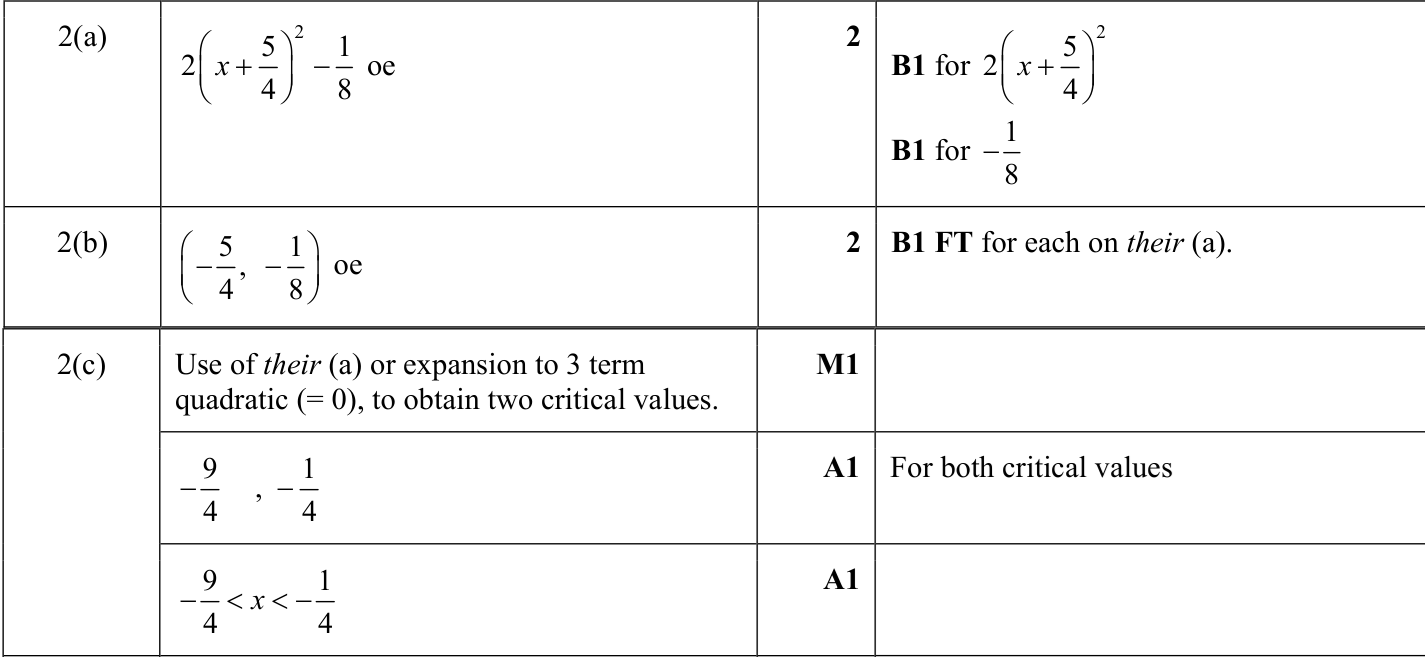
(a) Write \(2x^2+5x+3\) in the form \(2(x+a)^2+b\), where \(a\) and \(b\) are rational numbers.
(b) Hence write down the coordinates of the stationary point on the curve \(y=2x^2+5x+3\).
(c) Solve the inequality \(2x^2+5x+3\lt\frac{15}{8}\).
0606 P21 - Nov 2022 - Q6 - 9 marks
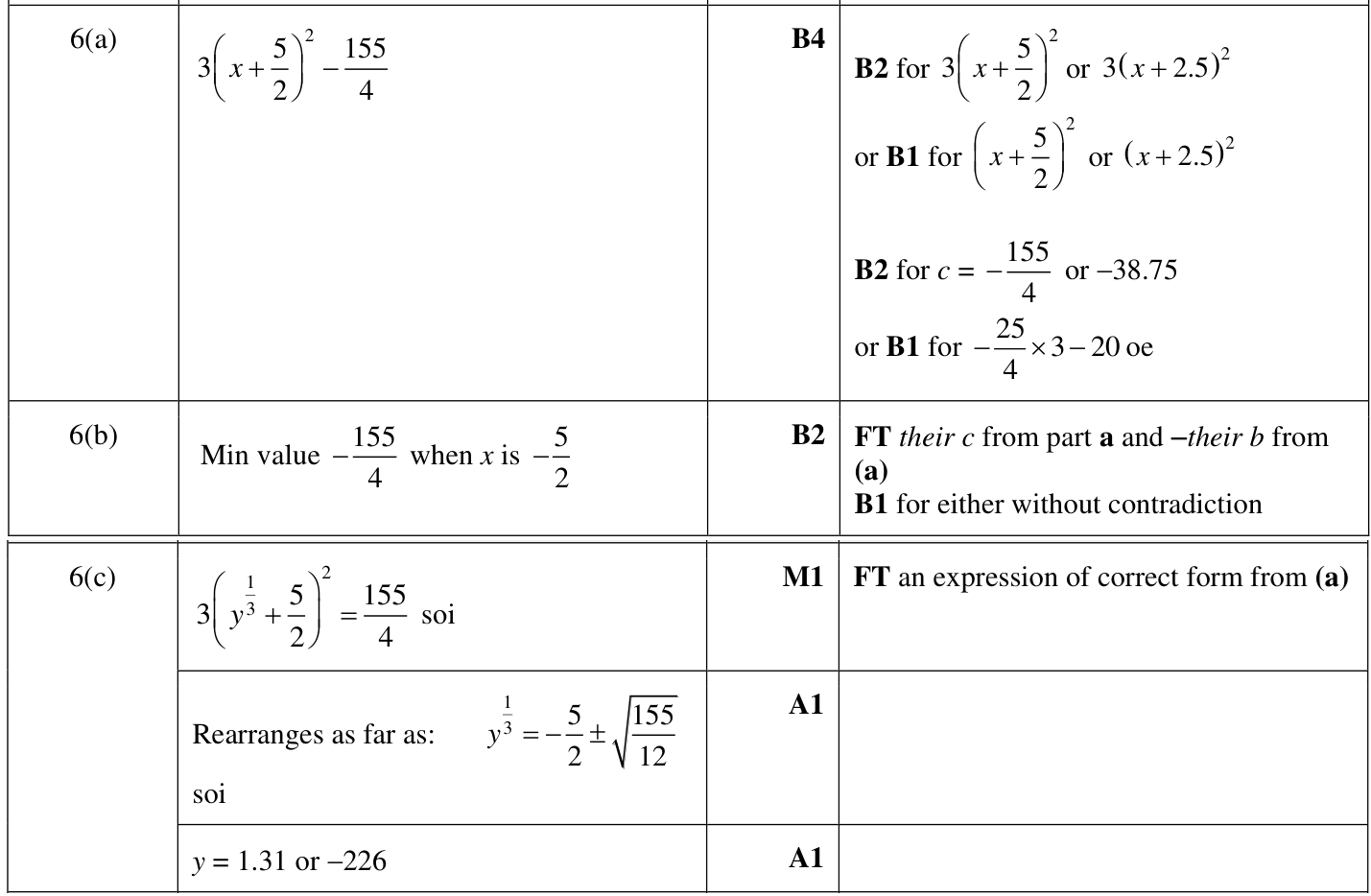
(a) Write
\(3x^2+15x-20\)
in the form \(a(x+b)^2+c\), where \(a\), \(b\) and \(c\) are rational numbers.
(b) State the minimum value of \(3x^2+15x-20\) and the value of \(x\) at which it occurs.
(c) Use your answer to part (a) to solve the equation
\(3y^{2/3}+15y^{1/3}-20=0,\)
giving your answers correct to three significant figures.
0606 P21 - Jun 2021 - Q1 - 3 marks
(a) Write the expression
\(x^2-6x+1\)
in the form \((x+a)^2+b\), where \(a\) and \(b\) are constants.
(b) Hence write down the coordinates of the minimum point on the curve
\(y=x^2-6x+1.\)

0606 P21 - Jun 2020 - Q2 - 4 marks
(a) Write \(9x^2-12x+5\) in the form \(p(x-q)^2+r\), where \(p\), \(q\) and \(r\) are constants.
(b) Hence state the coordinates of the minimum point on the curve \(y=9x^2-12x+5\).

0606 P22 - Jun 2019 - Q5 - 5 marks
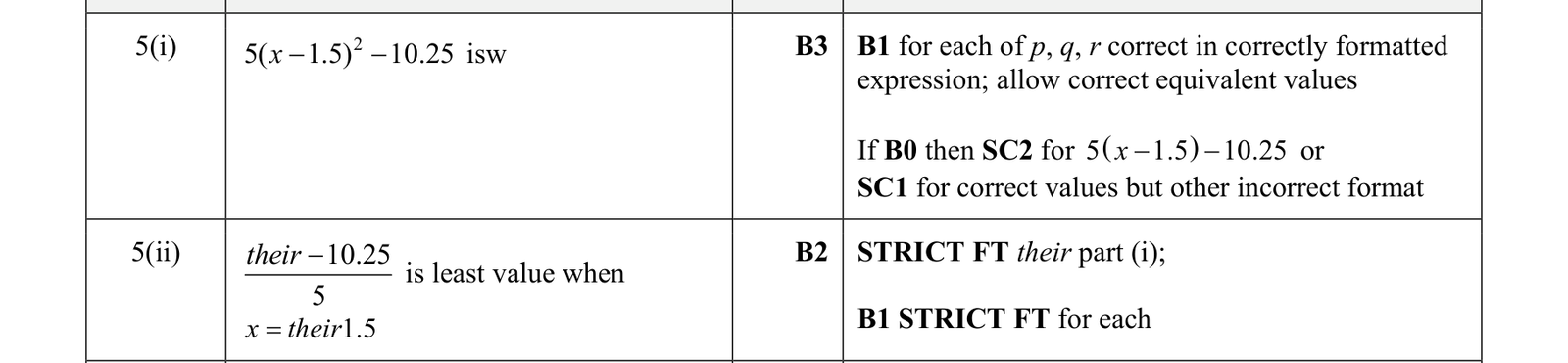
(i) Express \(5x^2-15x+1\) in the form \(p(x+q)^2+r\), where \(p\), \(q\), and \(r\) are constants.
(ii) Hence state the least value of \(x^2-3x+0.2\) and the value of \(x\) at which it occurs.
0606 P23 - Nov 2019 - Q4 - 8 marks
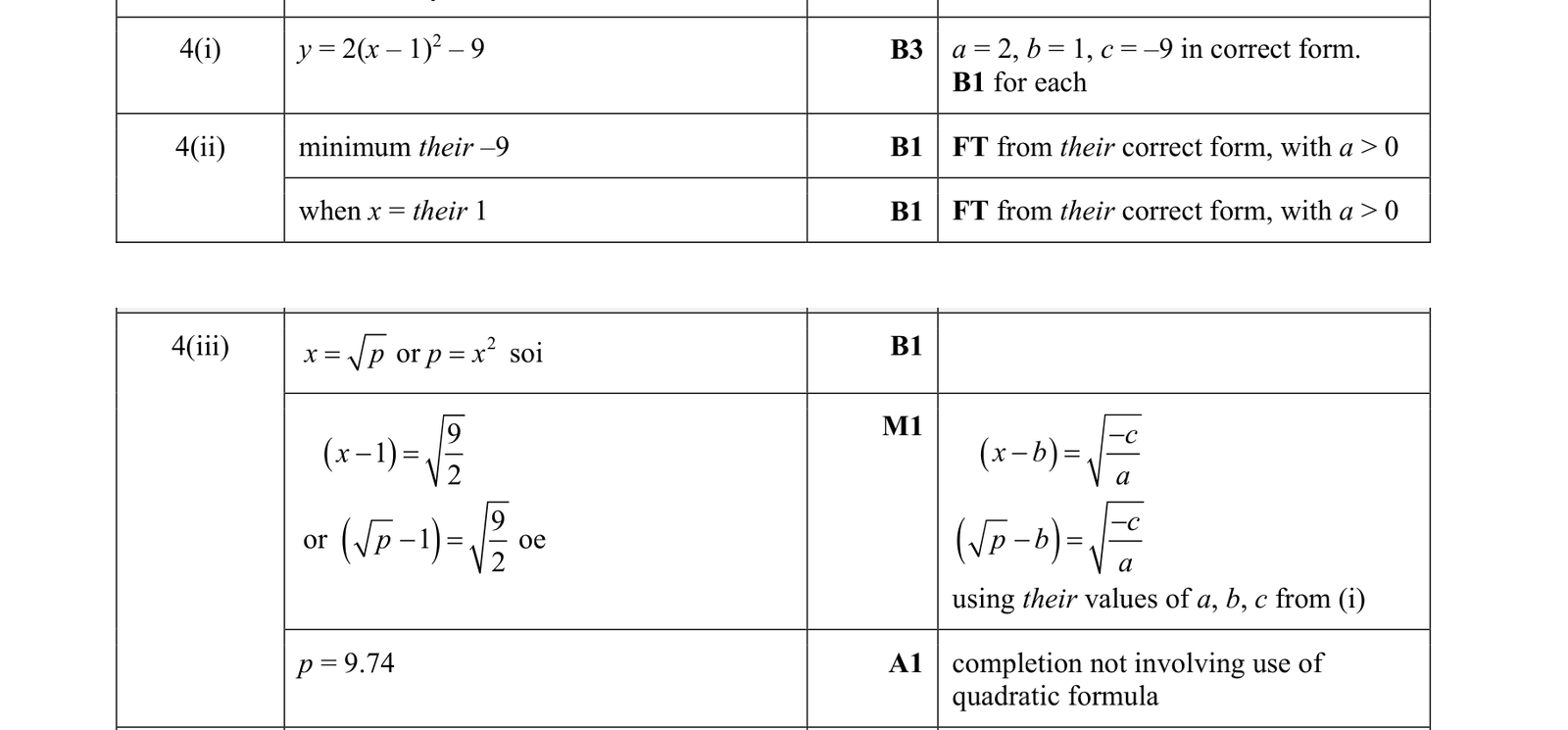
(i) Given that \(y=2x^2-4x-7\), write \(y\) in the form \(a(x-b)^2+c\), where \(a\), \(b\) and \(c\) are constants.
(ii) Hence write down the minimum value of \(y\) and the value of \(x\) at which it occurs.
(iii) Using your answer to part (i), solve
\(2p-4\sqrt p-7=0,\)
giving your answer correct to 2 decimal places.
0606 P23 - Nov 2018 - Q3 - 8 marks
(i) Write
\(8+7x-x^2\)
in the form \(a-(x-b)^2\), where \(a\) and \(b\) are constants.
(ii) Hence state the maximum value of \(8+7x-x^2\) and the value of \(x\) at which it occurs.
(iii) Using your answer to part (i), or otherwise, solve the equation
\(8+7z^2-z^4=0.\)

0606 P23 - Nov 2025 - Q3 - 9 marks
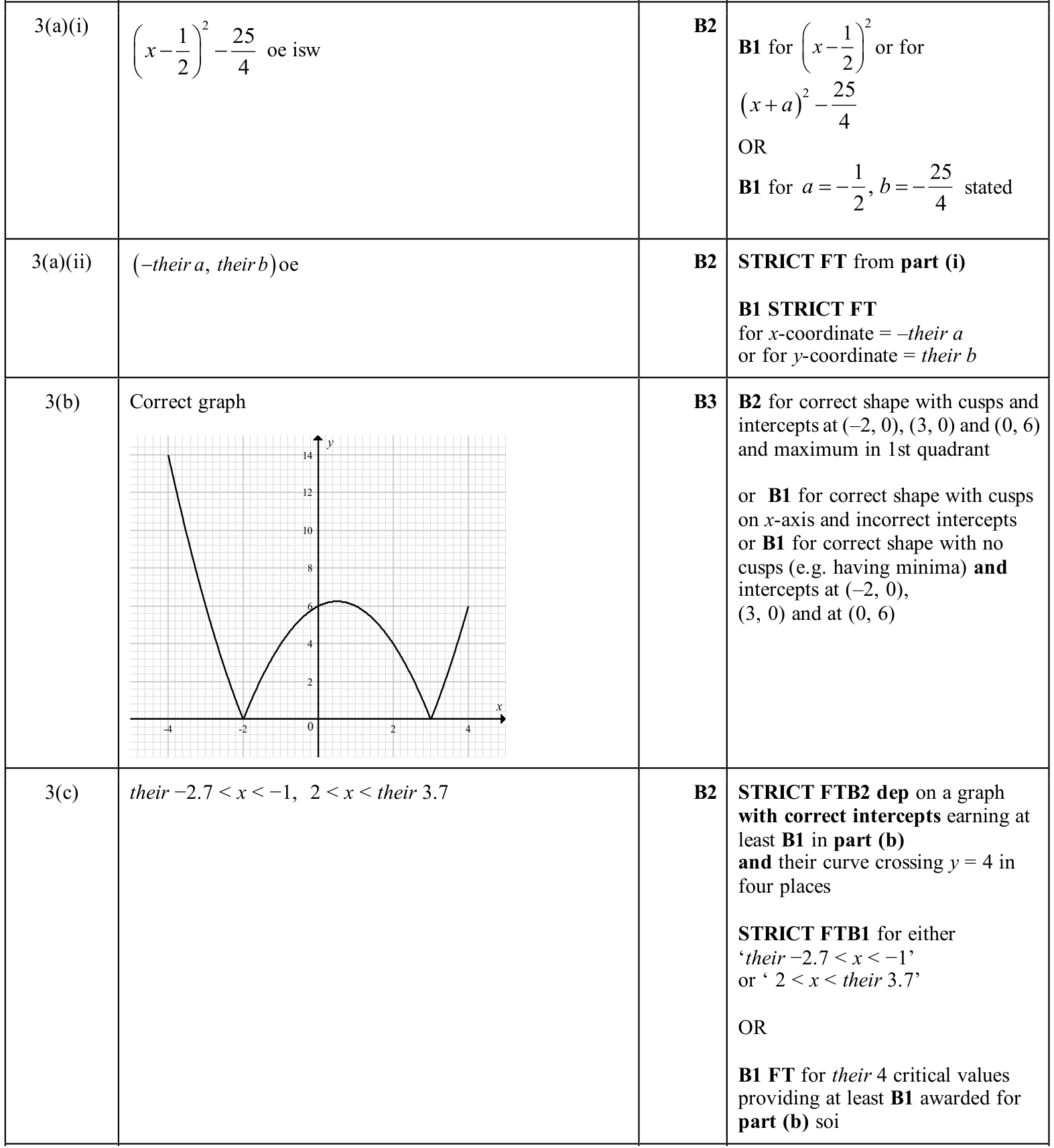
(a) (i) Write \(x^{2}-x-6\) in the form \((x+a)^{2}+b\) where \(a\) and \(b\) are constants.
(ii) Hence write down the coordinates of the stationary point on the curve \(y=x^{2}-x-6\).
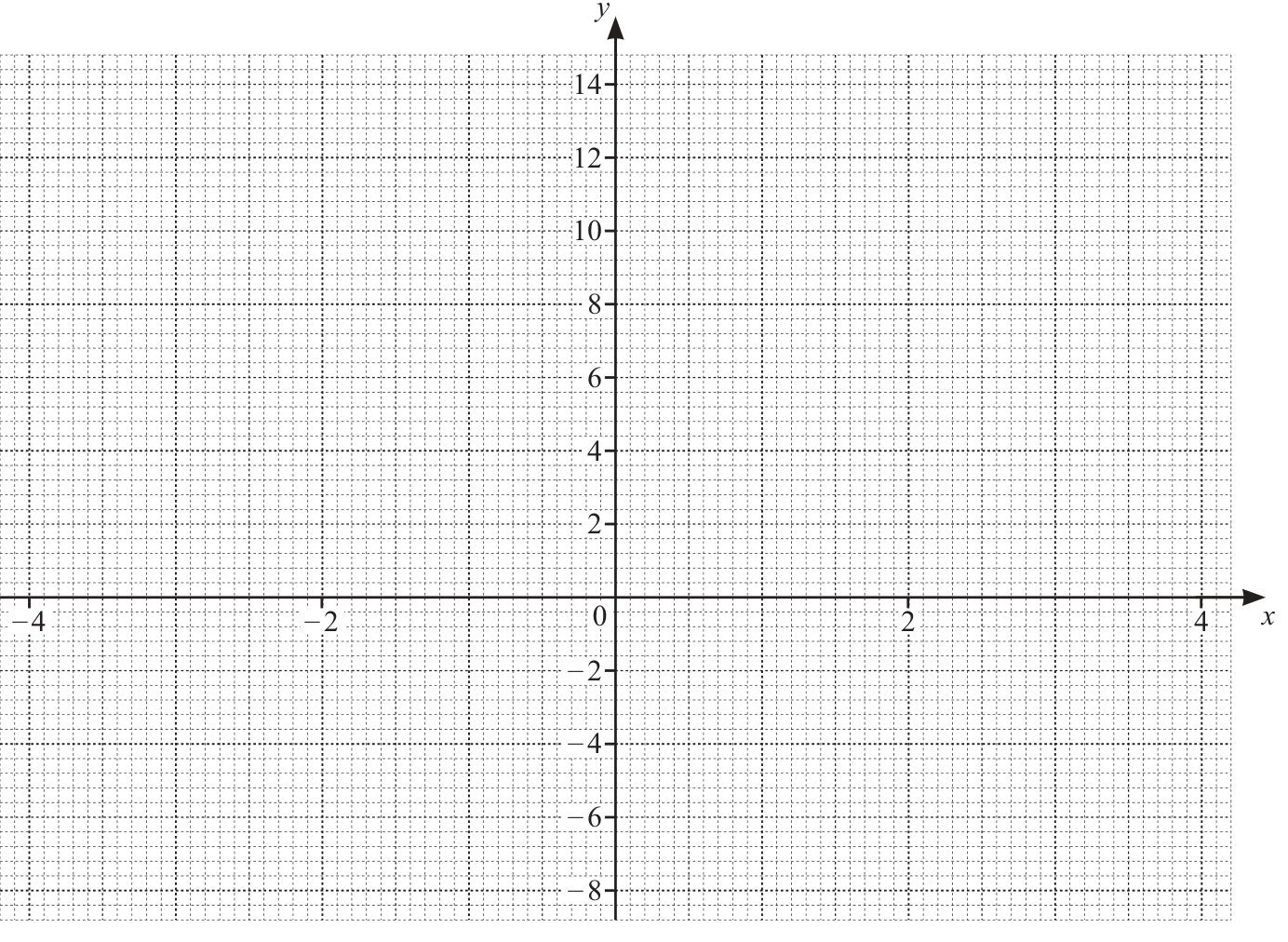
(b) On the axes, draw the graph of \(y=\left|x^{2}-x-6\right|\) for \(-4 \leqslant x \leqslant 4\).
(c) Use your graph to solve the inequality \(\left|x^{2}-x-6\right|\lt 4\).
0606 P13 - Nov 2024 - Q1 - 6 marks
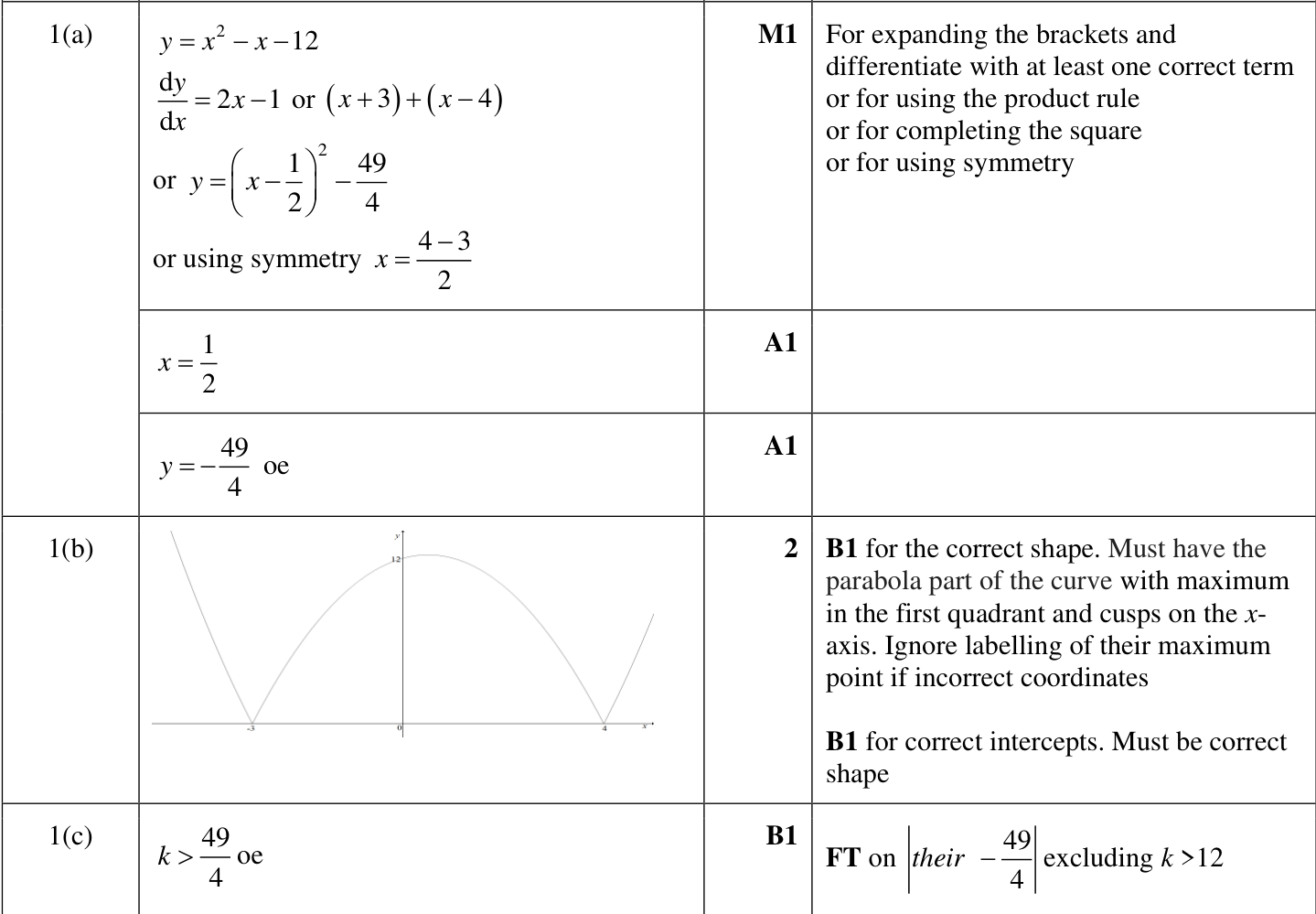
(a) Find the coordinates of the stationary point on the curve \(y=(x+3)(x-4)\).
(b) On the axes, sketch the graph of \(y=|(x+3)(x-4)|\), stating the intercepts with the axes. (c) Given that \(k\gt 0\), write down the values of \(k\) for which the equation \(|(x+3)(x-4)|=k\) has exactly 2 distinct real roots.
0606 P11 - Jun 2023 - Q1 - 10 marks
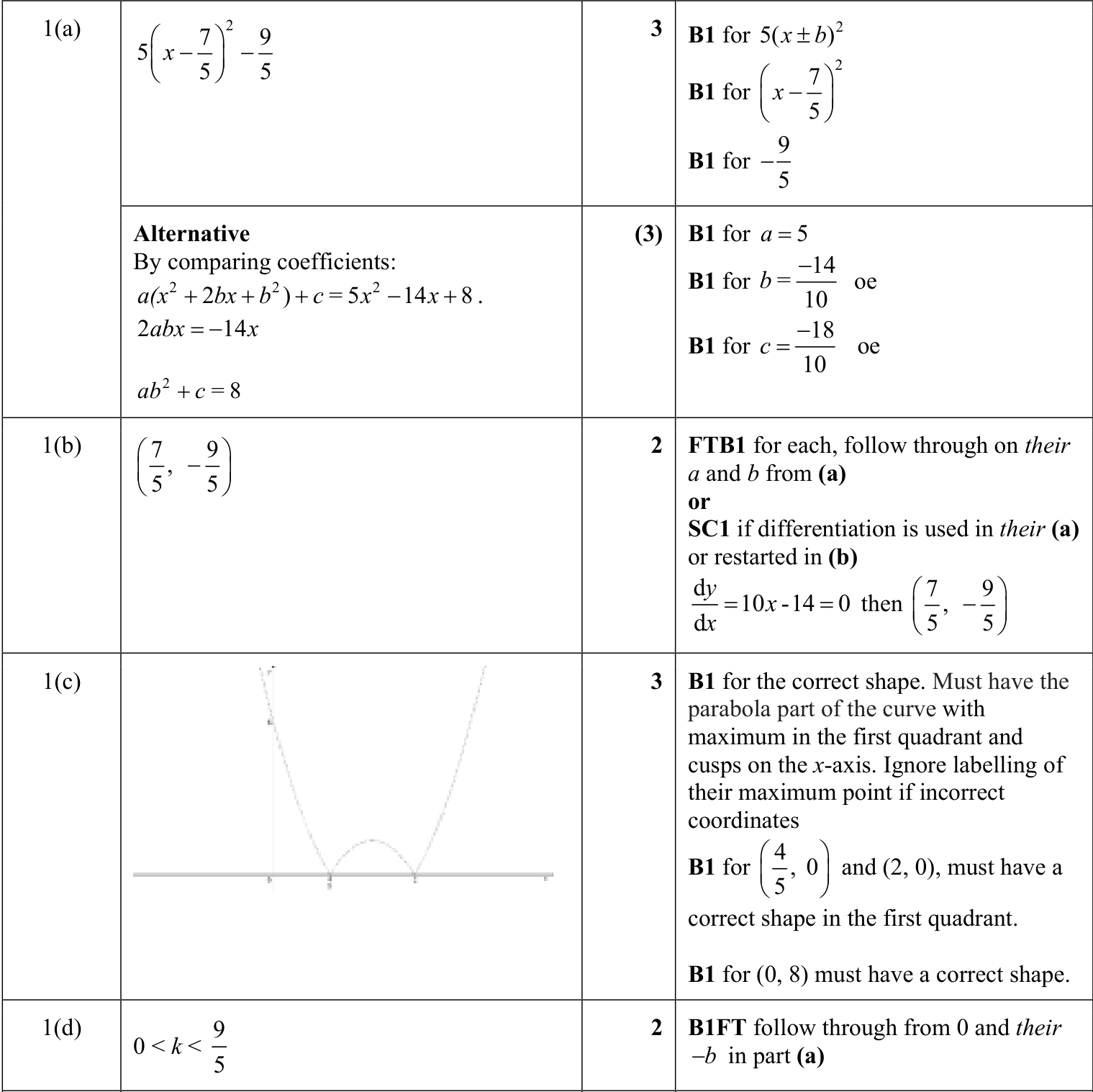
(a) Write \(5x^2-14x+8\) in the form \(a(x+b)^2+c\), where \(a\), \(b\) and \(c\) are constants to be found.
(b) Hence state the coordinates of the stationary point on the curve \(y=5x^2-14x+8\).
(c) On the axes, sketch the curve \(y=\lvert 5x^2-14x+8\rvert\), stating the coordinates of the points where the curve meets the coordinate axes.
(d) Find the set of values of \(k\) for which the equation \(\lvert 5x^2-14x+8\rvert=k\) has four distinct roots.
0606 P12 - Nov 2022 - Q2 - 8 marks
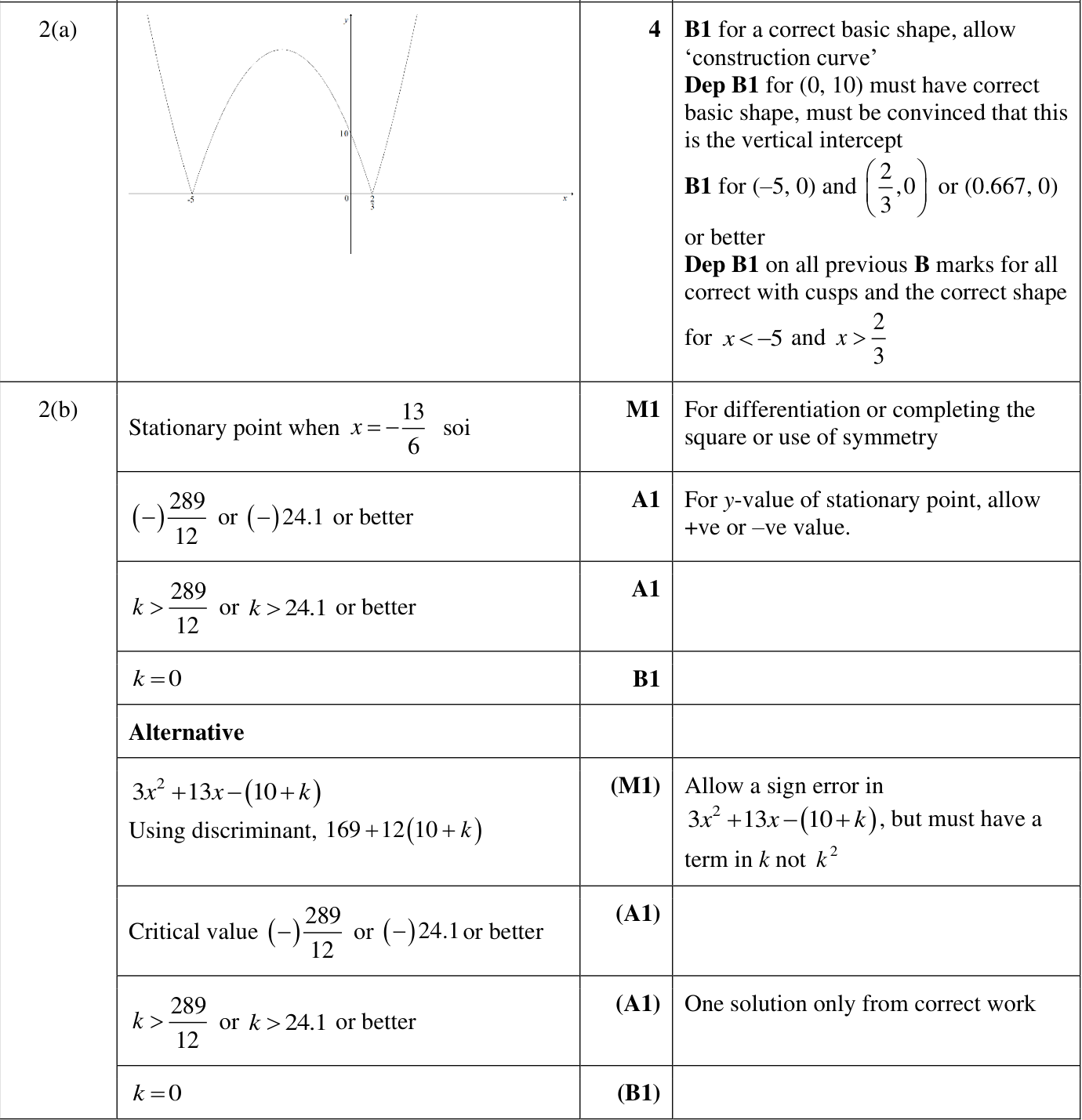
(a) On the axes, draw the graph of
\(y=\left|3x^2+13x-10\right|,\)
stating the coordinates of the points where the graph meets the axes.
(b) Find the set of values of the constant \(k\) such that the equation
\(k=\left|3x^2+13x-10\right|\)
has exactly \(2\) distinct roots.
0606 P13 - Nov 2022 - Q2 - 8 marks
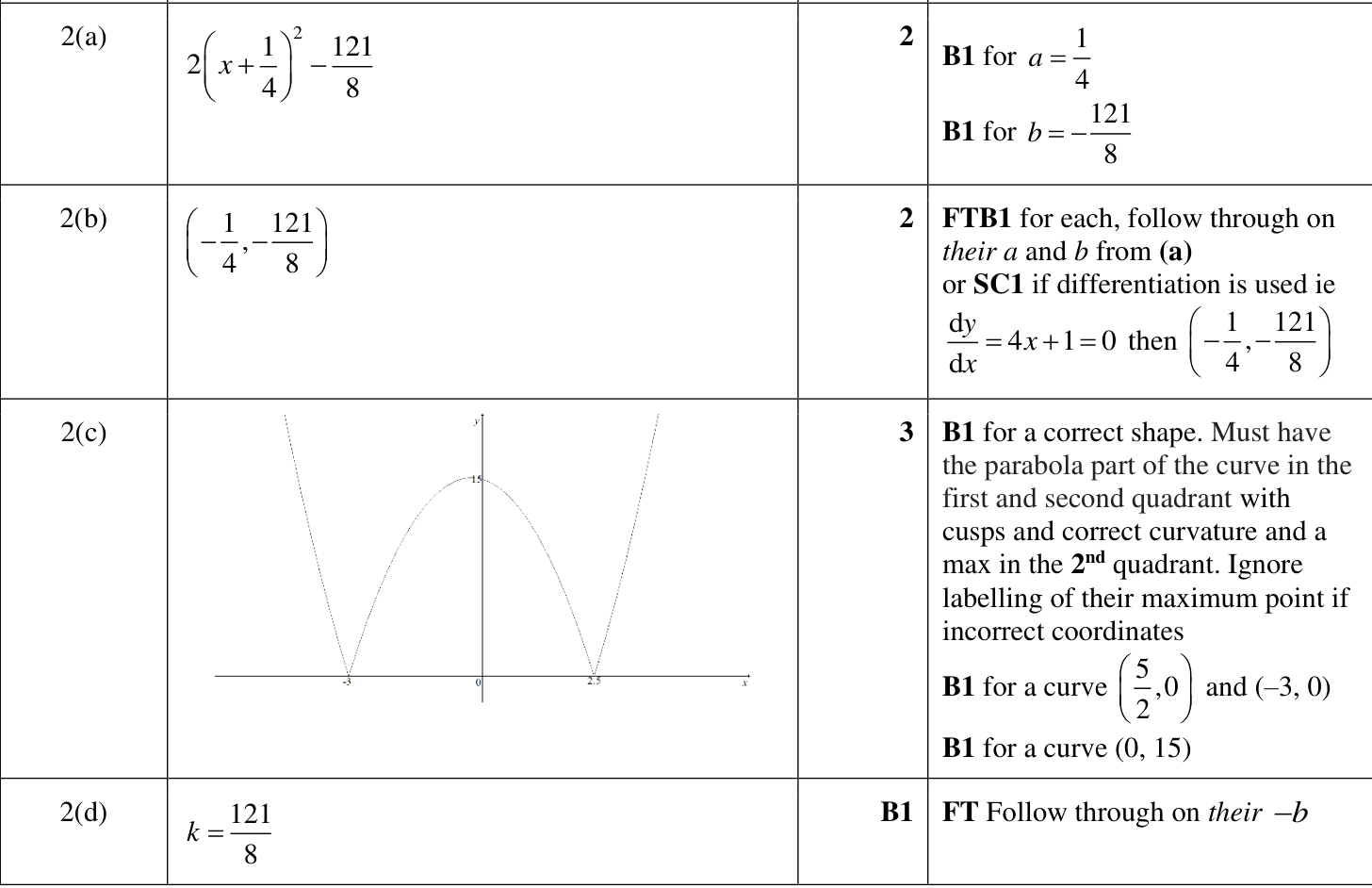
(a) Show that \(2x^2+x-15\) can be written in the form \(2(x+a)^2+b\), where \(a\) and \(b\) are exact constants to be found.
(b) Hence write down the coordinates of the stationary point on the curve \(y=2x^2+x-15\).
(c) On the axes, sketch the graph of
\(y=\left|2x^2+x-15\right|,\)
stating the coordinates of the points where the graph meets the coordinate axes.
(d) Write down the value of the constant \(k\) for which the equation
\(\left|2x^2+x-15\right|=k\)
has \(3\) distinct solutions.
0606 P12 - Mar 2021 - Q4 - 9 marks
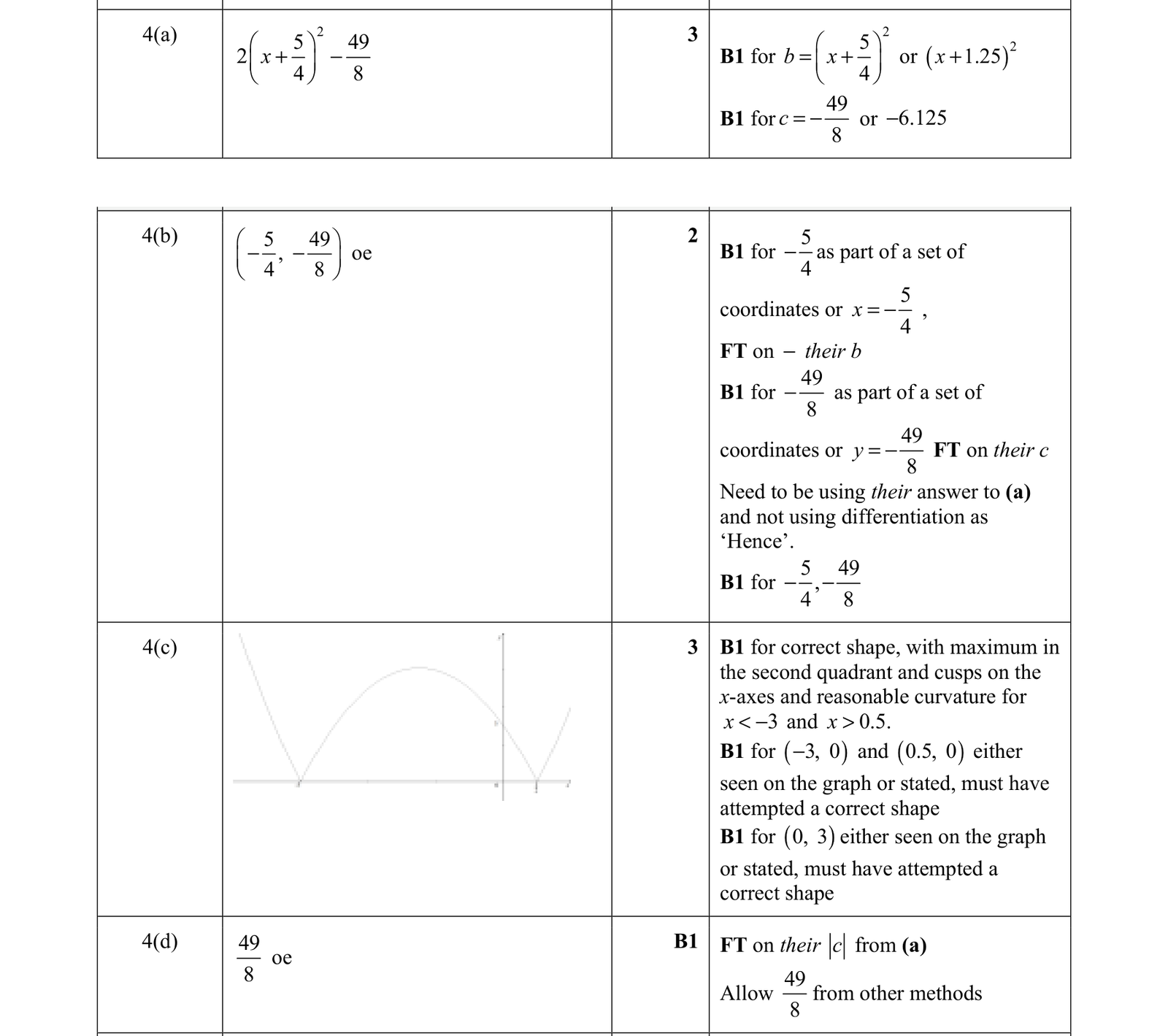
(a) Show that \(2x^2+5x-3\) can be written in the form \(a(x+b)^2+c\), where \(a\), \(b\) and \(c\) are constants.
(b) Hence write down the coordinates of the stationary point on the curve with equation
\(y=2x^2+5x-3.\)
(c) On the axes, sketch the graph of \(y=|2x^2+5x-3|\), stating the coordinates of the intercepts with the axes.
(d) Write down the value of \(k\) for which the equation \(|2x^2+5x-3|=k\) has exactly 3 distinct solutions.