Past Exam Questions
← Back0606 P21 - Nov 2017 - Q1 - 4 marks
Solve the inequality \((x-1)(x-5)\gt 12\).

0606 P11 - Nov 2025 - Q2 - 6 marks
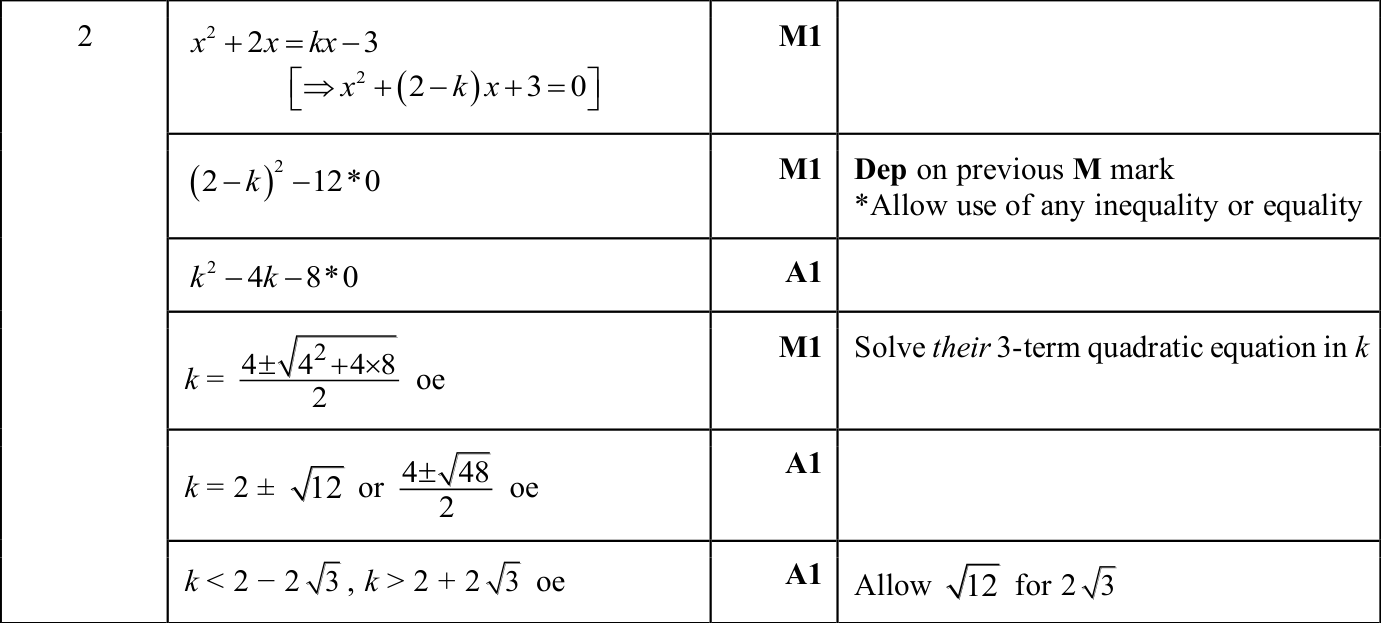
The line \(y=kx-3\) meets the curve \(y=x^2+2x\) at two distinct points.
Find the set of possible values of \(k\), giving your answer in exact form.
0606 P13 - Jun 2025 - Q2 - 4 marks
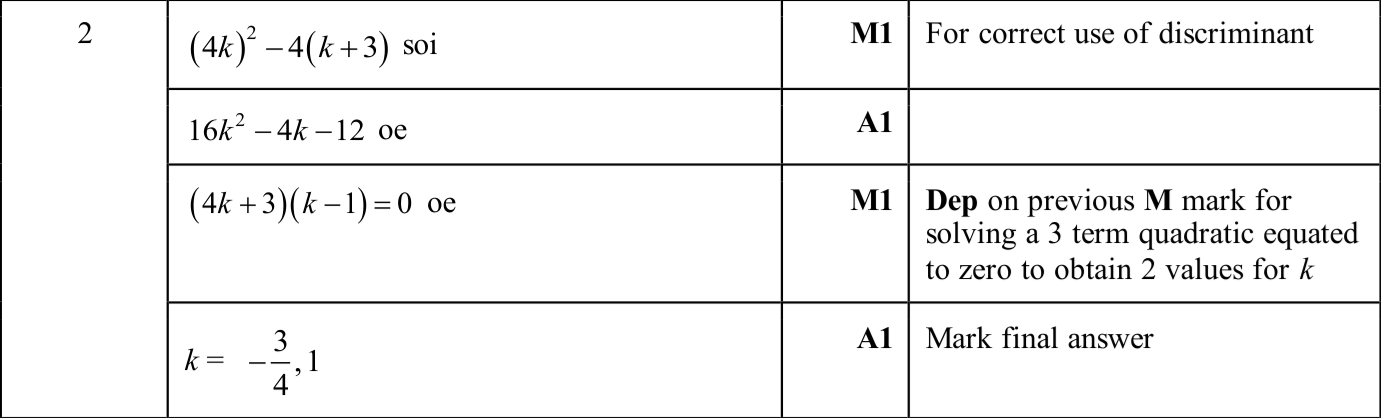
Find the values of \(k\) for which the equation \(x^{2}+4 k x+k+3=0\) has two equal roots.
0606 P21 - Jun 2025 - Q2 - 5 marks
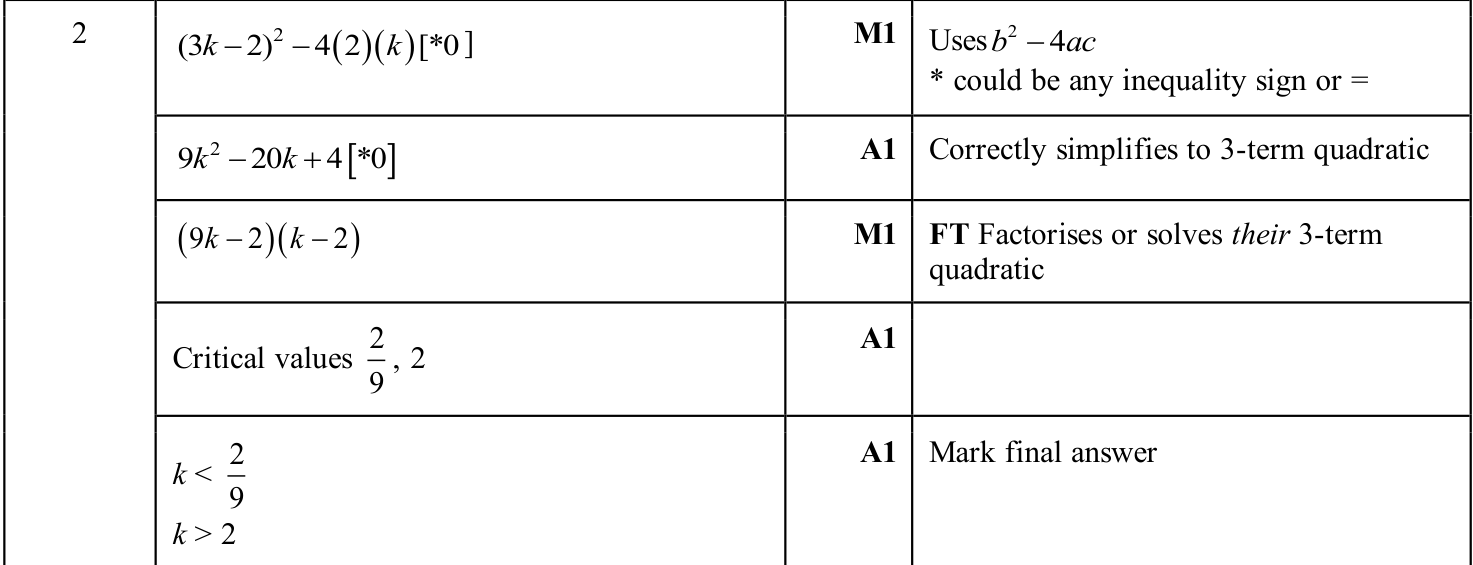
In this question, \(k\) is a constant. It is given that \(2 x^{2}+(3 k-2) x+k=0\) has roots that are real and distinct. Find the set of possible values of \(k\).
0606 P21 - Nov 2024 - Q9 - 6 marks
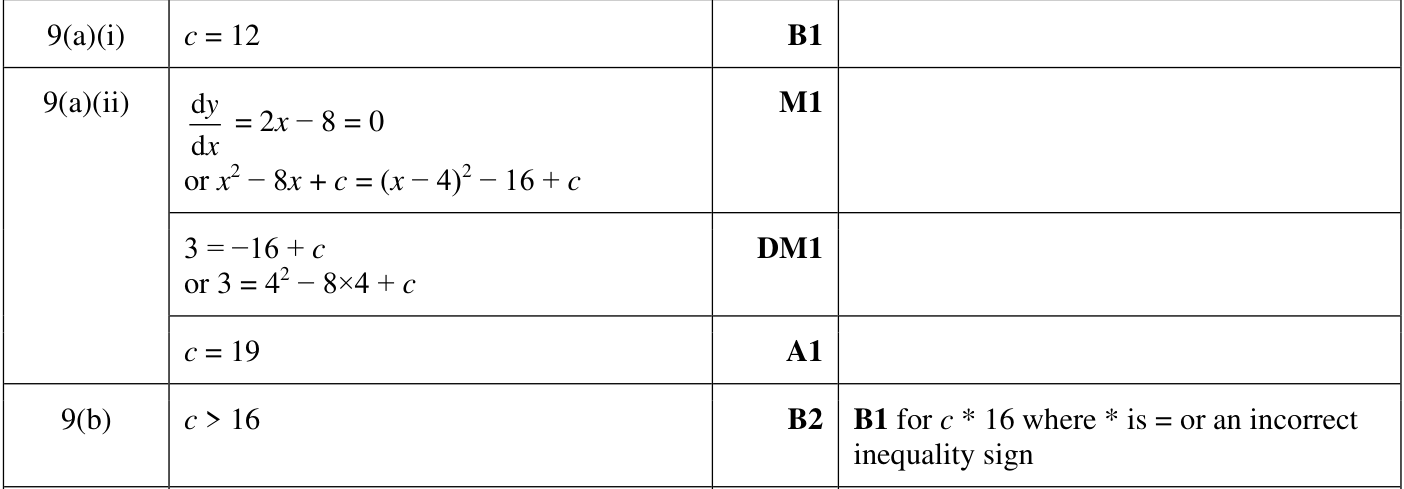
A curve has equation \(y=x^{2}-8 x+c\), where \(c\) is a constant. (a) Find the value of \(c\) in each of the following cases. (i) The curve crosses the \(x\)-axis at \(x=2\).
(ii) The minimum value of \(y\) is 3 .
(b) Find the range of values of \(c\) for which \(y\) is always greater than 0 .
0606 P21 - Jun 2024 - Q3 - 3 marks
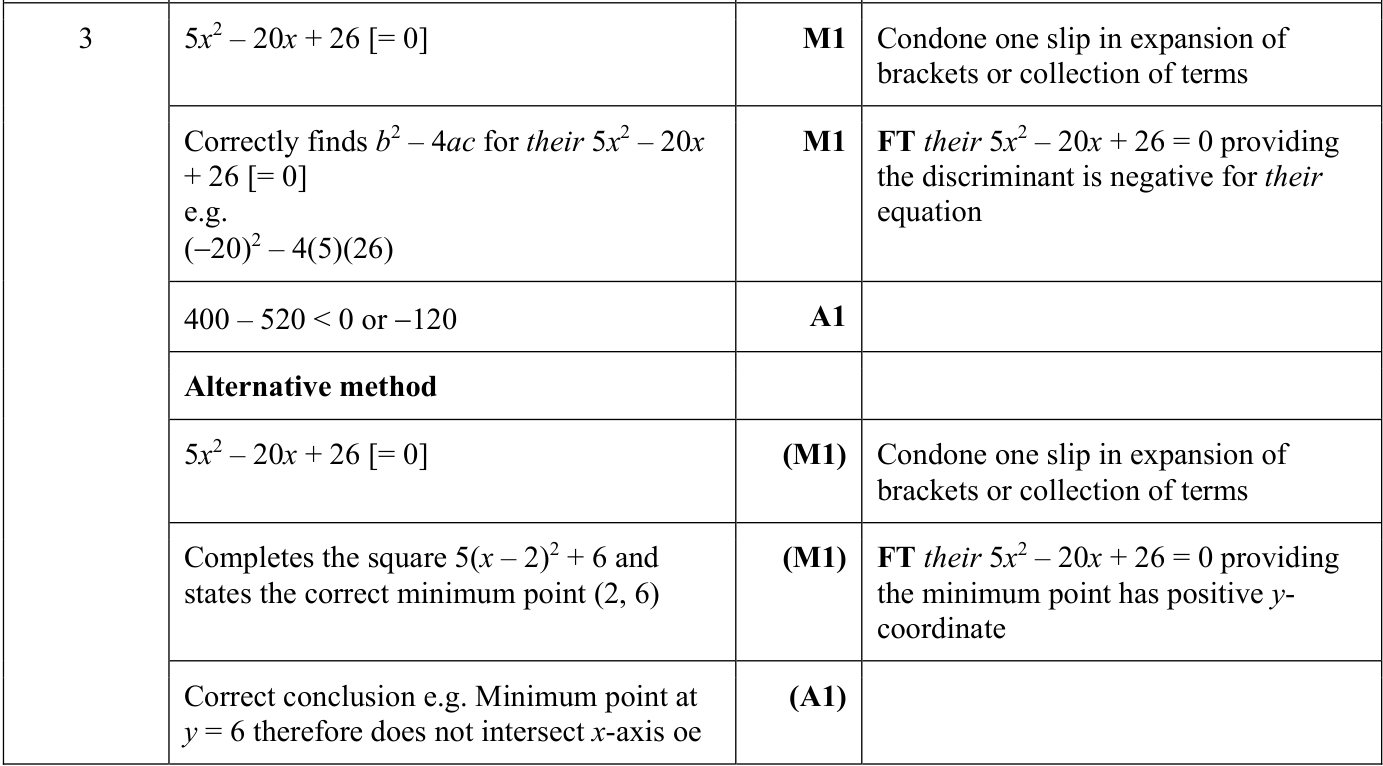
Use algebra to show that the equation \(5 x(x-3)=5 x-26\) has no real solutions.
0606 P23 - Nov 2023 - Q2 - 4 marks
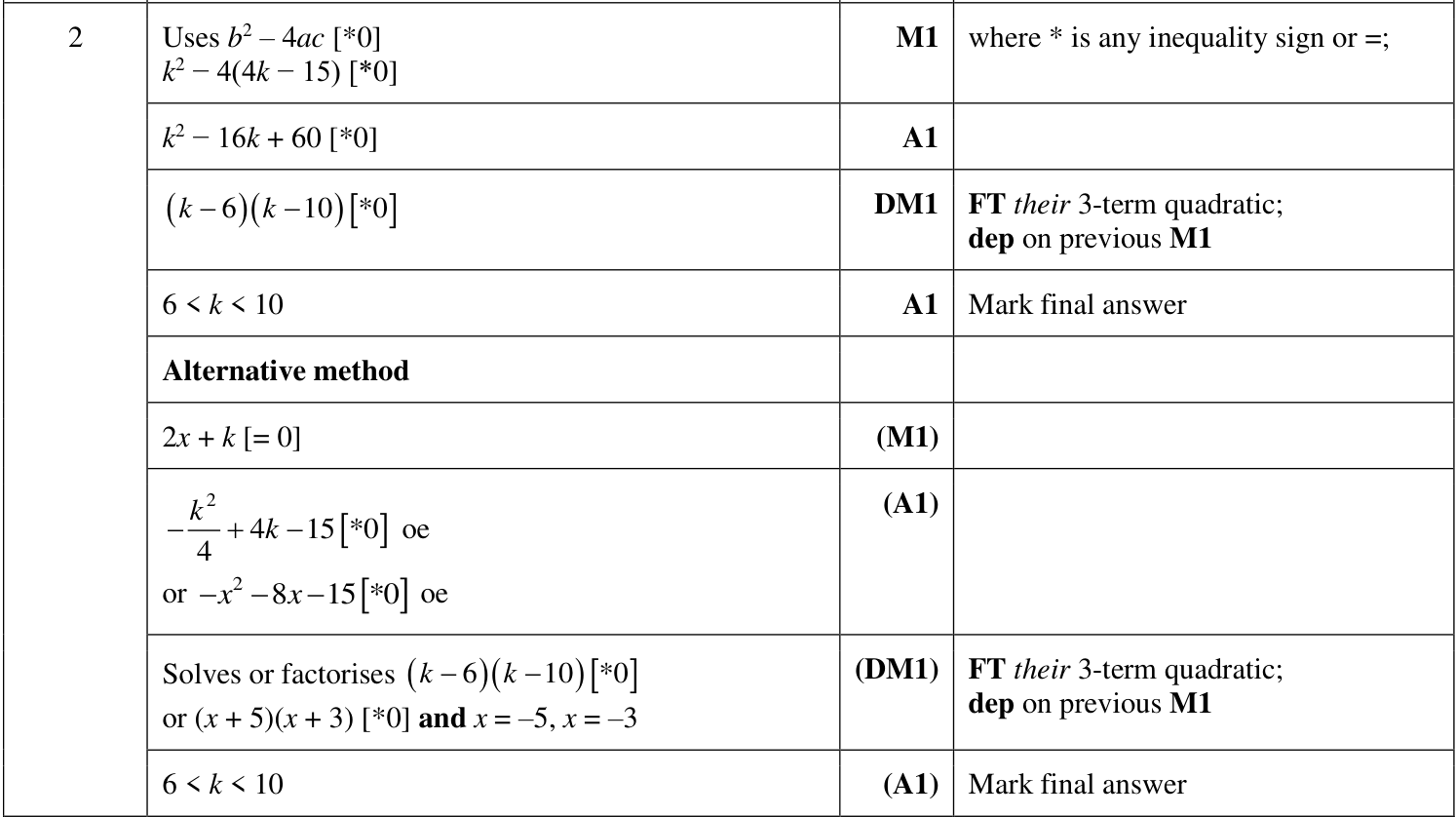
Find the values of \(k\) for which the curve
\(y=x^2+kx+4k-15\)
is completely above the \(x\)-axis.
0606 P23 - Jun 2024 - Q2 - 4 marks
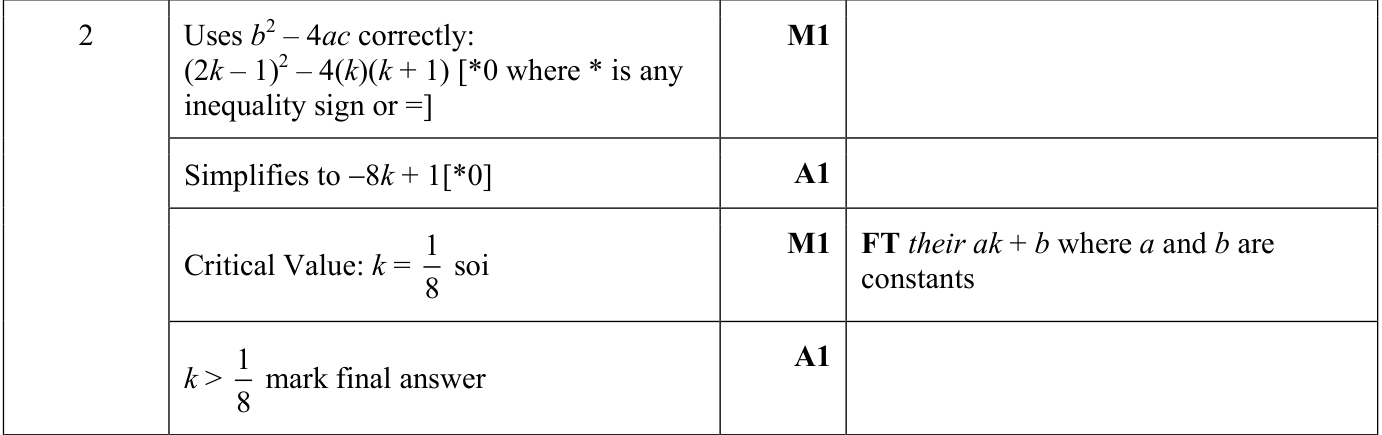
Given that the equation \(k x^{2}+(2 k-1) x+k+1=0\) has no real roots, find the set of possible values of \(k\).
0606 P12 - Jun 2023 - Q2 - 5 marks
Do not use a calculator in this question.
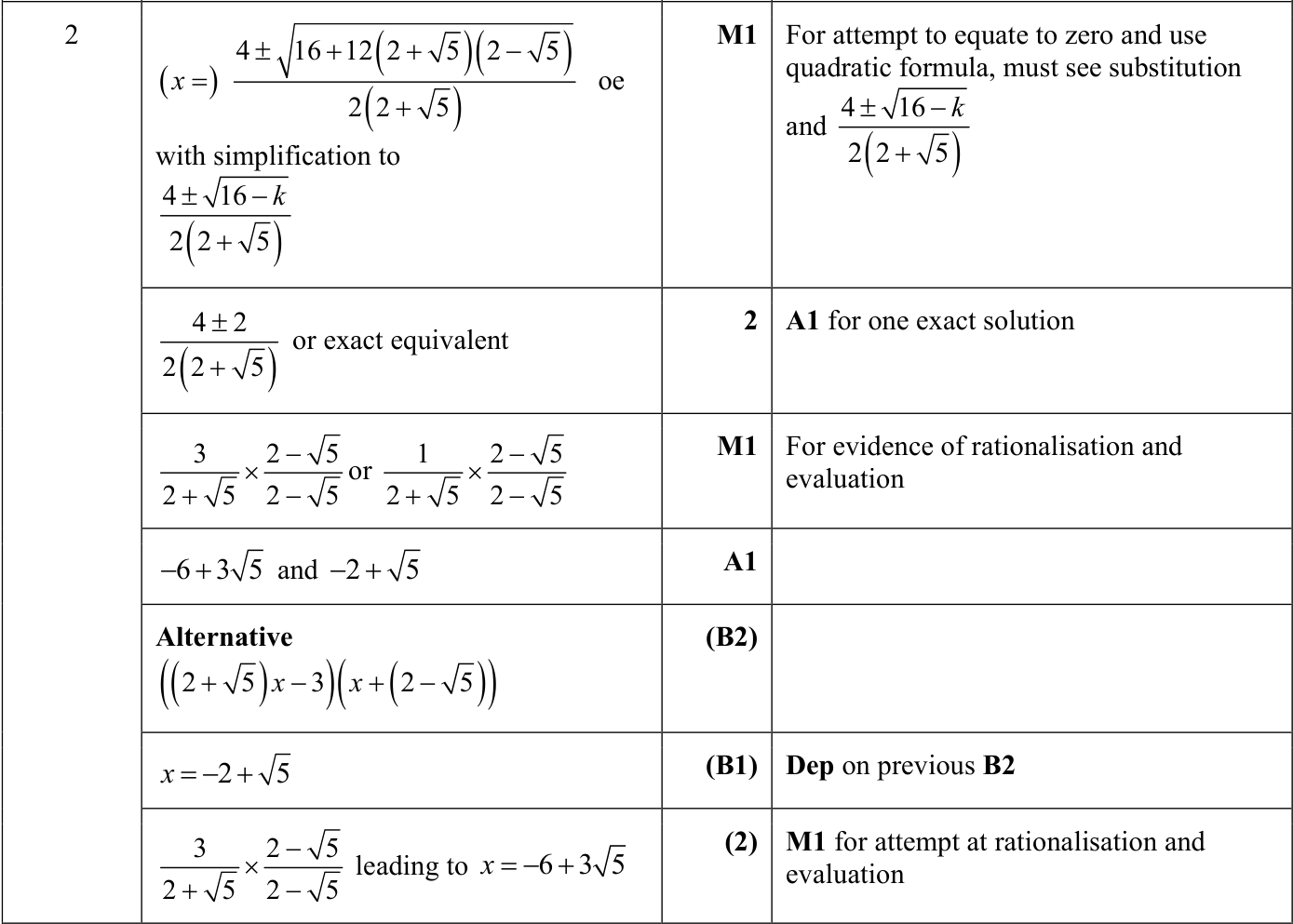
Solve the equation
\((2+\sqrt5)x^2=4x+3(2-\sqrt5),\)
giving your answers in the form \(a+b\sqrt5\), where \(a\) and \(b\) are integers.
0606 P12 - Mar 2022 - Q1 - 5 marks
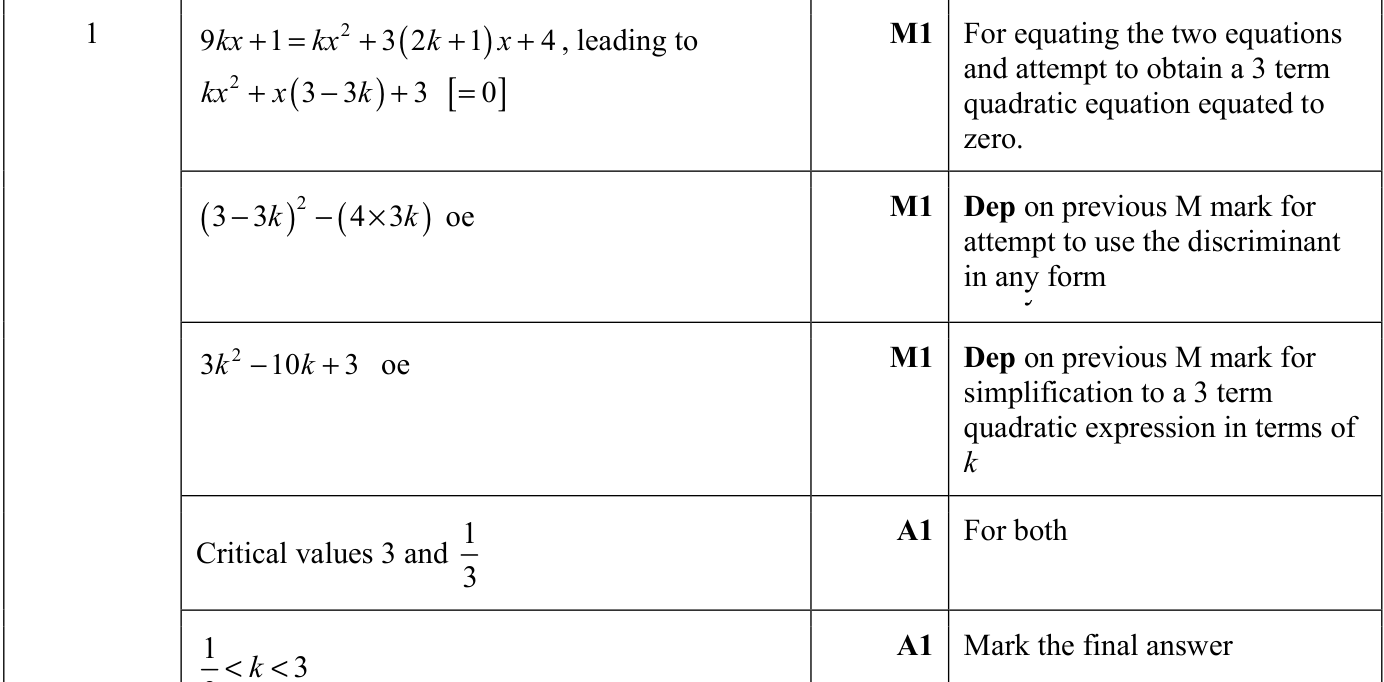
Find the values of \(k\) such that the line \(y=9kx+1\) does not meet the curve \(y=kx^2+3x(2k+1)+4\).
0606 P22 - Jun 2022 - Q3 - 5 marks
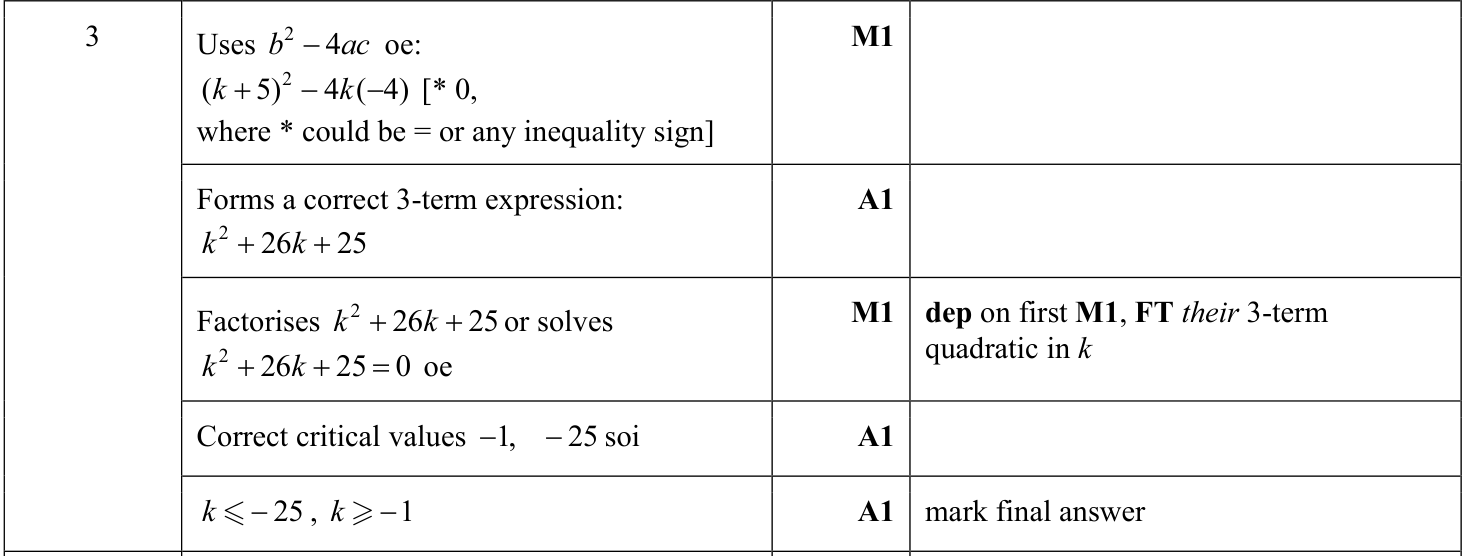
Find the possible values of \(k\) for which the equation \(kx^2+(k+5)x-4=0\) has real roots.
0606 P23 - Jun 2022 - Q4 - 5 marks
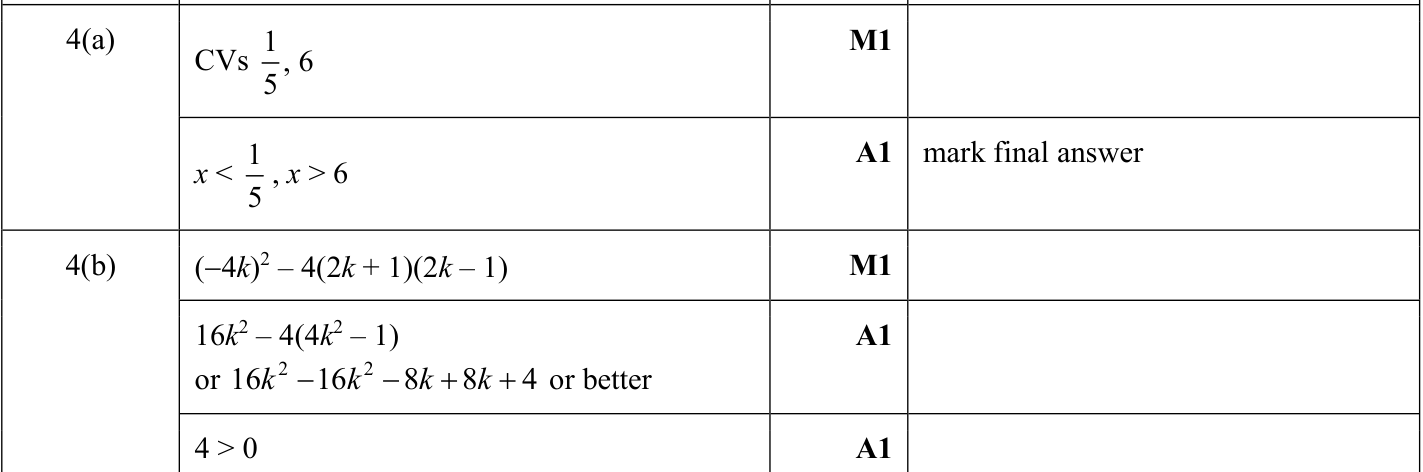
(a) Find the set of values of \(x\) for which \((5x-1)(6-x)\lt 0\).
(b) Show that, when \(k\ne-\frac12\), the equation \((2k+1)x^2-4kx+2k-1=0\) has distinct real roots for all values of \(k\).
0606 P22 - Mar 2021 - Q2 - 4 marks
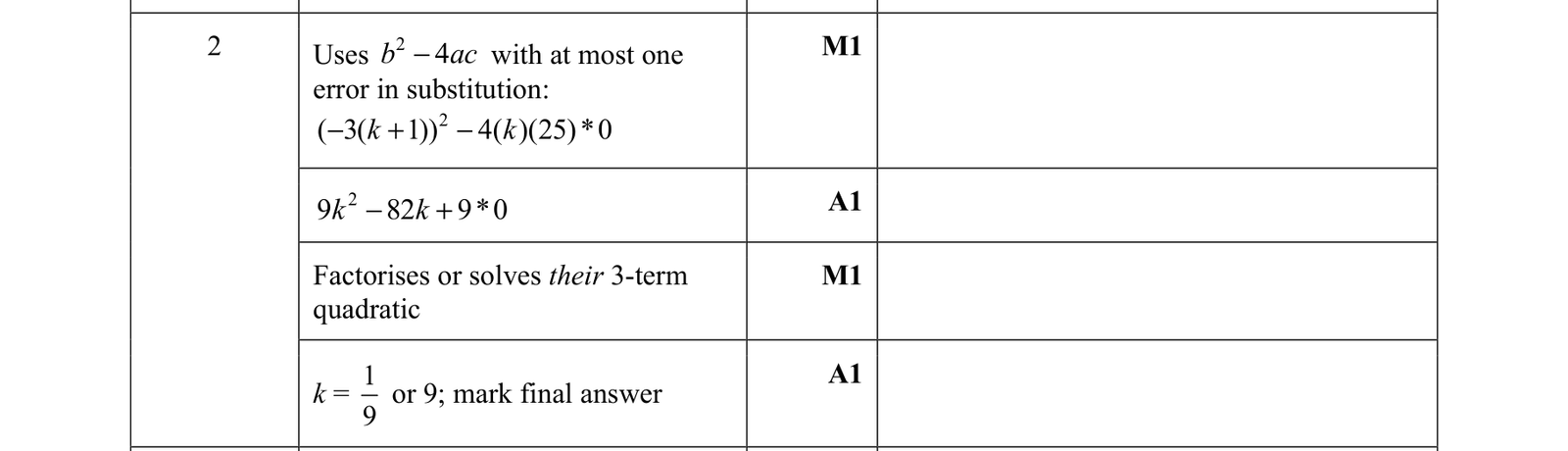
Find the values of the constant \(k\) for which the equation
\(kx^2-3(k+1)x+25=0\)
has equal roots.
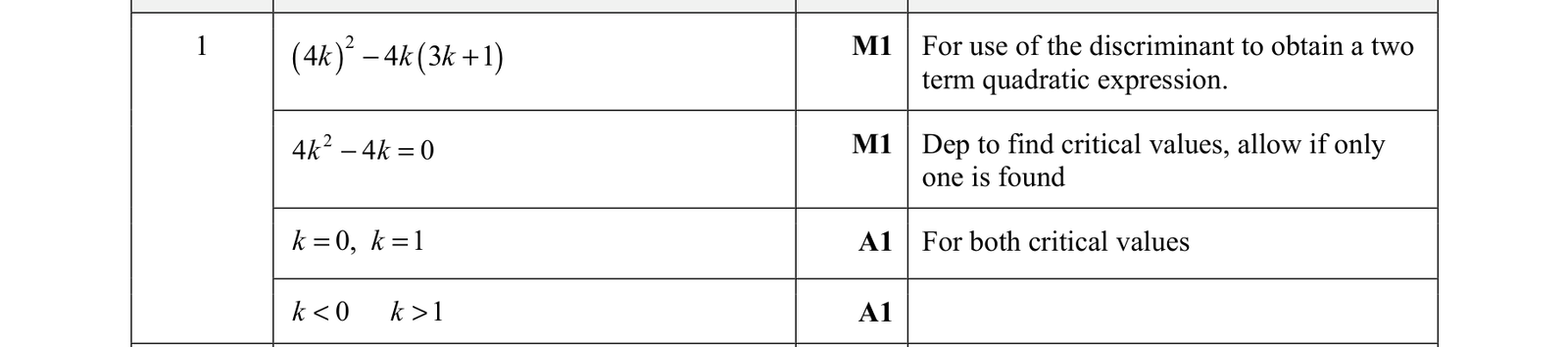
0606 P13 - Jun 2021 - Q1 - 4 marks
Find the possible values of the constant \(k\) such that the equation
\(kx^2+4kx+3k+1=0\)
has two different real roots.
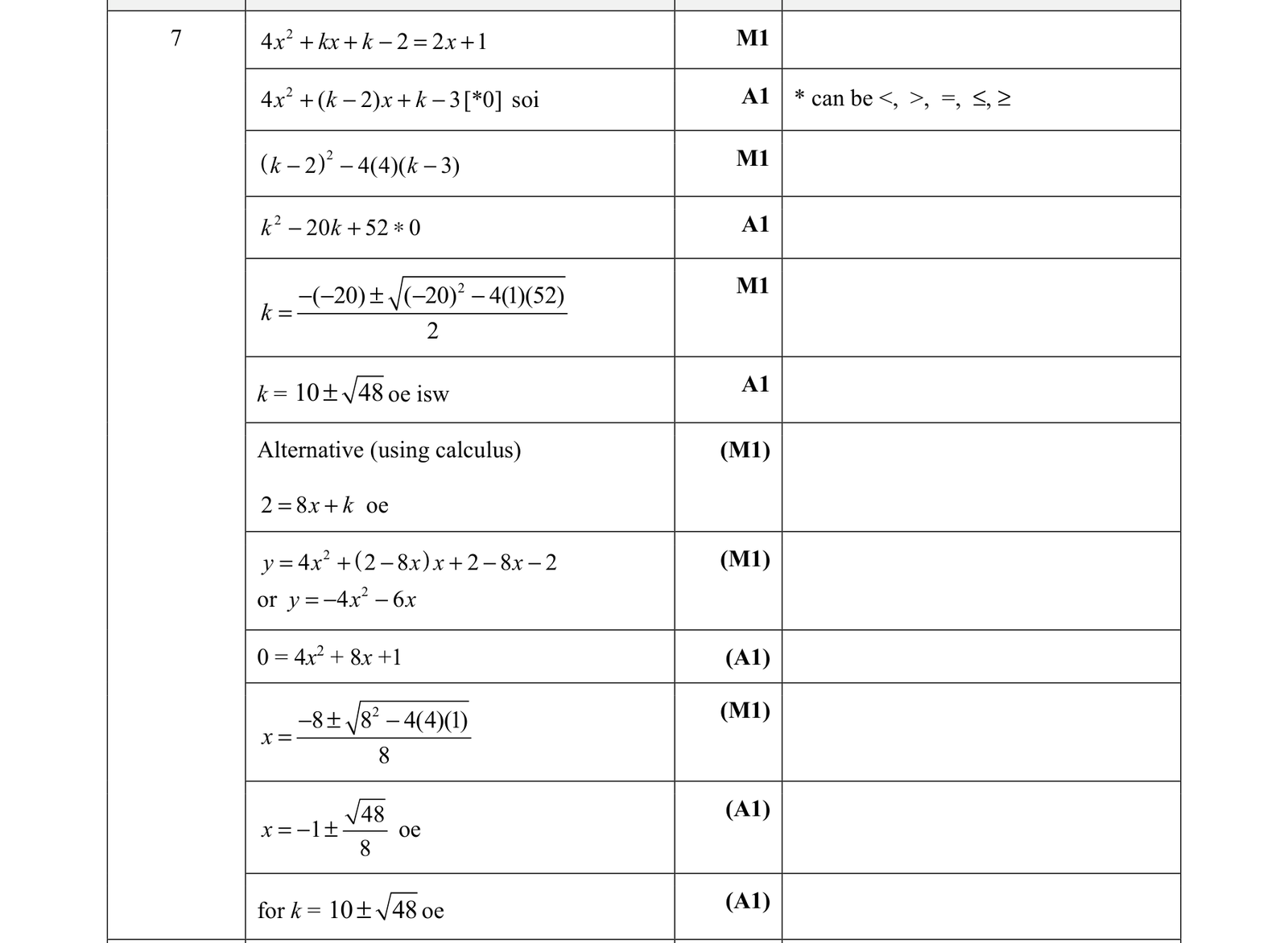
0606 P21 - Jun 2021 - Q7 - 6 marks
Find the exact values of the constant \(k\) for which the line
\(y=2x+1\)
is a tangent to the curve
\(y=4x^2+kx+k-2.\)
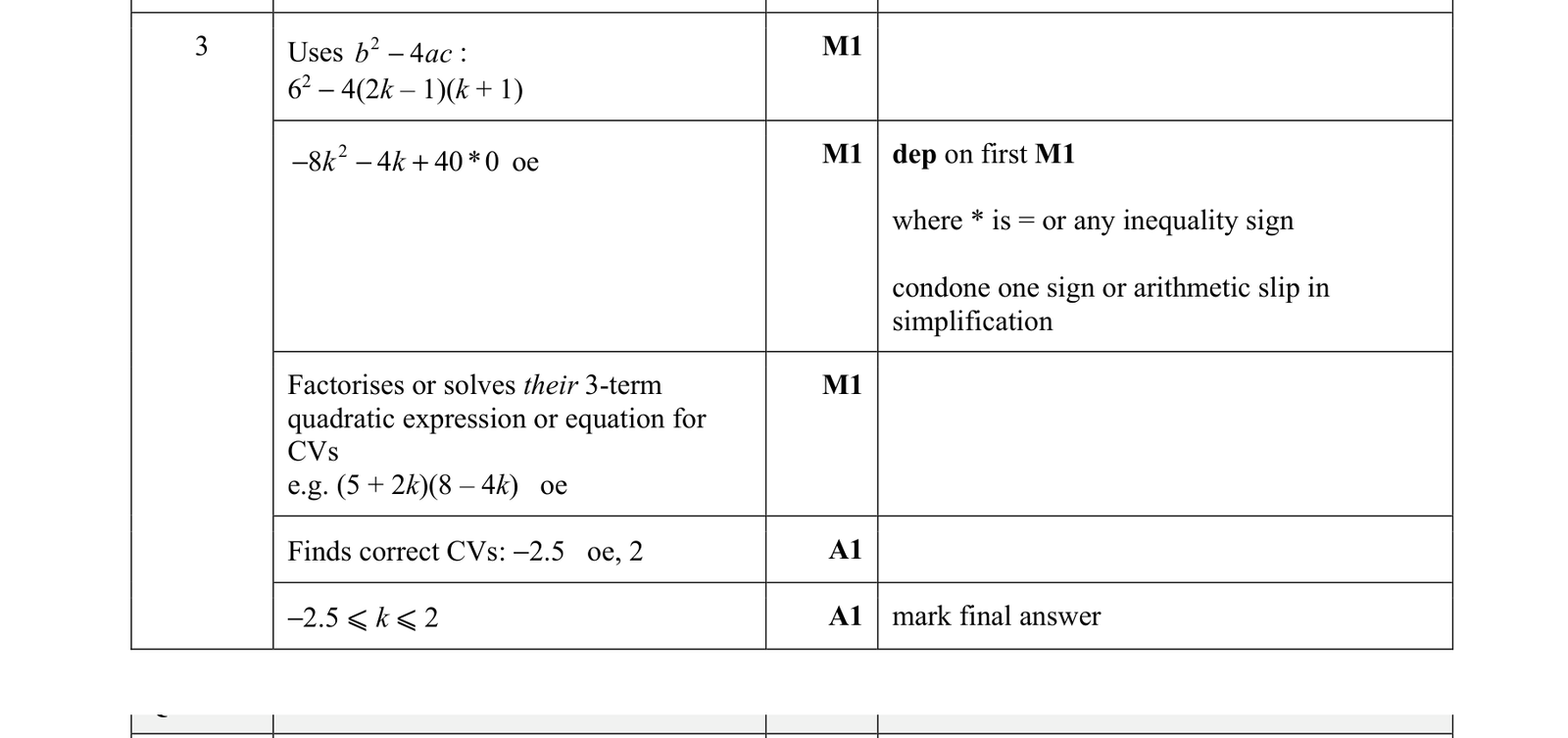
0606 P22 - Jun 2021 - Q3 - 5 marks
Find the values of the constant \(k\) for which
\((2k-1)x^2+6x+k+1=0\)
has real roots.
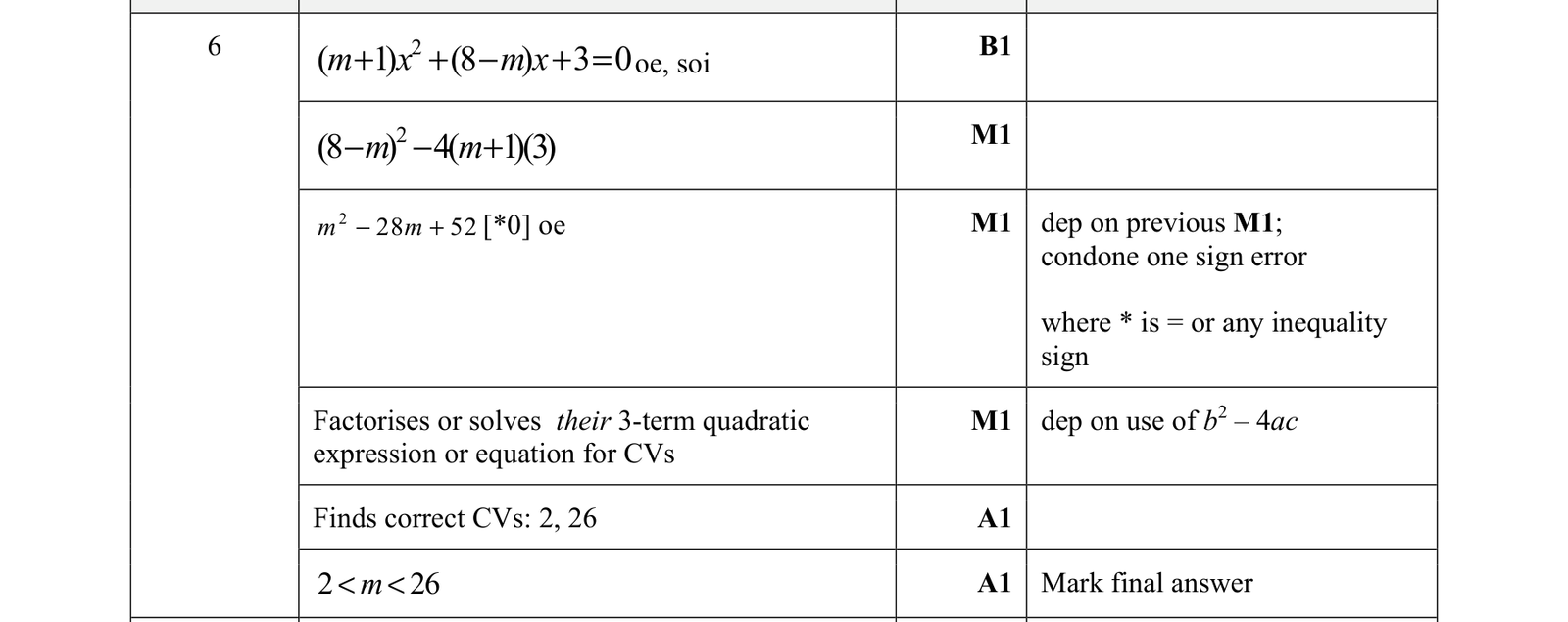
0606 P21 - Nov 2021 - Q6 - 6 marks
Find the set of values of \(m\) for which the line \(y=mx-2\) does not touch or cut the curve
\(y=(m+1)x^2+8x+1.\)
0606 P12 - Mar 2020 - Q2 - 5 marks
Find the values of \(k\) for which the line
\(y=kx+3\)
is a tangent to the curve
\(y=2x^2+4x+k-1.\)

0606 P11 - Jun 2020 - Q4 - 5 marks
Do not use a calculator in this question.
Find the positive solution of the equation
\((5+4\sqrt7)x^2+(4-2\sqrt7)x-1=0,\)
giving your answer in the form \(a+b\sqrt7\), where \(a\) and \(b\) are fractions in their simplest form.

0606 P21 - Jun 2020 - Q6 - 6 marks
Find the values of \(k\) for which the line
\(y=kx-7\)
and the curve
\(y=3x^2+8x+5\)
do not intersect.
