Past Exam Questions
← Back0606 P23 - Jun 2020 - Q2 - 5 marks
Find the set of values of \(k\) for which
\(4x^2-4kx+2k+3=0\)
has no real roots.

0606 P12 - Nov 2020 - Q1 - 4 marks
The curve \(y=2x^2+k+4\), where \(k\) is a constant, intersects the straight line \(y=(k+4)x\) at two distinct points. Find the possible values of \(k\).

0606 P23 - Nov 2020 - Q3 - 4 marks
Find the set of values of \(k\) for which the equation
\(x^2+(k+9)x+9=0\)
has two distinct real roots.

0606 P23 - Nov 2020 - Q11 - 7 marks
Do not use a calculator in this question.
Solve the equation
\((\sqrt7-2)x^2-4x+(\sqrt7+2)=0,\)
giving each answer in the form \(a+b\sqrt7\), where \(a\) and \(b\) are rational numbers.

0606 P13 - Jun 2019 - Q3 - 4 marks
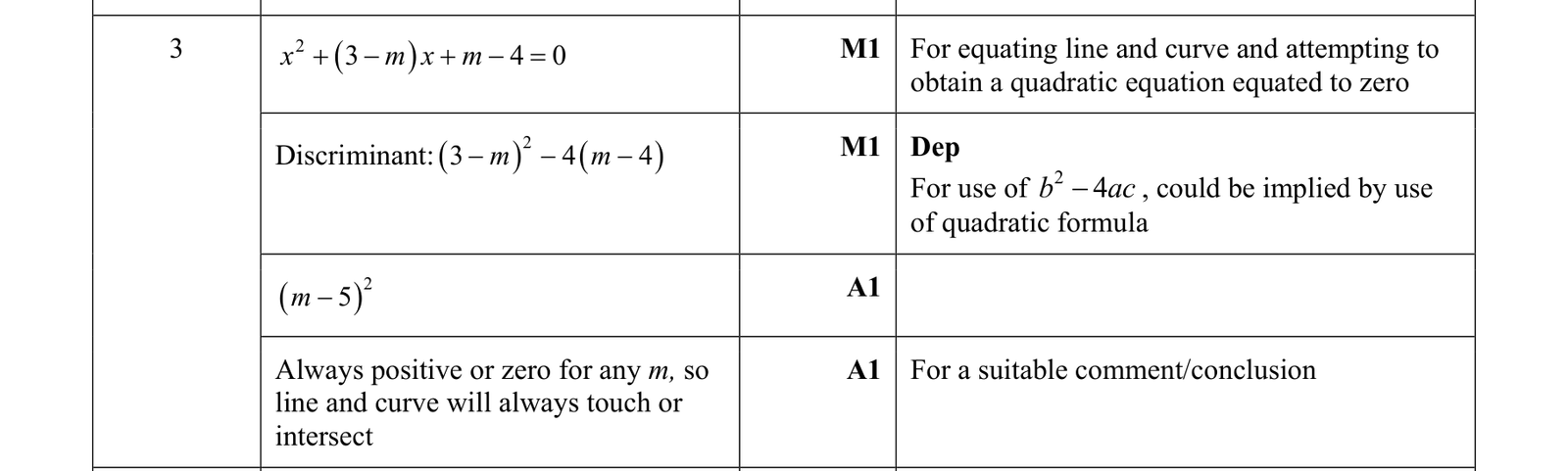
Show that the line \(y=mx+4\) will touch or intersect the curve \(y=x^2+3x+m\) for all values of \(m\).
0606 P22 - Jun 2019 - Q2 - 4 marks
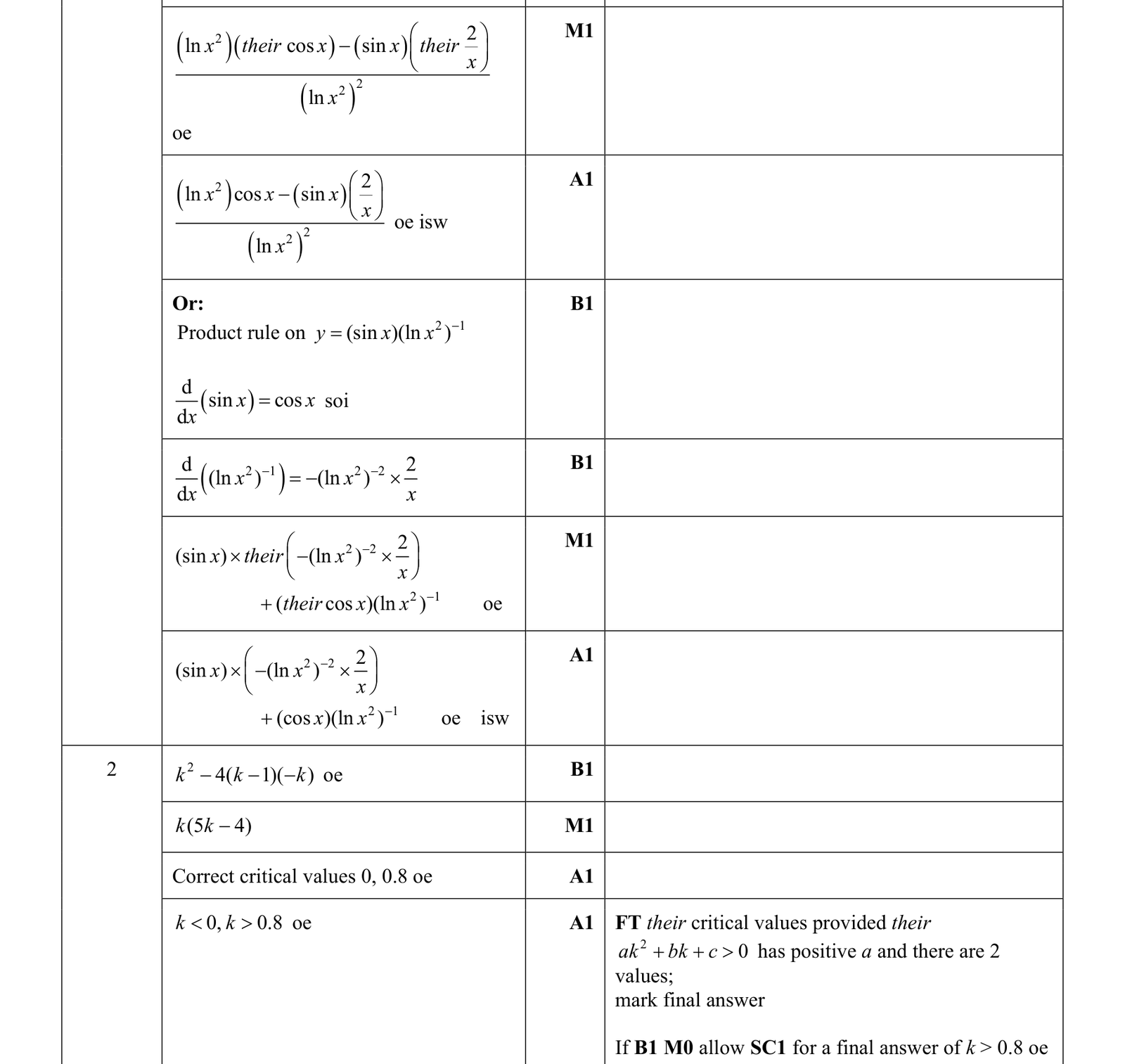
Find the set of values of \(k\) for which the equation \((k-1)x^2+kx-k=0\) has real and distinct roots.
0606 P11 - Nov 2019 - Q2 - 5 marks
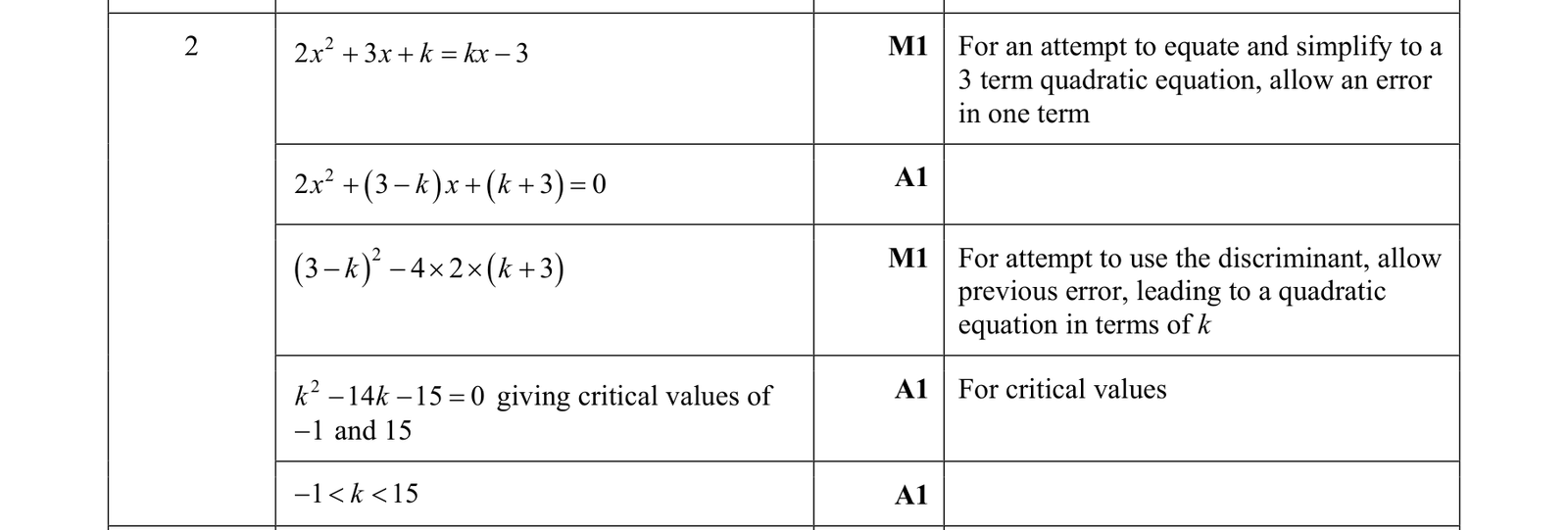
Find the values of \(k\) for which the line \(y=kx-3\) and the curve \(y=2x^2+3x+k\) do not intersect.
0606 P22 - Mar 2018 - Q2 - 5 marks
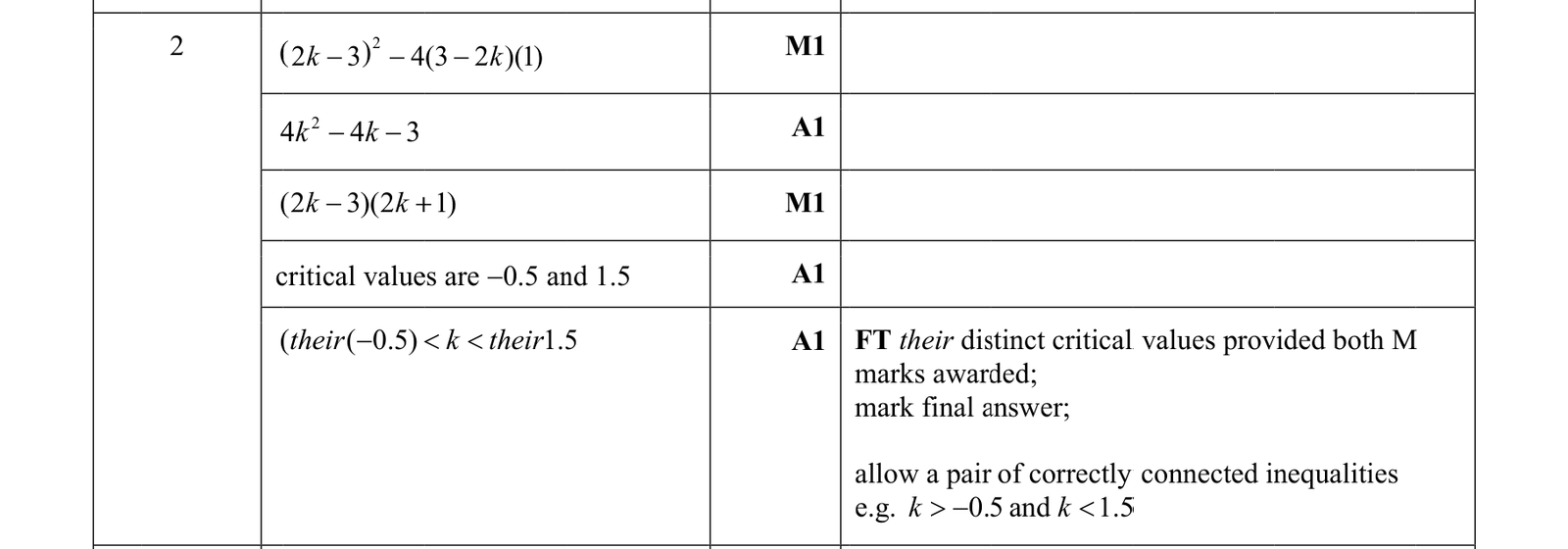
Determine the set of values of \(k\) for which the equation \((3-2k)x^2+(2k-3)x+1=0\) has no real roots.
0606 P22 - Jun 2017 - Q6 - 4 marks
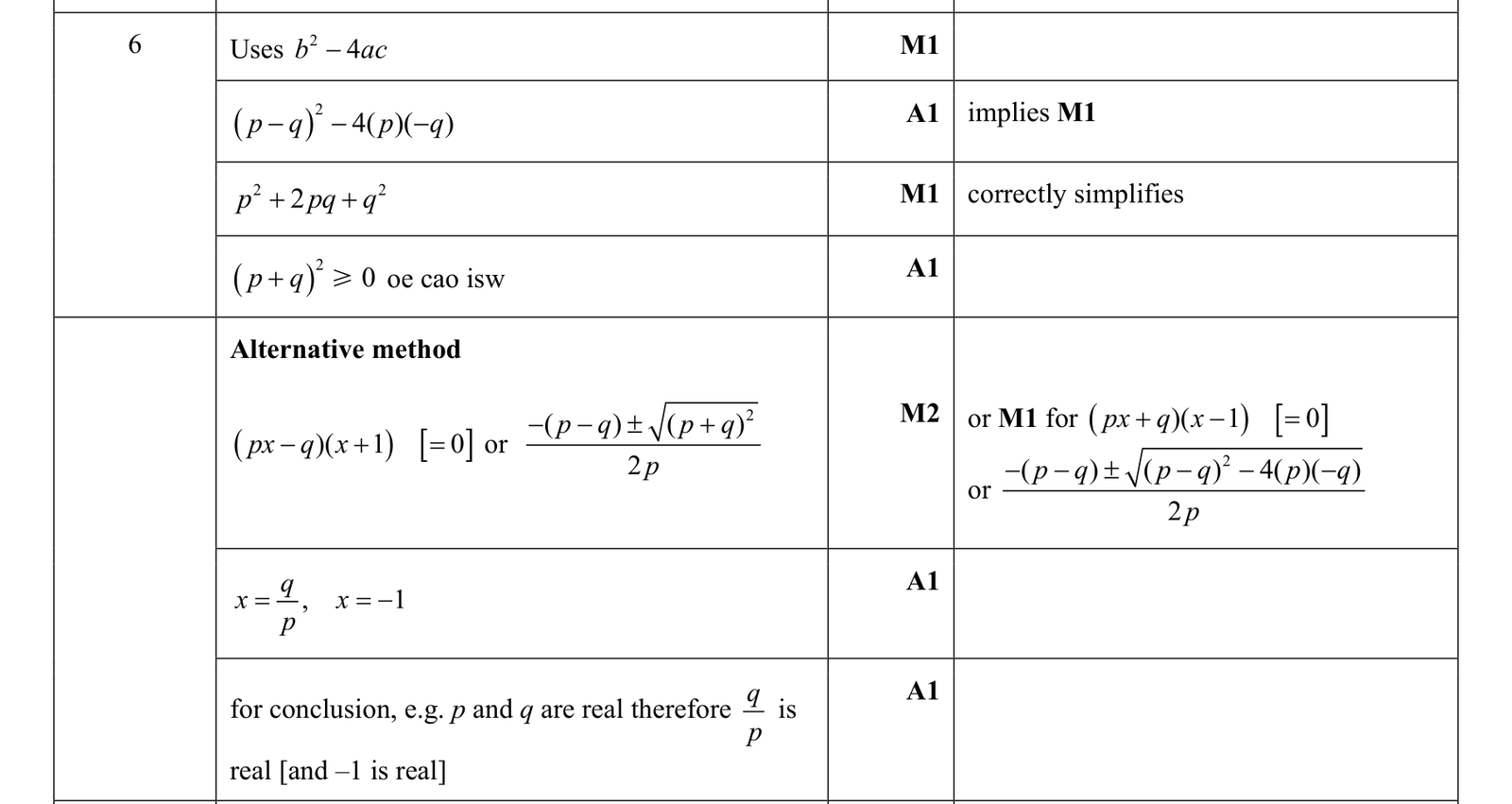
Show that the roots of
\(px^2+(p-q)x-q=0\)
are real for all real values of \(p\) and \(q\).
0606 P13 - Nov 2017 - Q3 - 4 marks
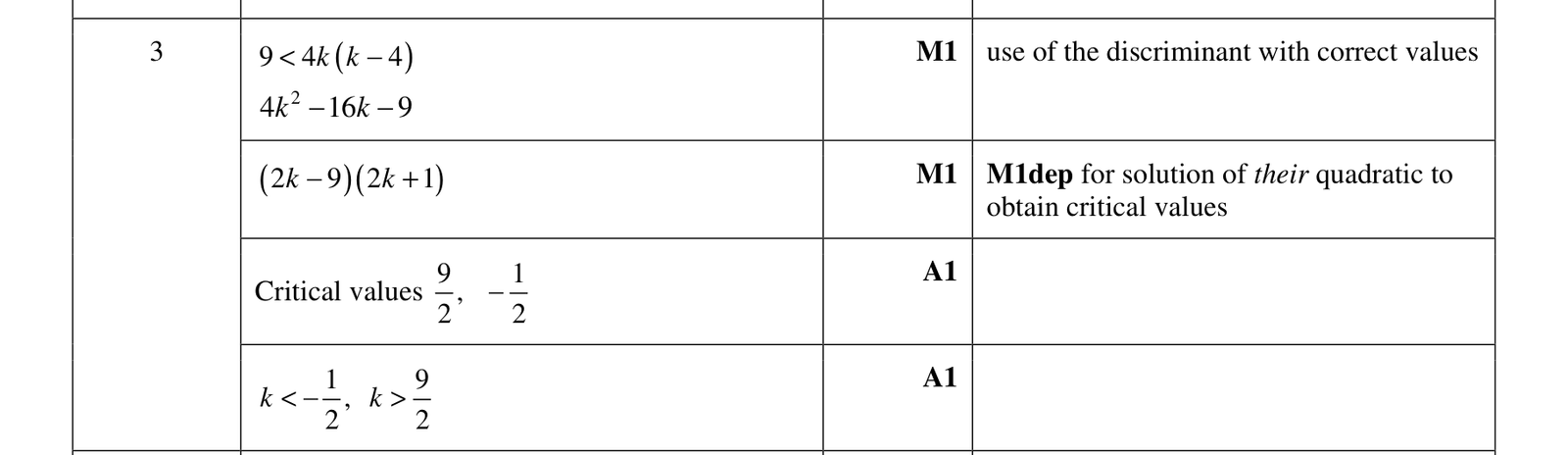
Find the set of values of \(k\) for which the equation \(kx^2+3x-4+k=0\) has no real roots.
0606 P23 - Nov 2025 - Q6 - 7 marks
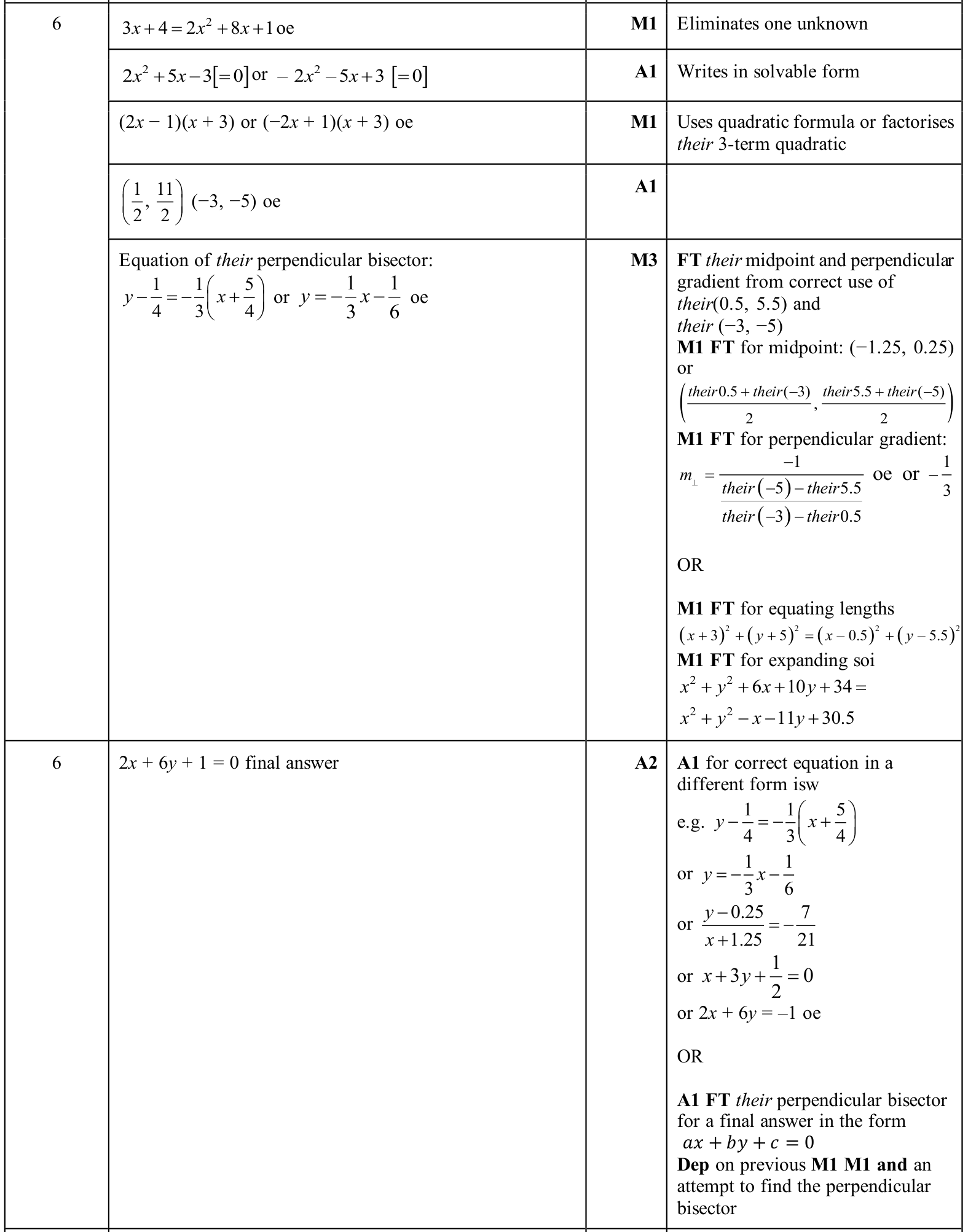
The line \(y=3 x+4\) meets the curve \(y=2 x^{2}+8 x+1\) at two points \(A\) and \(B\).
Find the equation of the perpendicular bisector of \(A B\), giving your answer in the form \(a x+b y+c=0\), where \(a, b\) and \(c\) are integers.
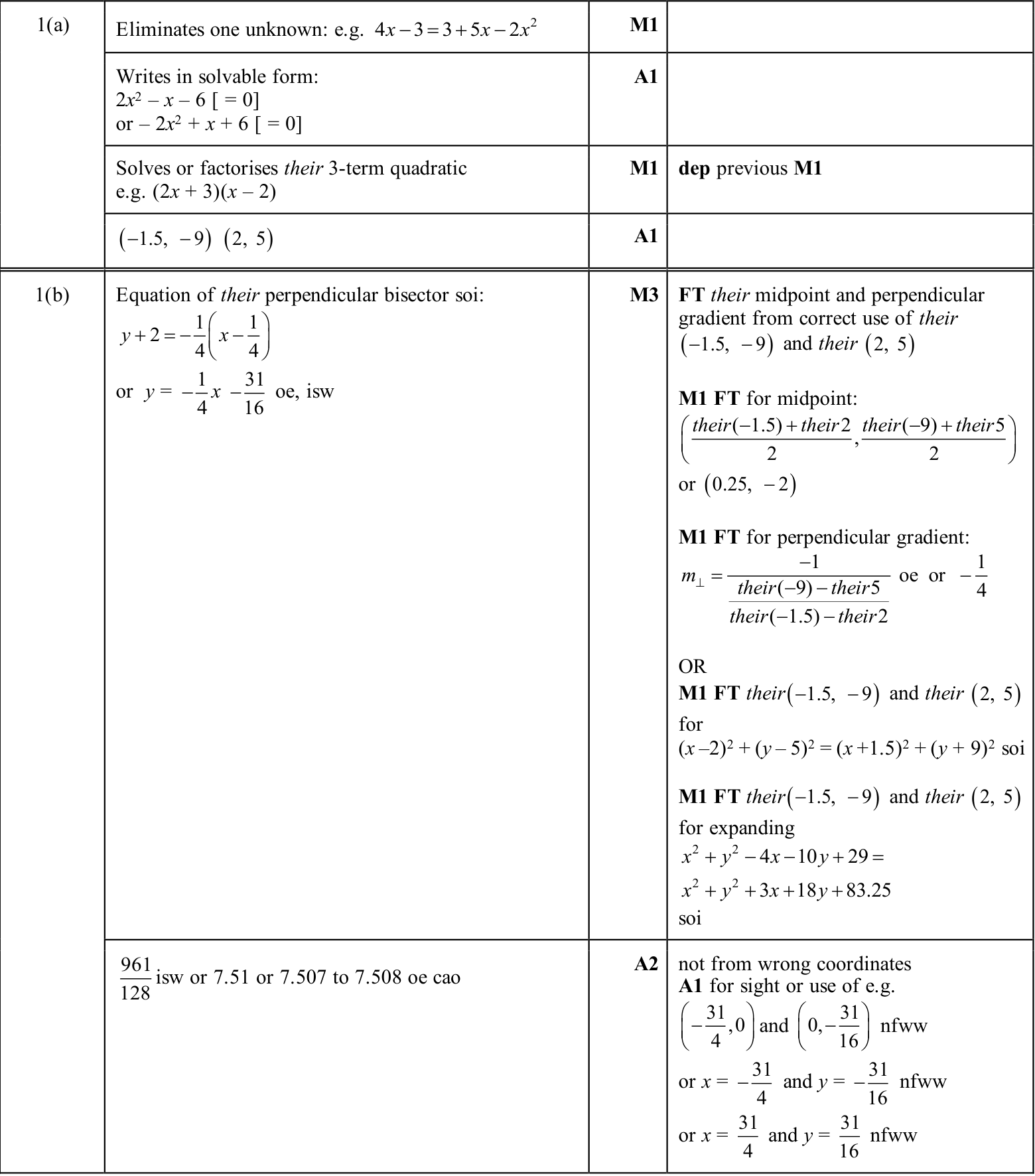
0606 P22 - Nov 2025 - Q1 - 9 marks
The line \(y=4x-3\) meets the curve \(y=3+5x-2x^2\) at the points \(A\) and \(B\).
(a) Find the coordinates of \(A\) and \(B\).
(b) The perpendicular bisector of the line \(AB\) cuts the coordinate axes at the points \(P\) and \(Q\). Given that \(O\) is the origin, find the area of triangle \(POQ\).
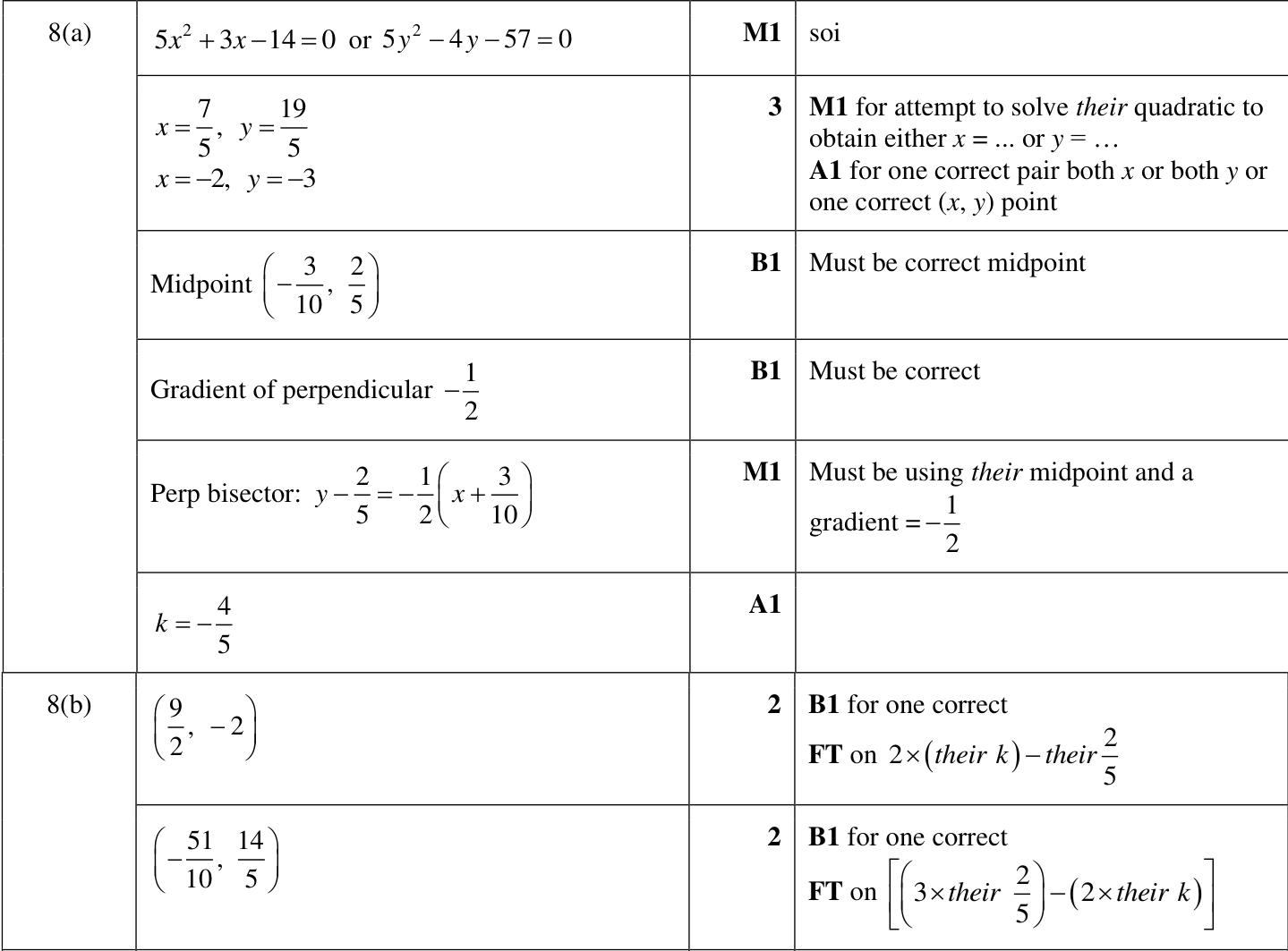
0606 P13 - Nov 2024 - Q8 - 8 marks
The straight line \(y=2 x+1\) intersects the curve \(y+x y+3 x^{2}=15\) at the points \(A\) and \(B\). The point \(C\) with coordinates \(\left(\frac{21}{10}, k\right)\) lies on the perpendicular bisector of \(A B\). (a) Find the exact value of \(k\).
(b) The point \(D\) lies on the perpendicular bisector of \(A B\) such that its perpendicular distance from \(A B\) is twice that of the point \(C\) from \(A B\). Find the possible coordinates of \(D\).
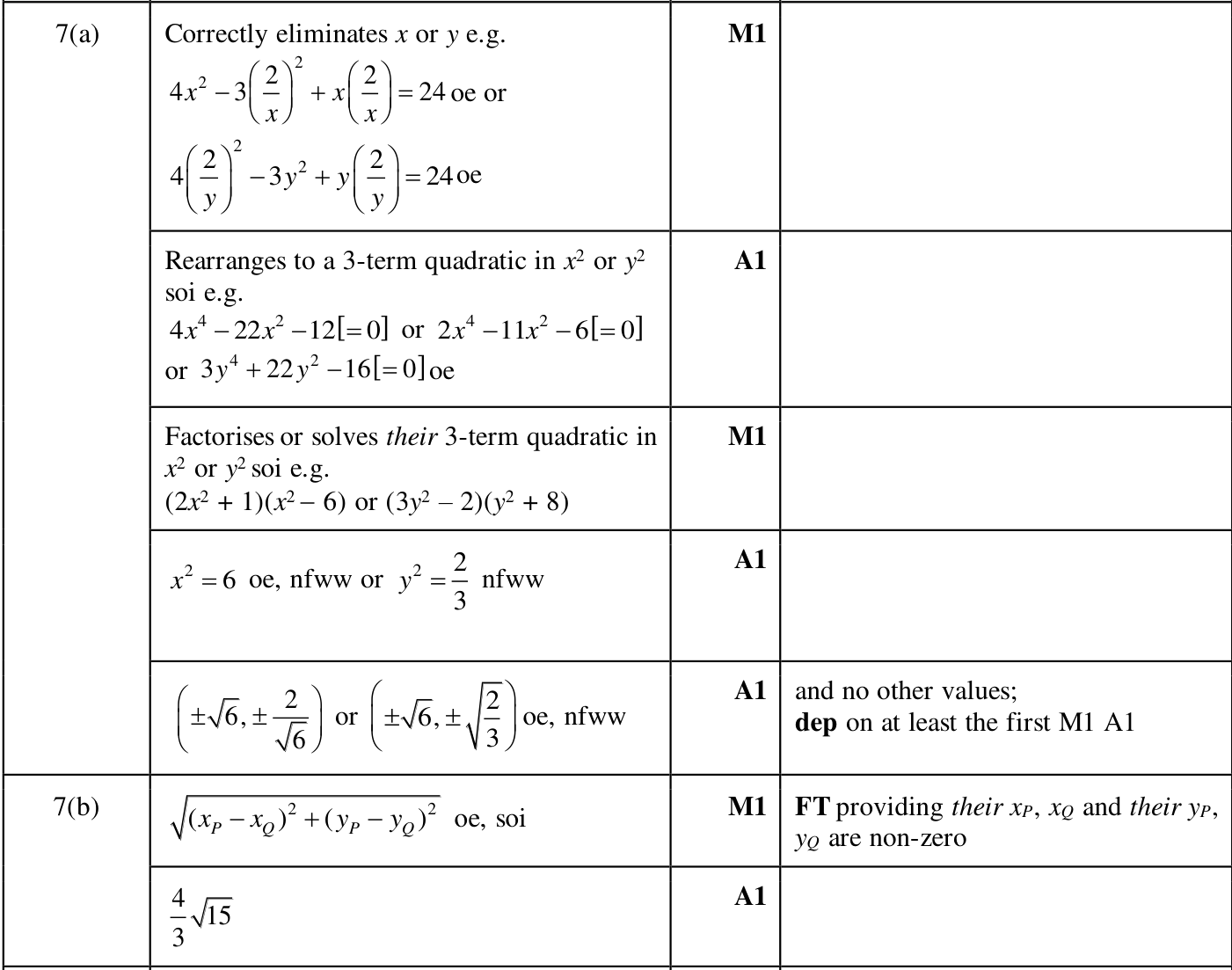
0606 P22 - Mar 2024 - Q7 - 7 marks
(a) The curves \(4 x^{2}-3 y^{2}+x y=24\) and \(y=\frac{2}{x}\) intersect at the points \(P\) and \(Q\). Find the coordinates of \(P\) and \(Q\). (b) Find the length of \(P Q\). Give your answer in the form \(a \sqrt{b}\), where \(a\) is rational and \(b\) is the smallest possible integer.
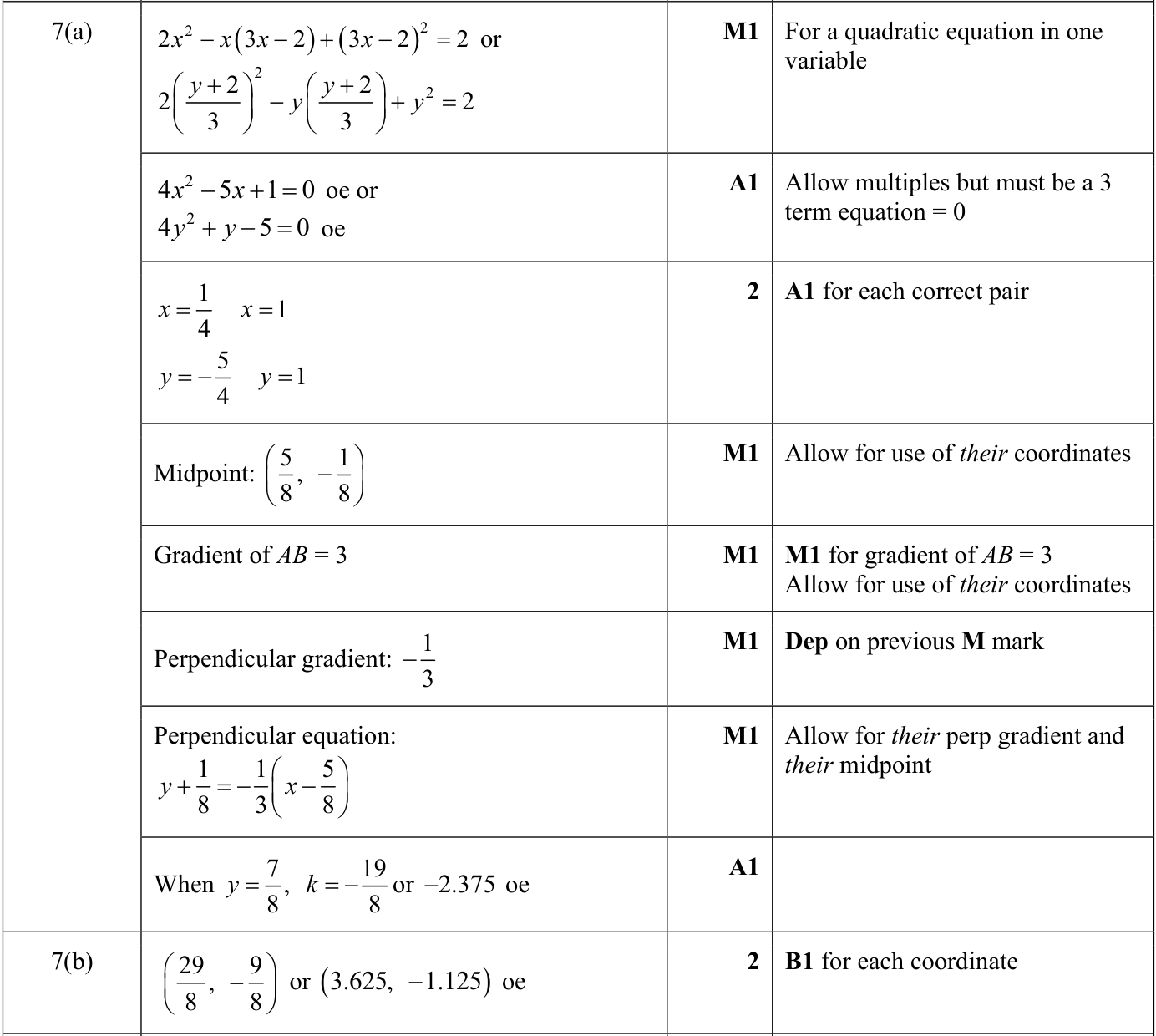
0606 P12 - Jun 2024 - Q7 - 11 marks
(a) The line \(y=3 x-2\) intersects the curve \(2 x^{2}-x y+y^{2}=2\) at the points \(A\) and \(B\). The point \(C\) with coordinates \(\left(k, \frac{7}{8}\right)\) lies on the perpendicular bisector of the line \(A B\). Find the exact value of \(k\). (b) The point \(D\) lies on the perpendicular bisector of \(A B\) such that \(D\) is a reflection of \(C\) in the line \(A B\). Find the coordinates of \(D\).
0606 P21 - Jun 2024 - Q4 - 10 marks
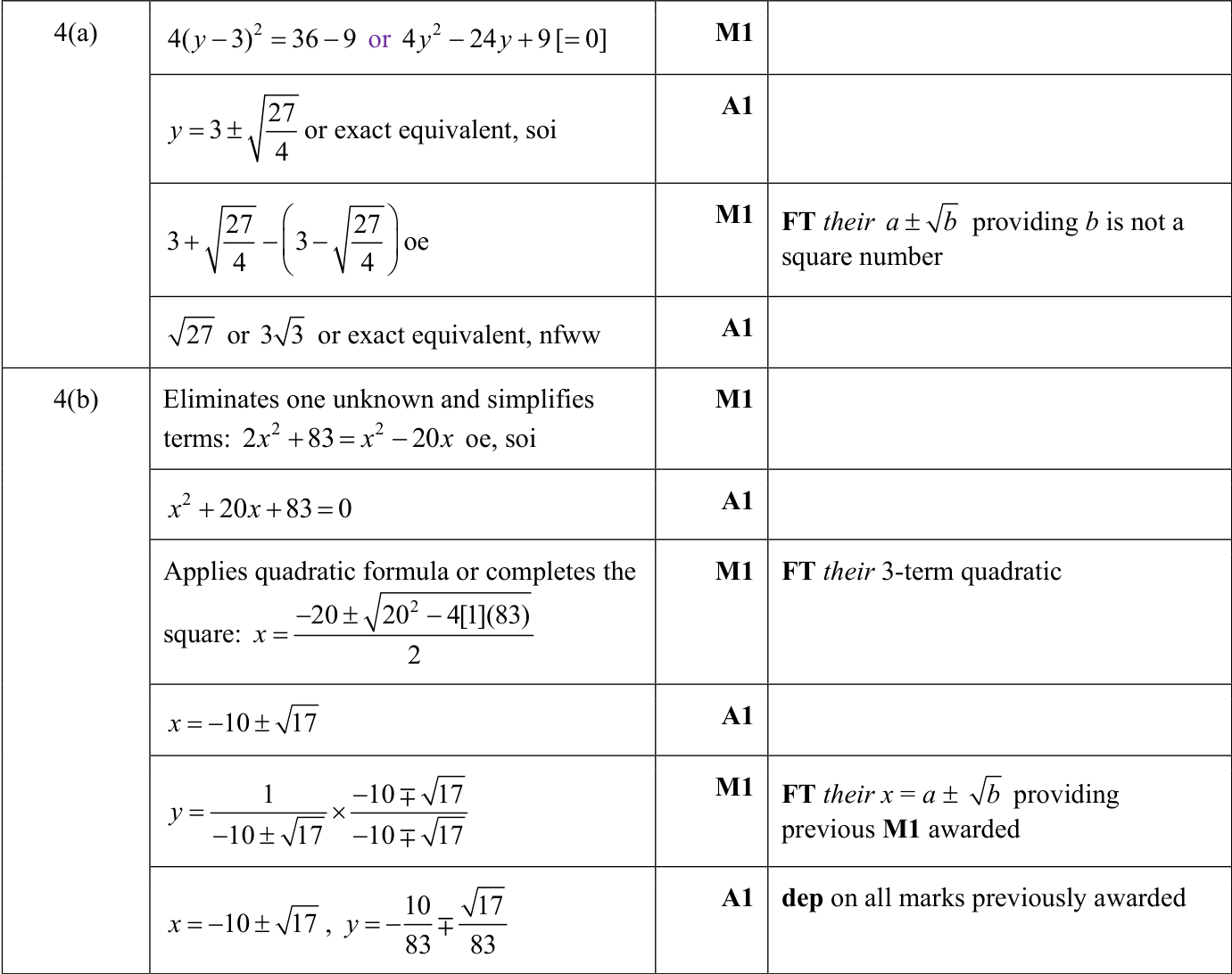
DO NOT USE A CALCULATOR IN THIS QUESTION. (a) Find the exact distance between the two points where the curve \(9(x-1)^{2}+4(y-3)^{2}=36\) cuts the \(y\)-axis. (b) Find the coordinates of the points where the curve with equation \(2 x^{2}+83 x y=x^{3} y-20 x\) intersects the curve with equation \(y=\frac{1}{x}\). Give each of your answers in the form \(a+b \sqrt{c}\), where \(a\) and \(b\) are rational and \(c\) is the smallest integer possible.
0606 P21 - Nov 2023 - Q6 - 6 marks
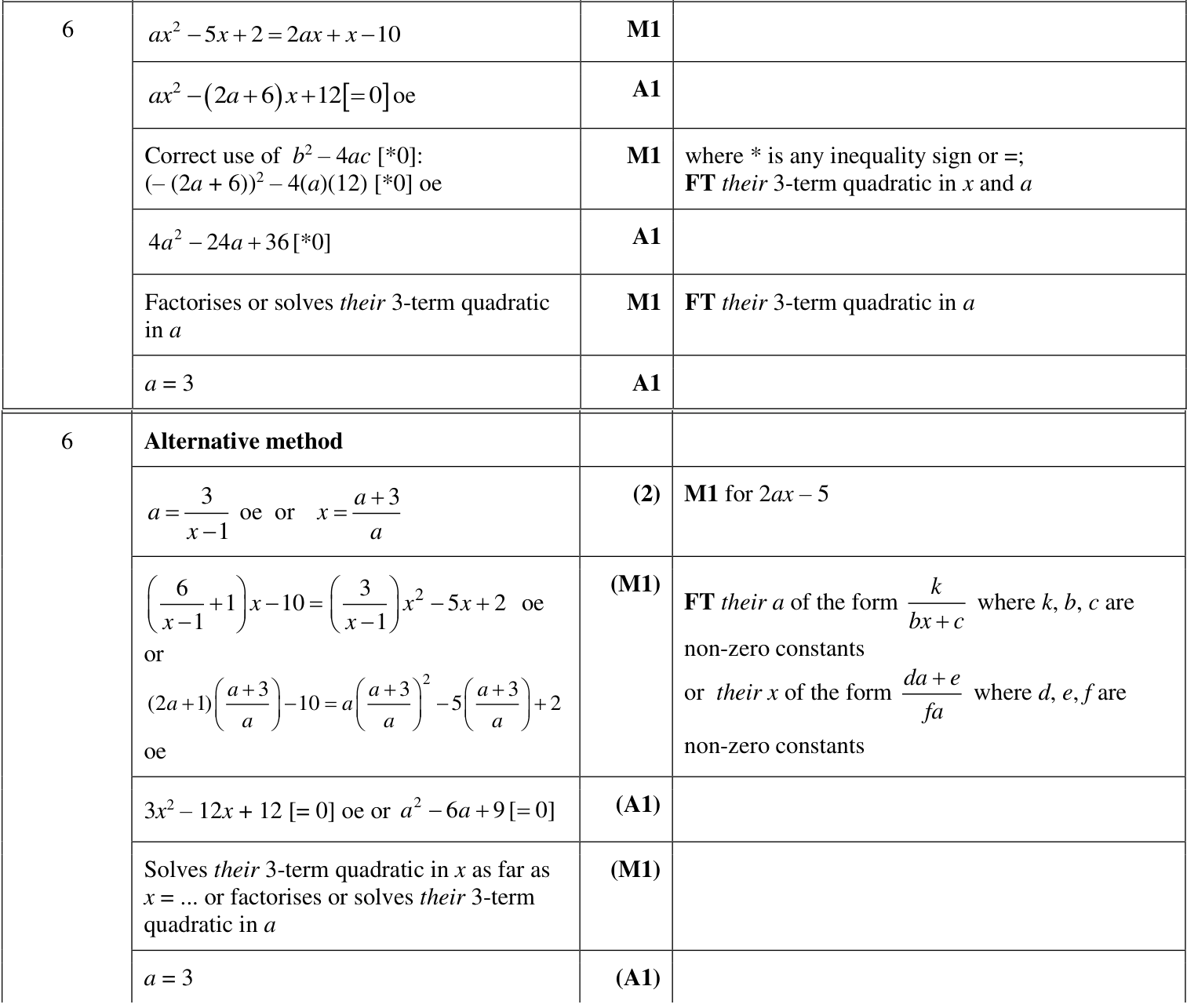
Find the value of the constant \(a\) for which the line
\(y=(2a+1)x-10\)
is a tangent to the curve
\(y=ax^2-5x+2.\)
0606 P22 - Nov 2023 - Q2 - 5 marks
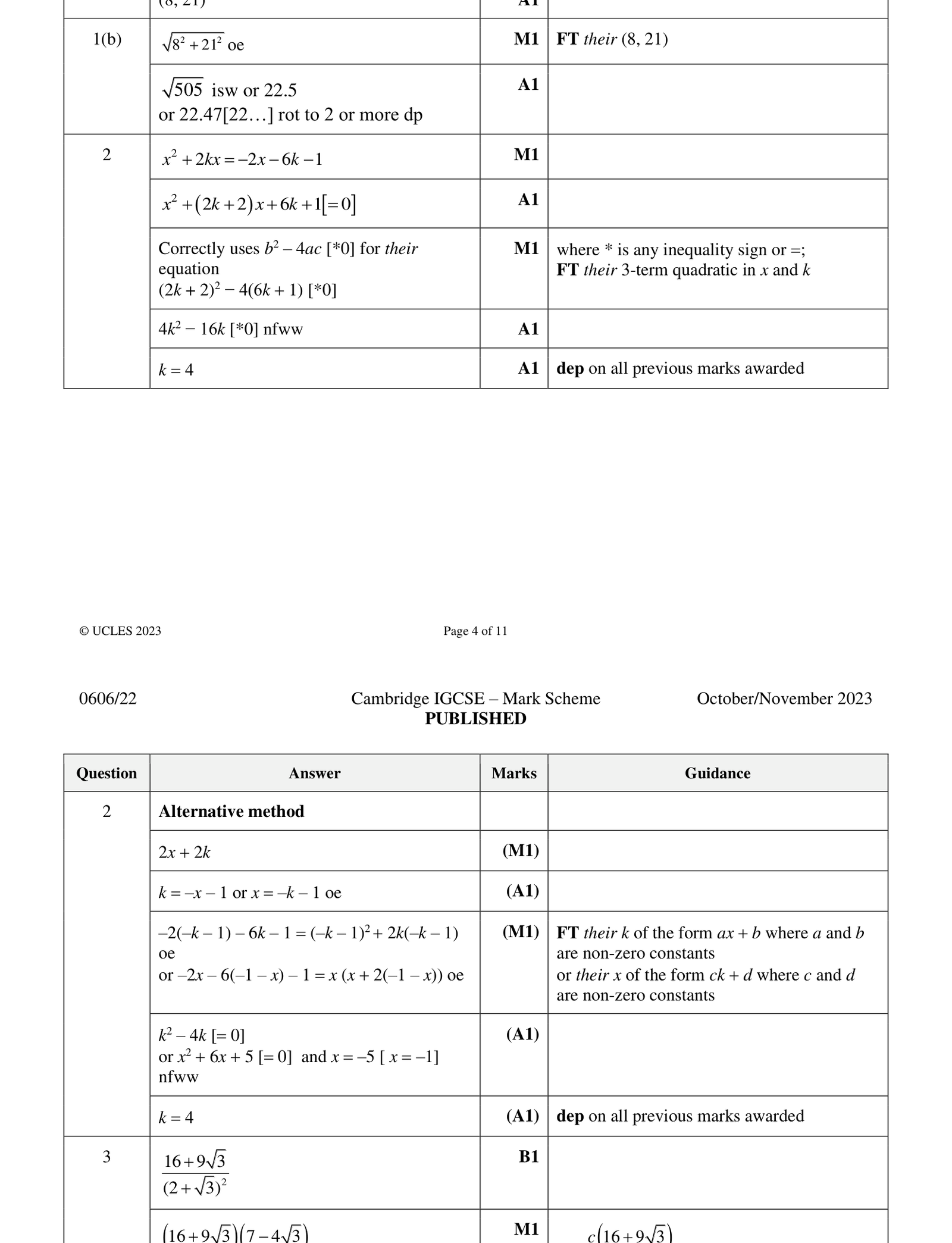
Find the non-zero value of \(k\) for which the line \(y=-2x-6k-1\) is a tangent to the curve \(y=x(x+2k)\).
0606 P12 - Mar 2023 - Q1 - 4 marks
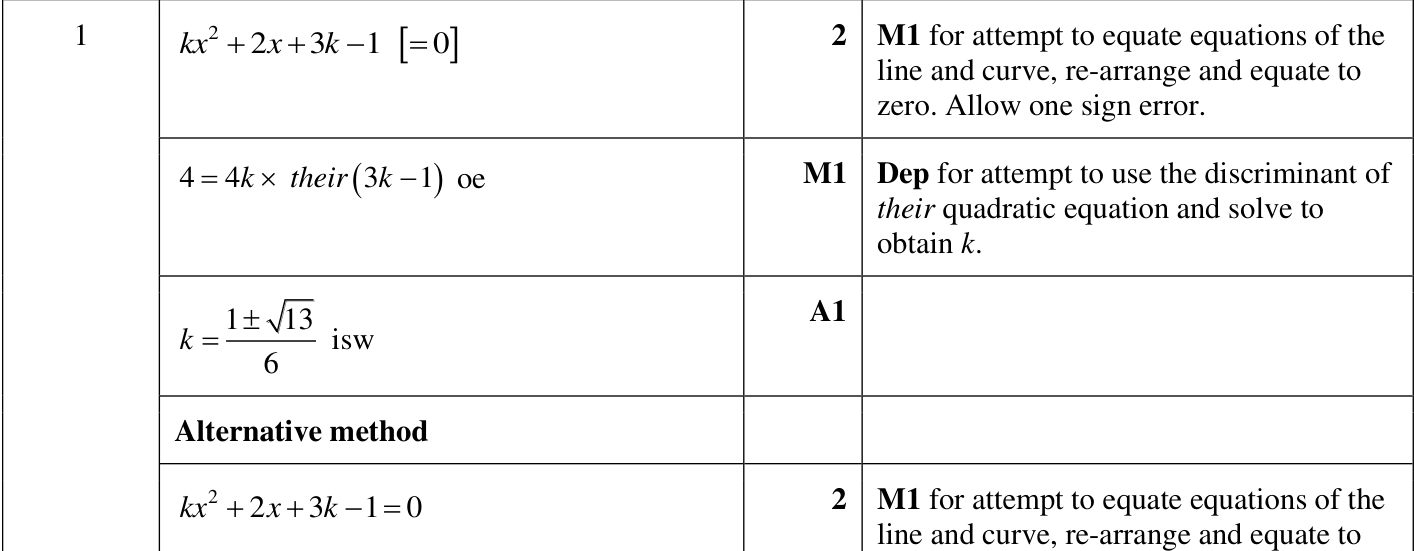
Find the exact values of \(k\) such that the straight line
\(y=1-k-x\)
is a tangent to the curve
\(y=kx^2+x+2k.\)
0606 P21 - Nov 2022 - Q2 - 5 marks
Do not use a calculator in this question.
Find the \(x\)-coordinates of the points where the line
\(y=3x-8\)
cuts the curve
\(y=2x^3+3x^2-26x+22.\)