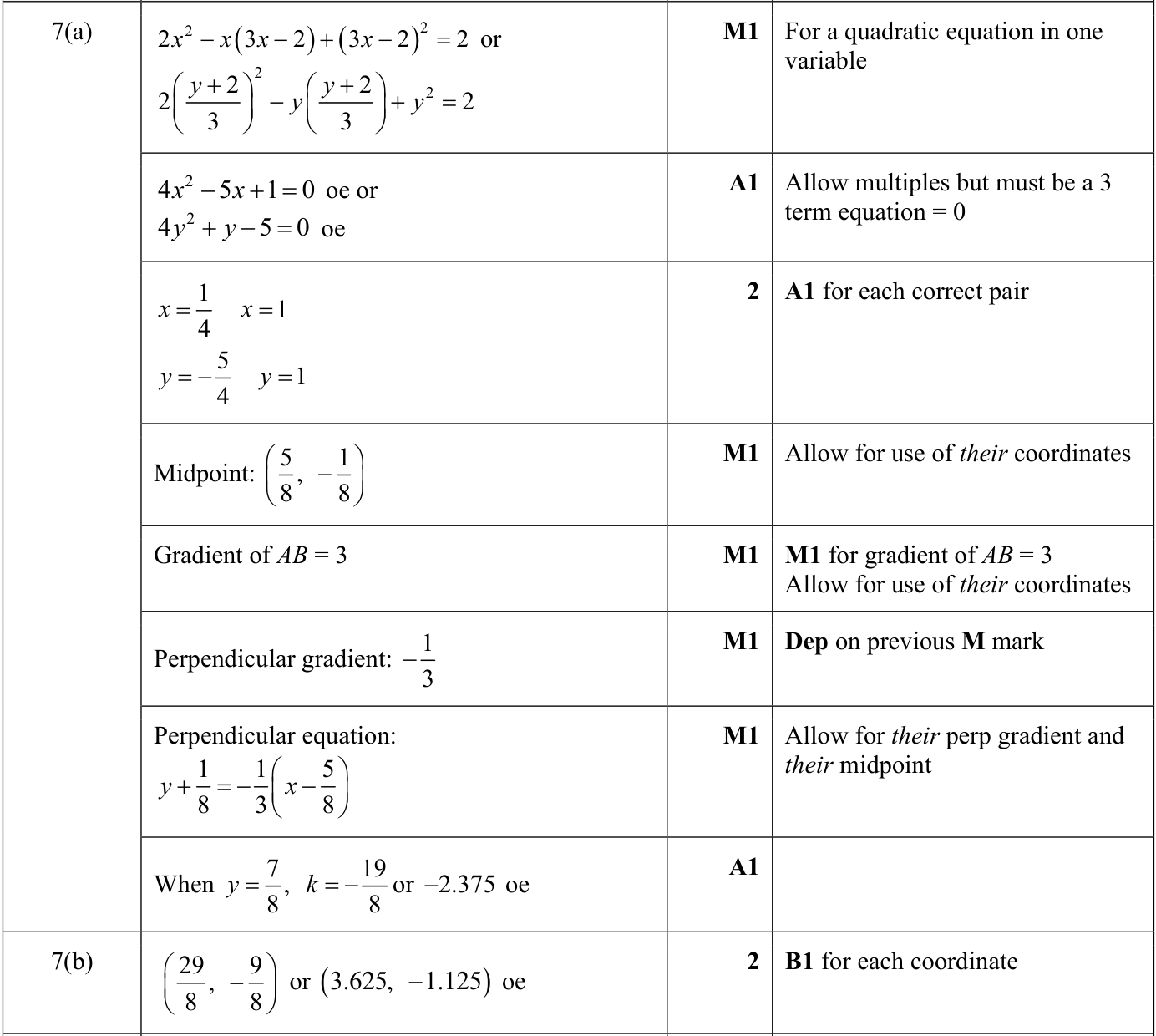
Answer: \(k=-\dfrac{19}{8}\), and \(D=\left(\dfrac{29}{8},-\dfrac98\right)\).
We start with the main method. Substitute the line into the curve; a tangent corresponds to a repeated root, so the discriminant is zero.
Substitute \(y=3x-2\) into
\(2x^2-xy+y^2=2.\)
This gives
\(2x^2-x(3x-2)+(3x-2)^2=2.\)
Expanding and simplifying,
\(4x^2-5x+1=0.\)
Factorise:
\((4x-1)(x-1)=0.\)
So
\(x=\frac14\quad\text{or}\quad x=1.\)
Using \(y=3x-2\), the intersection points are
\(\left(\frac14,-\frac54\right)\quad\text{and}\quad(1,1).\)
The midpoint of \(AB\) is
\(\left(\frac{\frac14+1}{2},\frac{-\frac54+1}{2}\right) =\left(\frac58,-\frac18\right).\)
The gradient of \(AB\) is \(3\), because \(AB\) lies on \(y=3x-2\).
Therefore the perpendicular bisector has gradient \(-\frac13\).
Its equation is
\(y+\frac18=-\frac13\left(x-\frac58\right).\)
The point \(C=\left(k,\frac78\right)\) lies on this line, so substitute \(y=\frac78\):
\(\frac78+\frac18=-\frac13\left(k-\frac58\right).\)
So
\(1=-\frac13\left(k-\frac58\right).\)
Hence
\(k-\frac58=-3\), and
\(k=-\frac{19}{8}.\)
For part (b), \(D\) is the reflection of \(C\) in the line \(AB\).
The perpendicular bisector meets \(AB\) at the midpoint of \(CD\), which is also the midpoint of \(AB\):
\(M=\left(\frac58,-\frac18\right).\)
Since \(M\) is the midpoint of \(C\) and \(D\),
\(D=2M-C.\)
Thus
\(D=\left(2\cdot\frac58-\left(-\frac{19}{8}\right),\ 2\cdot\left(-\frac18\right)-\frac78\right).\)
Therefore
\(D=\left(\frac{29}{8},-\frac98\right).\)
This completes the solution and gives the required result.