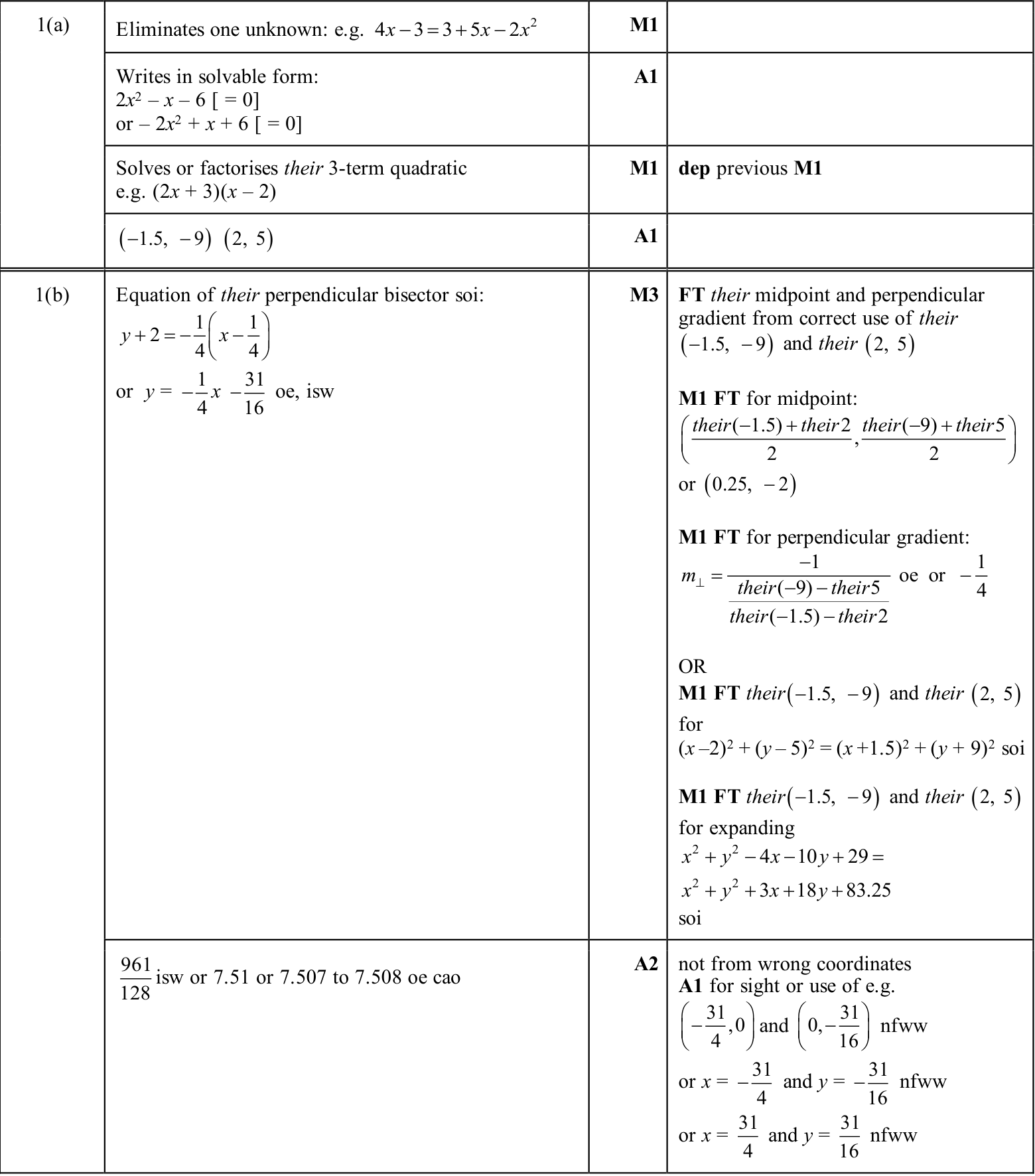
Answer: \(A=\left(-\frac32,-9\right)\), \(B=(2,5)\), and the area of \(\triangle POQ\) is \(\dfrac{961}{128}\).
At the points of intersection, the two expressions for \(y\) are equal:
\(4x-3=3+5x-2x^2\).
Rearranging gives
\(2x^2-x-6=0\).
Factorising,
\((2x+3)(x-2)=0\).
Hence
\(x=-\frac32\quad\text{or}\quad x=2\).
Using the straight line \(y=4x-3\), the corresponding coordinates are
\(x=-\frac32:\quad y=4\left(-\frac32\right)-3=-9\),
and
\(x=2:\quad y=4(2)-3=5\).
So the two points are
\(A=\left(-\frac32,-9\right)\), \(B=(2,5)\).
The gradient of \(AB\) is
\(\dfrac{5-(-9)}{2-\left(-\frac32\right)}=\dfrac{14}{\frac72}=4\).
Therefore the gradient of the perpendicular bisector is \(-\dfrac14\).
The midpoint of \(AB\) is
\(\left(\dfrac{-\frac32+2}{2},\dfrac{-9+5}{2}\right)=\left(\frac14,-2\right)\).
So the perpendicular bisector is
\(y+2=-\dfrac14\left(x-\frac14\right)\).
Simplifying,
\(y=-\dfrac14x-\dfrac{31}{16}\).
When \(y=0\), \(x=-\dfrac{31}{4}\), so \(P=\left(-\dfrac{31}{4},0\right)\).
When \(x=0\), \(y=-\dfrac{31}{16}\), so \(Q=\left(0,-\dfrac{31}{16}\right)\).
The triangle \(POQ\) is right-angled at \(O\), hence
\(\text{area}=\dfrac12\left|OP\right|\left|OQ\right|=\dfrac12\cdot\dfrac{31}{4}\cdot\dfrac{31}{16}=\dfrac{961}{128}\).