Past Exam Questions
← Back0606 P22 - Nov 2022 - Q5 - 5 marks
Do not use a calculator in this question.
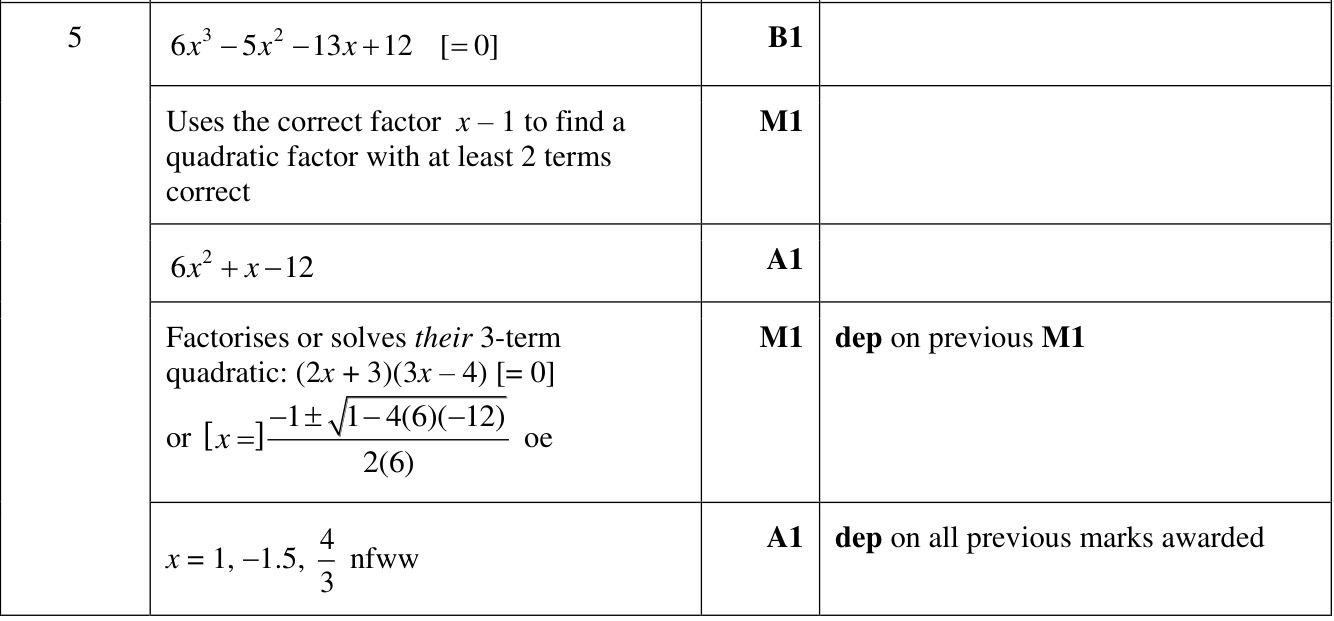
Find the \(x\)-coordinates of the points of intersection of the curves
\(y=7x^3-7x^2-17x-4\)
and
\(y=x^3-2x^2-4x-16.\)
0606 P23 - Nov 2022 - Q4 - 6 marks
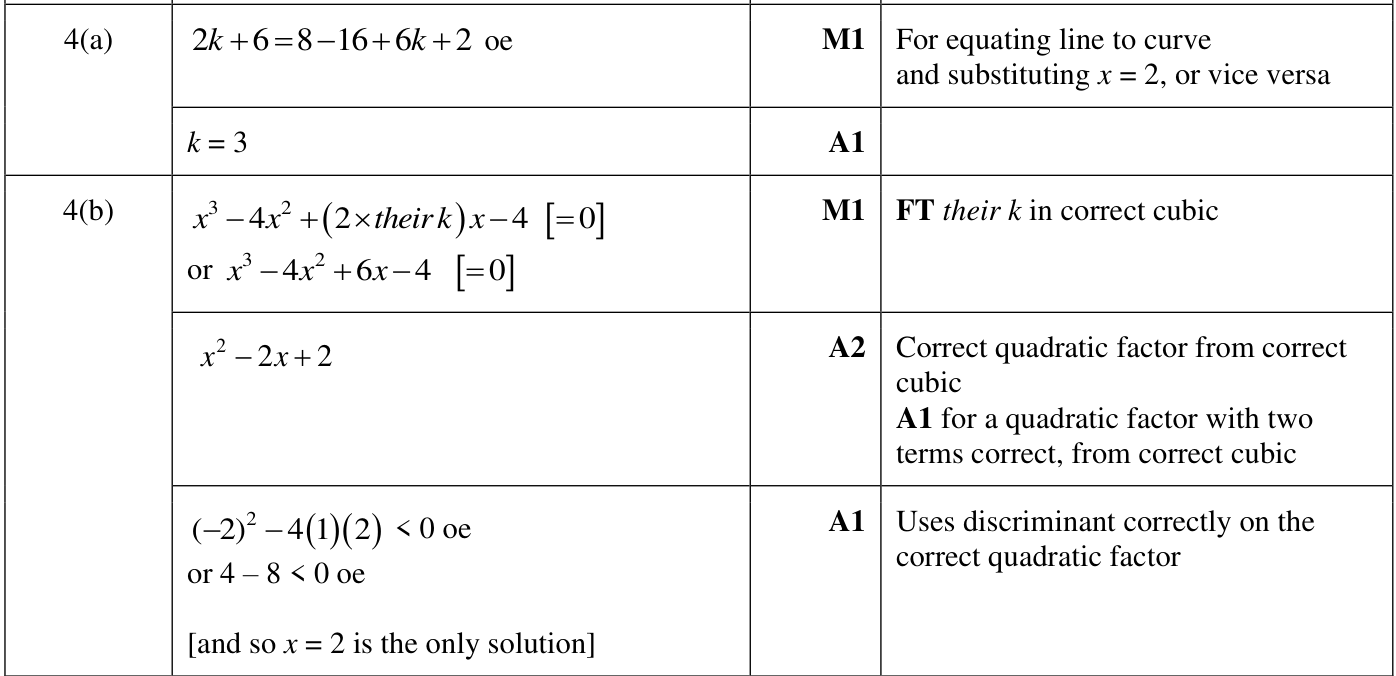
The line \(y=kx+6\) intersects the curve \(y=x^3-4x^2+3kx+2\) at the point where \(x=2\).
(a) Find the value of \(k\).
(b) Show that the line intersects the curve at only one point.
0606 P22 - Mar 2020 - Q7 - 5 marks
Find the coordinates of the points of intersection of the curves
\(x^2=5y-1\)
and
\(y=x^2-2x+1.\)

0606 P22 - Jun 2020 - Q3 - 6 marks
Find the values of \(k\) for which the line \(y=x-3\) intersects the curve
\(y=k^2x^2+5kx+1\)
at two distinct points.

0606 P21 - Nov 2020 - Q2 - 5 marks
The line \(y=\frac{2}{3}x-2\) intersects the curve
\(x^2+xy=9.\)
Find the coordinates of the points of intersection.

0606 P12 - Jun 2019 - Q2 - 5 marks
Do not use a calculator in this question.
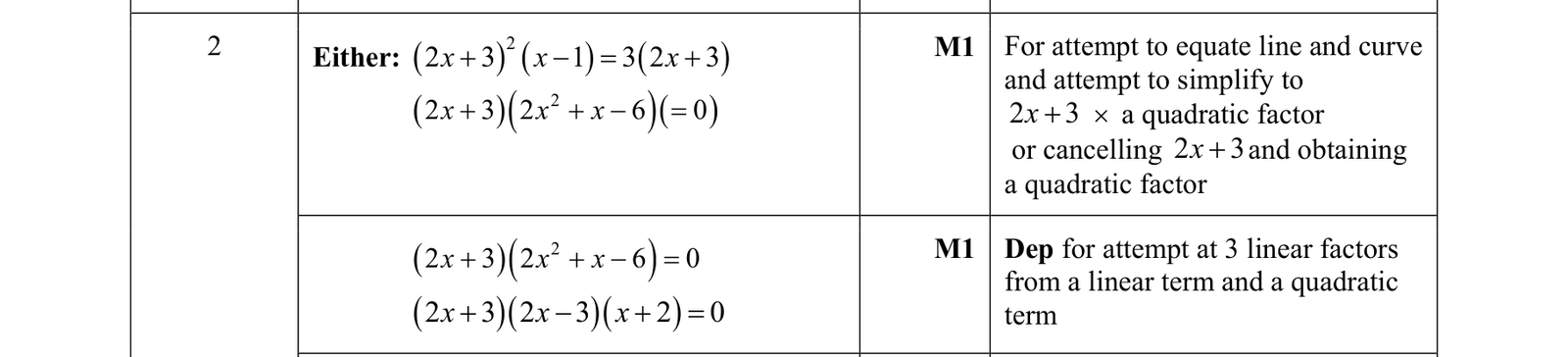
Find the coordinates of the points of intersection of the curve \(y=(2x+3)^2(x-1)\) and the line \(y=3(2x+3)\).
0606 P23 - Jun 2019 - Q12 - 10 marks
Do not use a calculator in this question.
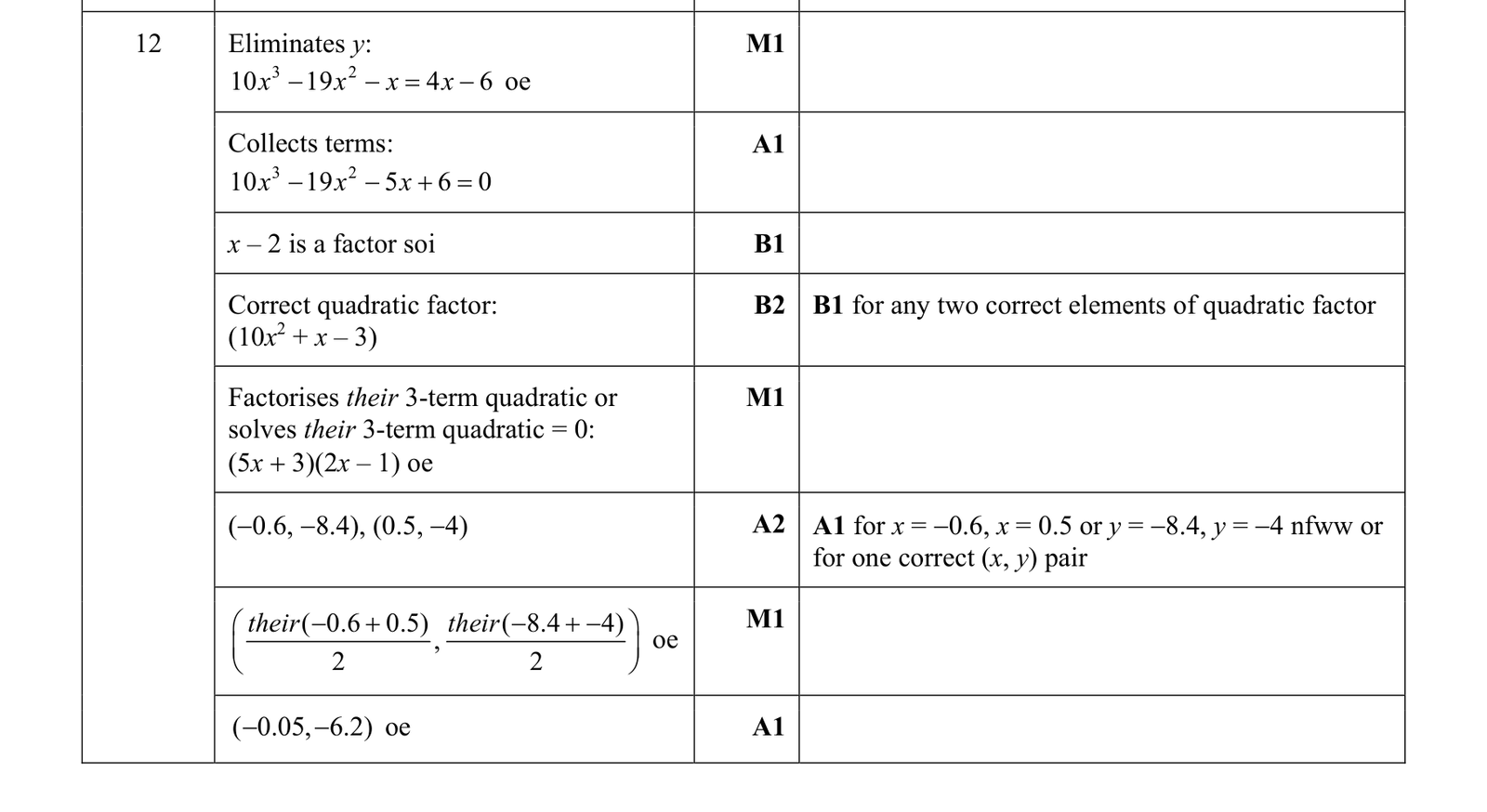
The line \(y=4x-6\) intersects the curve \(y=10x^3-19x^2-x\) at the points \(A\), \(B\) and \(C\). Given that \(C\) is the point \((2,2)\), find the coordinates of the midpoint of \(AB\).
0606 P21 - Nov 2019 - Q6 - 7 marks
Do not use a calculator in this question.
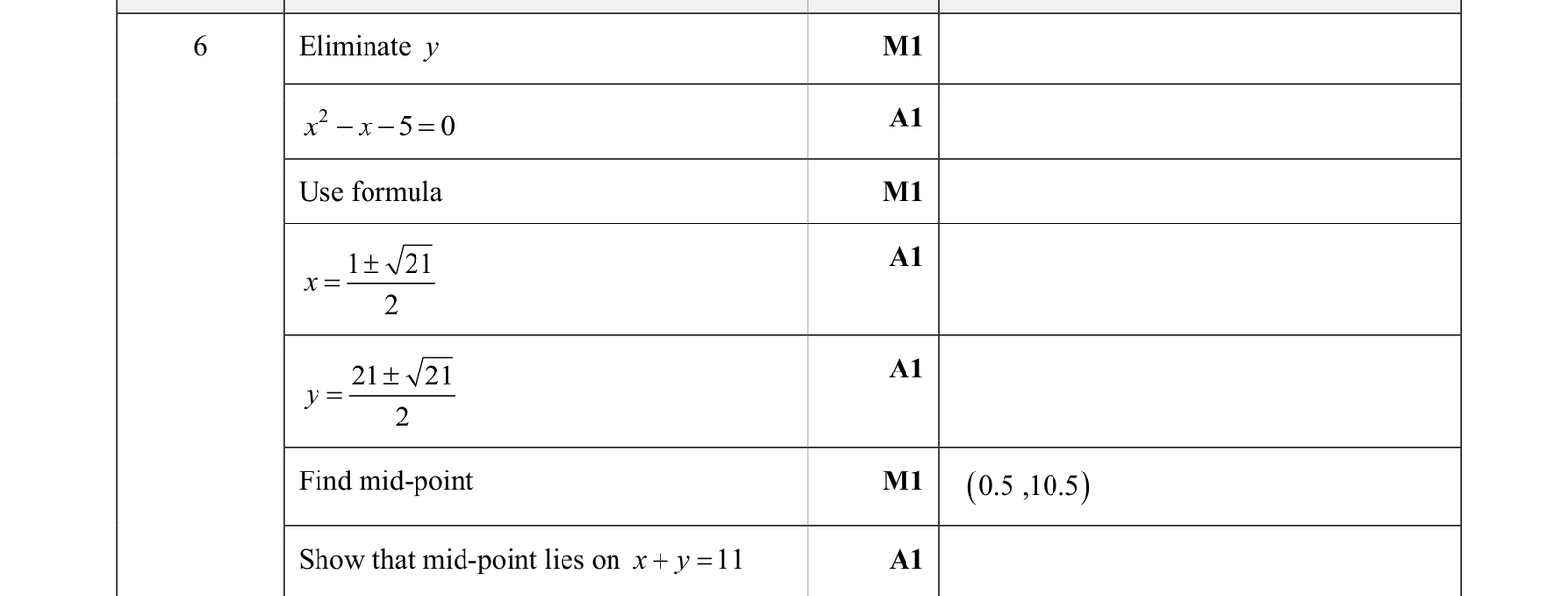
The curve \(xy=11x+5\) cuts the line \(y=x+10\) at the points \(A\) and \(B\). The midpoint of \(AB\) is the point \(C\). Show that the point \(C\) lies on the line \(x+y=11\).
0606 P22 - Nov 2019 - Q4 - 5 marks
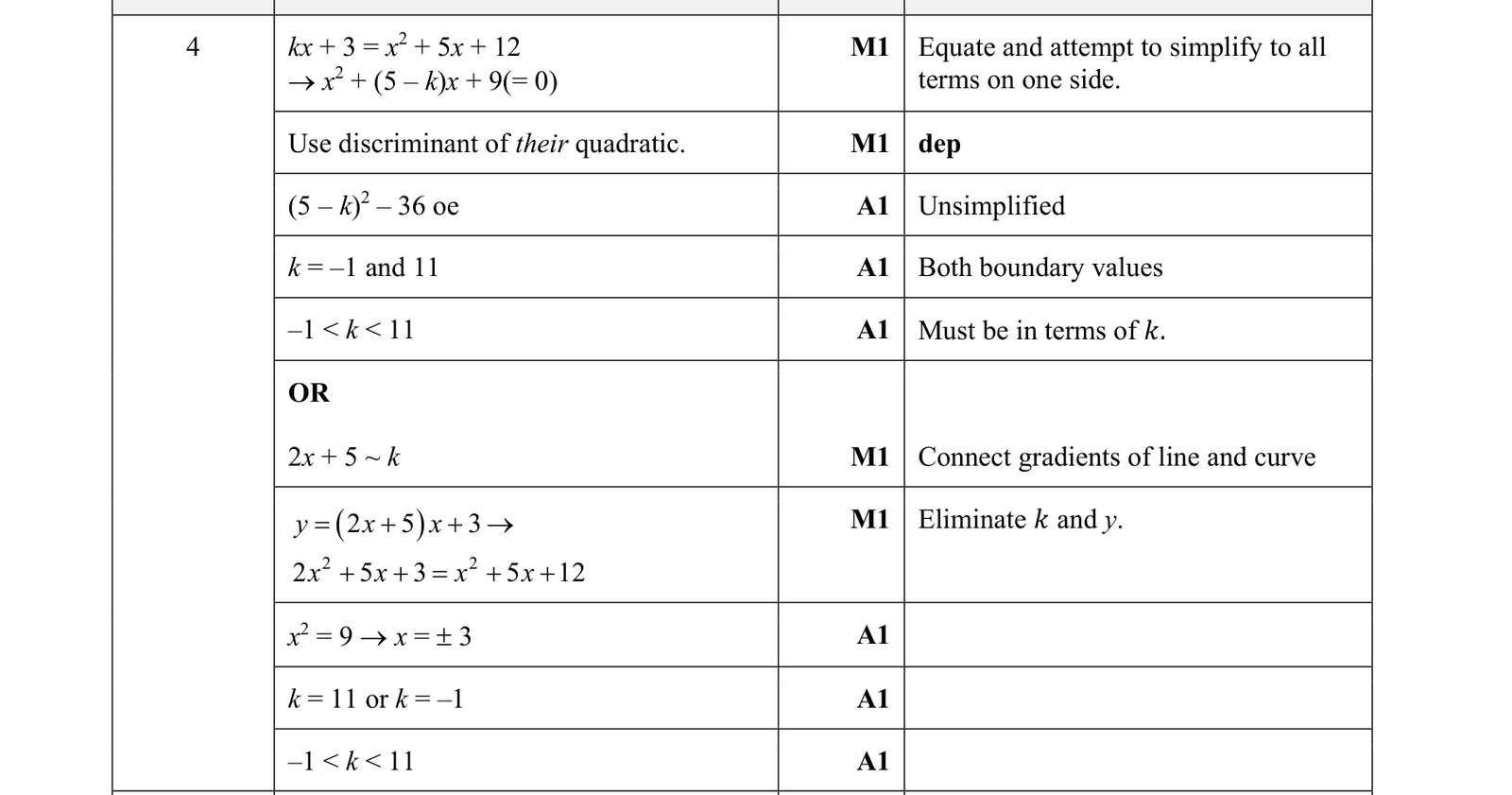
Find the values of \(k\) for which the line \(y=kx+3\) does not meet the curve \(y=x^2+5x+12\).
0606 P12 - Jun 2018 - Q2 - 5 marks
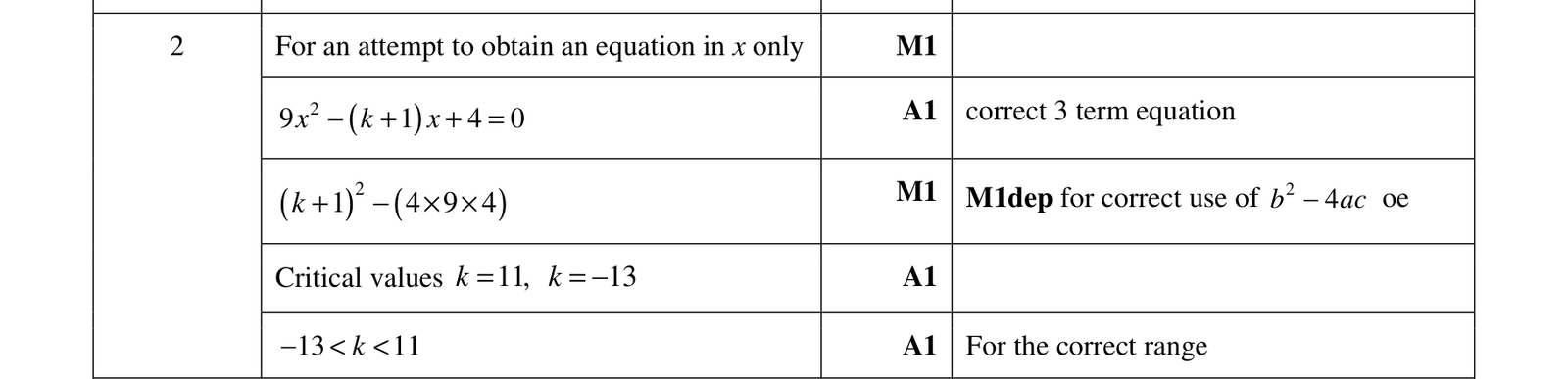
Find the values of \(k\) for which the line \(y=1-2kx\) does not meet the curve
\(y=9x^2-(3k+1)x+5.\)
0606 P12 - Nov 2018 - Q12 - 9 marks
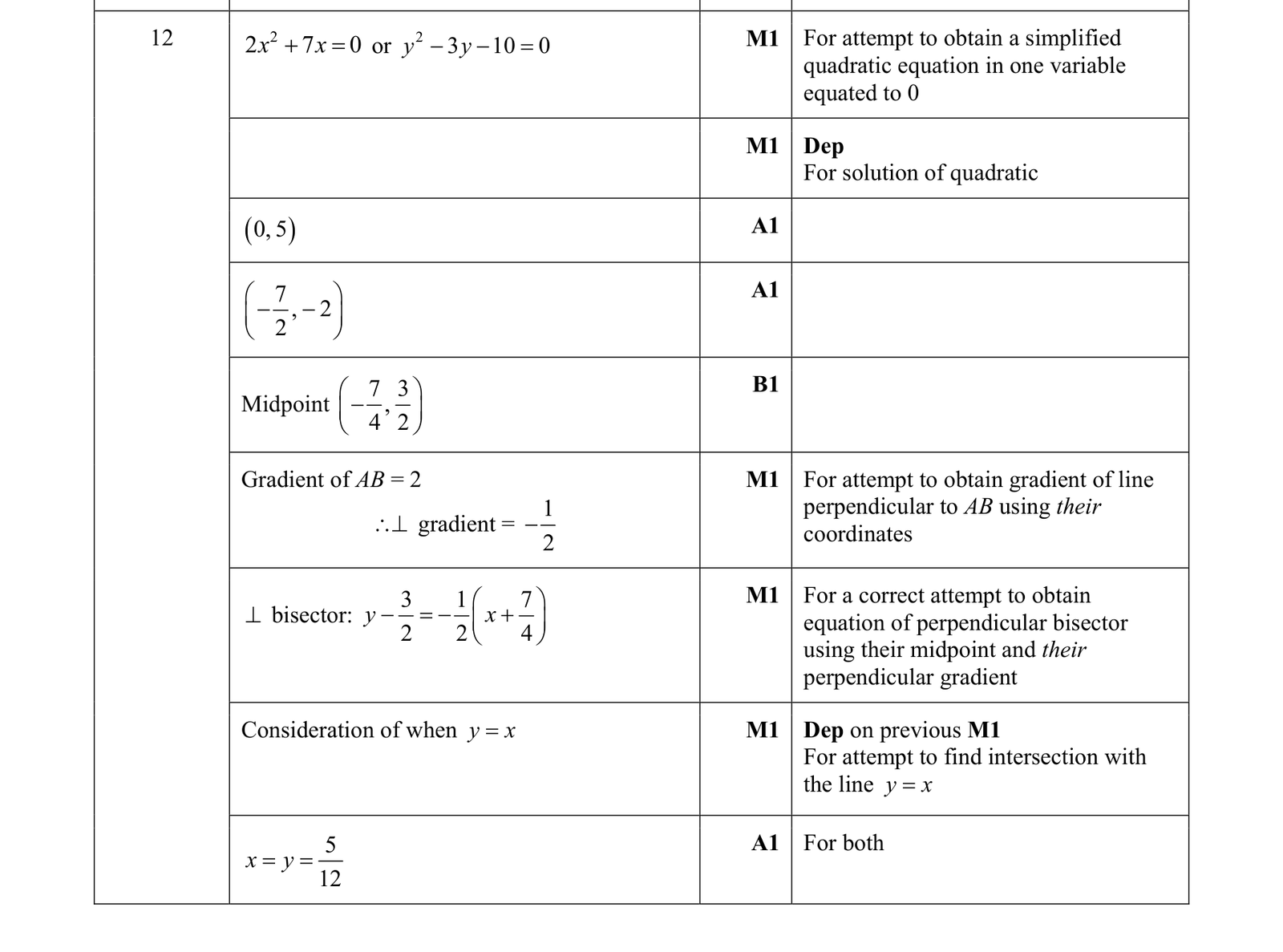
The line \(y=2x+5\) intersects the curve \(y+xy=5\) at the points \(A\) and \(B\). Find the coordinates of the point where the perpendicular bisector of the line \(AB\) intersects the line \(y=x\).
0606 P21 - Nov 2018 - Q10 - 11 marks
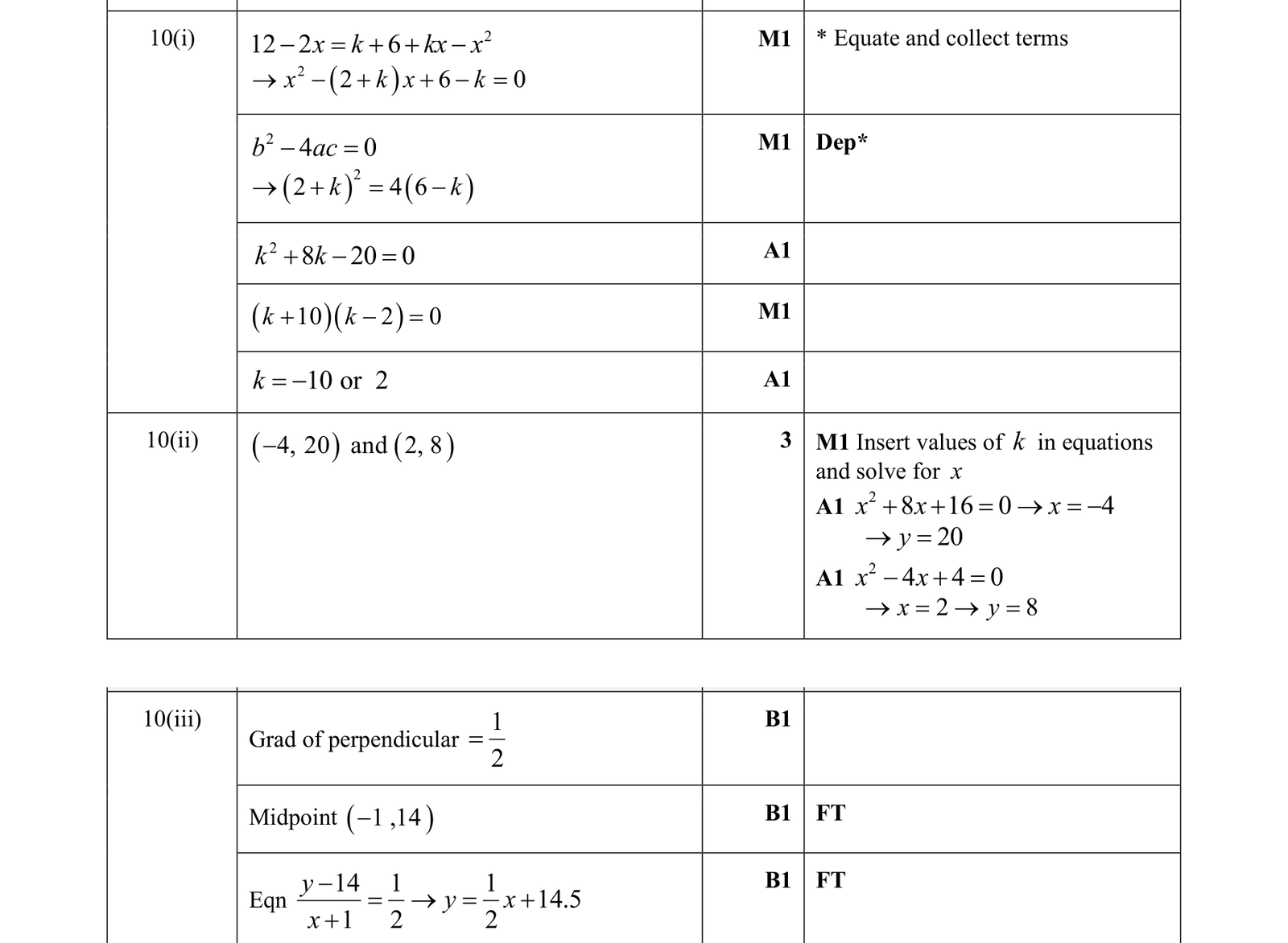
The line \(y=12-2x\) is a tangent to two curves. Each curve has an equation of the form
\(y=k+6+kx-x^2,\)
where \(k\) is a constant.
(i) Find the two values of \(k\).
The line \(y=12-2x\) is a tangent to one curve at the point \(A\) and the other curve at the point \(B\).
(ii) Find the coordinates of \(A\) and of \(B\).
(iii) Find the equation of the perpendicular bisector of \(AB\).
0606 P22 - Nov 2018 - Q10 - 9 marks
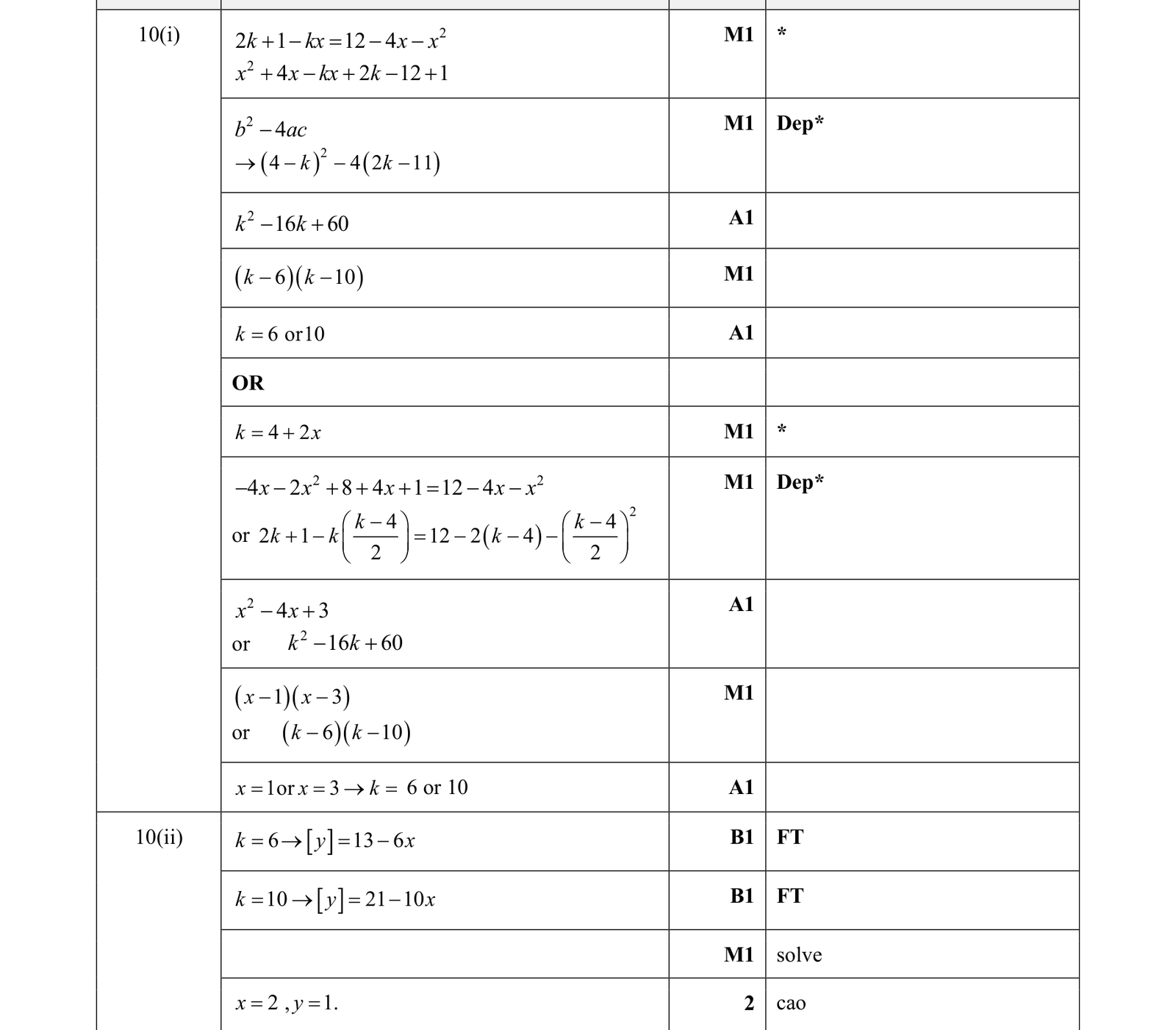
Two lines are tangents to the curve
\(y=12-4x-x^2.\)
The equation of each tangent is of the form
\(y=2k+1-kx,\)
where \(k\) is a constant.
(i) Find the two possible values of \(k\).
(ii) Find the coordinates of the point of intersection of the two tangents.
0606 P23 - Nov 2018 - Q11 - 12 marks
A line with equation
\(y=-5x+k+5\)
is a tangent to a curve with equation
\(y=7-kx-x^2.\)
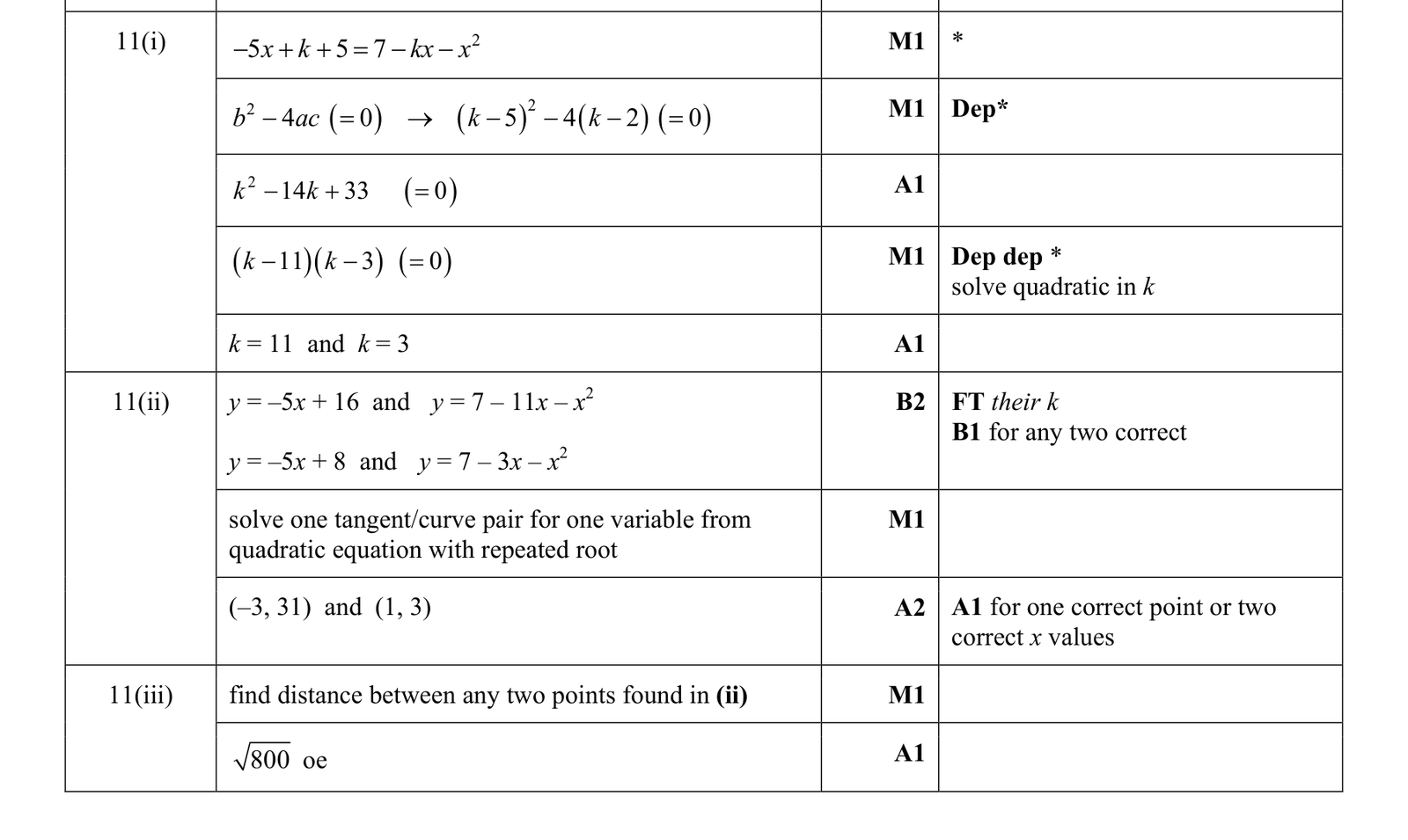
(i) Find the two possible values of \(k\).
(ii) Find, for each of your values of \(k\), the equation of the tangent, the equation of the curve, and the coordinates of the point of contact of the tangent and the curve.
(iii) Find the distance between the two points of contact.
0606 P21 - Jun 2017 - Q9 - 9 marks
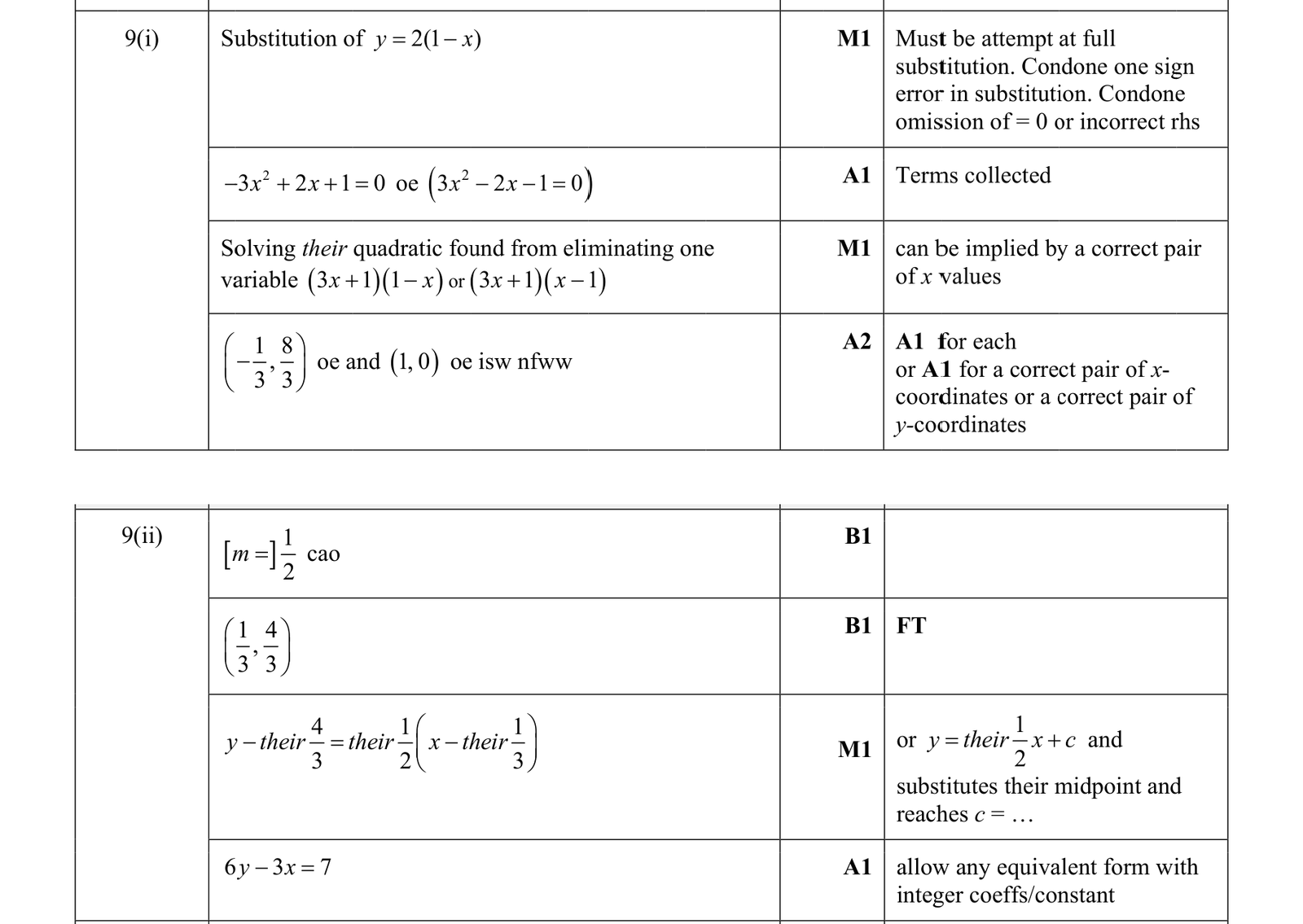
The curve \(3x^2+xy-y^2+4y-3=0\) and the line \(y=2(1-x)\) intersect at the points \(A\) and \(B\).
(i) Find the coordinates of \(A\) and \(B\).
(ii) Find the equation of the perpendicular bisector of the line \(AB\), giving your answer in the form \(ax+by=c\), where \(a\), \(b\) and \(c\) are integers.
9709 P11 - Jun 2019 - Q4
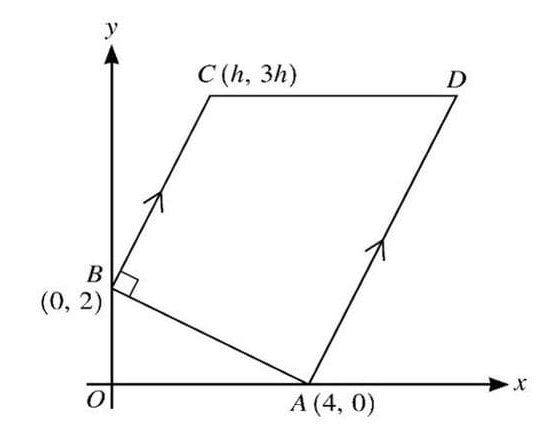
The diagram shows a trapezium ABCD in which the coordinates of A, B, and C are (4, 0), (0, 2), and (h, 3h) respectively. The lines BC and AD are parallel, angle ∠ABC = 90° and CD is parallel to the x-axis.
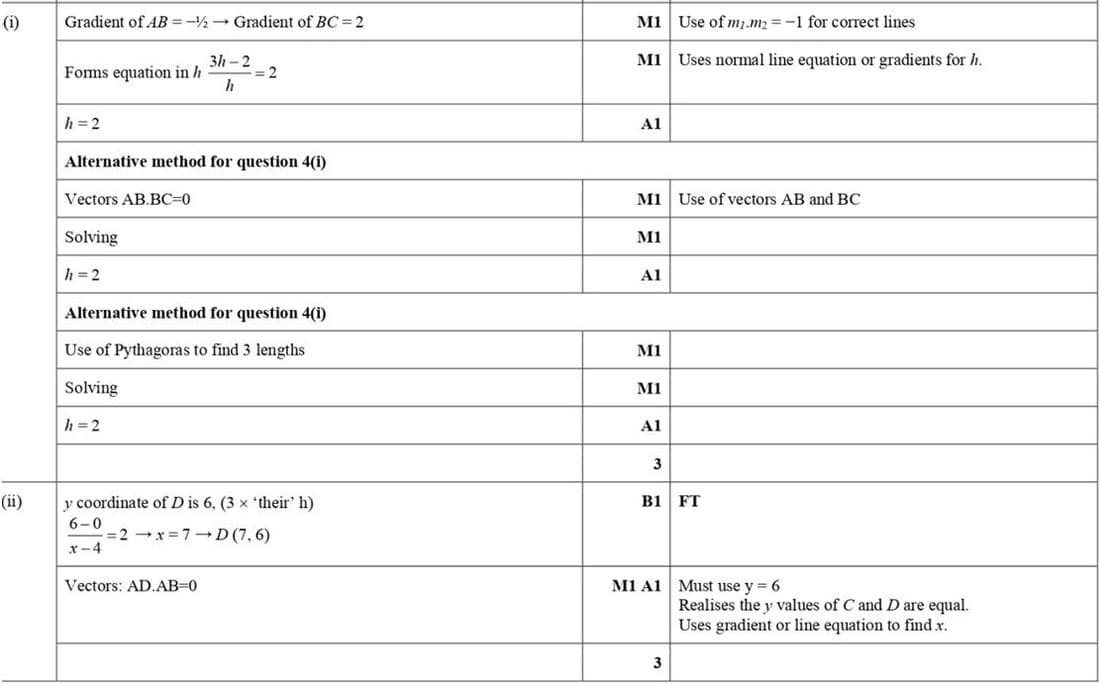
(i) Find, by calculation, the value of h.
(ii) Hence find the coordinates of D.
9709 P13 - Jun 2010 - Q8
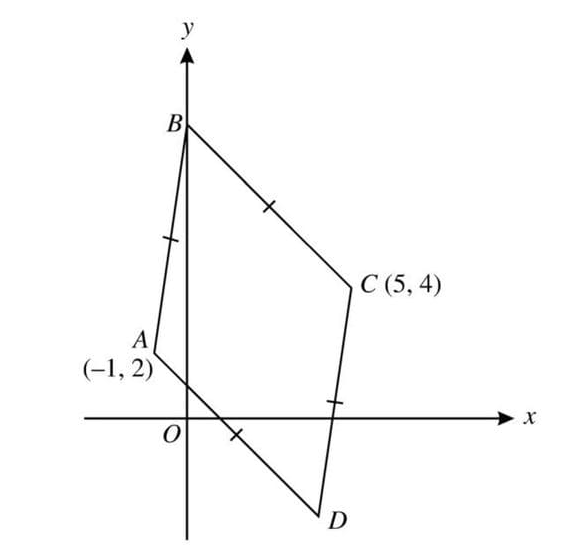
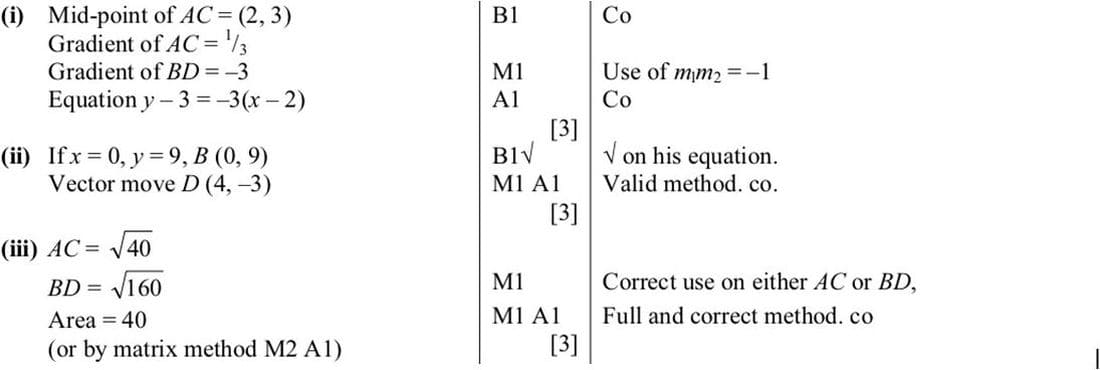
The diagram shows a rhombus ABCD in which the point A is (-1, 2), the point C is (5, 4) and the point B lies on the y-axis. Find
- the equation of the perpendicular bisector of AC,
- the coordinates of B and D,
- the area of the rhombus.
9709 P12 - Jun 2010 - Q4
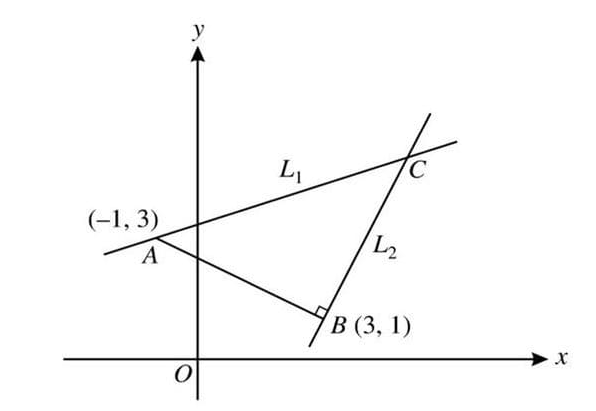
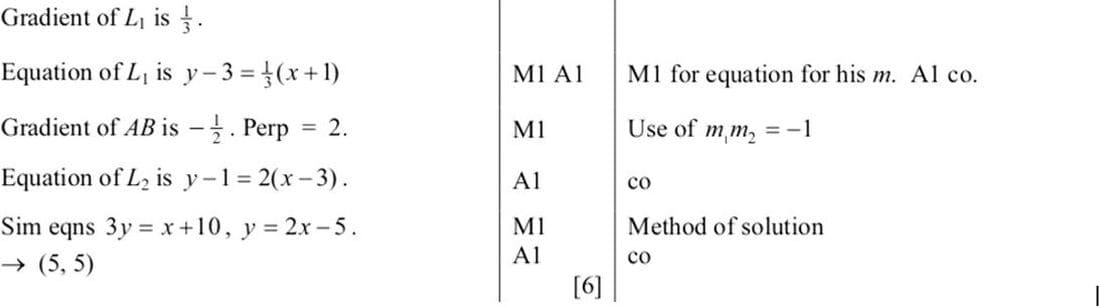
In the diagram, A is the point (-1, 3) and B is the point (3, 1). The line L1 passes through A and is parallel to OB. The line L2 passes through B and is perpendicular to AB. The lines L1 and L2 meet at C. Find the coordinates of C.
9709 P11 - Jun 2010 - Q8
The diagram shows a triangle ABC in which A is (3, -2) and B is (15, 22). The gradients of AB, AC and BC are 2m, -2m and m respectively, where m is a positive constant.
- Find the gradient of AB and deduce the value of m.
- Find the coordinates of C.
- Find the coordinates of D.
The perpendicular bisector of AB meets BC at D.


9709 P12 - Nov 2009 - Q9
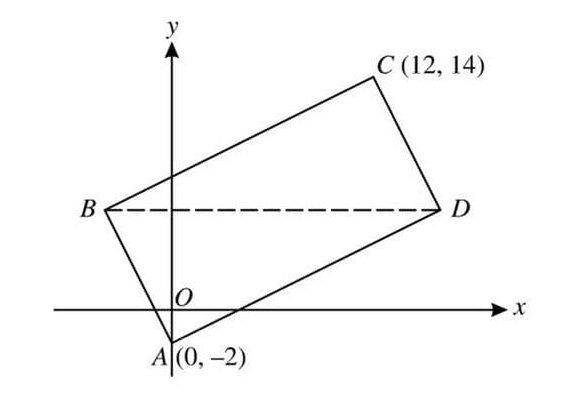
The diagram shows a rectangle ABCD. The point A is (0, -2) and C is (12, 14). The diagonal BD is parallel to the x-axis.
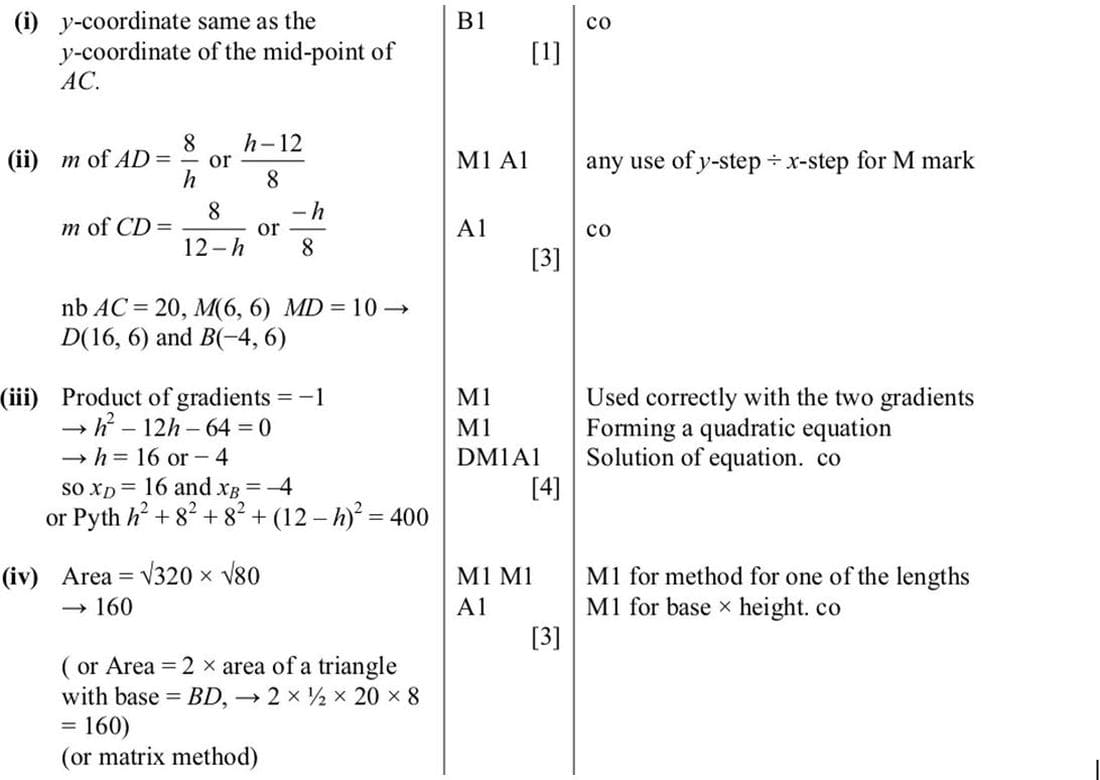
- Explain why the y-coordinate of D is 6.
- The x-coordinate of D is h. Express the gradients of AD and CD in terms of h.
- Calculate the x-coordinates of D and B.
- Calculate the area of the rectangle ABCD.