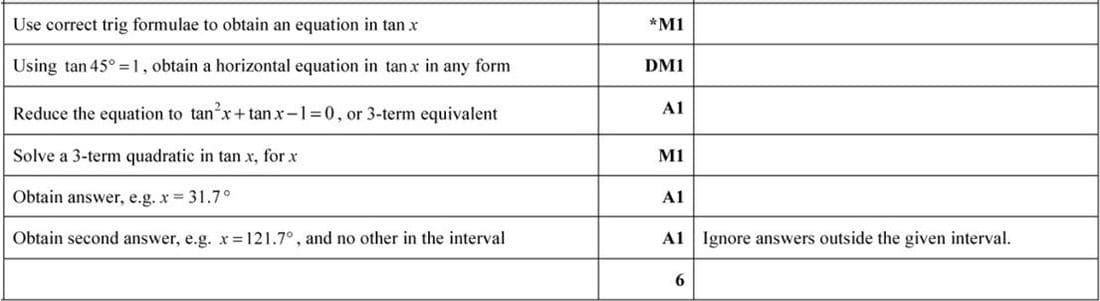
1. Use the identity \(\tan(a + b) = \frac{\tan a + \tan b}{1 - \tan a \tan b}\) to express \(\tan(x + 45^\circ)\):
\(\tan(x + 45^\circ) = \frac{\tan x + 1}{1 - \tan x}\)
2. Substitute \(\cot x = \frac{1}{\tan x}\) into the equation:
\(\frac{\tan x + 1}{1 - \tan x} = 2 \cdot \frac{1}{\tan x} + 1\)
3. Clear the fractions by multiplying through by \(\tan x (1 - \tan x)\):
\((\tan x + 1) \tan x = 2(1 - \tan x) + \tan x (1 - \tan x)\)
4. Simplify and rearrange to form a quadratic equation:
\(\tan^2 x + \tan x = 2 - 2\tan x + \tan x - \tan^2 x\)
\(2\tan^2 x + \tan x - 1 = 0\)
5. Solve the quadratic equation using the quadratic formula \(\tan x = \frac{-b \pm \sqrt{b^2 - 4ac}}{2a}\):
\(a = 2, \ b = 1, \ c = -1\)
\(\tan x = \frac{-1 \pm \sqrt{1^2 - 4 \cdot 2 \cdot (-1)}}{2 \cdot 2}\)
\(\tan x = \frac{-1 \pm \sqrt{1 + 8}}{4}\)
\(\tan x = \frac{-1 \pm 3}{4}\)
\(\tan x = \frac{2}{4} = 0.5 \quad \text{or} \quad \tan x = \frac{-4}{4} = -1\)
6. Find \(x\) for \(\tan x = 0.5\):
\(x = \tan^{-1}(0.5) \approx 26.6^\circ\)
7. Find \(x\) for \(\tan x = -1\):
\(x = 135^\circ\)
8. Adjust for the given interval \(0^\circ < x < 180^\circ\):
\(x = 31.7^\circ \quad \text{and} \quad x = 121.7^\circ\)