Past Exam Questions
← Back9709 P11 - Jun 2022 - Q9
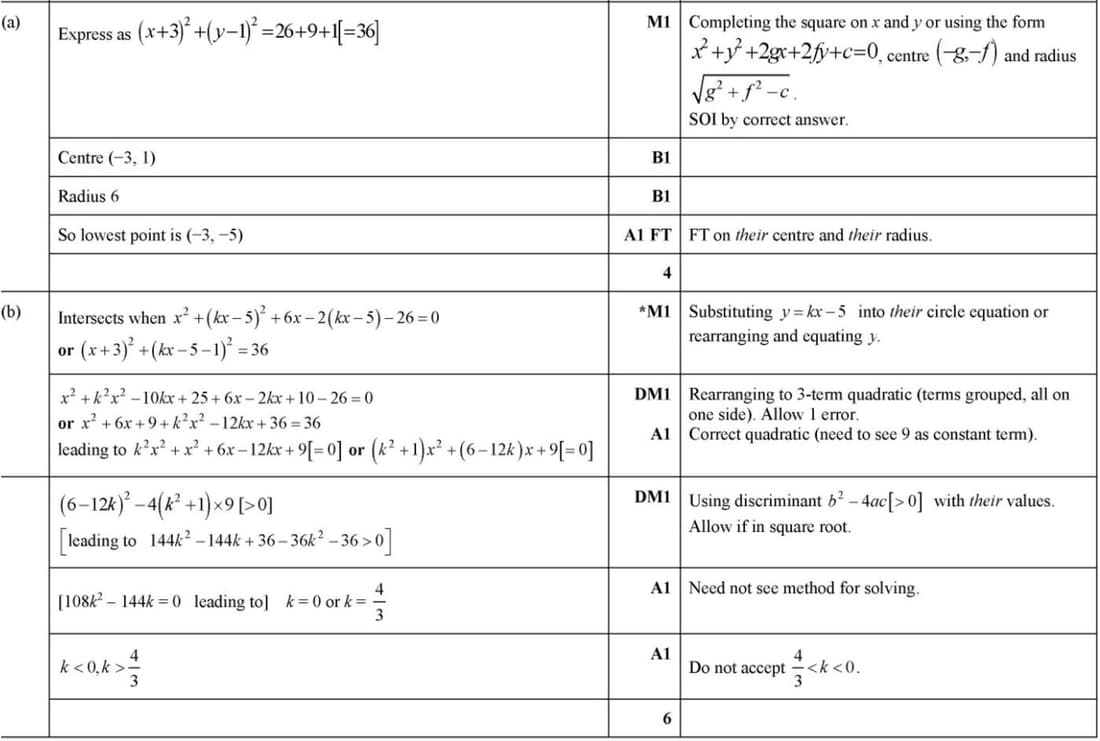
The equation of a circle is \(x^2 + y^2 + 6x - 2y - 26 = 0\).
(a) Find the coordinates of the centre of the circle and the radius. Hence find the coordinates of the lowest point on the circle.
(b) Find the set of values of the constant \(k\) for which the line with equation \(y = kx - 5\) intersects the circle at two distinct points.
9709 P12 - Mar 2022 - Q6
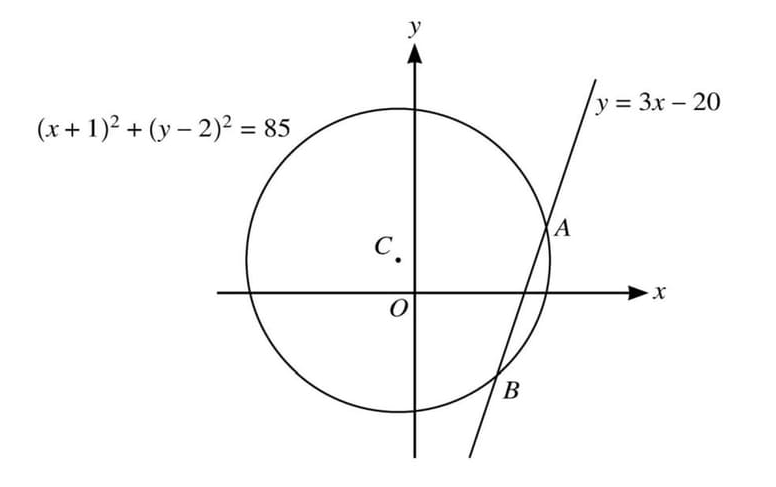
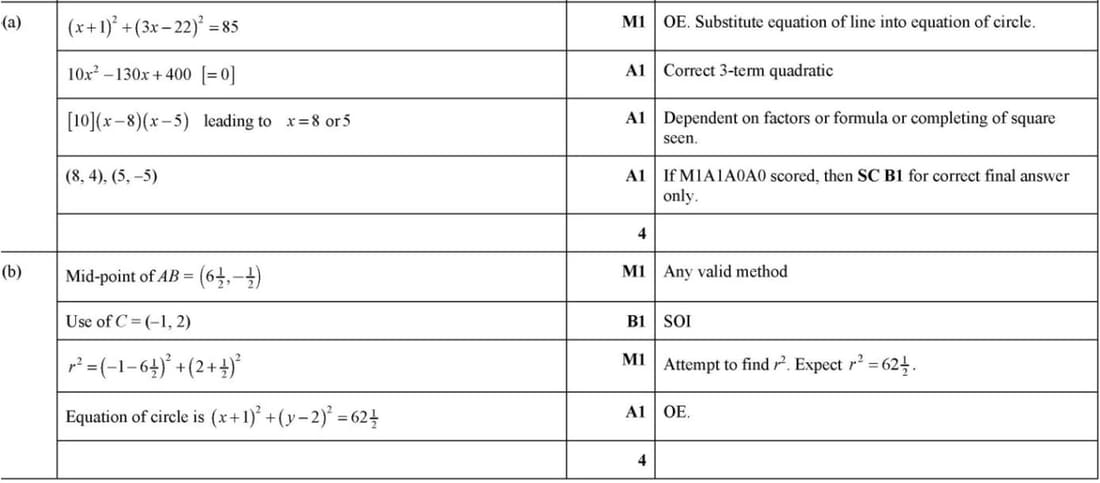
The circle with equation \((x+1)^2 + (y-2)^2 = 85\) and the straight line with equation \(y = 3x - 20\) are shown in the diagram. The line intersects the circle at \(A\) and \(B\), and the centre of the circle is at \(C\).
(a) Find, by calculation, the coordinates of \(A\) and \(B\).
(b) Find an equation of the circle which has its centre at \(C\) and for which the line with equation \(y = 3x - 20\) is a tangent to the circle.
9709 P13 - Nov 2021 - Q9
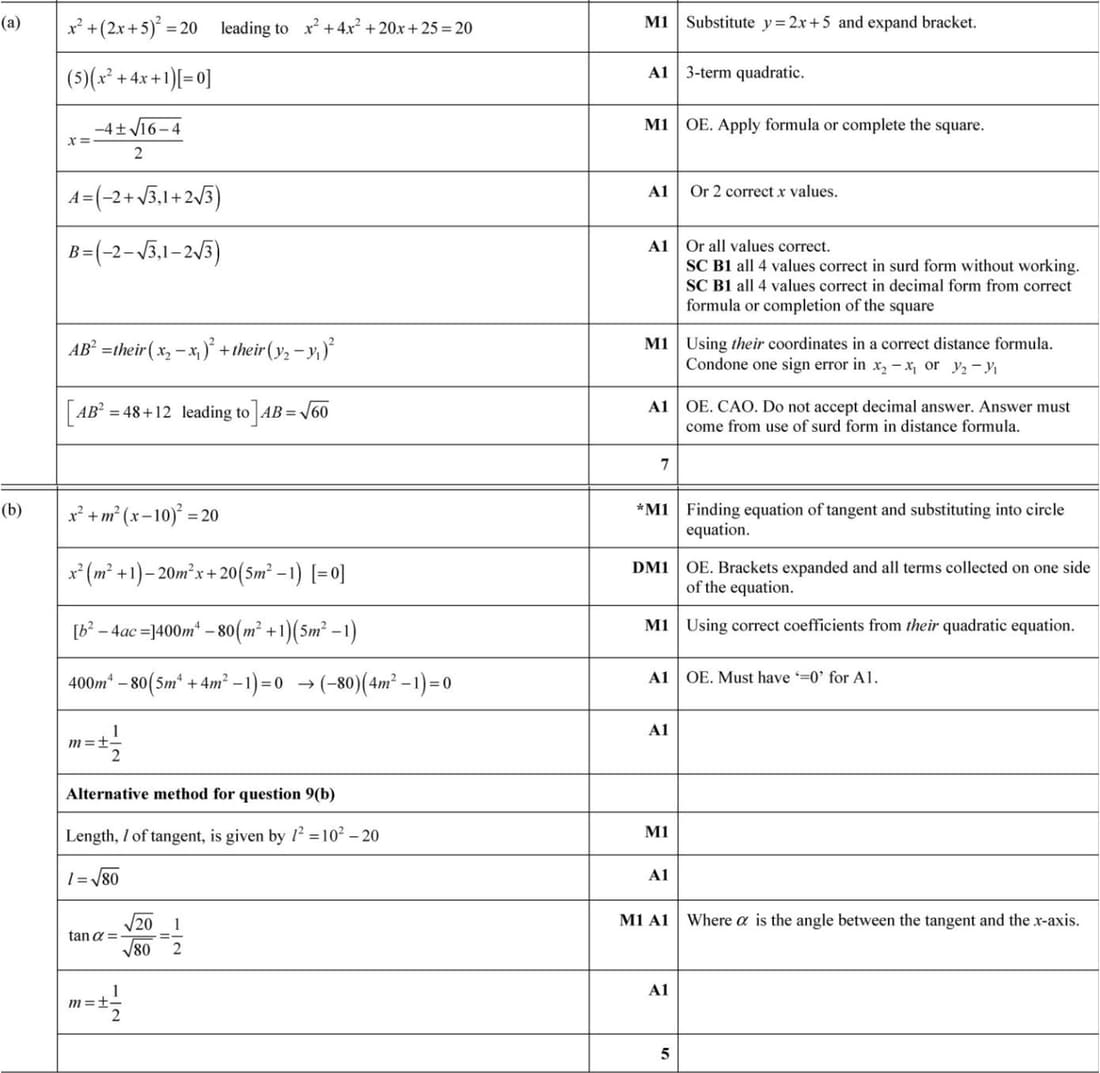
The line \(y = 2x + 5\) intersects the circle with equation \(x^2 + y^2 = 20\) at \(A\) and \(B\).
(a) Find the coordinates of \(A\) and \(B\) in surd form and hence find the exact length of the chord \(AB\).
A straight line through the point \((10, 0)\) with gradient \(m\) is a tangent to the circle.
(b) Find the two possible values of \(m\).
9709 P12 - Nov 2021 - Q12
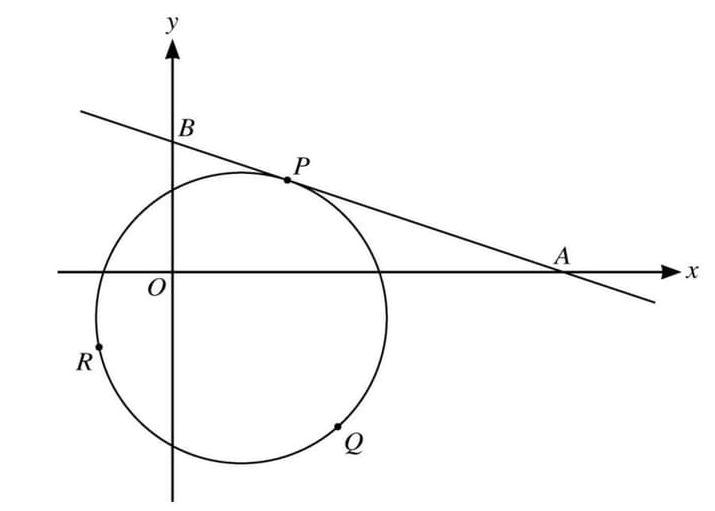
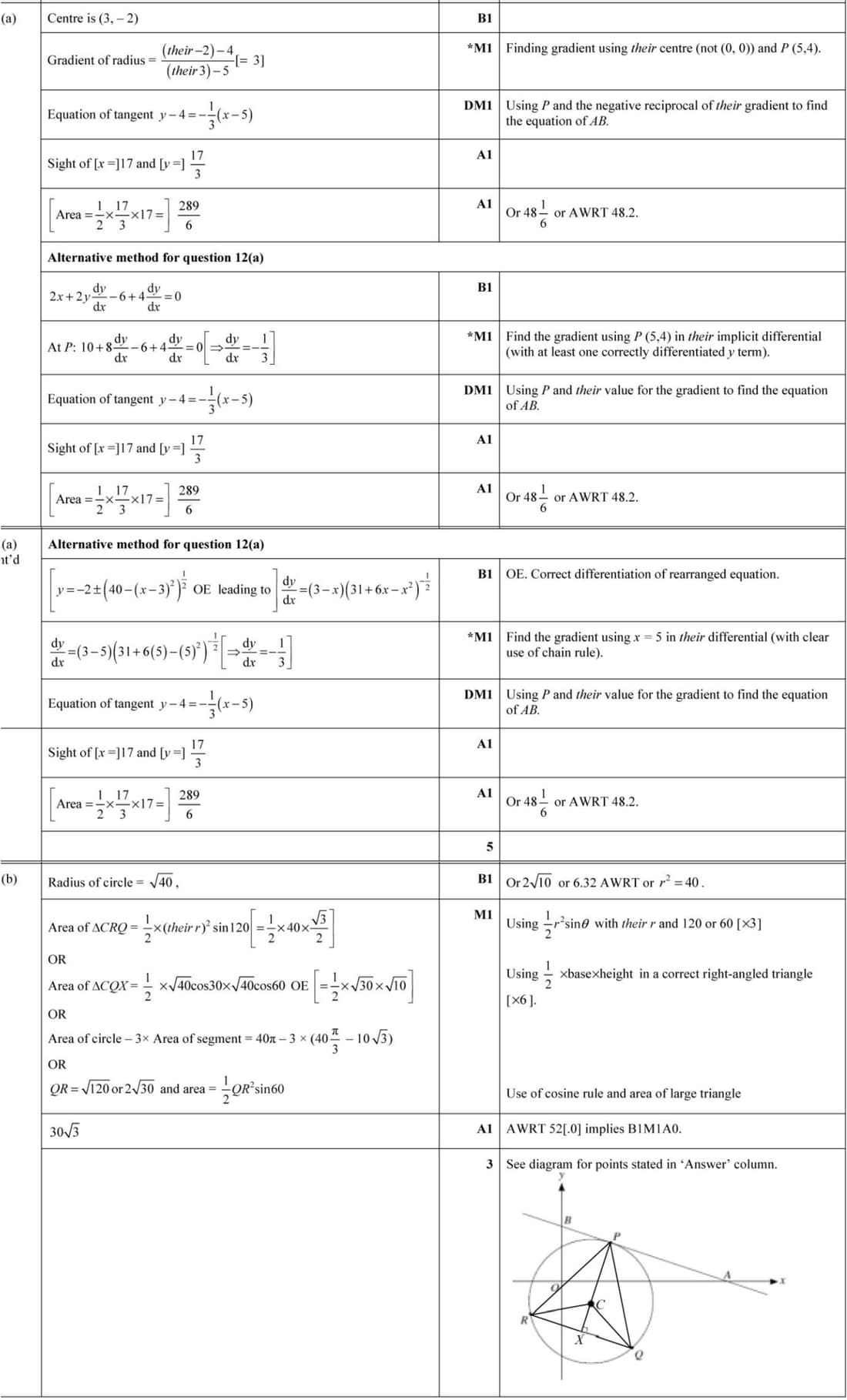
The diagram shows the circle with equation \(x^2 + y^2 - 6x + 4y - 27 = 0\) and the tangent to the circle at the point \(P (5, 4)\).
(a) The tangent to the circle at \(P\) meets the \(x\)-axis at \(A\) and the \(y\)-axis at \(B\). Find the area of triangle \(OAB\), where \(O\) is the origin.
(b) Points \(Q\) and \(R\) also lie on the circle, such that \(PQR\) is an equilateral triangle. Find the exact area of triangle \(PQR\).
9709 P11 - Nov 2021 - Q7
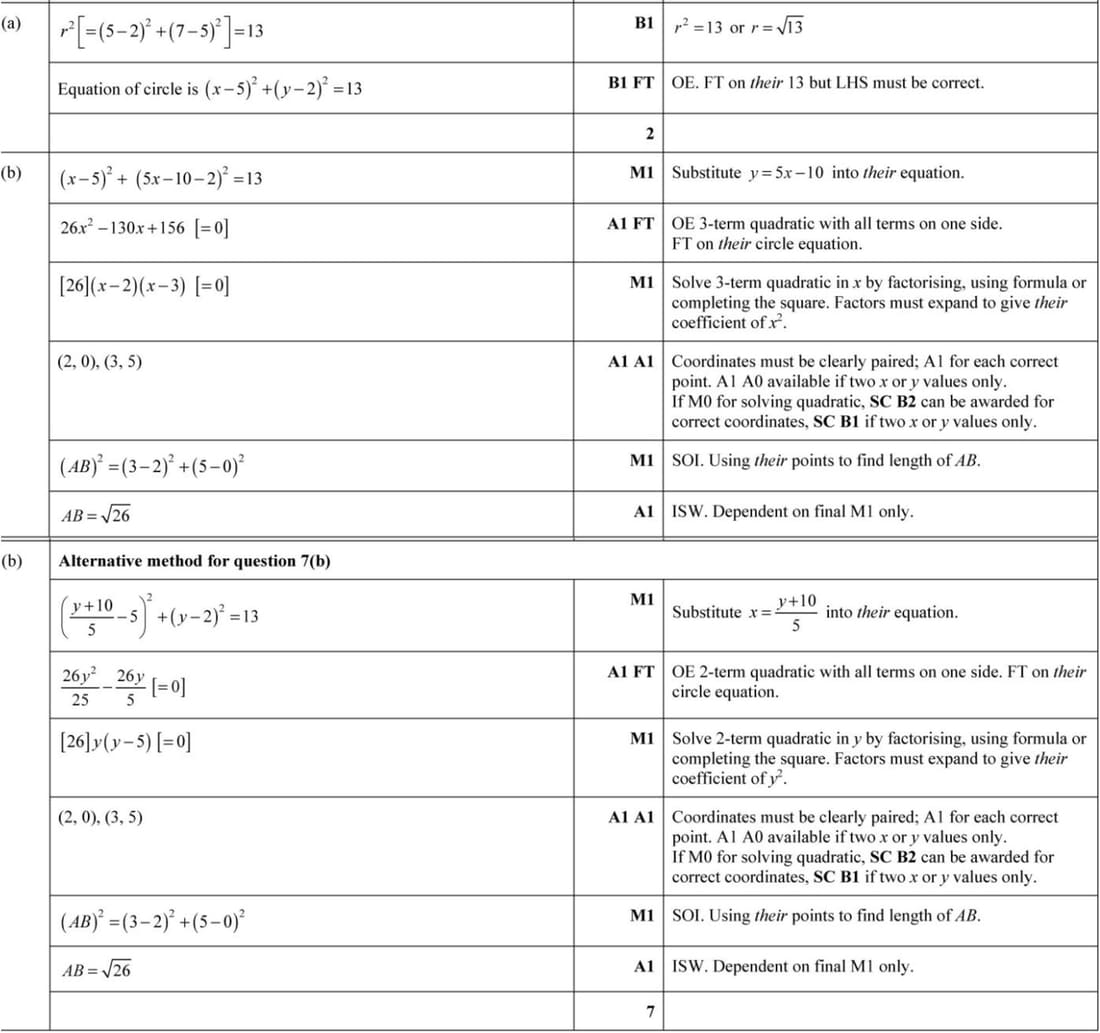
A circle with centre (5, 2) passes through the point (7, 5).
(a) Find an equation of the circle.
The line \(y = 5x - 10\) intersects the circle at A and B.
(b) Find the exact length of the chord AB.
9709 P13 - Jun 2021 - Q10
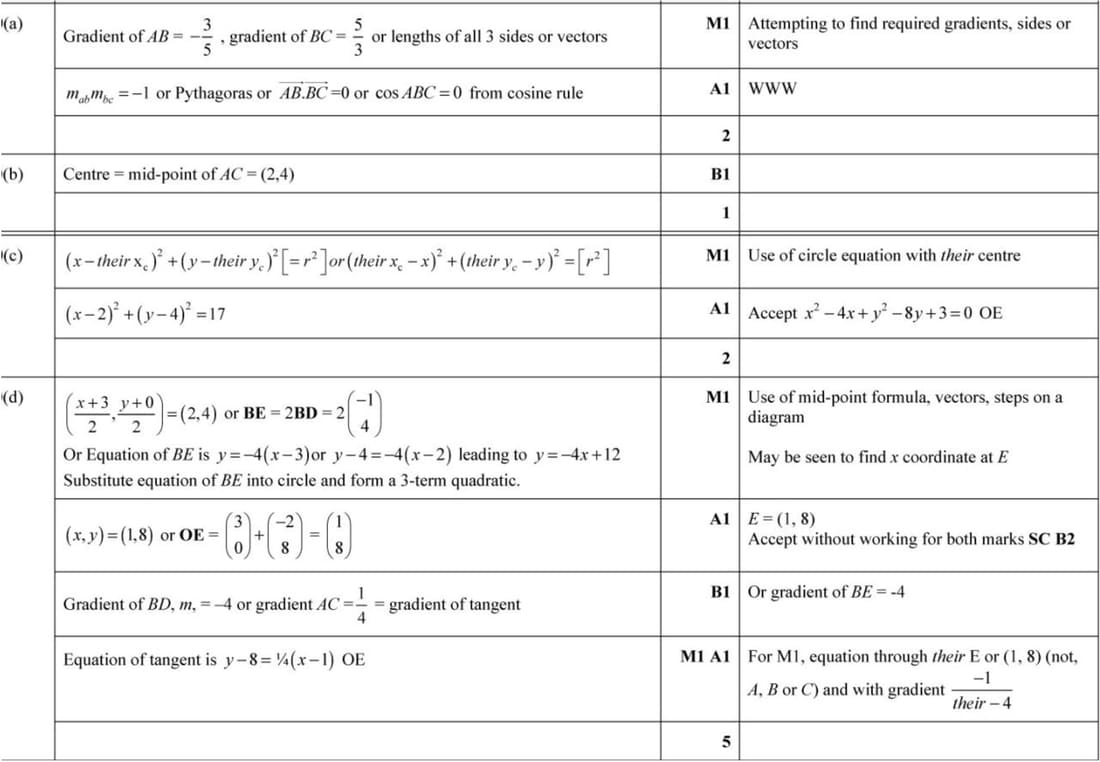
Points \(A(-2, 3)\), \(B(3, 0)\) and \(C(6, 5)\) lie on the circumference of a circle with centre \(D\).
(a) Show that angle \(ABC = 90^\circ\).
(b) Hence state the coordinates of \(D\).
(c) Find an equation of the circle.
The point \(E\) lies on the circumference of the circle such that \(BE\) is a diameter.
(d) Find an equation of the tangent to the circle at \(E\).
9709 P12 - Jun 2021 - Q7
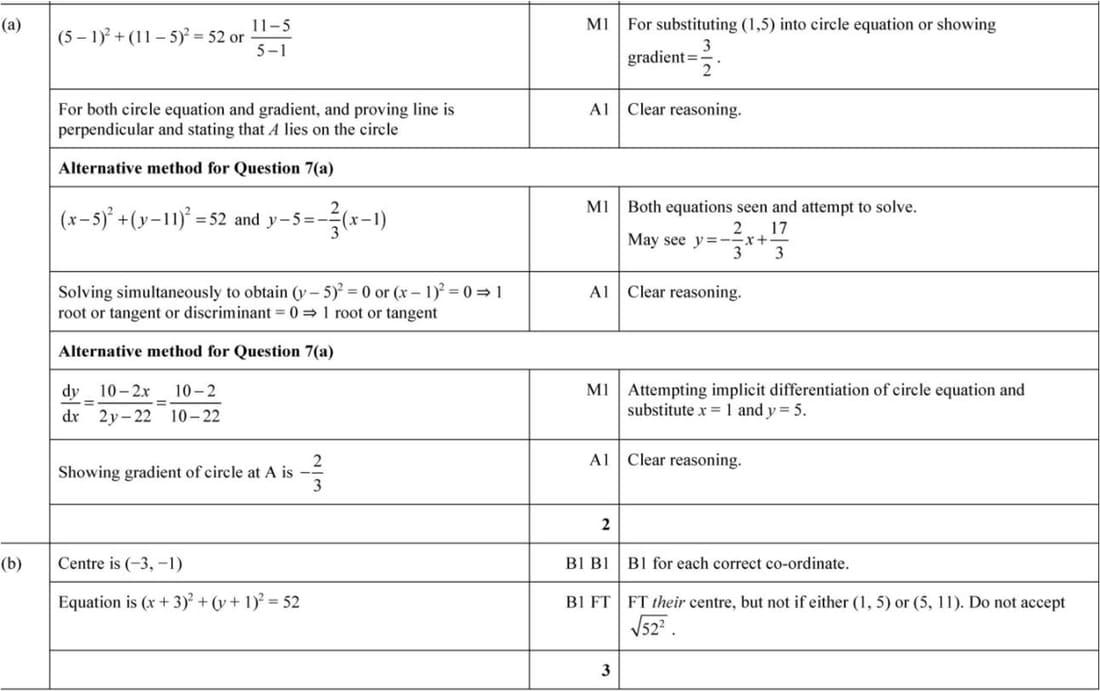
The point A has coordinates (1, 5) and the line l has gradient \(-\frac{2}{3}\) and passes through A. A circle has centre (5, 11) and radius \(\sqrt{52}\).
(a) Show that l is the tangent to the circle at A.
(b) Find the equation of the other circle of radius \(\sqrt{52}\) for which l is also the tangent at A.
9709 P12 - Nov 2023 - Q11
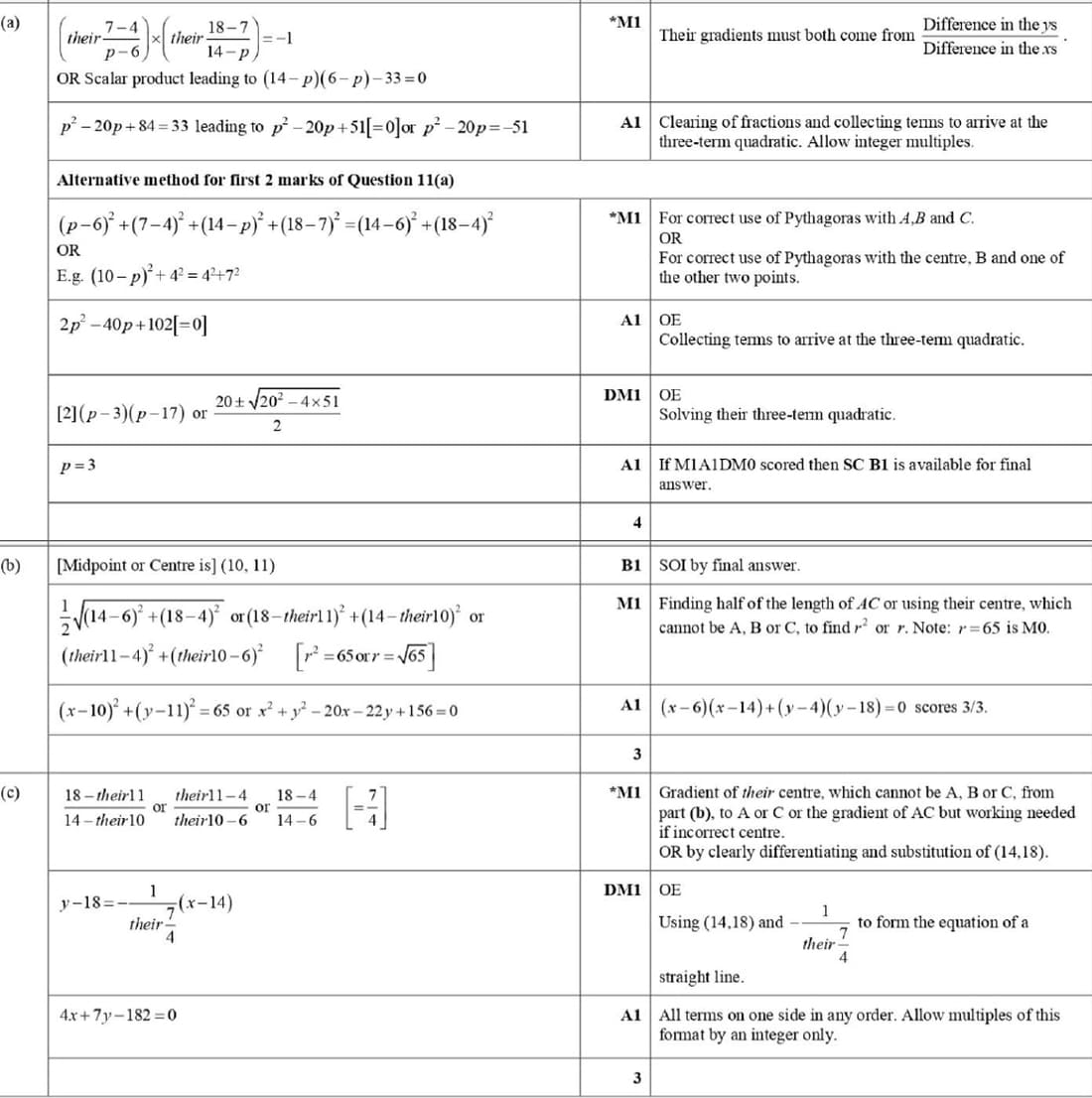
The coordinates of points A, B and C are (6, 4), (p, 7) and (14, 18) respectively, where p is a constant. The line AB is perpendicular to the line BC.
(a) Given that p < 10, find the value of p.
A circle passes through the points A, B and C.
(b) Find the equation of the circle.
(c) Find the equation of the tangent to the circle at C, giving the answer in the form dx + ey + f = 0, where d, e and f are integers.
9709 P11 - Jun 2021 - Q10
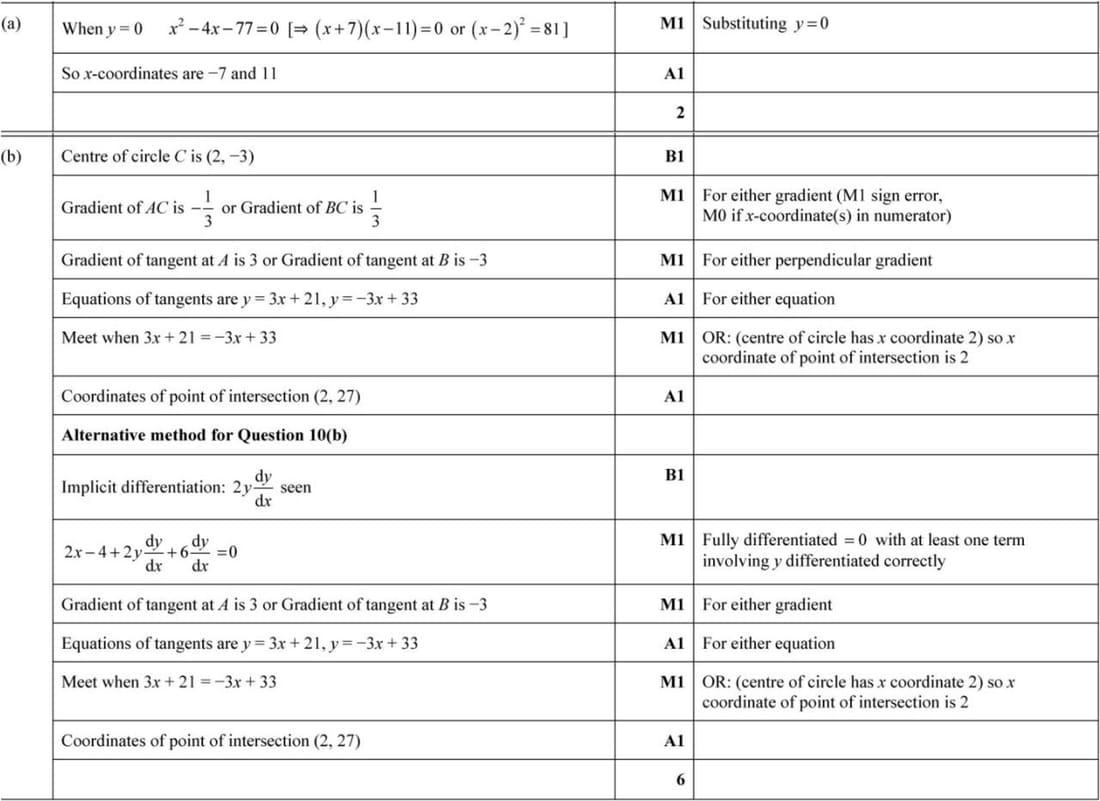
The equation of a circle is \(x^2 + y^2 - 4x + 6y - 77 = 0\).
(a) Find the \(x\)-coordinates of the points \(A\) and \(B\) where the circle intersects the \(x\)-axis.
(b) Find the point of intersection of the tangents to the circle at \(A\) and \(B\).
9709 P12 - Mar 2021 - Q8
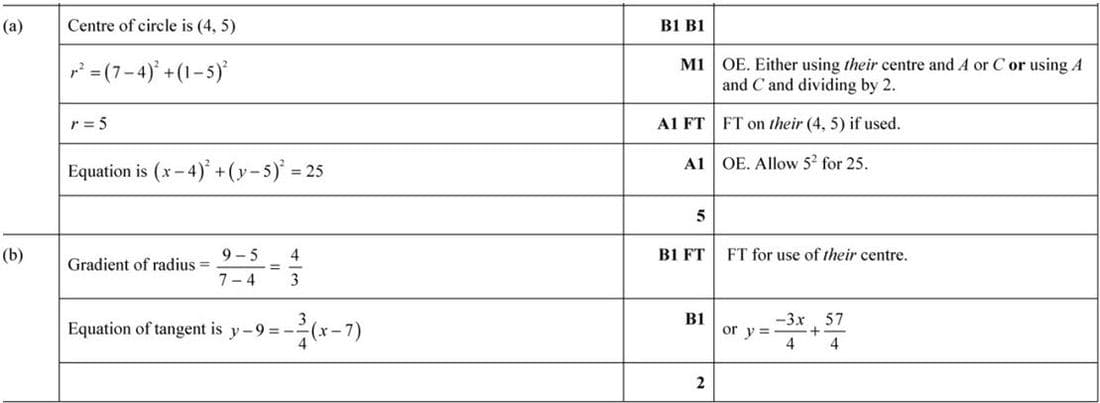
The points \(A(7, 1)\), \(B(7, 9)\), and \(C(1, 9)\) are on the circumference of a circle.
(a) Find an equation of the circle.
(b) Find an equation of the tangent to the circle at \(B\).
9709 P13 - Nov 2020 - Q11
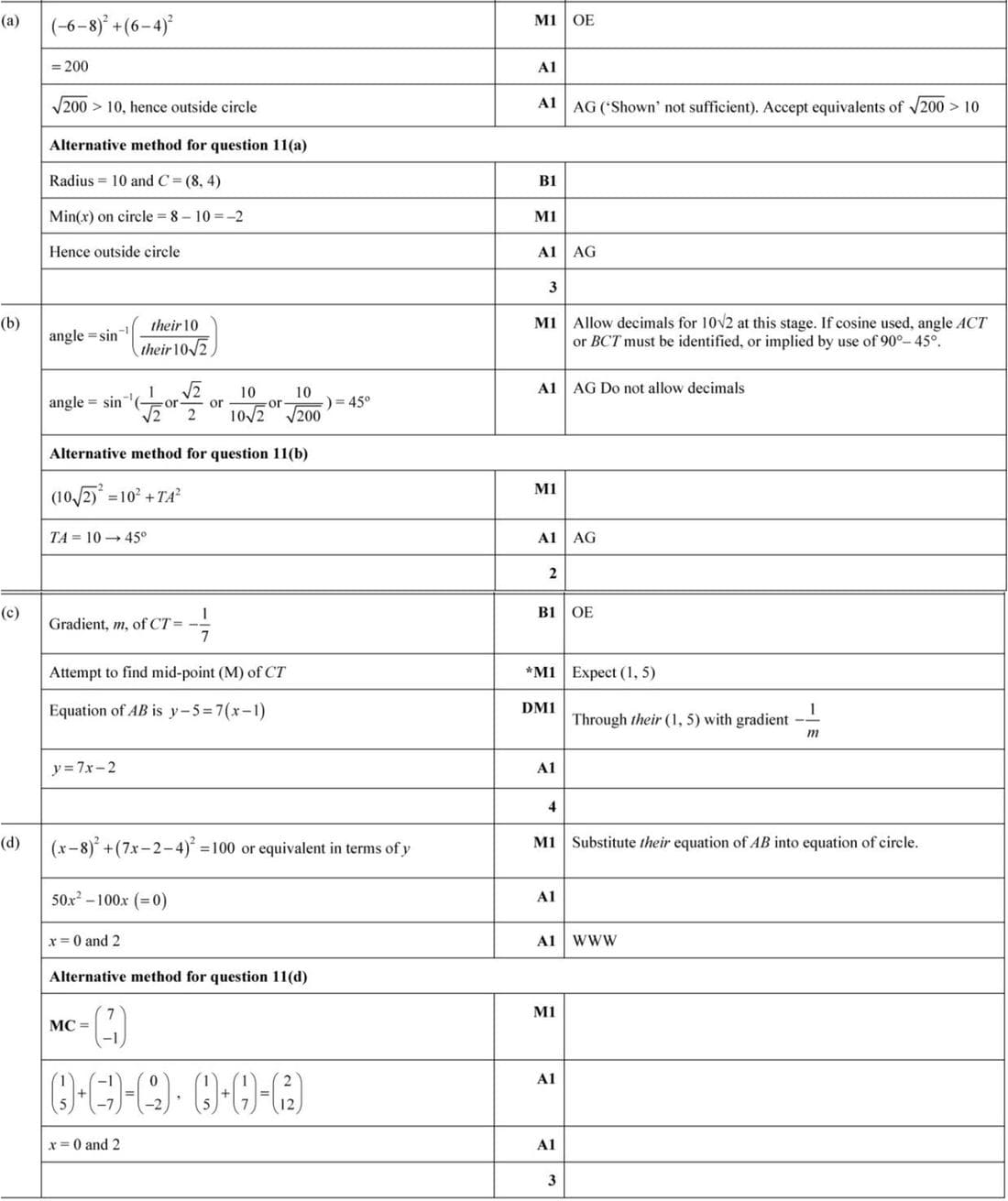
A circle with centre C has equation \((x - 8)^2 + (y - 4)^2 = 100\).
(a) Show that the point \(T(-6, 6)\) is outside the circle.
Two tangents from \(T\) to the circle are drawn.
(b) Show that the angle between one of the tangents and \(CT\) is exactly \(45^\circ\).
The two tangents touch the circle at \(A\) and \(B\).
(c) Find the equation of the line \(AB\), giving your answer in the form \(y = mx + c\).
(d) Find the \(x\)-coordinates of \(A\) and \(B\).
9709 P12 - Nov 2020 - Q9
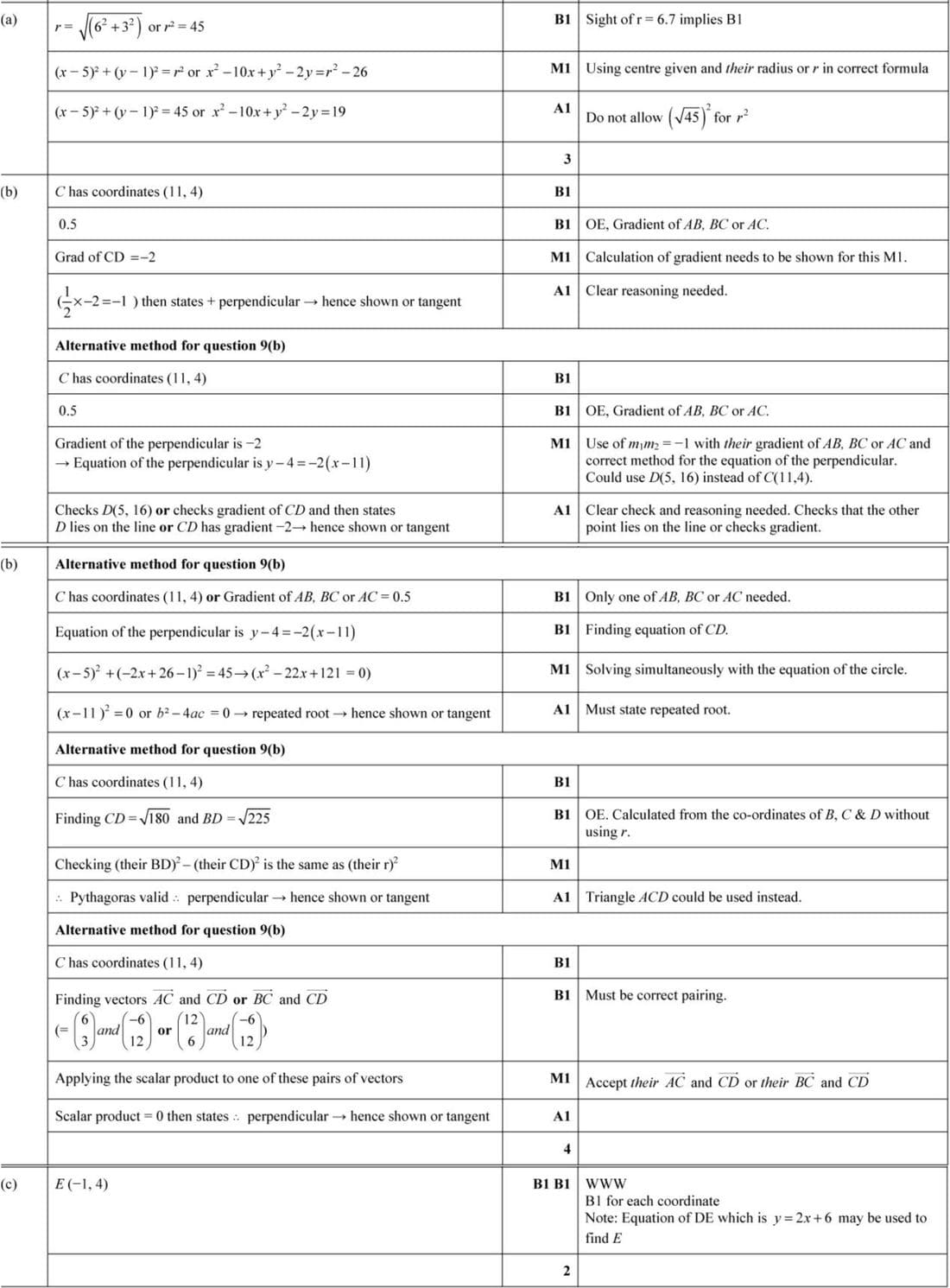
A circle has centre at the point \(B(5, 1)\). The point \(A(-1, -2)\) lies on the circle.
(a) Find the equation of the circle.
Point \(C\) is such that \(AC\) is a diameter of the circle. Point \(D\) has coordinates \((5, 16)\).
(b) Show that \(DC\) is a tangent to the circle.
The other tangent from \(D\) to the circle touches the circle at \(E\).
(c) Find the coordinates of \(E\).
9709 P11 - Nov 2020 - Q9
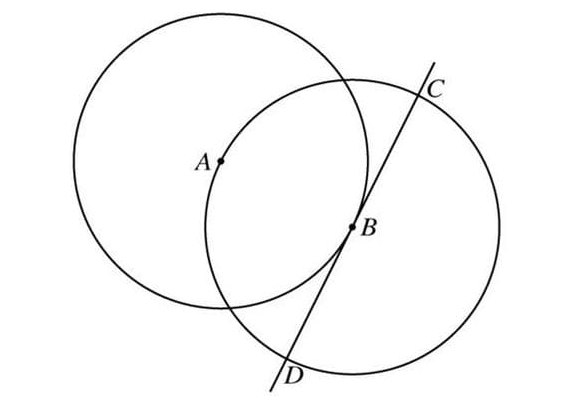
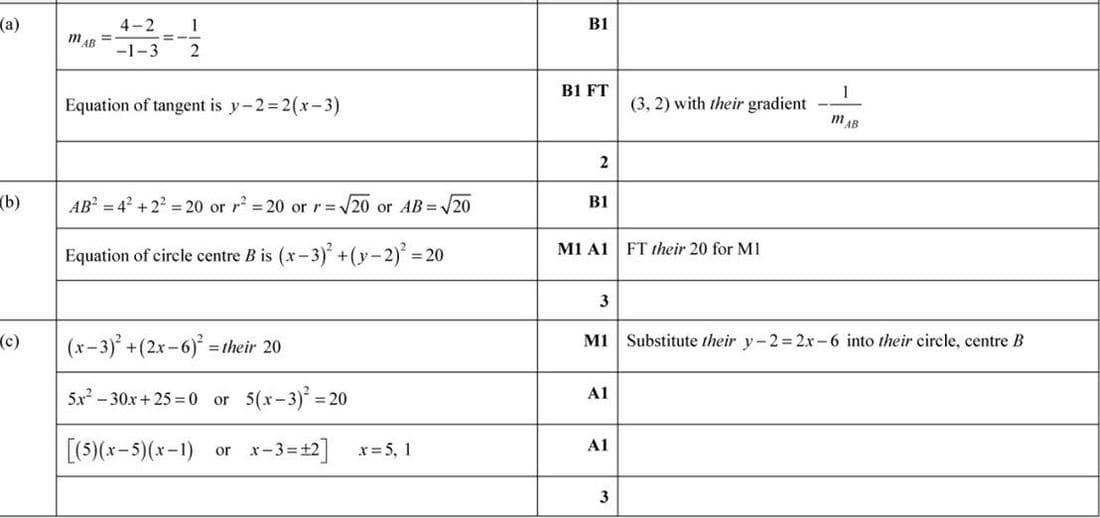
The diagram shows a circle with centre A passing through the point B. A second circle has centre B and passes through A. The tangent at B to the first circle intersects the second circle at C and D.
The coordinates of A are (-1, 4) and the coordinates of B are (3, 2).
- Find the equation of the tangent CBD.
- Find an equation of the circle with centre B.
- Find, by calculation, the x-coordinates of C and D.
9709 P13 - Jun 2020 - Q10
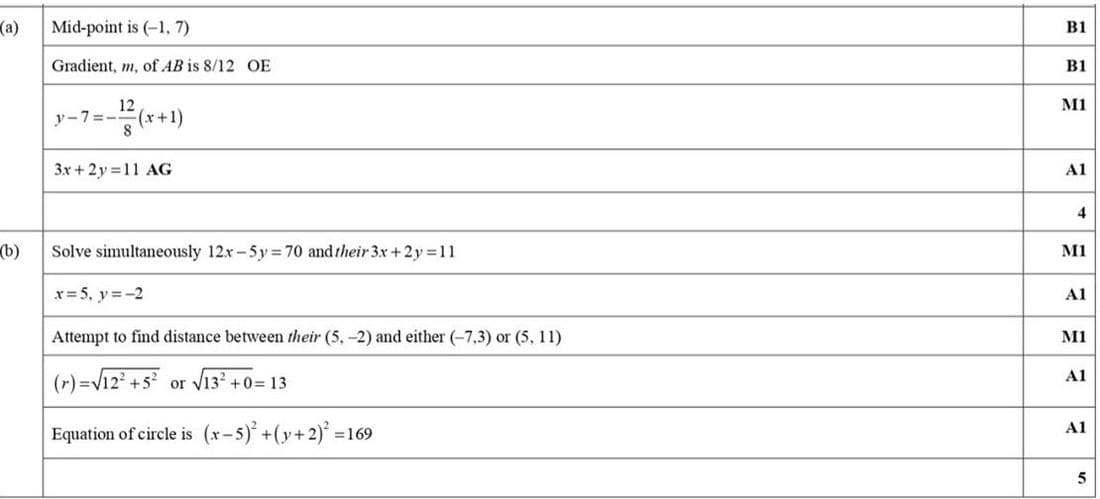
(a) The coordinates of two points A and B are \((-7, 3)\) and \((5, 11)\) respectively. Show that the equation of the perpendicular bisector of \(AB\) is \(3x + 2y = 11\).
(b) A circle passes through \(A\) and \(B\) and its centre lies on the line \(12x - 5y = 70\). Find an equation of the circle.
9709 P12 - Jun 2020 - Q11
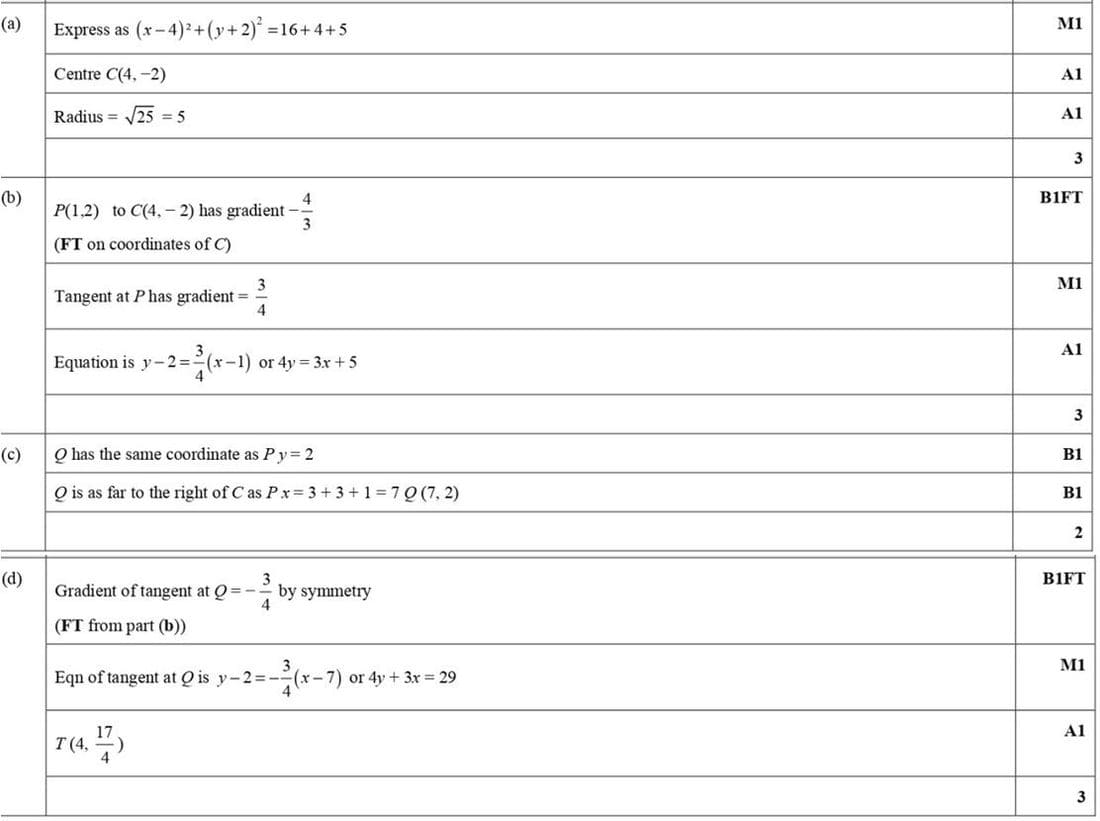
The equation of a circle with centre C is \(x^2 + y^2 - 8x + 4y - 5 = 0\).
(a) Find the radius of the circle and the coordinates of C.
The point P (1, 2) lies on the circle.
(b) Show that the equation of the tangent to the circle at P is \(4y = 3x + 5\).
The point Q also lies on the circle and PQ is parallel to the x-axis.
(c) Write down the coordinates of Q.
The tangents to the circle at P and Q meet at T.
(d) Find the coordinates of T.
9709 P11 - Jun 2020 - Q10
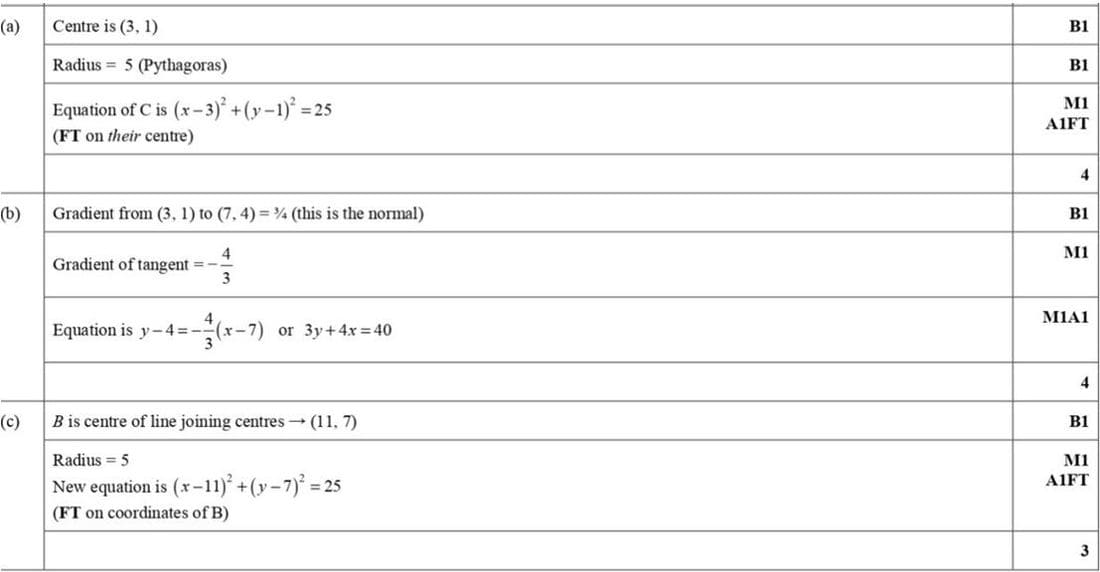
The coordinates of the points A and B are (-1, -2) and (7, 4) respectively.
(a) Find the equation of the circle, C, for which AB is a diameter.
(b) Find the equation of the tangent, T, to circle C at the point B.
(c) Find the equation of the circle which is the reflection of circle C in the line T.
Question #640
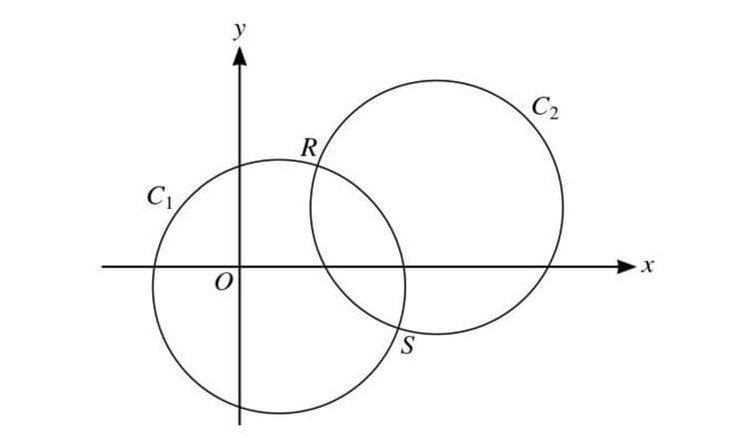
A diameter of a circle \(C_1\) has end-points at \((-3, -5)\) and \((7, 3)\).
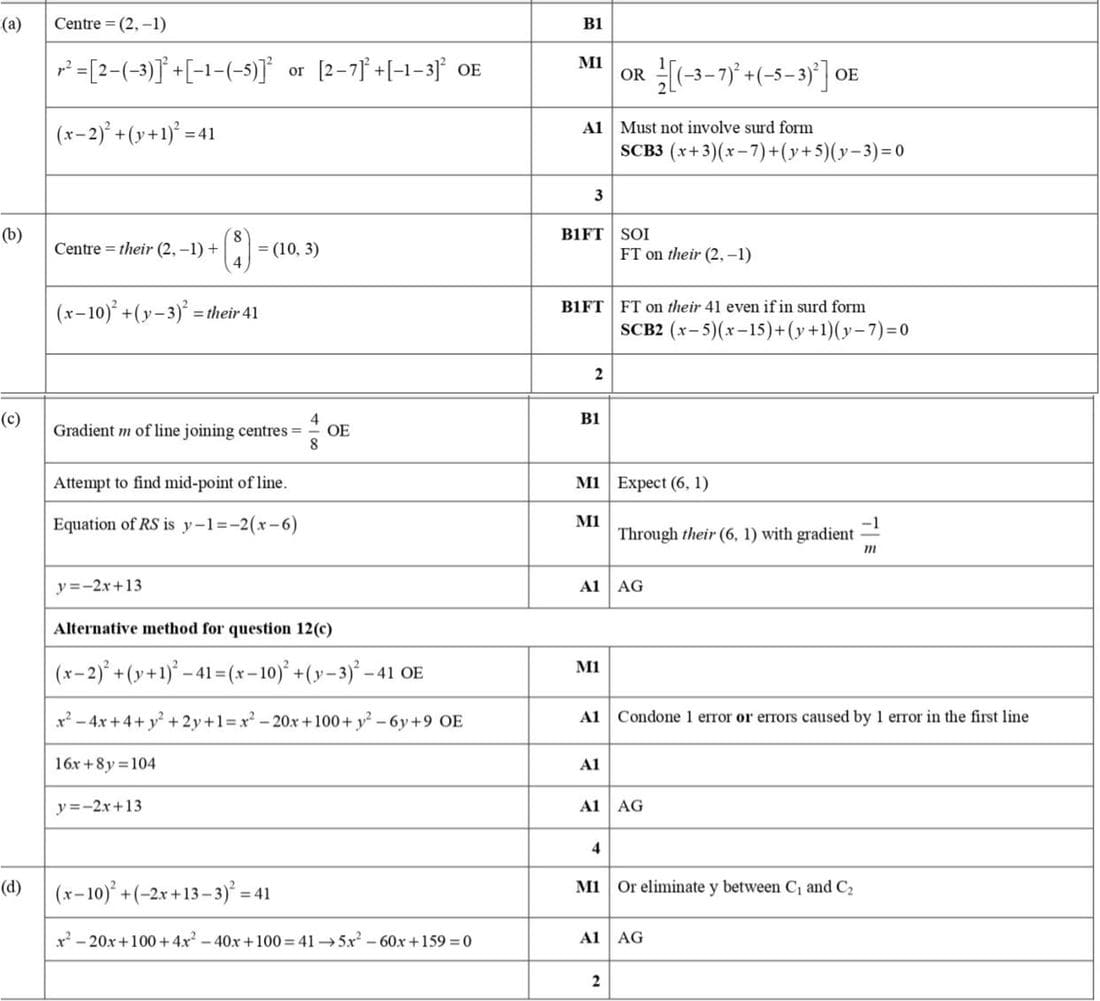
(a) Find an equation of the circle \(C_1\).
The circle \(C_1\) is translated by \(\begin{pmatrix} 8 \\ 4 \end{pmatrix}\) to give circle \(C_2\), as shown in the diagram.
(b) Find an equation of the circle \(C_2\).
The two circles intersect at points \(R\) and \(S\).
(c) Show that the equation of the line \(RS\) is \(y = -2x + 13\).
(d) Hence show that the \(x\)-coordinates of \(R\) and \(S\) satisfy the equation \(5x^2 - 60x + 159 = 0\).
9709 P11 - Nov 2023 - Q11
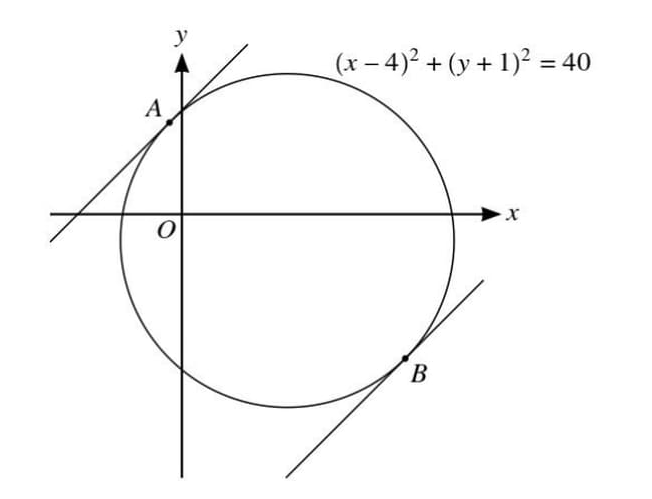
The diagram shows the circle with equation \((x-4)^2 + (y+1)^2 = 40\). Parallel tangents, each with gradient 1, touch the circle at points \(A\) and \(B\).
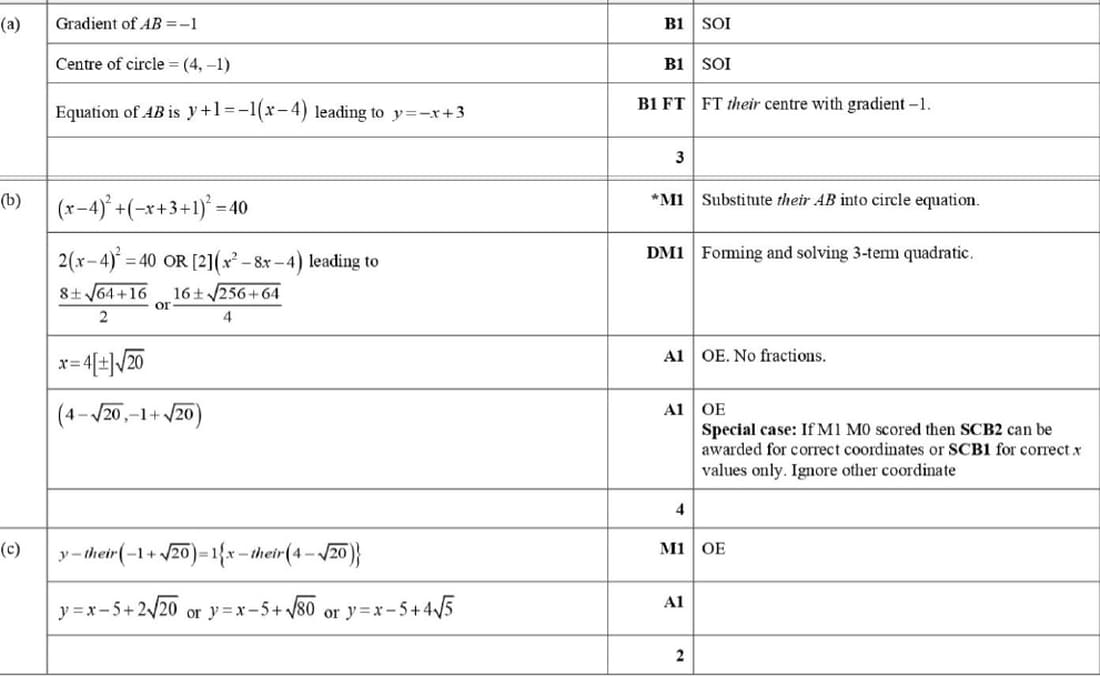
(a) Find the equation of the line \(AB\), giving the answer in the form \(y = mx + c\).
(b) Find the coordinates of \(A\), giving each coordinate in surd form.
(c) Find the equation of the tangent at \(A\), giving the answer in the form \(y = mx + c\), where \(c\) is in surd form.
9709 P13 - Jun 2023 - Q5
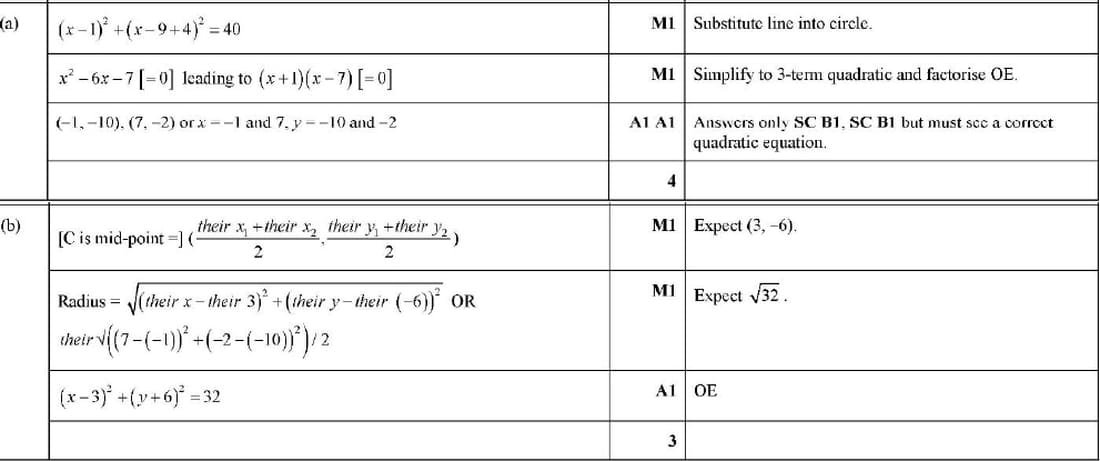
A circle has equation \((x - 1)^2 + (y + 4)^2 = 40\). A line with equation \(y = x - 9\) intersects the circle at points \(A\) and \(B\).
(a) Find the coordinates of the two points of intersection.
(b) Find an equation of the circle with diameter \(AB\).
9709 P12 - Jun 2023 - Q10
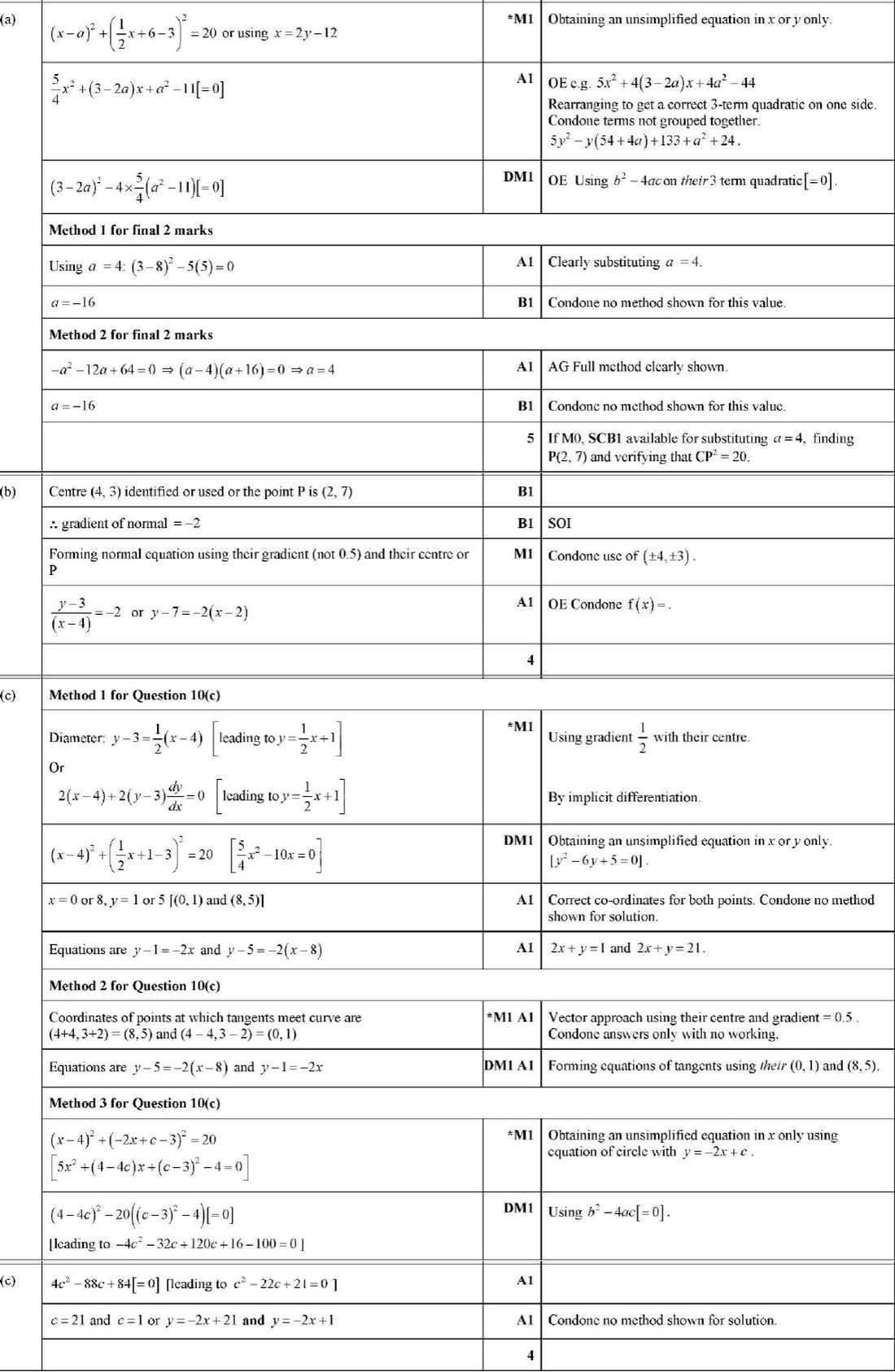
The equation of a circle is \((x-a)^2 + (y-3)^2 = 20\). The line \(y = \frac{1}{2}x + 6\) is a tangent to the circle at the point \(P\).
(a) Show that one possible value of \(a\) is 4 and find the other possible value.
(b) For \(a = 4\), find the equation of the normal to the circle at \(P\).
(c) For \(a = 4\), find the equations of the two tangents to the circle which are parallel to the normal found in (b).