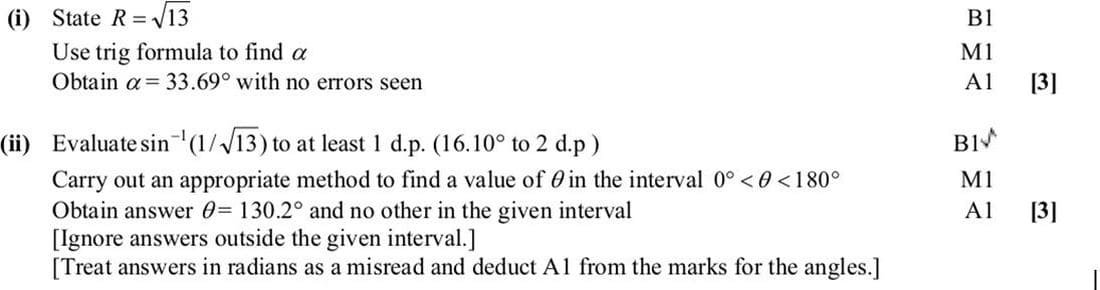
(i) To express \(3 \sin \theta + 2 \cos \theta\) in the form \(R \sin(\theta + \alpha)\), we use the identity:
\(a \sin \theta + b \cos \theta \equiv R \sin(\theta + \alpha)\)
where \(R = \sqrt{a^2 + b^2}\) and \(\tan \alpha = \frac{b}{a}\).
Here, \(a = 3\) and \(b = 2\).
Calculate \(R\):
\(R = \sqrt{3^2 + 2^2} = \sqrt{9 + 4} = \sqrt{13}\)
Calculate \(\alpha\):
\(\tan \alpha = \frac{2}{3}\)
\(\alpha = \tan^{-1}\left(\frac{2}{3}\right) \approx 33.69^\circ\)
(ii) Solve \(3 \sin \theta + 2 \cos \theta = 1\):
Using the expression from part (i):
\(R \sin(\theta + \alpha) = 1\)
\(\sqrt{13} \sin(\theta + 33.69^\circ) = 1\)
\(\sin(\theta + 33.69^\circ) = \frac{1}{\sqrt{13}}\)
\(\theta + 33.69^\circ = \sin^{-1}\left(\frac{1}{\sqrt{13}}\right)\)
\(\sin^{-1}\left(\frac{1}{\sqrt{13}}\right) \approx 16.10^\circ\)
\(\theta + 33.69^\circ = 16.10^\circ\) or \(\theta + 33.69^\circ = 180^\circ - 16.10^\circ\)
\(\theta = 16.10^\circ - 33.69^\circ = -17.59^\circ\) (not in range)
\(\theta = 180^\circ - 16.10^\circ - 33.69^\circ = 130.21^\circ\)
Thus, \(\theta = 130.2^\circ\).