Past Exam Questions
← Back9709 P13 - Jun 2015 - Q7 - 7 marks
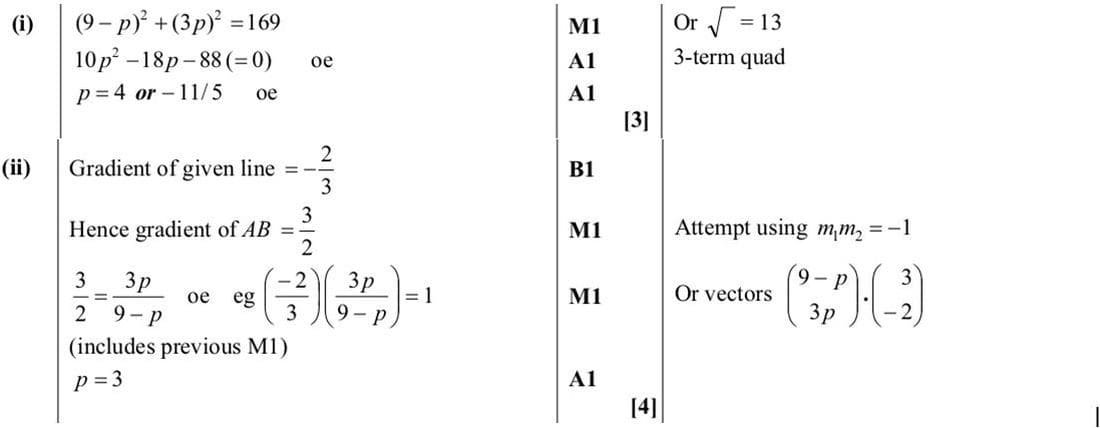
The point A has coordinates \((p, 1)\) and the point B has coordinates \((9, 3p + 1)\), where \(p\) is a constant.
(i) If the distance \(AB\) is 13 units, find the possible values of \(p\).
(ii) If the line with equation \(2x + 3y = 9\) is perpendicular to \(AB\), find the value of \(p\).
9709 P12 - Jun 2015 - Q7 - 7 marks
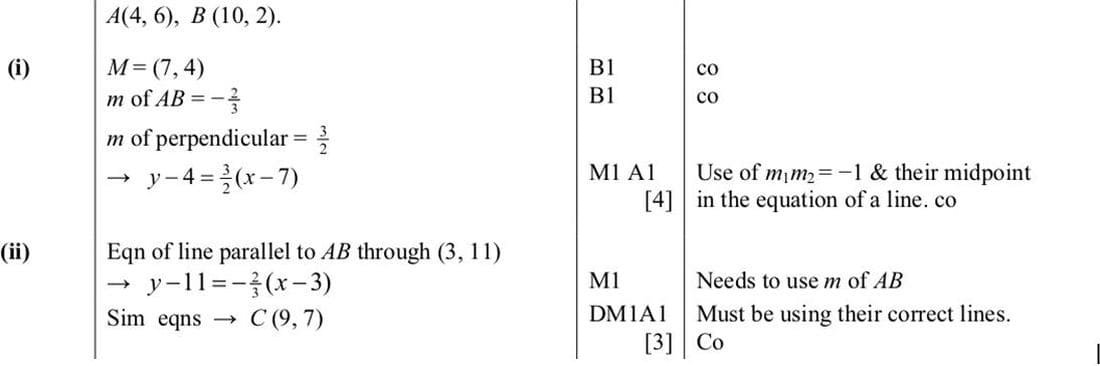
The point C lies on the perpendicular bisector of the line joining the points A (4, 6) and B (10, 2). C also lies on the line parallel to AB through (3, 11).
- Find the equation of the perpendicular bisector of AB.
- Calculate the coordinates of C.
9709 P11 - Jun 2015 - Q6 - 7 marks
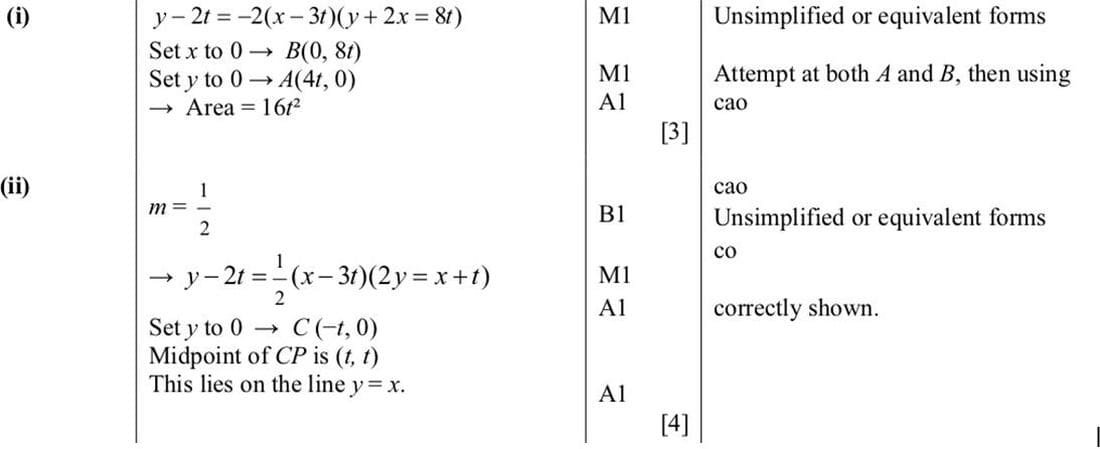
The line with gradient \(-2\) passing through the point \(P(3t, 2t)\) intersects the \(x\)-axis at \(A\) and the \(y\)-axis at \(B\).
- Find the area of triangle \(AOB\) in terms of \(t\).
- The line through \(P\) perpendicular to \(AB\) intersects the \(x\)-axis at \(C\). Show that the midpoint of \(PC\) lies on the line \(y = x\).
9709 P13 - Nov 2014 - Q6 - 7 marks
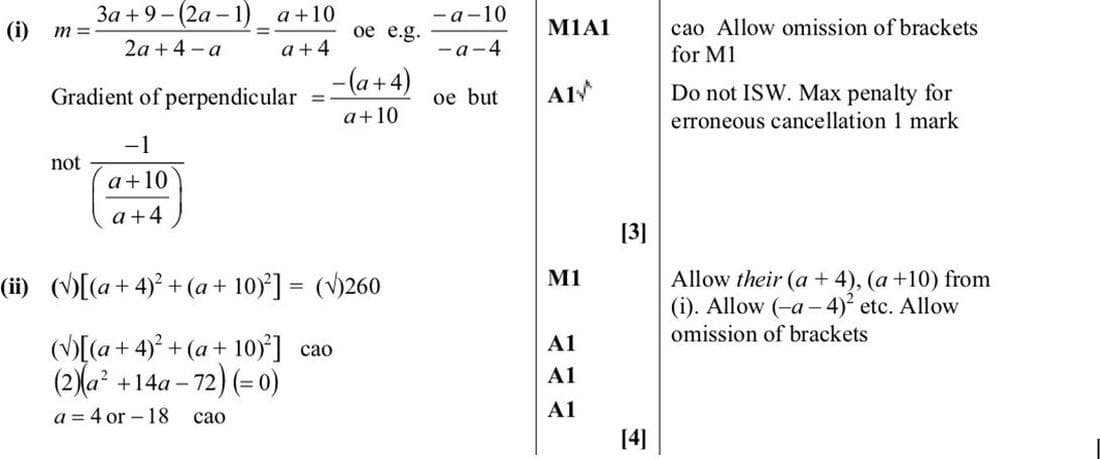
Point A is at \((a, 2a - 1)\) and point B is at \((2a + 4, 3a + 9)\), where \(a\) is a constant.
- Find, in terms of \(a\), the gradient of a line perpendicular to \(AB\).
- Given that the distance \(AB\) is \(\sqrt{260}\), find the possible values of \(a\).
9709 P11 - Nov 2014 - Q4 - 5 marks
The line 4x + ky = 20 passes through the points A (8, -4) and B (b, 2b), where k and b are constants.
- Find the values of k and b.
- Find the coordinates of the mid-point of AB.

9709 P12 - Jun 2014 - Q1 - 5 marks
Determine the coordinates where the perpendicular bisector of the line segment connecting the points (2, 7) and (10, 3) intersects the x-axis.

9709 P11 - Jun 2014 - Q7 - 6 marks
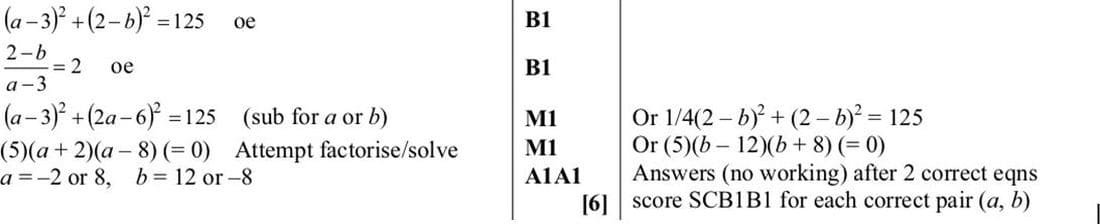
The coordinates of points A and B are \((a, 2)\) and \((3, b)\) respectively, where \(a\) and \(b\) are constants. The distance \(AB\) is \(\sqrt{125}\) units and the gradient of the line \(AB\) is 2. Find the possible values of \(a\) and \(b\).
9709 P12 - Nov 2019 - Q2 - 4 marks
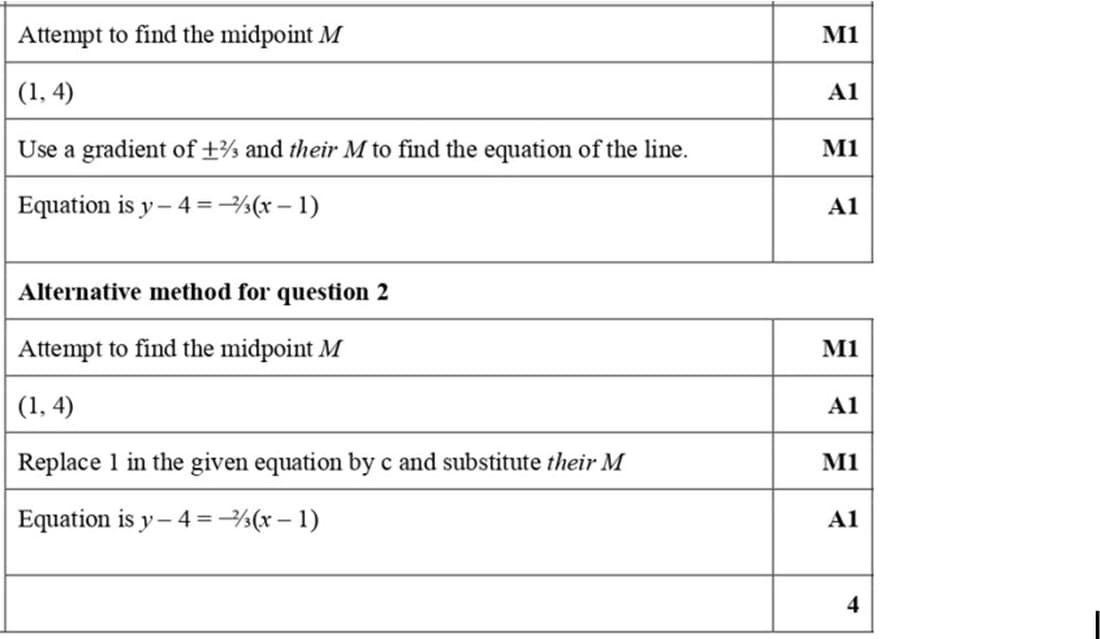
Point M is the midpoint of the line segment joining the points (3, 7) and (-1, 1). Find the equation of the line passing through M that is parallel to the line \(\frac{x}{3} + \frac{y}{2} = 1\).
9709 P13 - Nov 2013 - Q3 - 5 marks
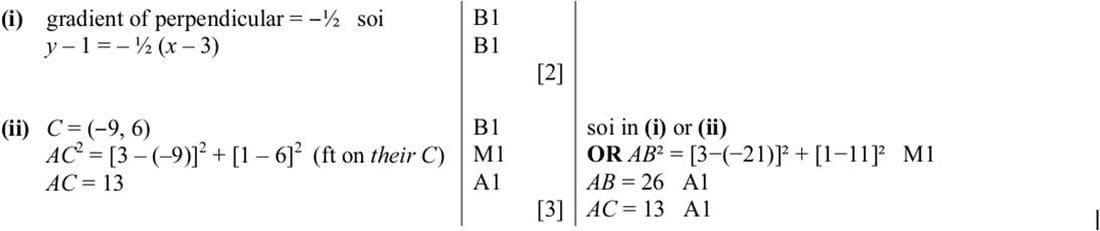
The point A has coordinates (3, 1) and the point B has coordinates (-21, 11). The point C is the midpoint of AB.
- Find the equation of the line through A that is perpendicular to y = 2x - 7.
- Find the distance AC.
9709 P11 - Nov 2013 - Q7 - 9 marks
The point A has coordinates (-1, 6) and the point B has coordinates (7, 2).
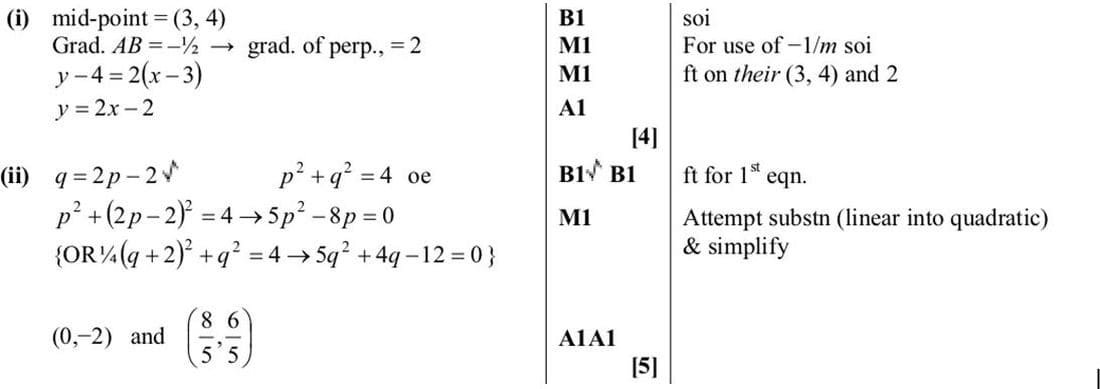
(i) Find the equation of the perpendicular bisector of AB, giving your answer in the form y = mx + c.
(ii) A point C on the perpendicular bisector has coordinates (p, q). The distance OC is 2 units, where O is the origin. Write down two equations involving p and q and hence find the coordinates of the possible positions of C.
9709 P12 - Jun 2013 - Q7 - 7 marks
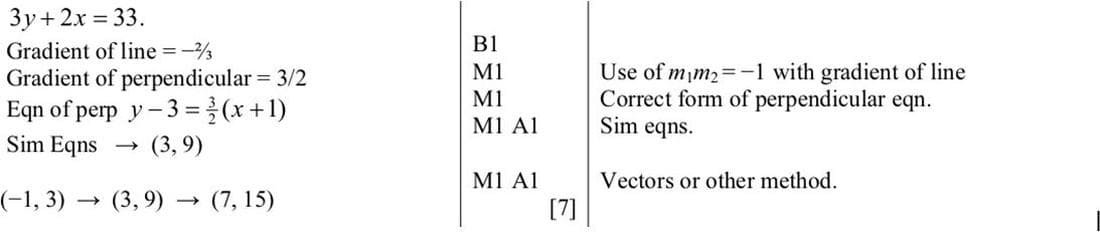
Find the coordinates of the reflection of the point (-1, 3) across the line 3y + 2x = 33.
9709 P11 - Jun 2013 - Q7I - 4 marks
A curve is given by the equation \(y = x^2 - 4x + 4\) and a line by the equation \(y = mx\), where \(m\) is a constant. For \(m = 1\), the curve and the line intersect at points \(A\) and \(B\). Find the coordinates of the midpoint of \(AB\).

9709 P13 - Jun 2012 - Q10I - 6 marks
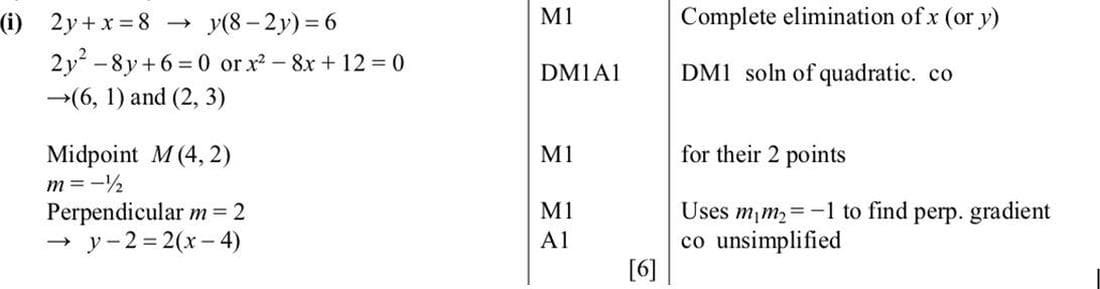
The equation of a line is \(2y + x = k\), where \(k\) is a constant, and the equation of a curve is \(xy = 6\). In the case where \(k = 8\), the line intersects the curve at the points \(A\) and \(B\). Find the equation of the perpendicular bisector of the line \(AB\).
9709 P12 - Jun 2012 - Q4 - 6 marks
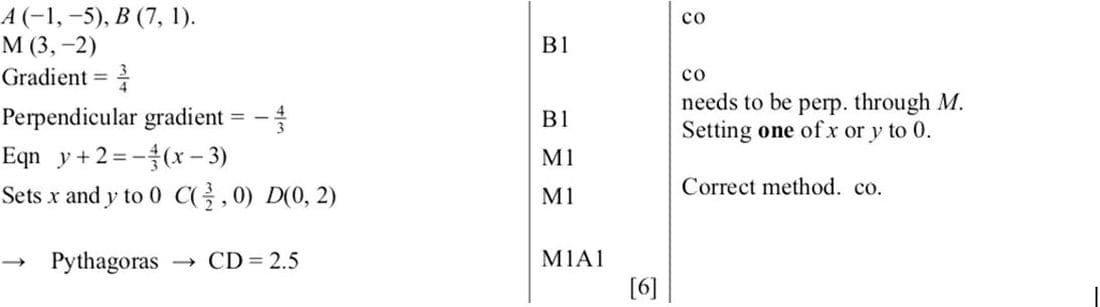
The point A has coordinates (-1, -5) and the point B has coordinates (7, 1). The perpendicular bisector of AB meets the x-axis at C and the y-axis at D. Calculate the length of CD.
9709 P11 - Jun 2012 - Q9 - 9 marks
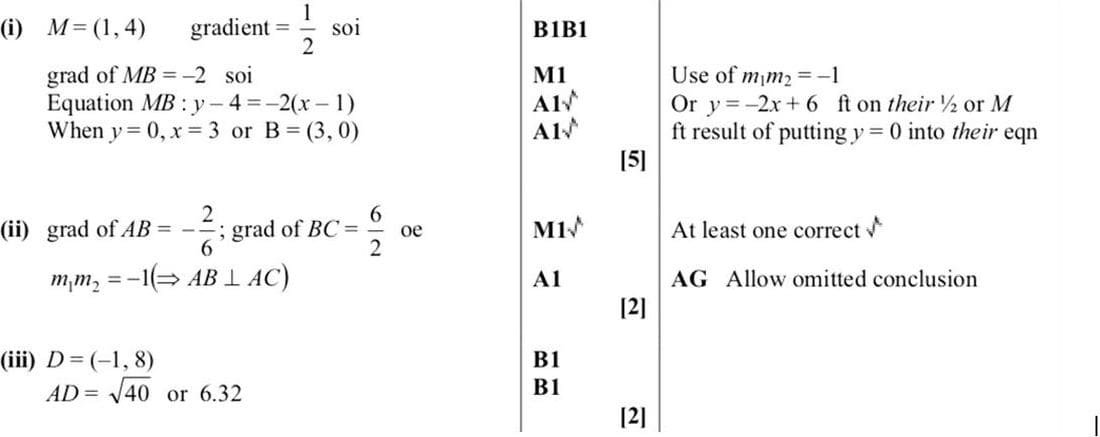
The coordinates of point A are (-3, 2) and the coordinates of point C are (5, 6). The midpoint of AC is M, and the perpendicular bisector of AC intersects the x-axis at B.
- Find the equation of MB and the coordinates of B.
- Show that AB is perpendicular to BC.
- Given that ABCD is a square, find the coordinates of D and the length of AD.
9709 P11 - Nov 2011 - Q9I - 5 marks
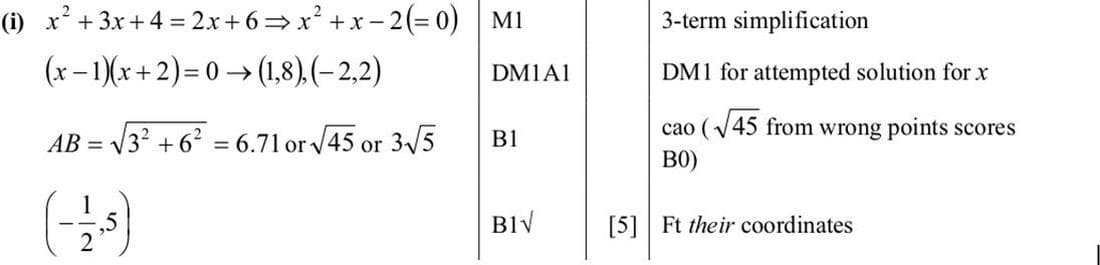
A line has the equation \(y = kx + 6\) and a curve has the equation \(y = x^2 + 3x + 2k\), where \(k\) is a constant. For the case where \(k = 2\), the line and the curve intersect at points \(A\) and \(B\). Find the distance \(AB\) and the coordinates of the midpoint of \(AB\).
9709 P13 - Jun 2011 - Q3 - 5 marks
The line \(\frac{x}{a} + \frac{y}{b} = 1\), where \(a\) and \(b\) are positive constants, meets the x-axis at \(P\) and the y-axis at \(Q\). Given that \(PQ = \sqrt{45}\) and that the gradient of the line \(PQ\) is \(-\frac{1}{2}\), find the values of \(a\) and \(b\).

9709 P12 - Jun 2011 - Q7 - 7 marks
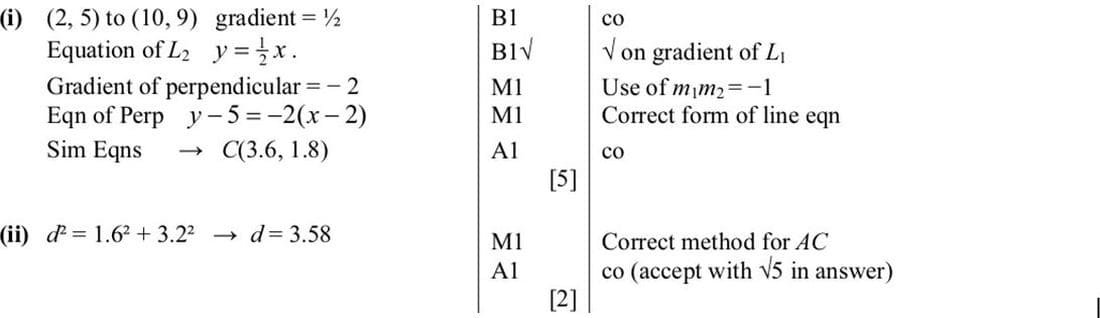
The line \(L_1\) passes through the points \(A(2, 5)\) and \(B(10, 9)\). The line \(L_2\) is parallel to \(L_1\) and passes through the origin. The point \(C\) lies on \(L_2\) such that \(AC\) is perpendicular to \(L_2\). Find:
- the coordinates of \(C\),
- the distance \(AC\).
9709 P13 - Jun 2019 - Q7 - 10 marks
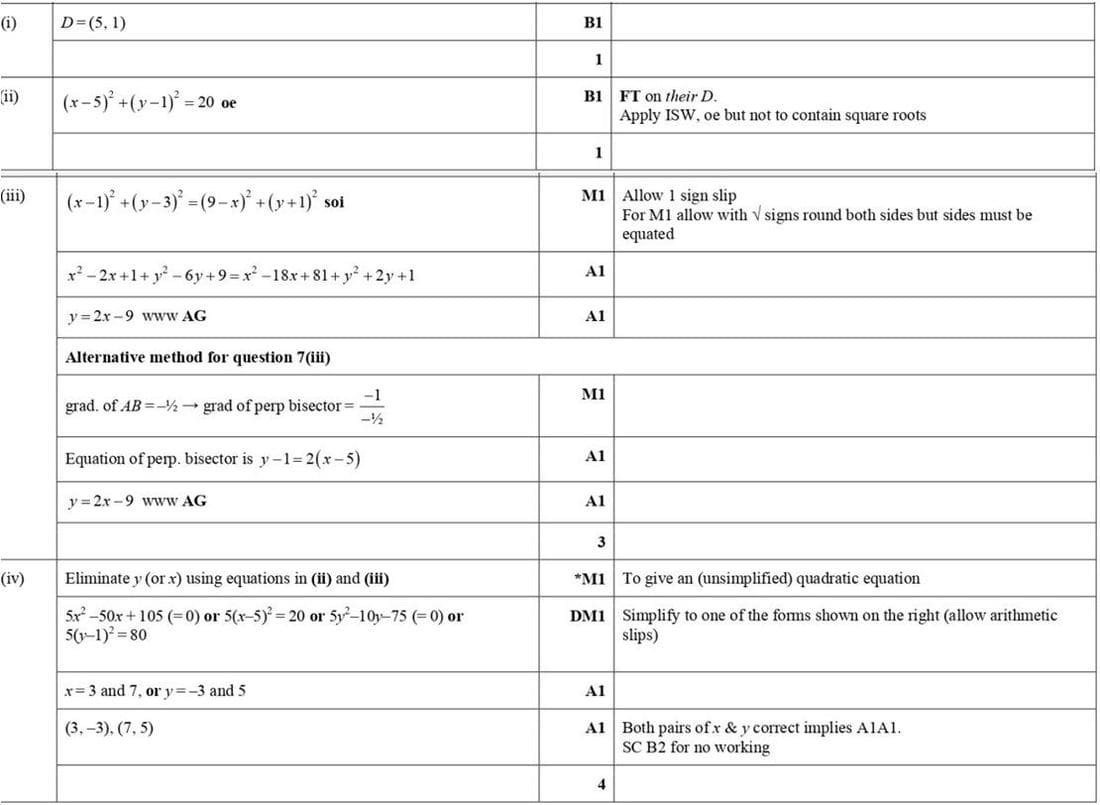
The coordinates of two points A and B are (1, 3) and (9, -1) respectively, and D is the midpoint of AB. A point C has coordinates (x, y), where x and y are variables.
- State the coordinates of D.
- Given that CD2 = 20, write an equation relating x and y.
- Given that AC and BC are equal in length, find an equation relating x and y and show that it can be simplified to y = 2x - 9.
- Using the results from parts (ii) and (iii), find the possible coordinates of C.
9709 P11 - Jun 2011 - Q10 - 6 marks
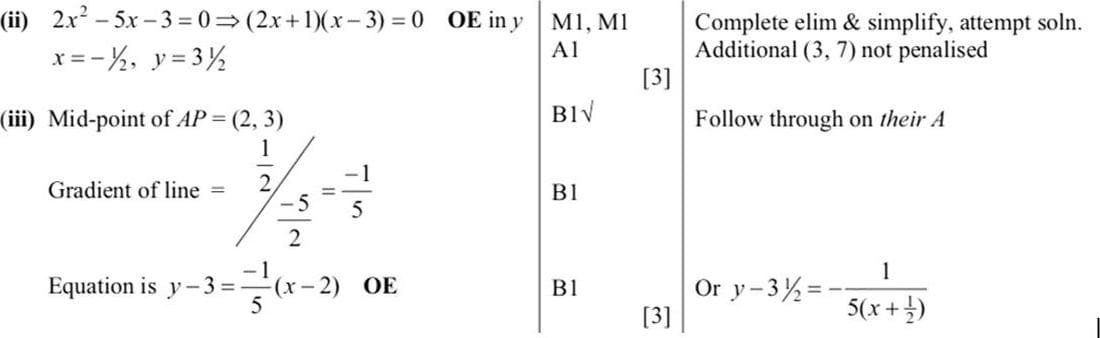
The line \(x - y + 4 = 0\) intersects the curve \(y = 2x^2 - 4x + 1\) at points \(P\) and \(Q\). It is given that the coordinates of \(P\) are \((3, 7)\).
(ii) Find the coordinates of \(Q\).
(iii) Find the equation of the line joining \(Q\) to the mid-point of \(AP\).