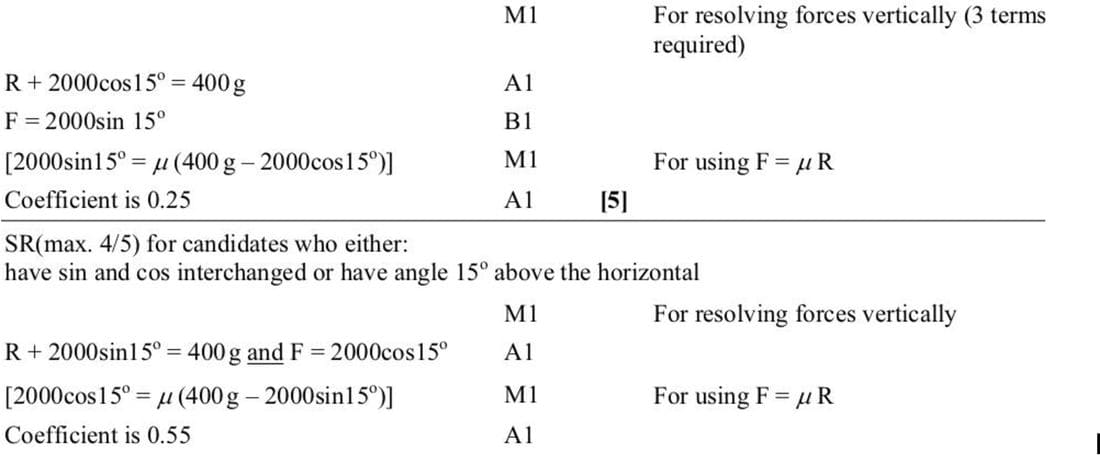
To find the coefficient of friction, we resolve the forces vertically and horizontally.
Vertically, the normal reaction force is given by:
\(R + 2000 \cos 15^{\circ} = 400g\)
where \(g\) is the acceleration due to gravity \((9.8 \text{ m/s}^2)\).
Horizontally, the frictional force \(F\) is:
\(F = 2000 \sin 15^{\circ}\)
In limiting equilibrium, the frictional force \(F\) is equal to \(\mu R\), where \(\mu\) is the coefficient of friction:
\(2000 \sin 15^{\circ} = \mu (400g - 2000 \cos 15^{\circ})\)
Solving for \(\mu\):
\(\mu = \frac{2000 \sin 15^{\circ}}{400g - 2000 \cos 15^{\circ}}\)
Substitute \(g = 9.8 \text{ m/s}^2\):
\(\mu = \frac{2000 \times 0.2588}{400 \times 9.8 - 2000 \times 0.9659}\)
\(\mu = \frac{517.6}{3920 - 1931.8}\)
\(\mu = \frac{517.6}{1988.2}\)
\(\mu \approx 0.26\)
Rounding to 2 significant figures, the coefficient of friction is \(0.25\).