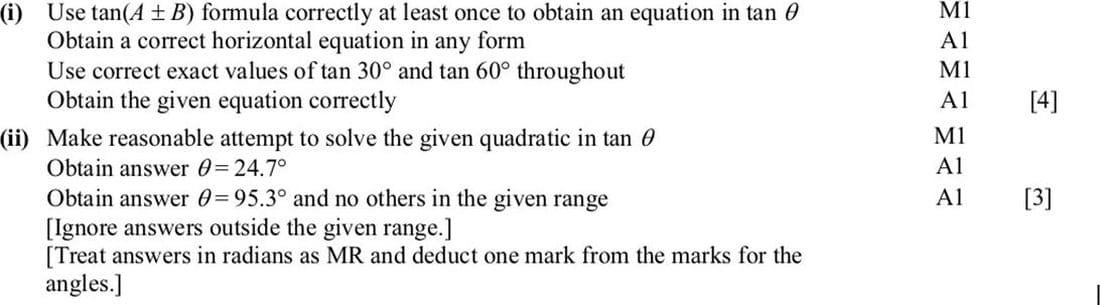
(i) Use the tangent addition and subtraction formulas:
\(\tan(A + B) = \frac{\tan A + \tan B}{1 - \tan A \tan B}\)
\(\tan(A - B) = \frac{\tan A - \tan B}{1 + \tan A \tan B}\)
Substitute \(A = 30^\circ\), \(B = \theta\), and \(A = 60^\circ\), \(B = \theta\):
\(\tan(30^\circ + \theta) = \frac{\tan 30^\circ + \tan \theta}{1 - \tan 30^\circ \tan \theta}\)
\(\tan(60^\circ - \theta) = \frac{\tan 60^\circ - \tan \theta}{1 + \tan 60^\circ \tan \theta}\)
Given \(\tan 30^\circ = \frac{1}{\sqrt{3}}\) and \(\tan 60^\circ = \sqrt{3}\), substitute these values:
\(\frac{\frac{1}{\sqrt{3}} + \tan \theta}{1 - \frac{1}{\sqrt{3}} \tan \theta} = 2 \times \frac{\sqrt{3} - \tan \theta}{1 + \sqrt{3} \tan \theta}\)
Cross-multiply and simplify:
\((\sqrt{3} + \tan \theta)(1 + \sqrt{3} \tan \theta) = 2(\sqrt{3} - \tan \theta)(1 - \frac{1}{\sqrt{3}} \tan \theta)\)
After simplification, you obtain:
\(\tan^2 \theta + 6\sqrt{3} \tan \theta - 5 = 0\)
(ii) Solve the quadratic equation:
\(\tan^2 \theta + 6\sqrt{3} \tan \theta - 5 = 0\)
Using the quadratic formula \(x = \frac{-b \pm \sqrt{b^2 - 4ac}}{2a}\), where \(a = 1\), \(b = 6\sqrt{3}\), \(c = -5\):
\(\tan \theta = \frac{-6\sqrt{3} \pm \sqrt{(6\sqrt{3})^2 - 4 \times 1 \times (-5)}}{2 \times 1}\)
\(\tan \theta = \frac{-6\sqrt{3} \pm \sqrt{108 + 20}}{2}\)
\(\tan \theta = \frac{-6\sqrt{3} \pm \sqrt{128}}{2}\)
\(\tan \theta = \frac{-6\sqrt{3} \pm 8\sqrt{2}}{2}\)
Calculate \(\theta\) for \(0^\circ \leq \theta \leq 180^\circ\):
\(\theta = 24.7^\circ\) and \(\theta = 95.3^\circ\).