9709 P12 - Mar 2018 - Q9 - 8 marks
79
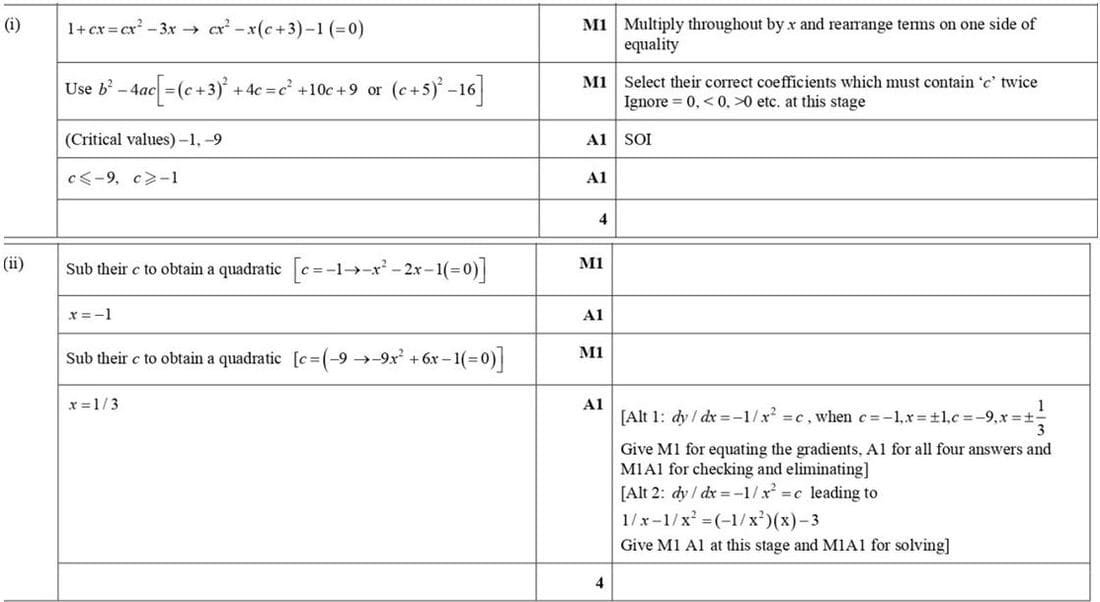
A curve is defined by the equation \(y = \frac{1}{x} + c\) and a line is defined by the equation \(y = cx - 3\), where \(c\) is a constant.
(i) Determine the set of values of \(c\) for which the curve and the line intersect.
(ii) The line is tangent to the curve for two specific values of \(c\). For each of these values, find the \(x\)-coordinate of the point where the tangent touches the curve.