Past Exam Questions
← Back9709 P41 - Nov 2018 - Q5
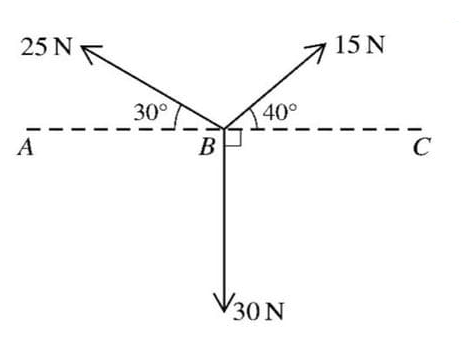
Coplanar forces, of magnitudes 15 N, 25 N and 30 N, act at a point B on the line ABC in the directions shown in the diagram.
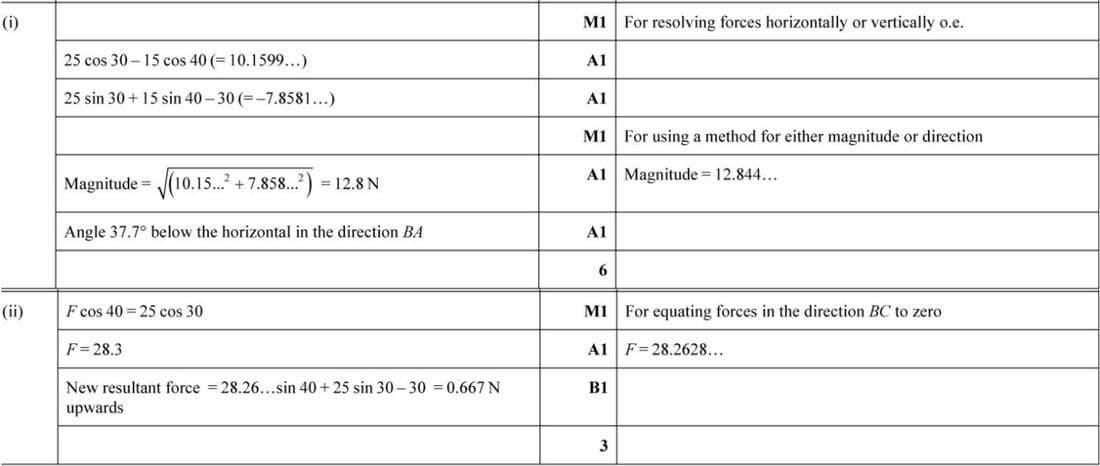
- Find the magnitude and direction of the resultant force.
- The force of magnitude 15 N is now replaced by a force of magnitude F N acting in the same direction. The new resultant force has zero component in the direction BC. Find the value of F, and find also the magnitude and direction of the new resultant force.
9709 P43 - Nov 2017 - Q1
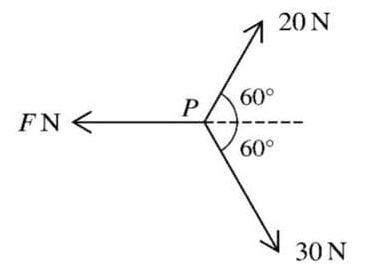
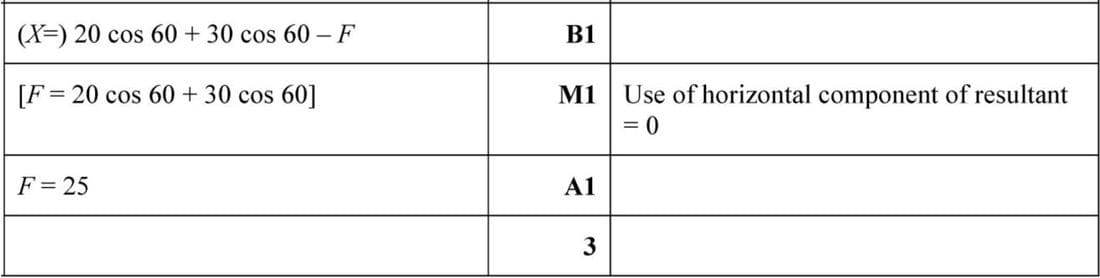
Three coplanar forces of magnitudes \(F \text{ N}\), \(20 \text{ N}\) and \(30 \text{ N}\) act at a point \(P\), as shown in the diagram. The resultant of the three forces acts in a direction perpendicular to the force of magnitude \(F \text{ N}\). Find the value of \(F\).
9709 P41 - Nov 2017 - Q6
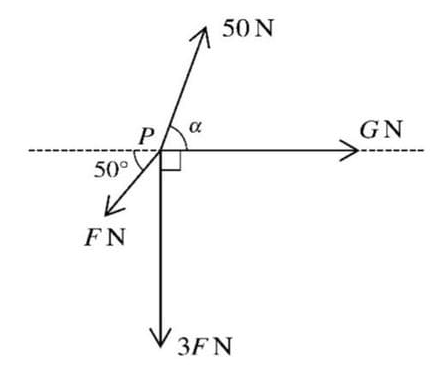
Coplanar forces, of magnitudes \(F \text{ N}, 3F \text{ N}, G \text{ N}\) and \(50 \text{ N}\), act at a point \(P\), as shown in the diagram.
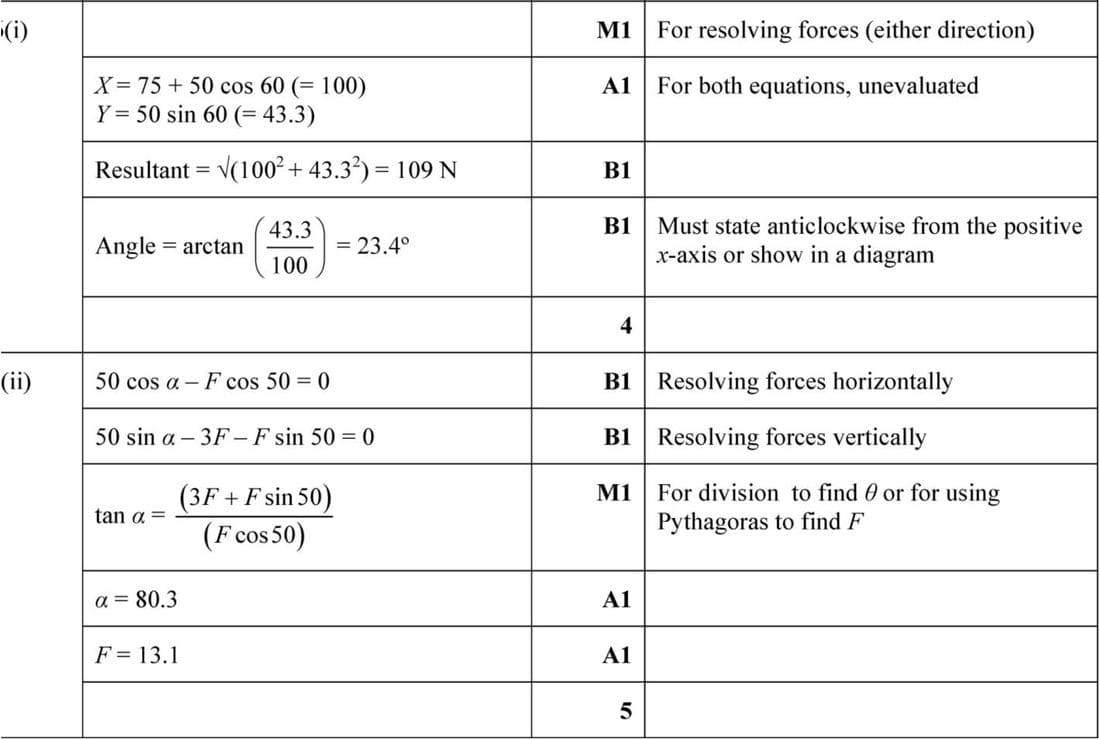
(i) Given that \(F = 0, G = 75\) and \(\alpha = 60^\circ\), find the magnitude and direction of the resultant force. [4]
(ii) Given instead that \(G = 0\) and the forces are in equilibrium, find the values of \(F\) and \(\alpha\). [5]
9709 P42 - Nov 2016 - Q3
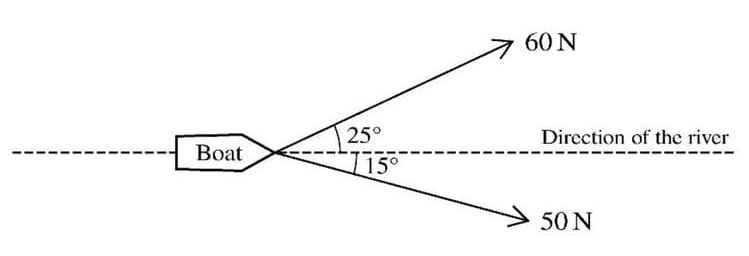
A boat is being pulled along a river by two people. One of the people walks along a path on one side of the river and the other person walks along a path on the opposite side of the river. The first person exerts a horizontal force of 60 N at an angle of 25° to the direction of the river. The second person exerts a horizontal force of 50 N at an angle of 15° to the direction of the river (see diagram).
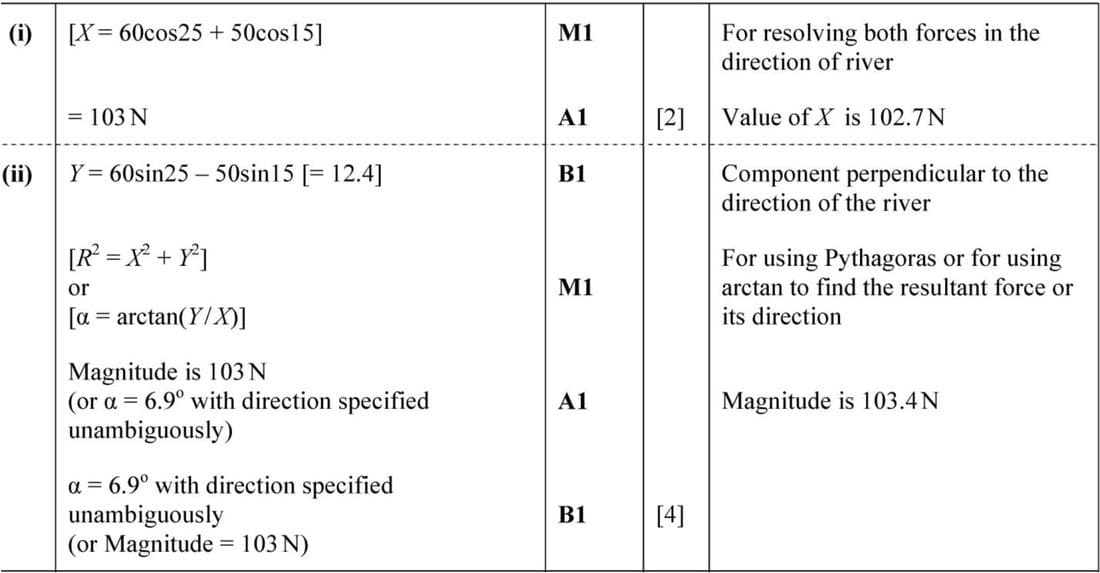
(i) Find the total force exerted by the two people in the direction of the river.
(ii) Find the magnitude and direction of the resultant force exerted by the two people.
9709 P42 - Jun 2016 - Q1
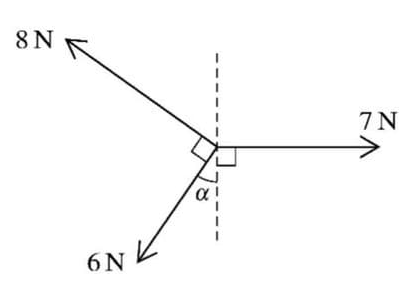
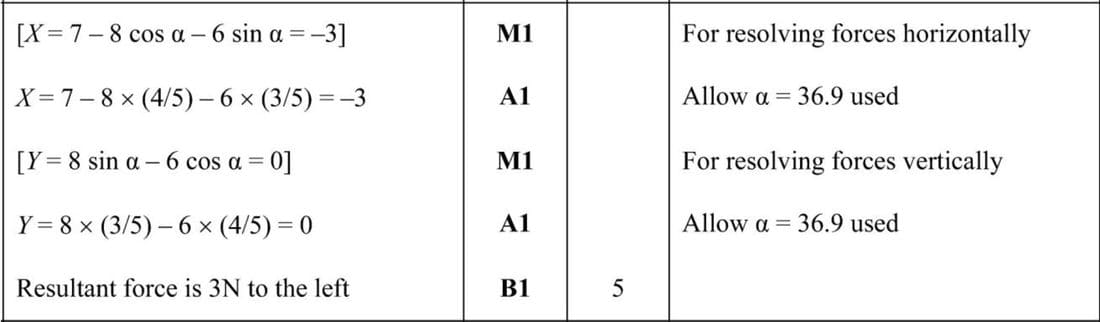
Coplanar forces of magnitudes 7 N, 6 N, and 8 N act at a point in the directions shown in the diagram. Given that \(\sin \alpha = \frac{3}{5}\), find the magnitude and direction of the resultant of the three forces.
9709 P42 - Mar 2016 - Q3
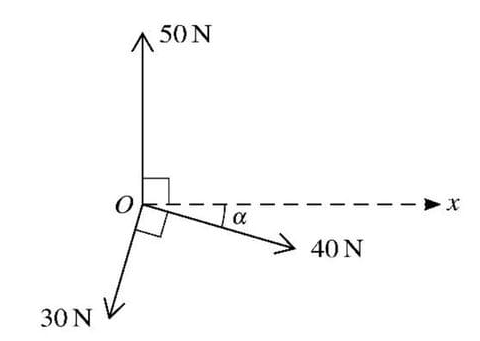
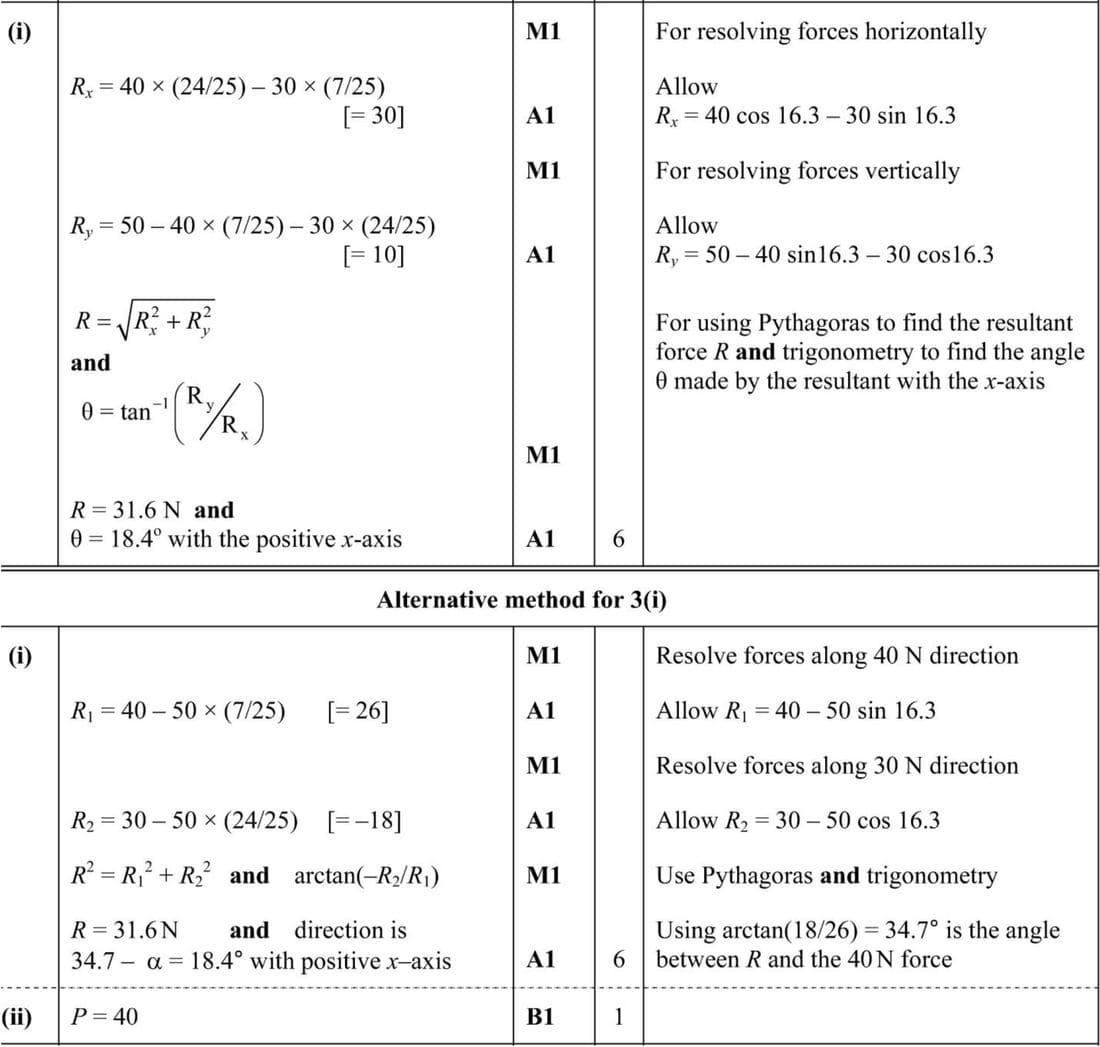
Coplanar forces of magnitudes 50 N, 40 N, and 30 N act at a point O in the directions shown in the diagram, where \(\tan \alpha = \frac{7}{24}\).
(i) Find the magnitude and direction of the resultant of the three forces.
(ii) The force of magnitude 50 N is replaced by a force of magnitude \(P\) N acting in the same direction. The resultant of the three forces now acts in the positive \(x\)-direction. Find the value of \(P\).
9709 P43 - Nov 2015 - Q3
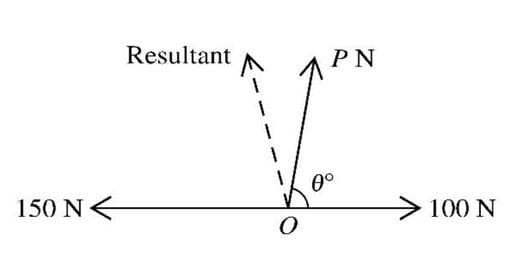
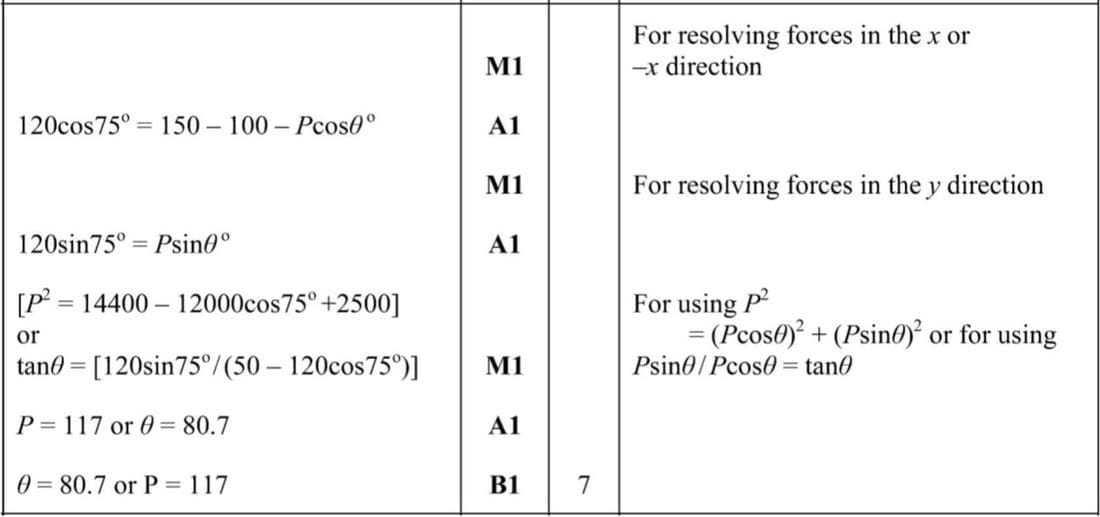
Three horizontal forces of magnitudes 150 N, 100 N, and \(P\) N have directions as shown in the diagram. The resultant of the three forces is shown by the broken line in the diagram. This resultant has magnitude 120 N and makes an angle 75° with the 150 N force. Find the values of \(P\) and \(\theta\).
9709 P43 - Jun 2015 - Q5
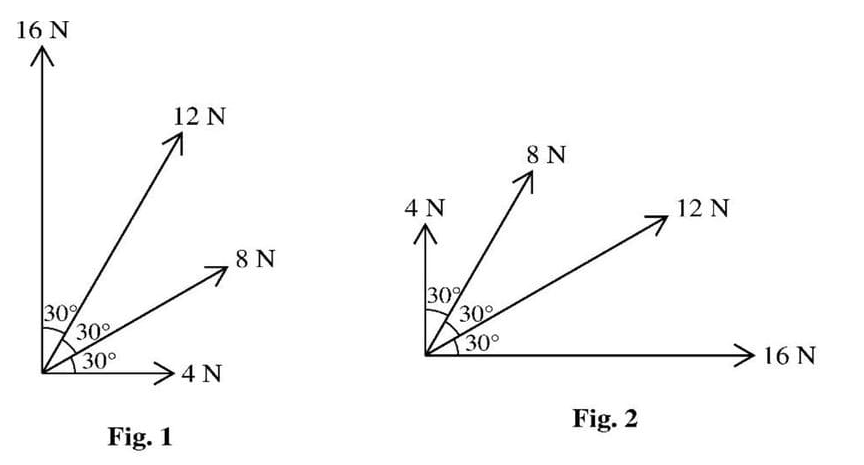
Four coplanar forces of magnitudes 4 N, 8 N, 12 N, and 16 N act at a point. The directions in which the forces act are shown in Fig. 1.
(i) Find the magnitude and direction of the resultant of the four forces.
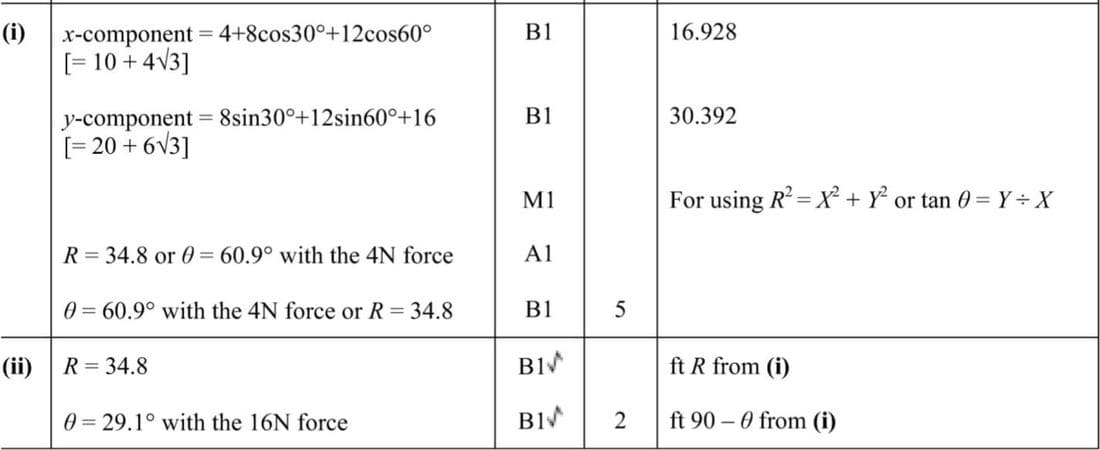
The forces of magnitudes 4 N and 16 N exchange their directions and the forces of magnitudes 8 N and 12 N also exchange their directions (see Fig. 2).
(ii) State the magnitude and direction of the resultant of the four forces in Fig. 2.
9709 P41 - Jun 2014 - Q3
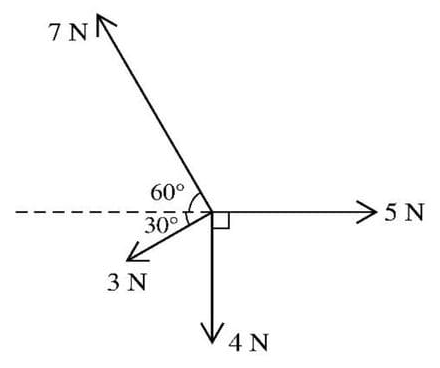
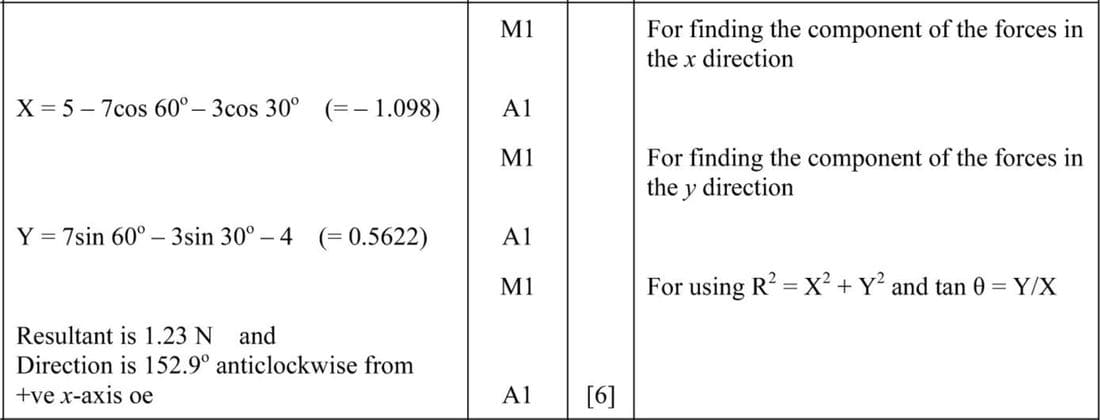
Four coplanar forces act at a point. The magnitudes of the forces are 5 N, 4 N, 3 N, and 7 N, and the directions in which the forces act are shown in the diagram. Find the magnitude and direction of the resultant of the four forces.
9709 P42 - Nov 2014 - Q2
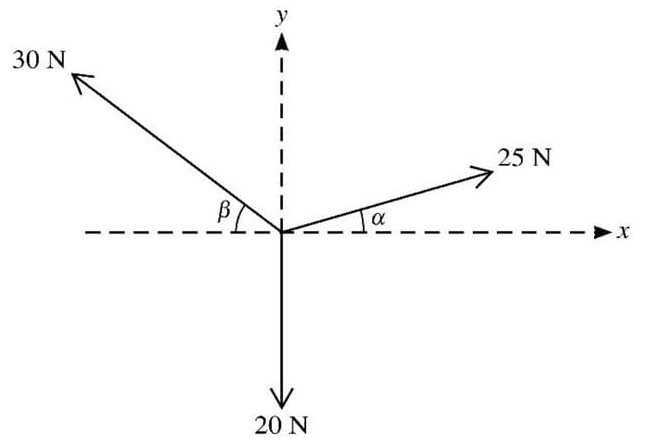
Three coplanar forces act at a point. The magnitudes of the forces are 20 N, 25 N, and 30 N, and the directions in which the forces act are as shown in the diagram, where \(\sin \alpha = 0.28\) and \(\cos \alpha = 0.96\), and \(\sin \beta = 0.6\) and \(\cos \beta = 0.8\).
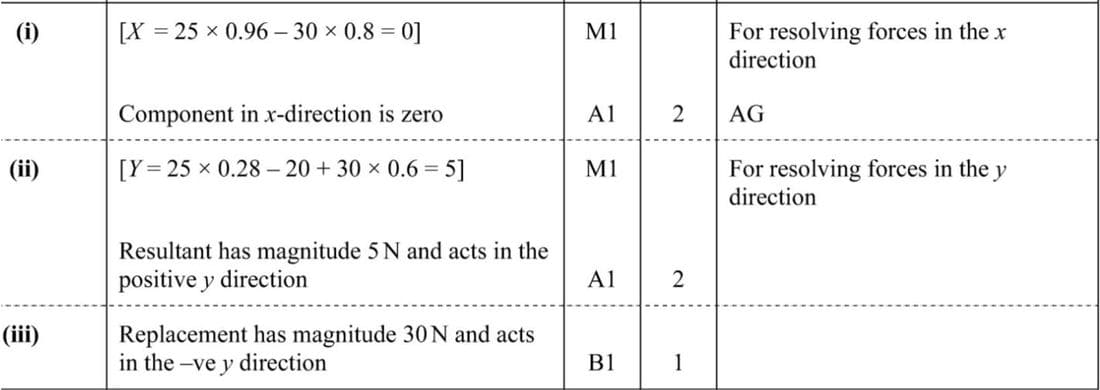
(i) Show that the resultant of the three forces has a zero component in the \(x\)-direction.
(ii) Find the magnitude and direction of the resultant of the three forces.
(iii) The force of magnitude 20 N is replaced by another force. The effect is that the resultant force is unchanged in magnitude but reversed in direction. State the magnitude and direction of the replacement force.
9709 P42 - Jun 2022 - Q2
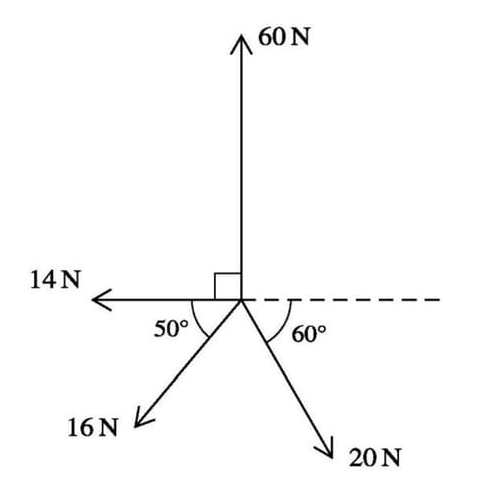
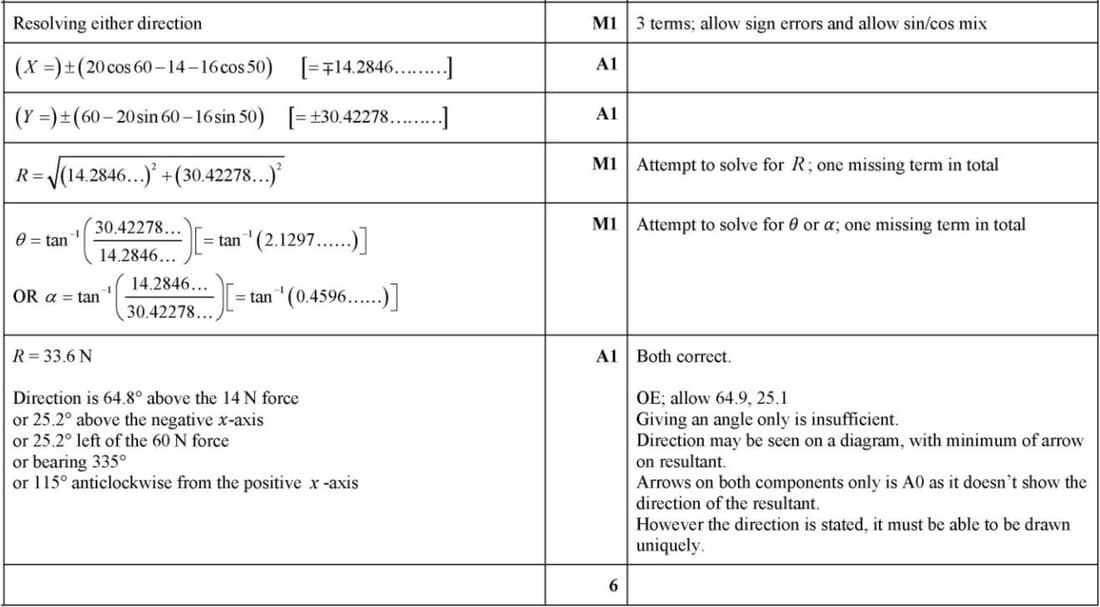
Coplanar forces of magnitudes 60 N, 20 N, 16 N, and 14 N act at a point in the directions shown in the diagram. Find the magnitude and direction of the resultant force.
9709 P42 - Nov 2012 - Q4
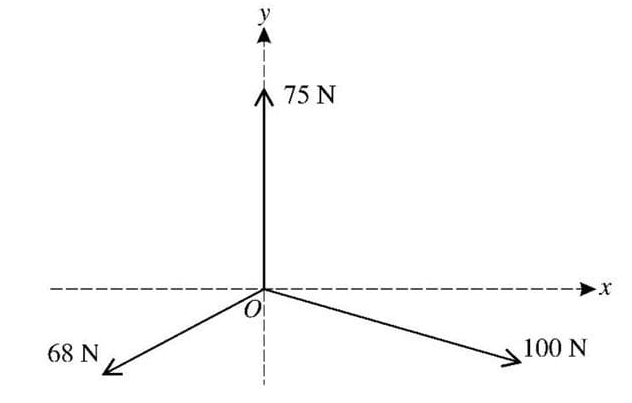
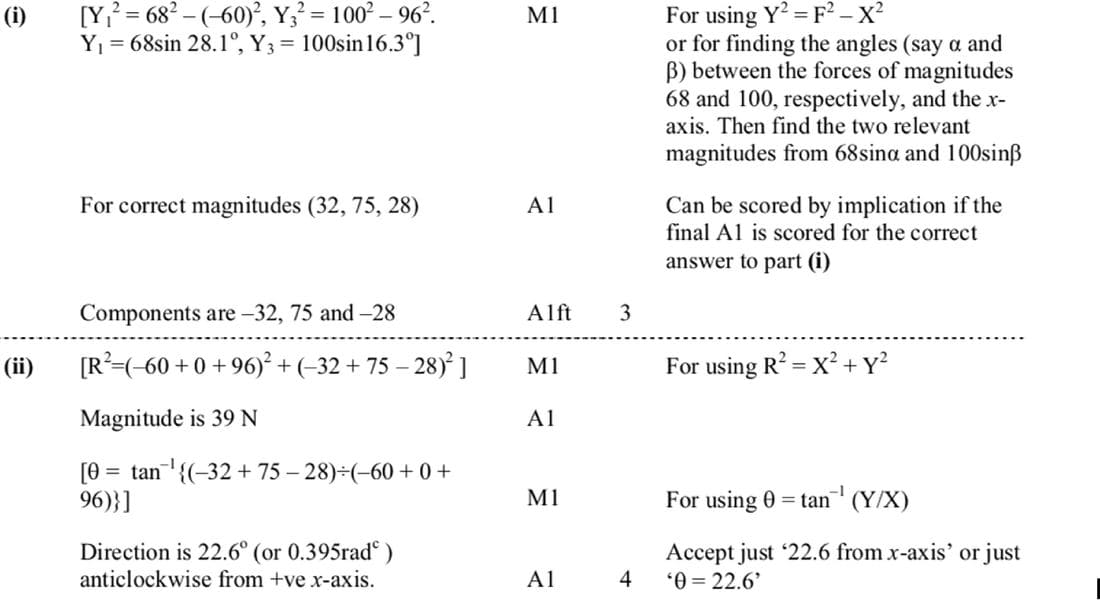
Three coplanar forces of magnitudes 68 N, 75 N, and 100 N act at an origin O, as shown in the diagram. The components of the three forces in the positive x-direction are -60 N, 0 N, and 96 N, respectively. Find
- the components of the three forces in the positive y-direction,
- the magnitude and direction of the resultant of the three forces.
9709 P41 - Nov 2012 - Q4
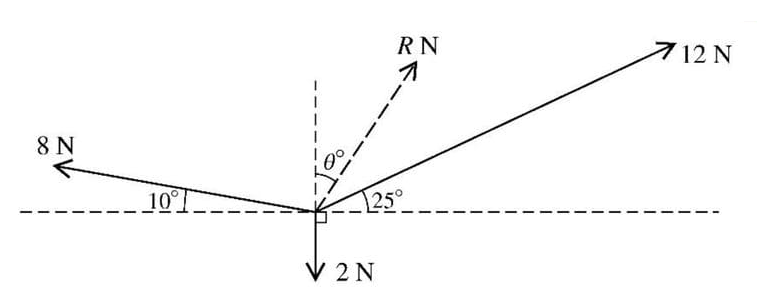
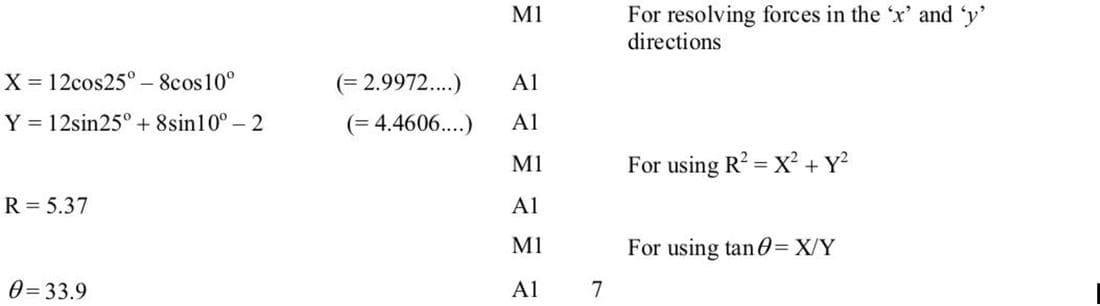
Three coplanar forces of magnitudes 8 N, 12 N, and 2 N act at a point. The resultant of the forces has magnitude \(R\) N. The directions of the three forces and the resultant are shown in the diagram. Find \(R\) and \(\theta\).
9709 P41 - Jun 2012 - Q2
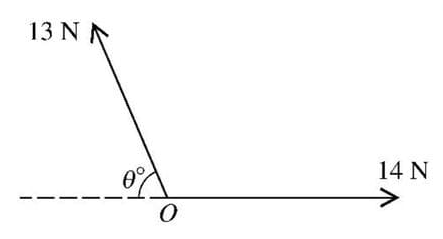
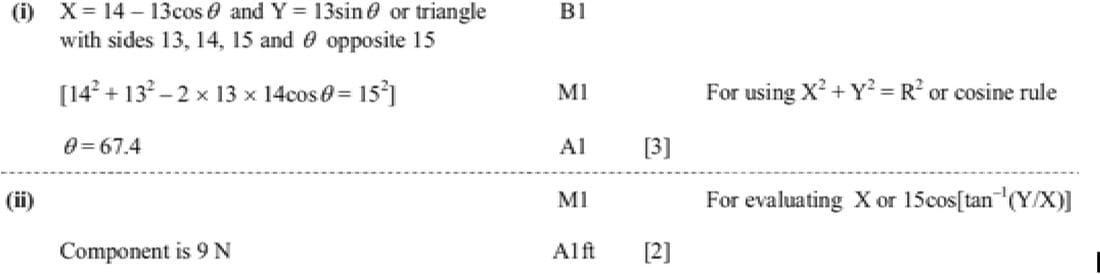
Forces of magnitudes 13 N and 14 N act at a point O in the directions shown in the diagram. The resultant of these forces has magnitude 15 N. Find
- the value of \(\theta\),
- the component of the resultant in the direction of the force of magnitude 14 N.
9709 P43 - Nov 2011 - Q2
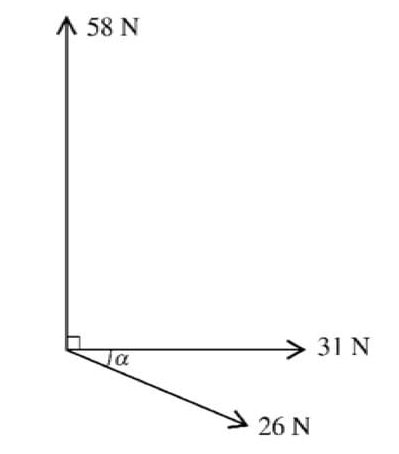
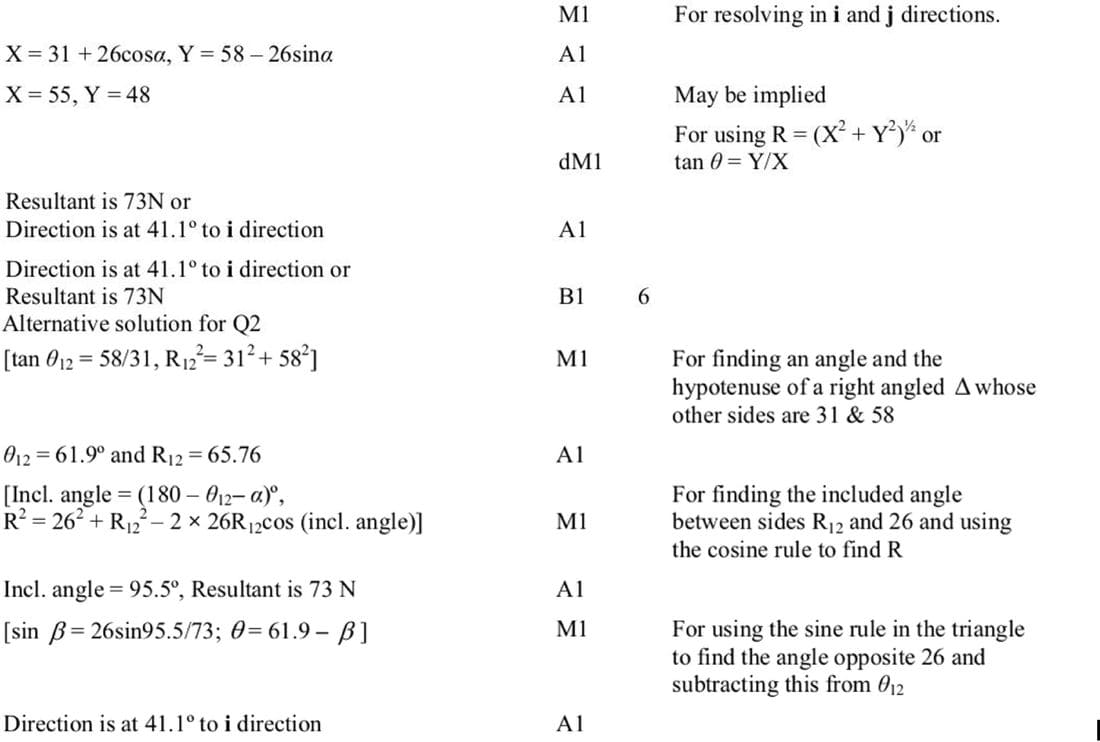
Coplanar forces of magnitudes 58 N, 31 N, and 26 N act at a point in the directions shown in the diagram. Given that \(\tan \alpha = \frac{5}{12}\), find the magnitude and direction of the resultant of the three forces.
9709 P41 - Nov 2011 - Q3
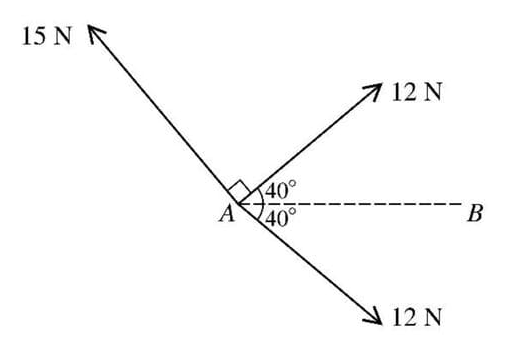
Three coplanar forces of magnitudes 15 N, 12 N, and 12 N act at a point A in directions as shown in the diagram.
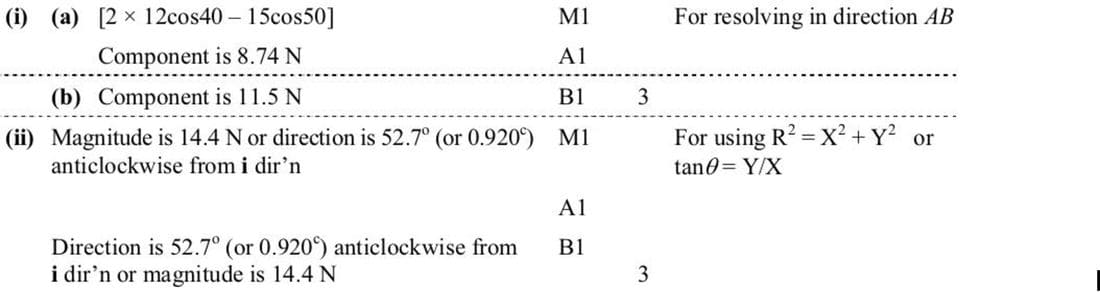
(i) Find the component of the resultant of the three forces
- in the direction of AB,
- perpendicular to AB.
(ii) Hence find the magnitude and direction of the resultant of the three forces.
9709 P42 - Jun 2011 - Q4
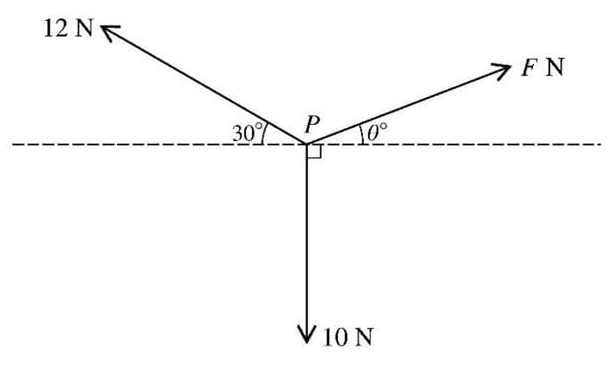
The three coplanar forces shown in the diagram act at a point P and are in equilibrium.
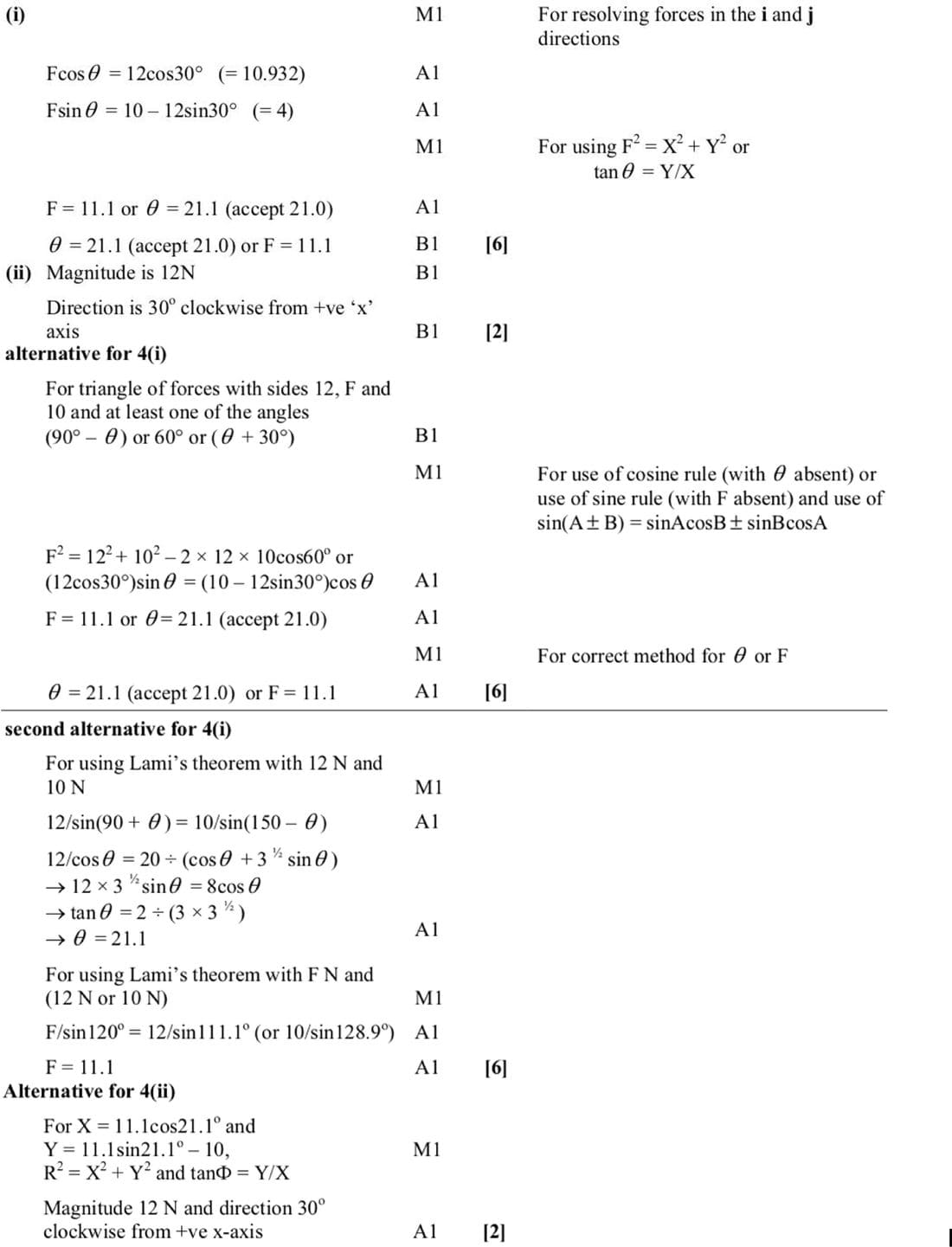
- Find the values of F and \(\theta\).
- State the magnitude and direction of the resultant force at P when the force of magnitude 12 N is removed.
9709 P43 - Nov 2010 - Q5
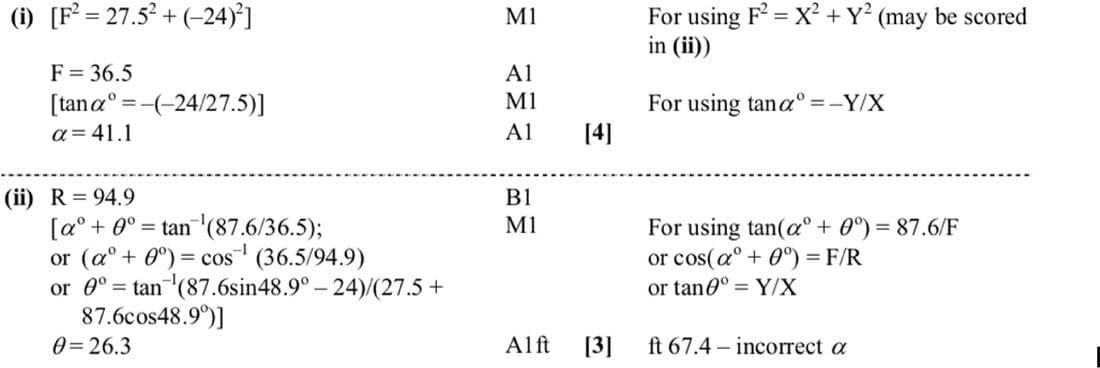
A force of magnitude \(F\) N acts in a horizontal plane and has components 27.5 N and \(-24\) N in the \(x\)-direction and the \(y\)-direction respectively. The force acts at an angle of \(\alpha^\circ\) below the \(x\)-axis.
- Find the values of \(F\) and \(\alpha\).
A second force, of magnitude 87.6 N, acts in the same plane at 90° anticlockwise from the force of magnitude \(F\) N. The resultant of the two forces has magnitude \(R\) N and makes an angle of \(\theta^\circ\) with the positive \(x\)-axis.
- Find the values of \(R\) and \(\theta\).
9709 P43 - Jun 2010 - Q1
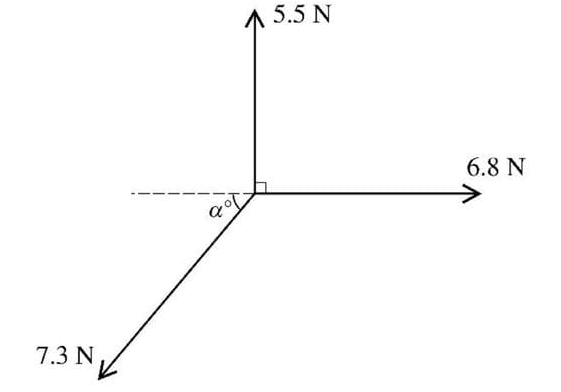
Three coplanar forces act at a point. The magnitudes of the forces are 5.5 N, 6.8 N, and 7.3 N, and the directions in which the forces act are as shown in the diagram. Given that the resultant of the three forces is in the same direction as the force of magnitude 6.8 N, find the value of \(\alpha\) and the magnitude of the resultant.

9709 P41 - Jun 2010 - Q4
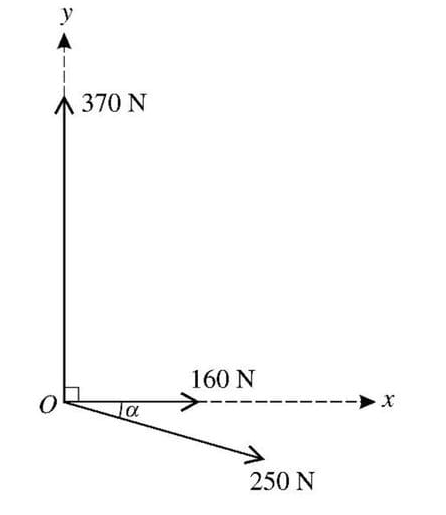
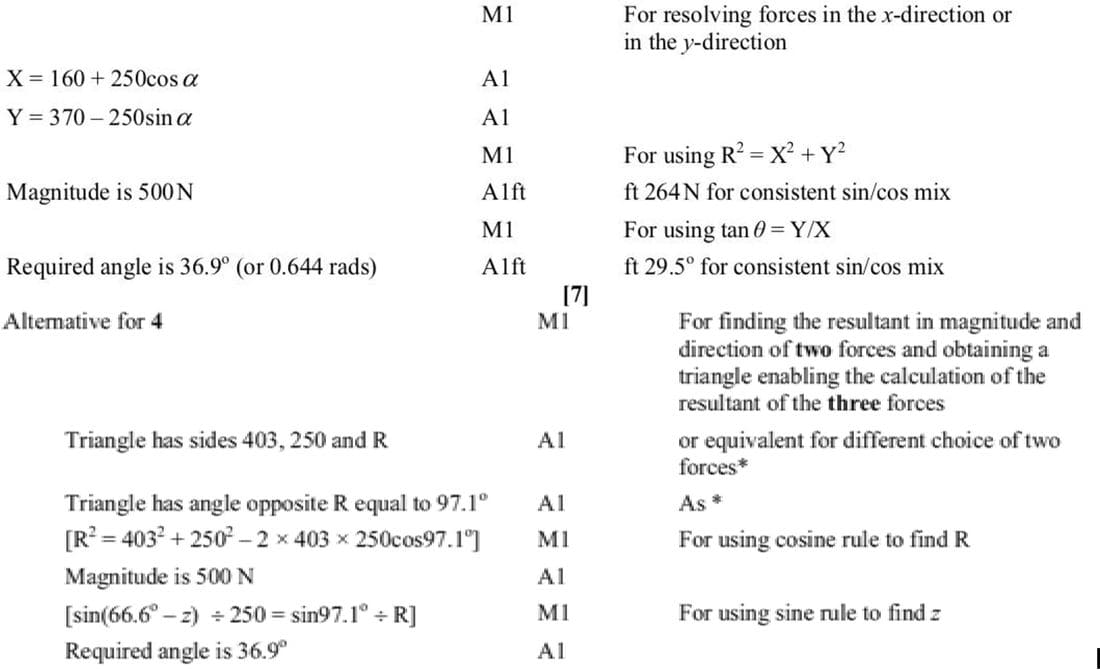
Coplanar forces of magnitudes 250 N, 160 N, and 370 N act at a point O in the directions shown in the diagram, where the angle \(\alpha\) is such that \(\sin \alpha = 0.28\) and \(\cos \alpha = 0.96\). Calculate the magnitude of the resultant of the three forces. Calculate also the angle that the resultant makes with the x-direction.