Browsing as Guest. Progress, bookmarks and attempts are disabled.
Log in to track your work.
0606 P21 - Nov 2024 - Q9 - 6 marks
7247
A curve has equation \(y=x^{2}-8 x+c\), where \(c\) is a constant. (a) Find the value of \(c\) in each of the following cases. (i) The curve crosses the \(x\)-axis at \(x=2\).
(ii) The minimum value of \(y\) is 3 .
(b) Find the range of values of \(c\) for which \(y\) is always greater than 0 .
Use differentiation to find the gradient information needed. Stationary points occur when the derivative is zero, and tangents or normals are found from the gradient at the given point.
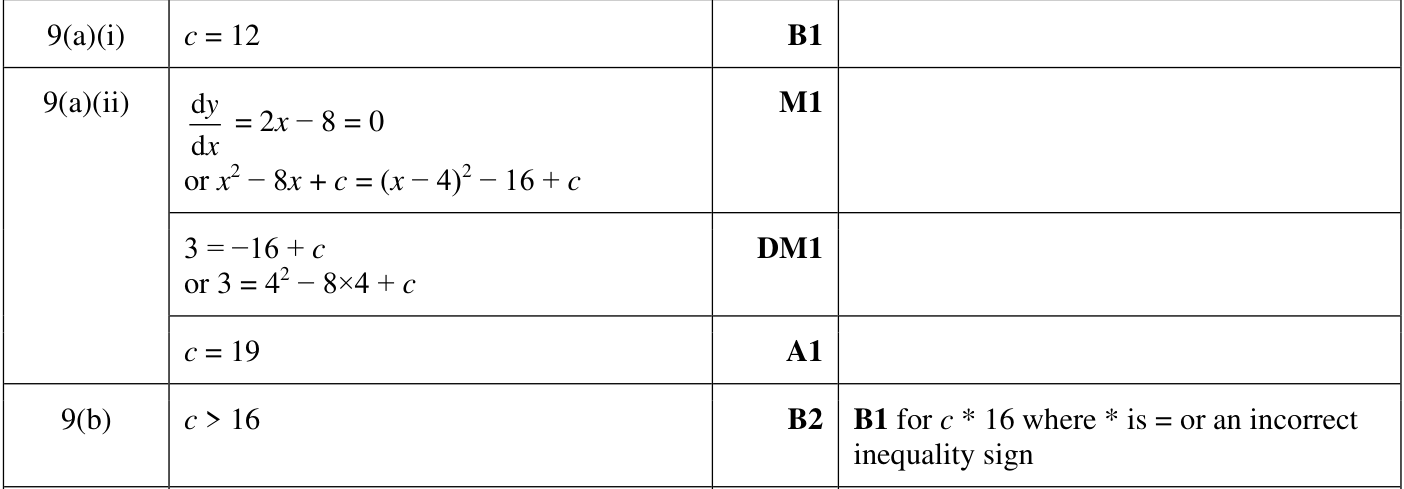
For part (a)(i), the curve crosses the \(x\)-axis at \(x=2\), so \(y=0\) when \(x=2\):
\(0=2^2-8(2)+c=4-16+c.\)
Thus \(c=12\).
For part (a)(ii), complete the square:
\(y=x^2-8x+c=(x-4)^2-16+c.\)
The minimum value is therefore \(c-16\). Given that the minimum value is \(3\),
\(c-16=3\), so \(c=19\).
For \(y\) to be always greater than \(0\), the minimum value must be greater than \(0\):
\(c-16\gt0.\)
Therefore \(c\gt16\).
The result has been obtained using the exact condition from the question, so no additional solutions are introduced.