Browsing as Guest. Progress, bookmarks and attempts are disabled.
Log in to track your work.
9709 P1 - Nov 2002 - Q9
612
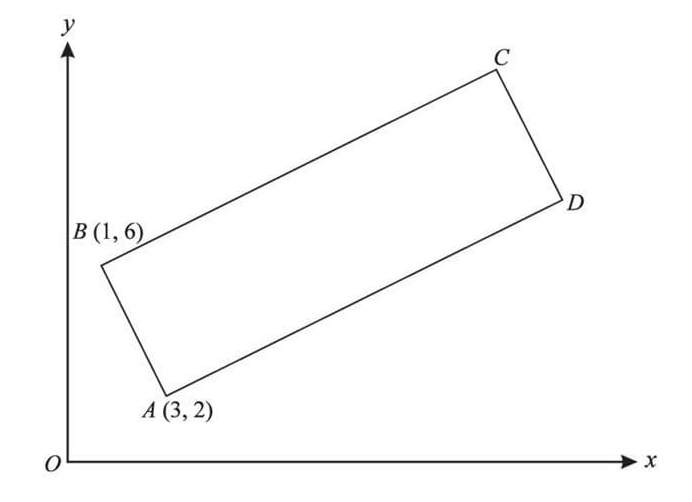
The diagram shows a rectangle ABCD, where A is (3, 2) and B is (1, 6).
Find the equation of BC.
Given that the equation of AC is y = x - 1, find the coordinates of C.
Find the perimeter of the rectangle ABCD.
Solution
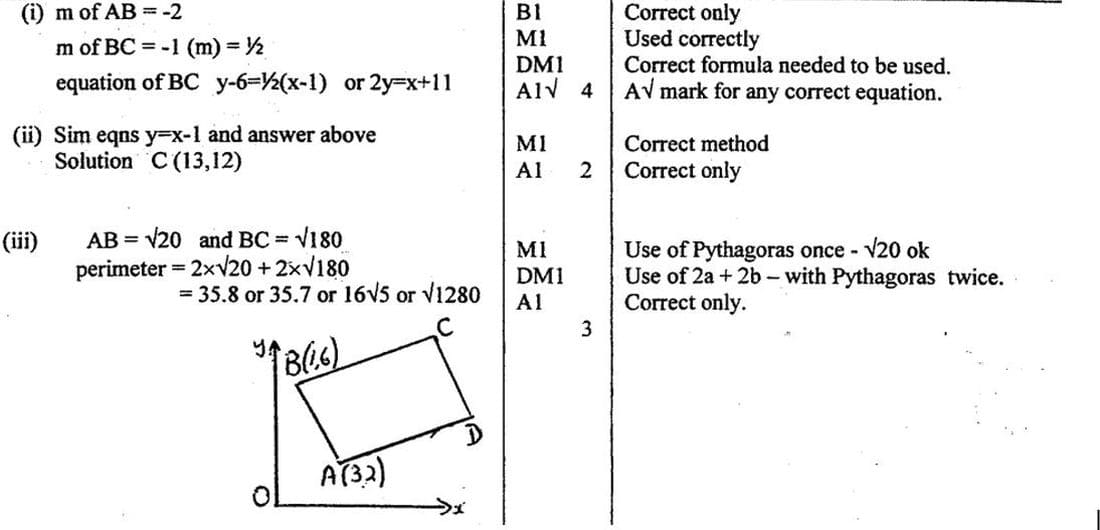
(i) The slope of AB is calculated as \(m = \frac{6 - 2}{1 - 3} = -2\). Since BC is perpendicular to AB, the slope of BC is \(\frac{1}{2}\). Using point B (1, 6), the equation of BC is \(y - 6 = \frac{1}{2}(x - 1)\) or \(2y = x + 11\).
(ii) To find the coordinates of C, solve the equations \(y = x - 1\) and \(y - 6 = \frac{1}{2}(x - 1)\). Substituting \(y = x - 1\) into the second equation gives \(x - 1 - 6 = \frac{1}{2}(x - 1)\). Solving this, we find \(x = 13\) and \(y = 12\), so C is (13, 12).
(iii) The length of AB is \(\sqrt{(3 - 1)^2 + (2 - 6)^2} = \sqrt{20}\). The length of BC is \(\sqrt{(13 - 1)^2 + (12 - 6)^2} = \sqrt{180}\). The perimeter is \(2 \times \sqrt{20} + 2 \times \sqrt{180} = 35.8\) or \(35.7\) or \(16\sqrt{5}\) or \(\sqrt{1280}\).