Browsing as Guest. Progress, bookmarks and attempts are disabled.
Log in to track your work.
Nov 2011 p12 q9
618
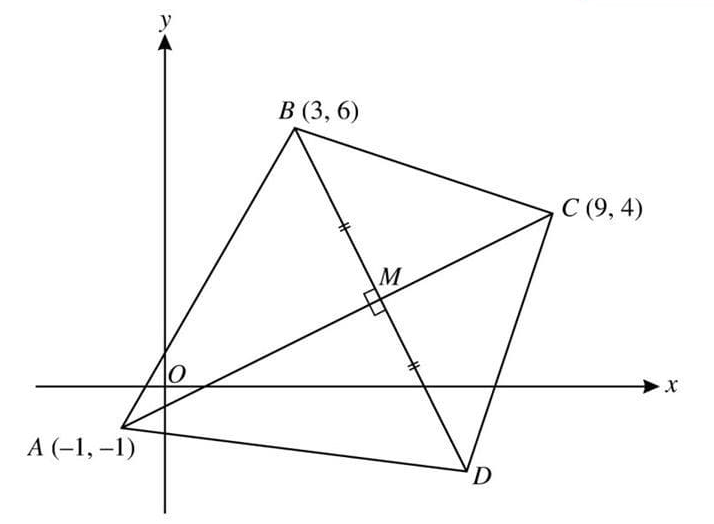
The diagram shows a quadrilateral ABCD in which the point A is
(-1, -1), the point B is (3, 6) and the point C is (9, 4). The diagonals
AC and BD intersect at M. Angle BMA = 90^0 and
BM = MD. Calculate
the coordinates of M and D,
the ratio AM : MC.
Solution
(i) To find the coordinates of M, we first find the equations of lines
AC and BD. The gradient of AC is
\(\frac{4 - (-1)}{9 - (-1)} = \frac{1}{2}\). The equation of line
AC is \(y + 1 = \frac{1}{2}(x + 1)\).
The gradient of BD is \(-2\) because it is perpendicular to
AC (\(m_1 m_2 = -1\)). The equation of line
BD is \(y - 6 = -2(x - 3)\).
Solving these equations simultaneously gives the intersection point
M as (5, 2).
\(To find D, use the midpoint formula or vector method. Since
BM = MD, D is at (7, -2).\)
(ii) To find the ratio AM : MC, calculate the distances
using the distance formula. \(AM = \sqrt{(5 - (-1))^2 + (2 - (-1))^2} = \sqrt{45}\)
and \(MC = \sqrt{(9 - 5)^2 + (4 - 2)^2} = \sqrt{20}\).