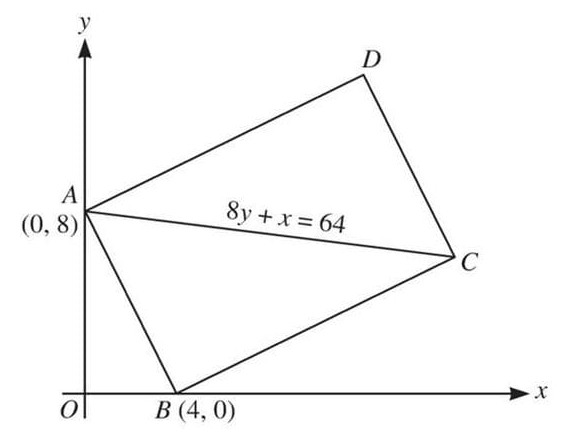
Given the points A (0, 8) and B (4, 0), and the equation of diagonal AC as \(8y + x = 64\).
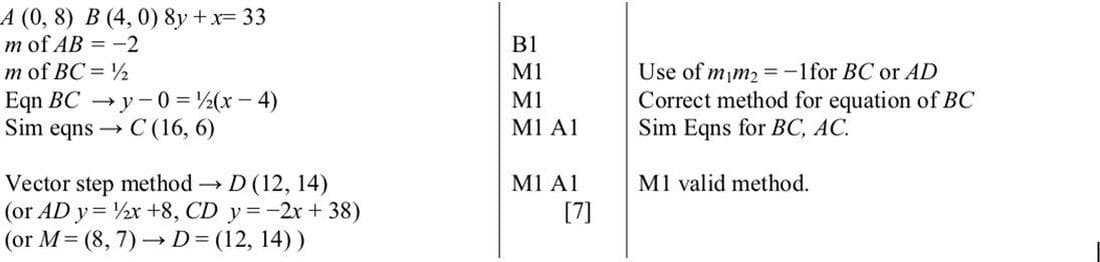
First, find the slope of AB: \(m_{AB} = \frac{8 - 0}{0 - 4} = -2\).
Since ABCD is a rectangle, BC is perpendicular to AB, so \(m_{BC} \times m_{AB} = -1\).
Thus, \(m_{BC} = \frac{1}{2}\).
The equation of line BC is \(y - 0 = \frac{1}{2}(x - 4)\), which simplifies to \(y = \frac{1}{2}x - 2\).
Now, solve the equations \(8y + x = 64\) and \(y = \frac{1}{2}x - 2\) simultaneously:
Substitute \(y = \frac{1}{2}x - 2\) into \(8y + x = 64\):
\(8(\frac{1}{2}x - 2) + x = 64\)
\(4x - 16 + x = 64\)
\(5x = 80\)
\(x = 16\)
Substitute \(x = 16\) back into \(y = \frac{1}{2}x - 2\):
\(y = \frac{1}{2}(16) - 2 = 8 - 2 = 6\)
Thus, the coordinates of C are (16, 6).
For D, use the vector step method or the fact that AD is parallel to BC:
Since AD is parallel to BC, \(m_{AD} = \frac{1}{2}\).
Using the midpoint M of AC as (8, 7), and knowing D is symmetric to C about M, calculate:
\(D = (2 \times 8 - 16, 2 \times 7 - 6) = (12, 14)\).
Thus, the coordinates of D are (12, 14).