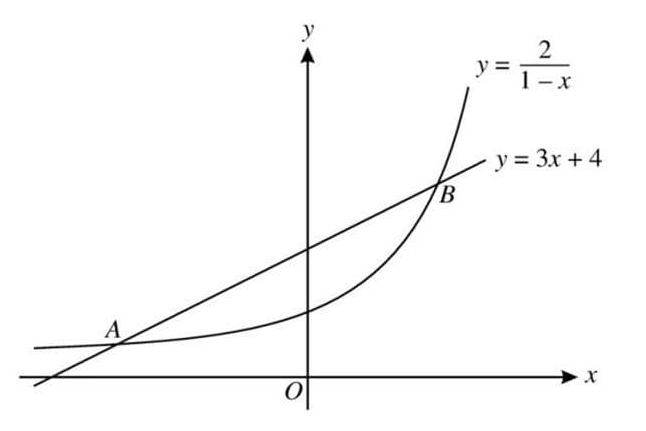
(i) To find the coordinates of \(A\) and \(B\), set the equations equal: \(\frac{2}{1-x} = 3x + 4\).
Cross-multiply to get: \(2 = (1-x)(3x + 4)\).
Expand and simplify: \(2 = 3x + 4 - 3x^2 - 4x\).
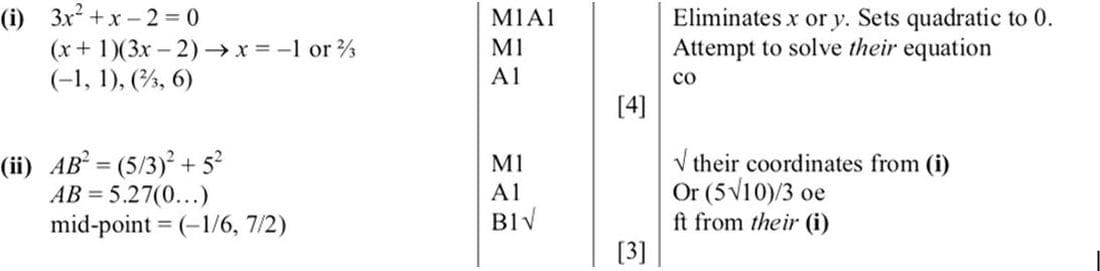
Rearrange to form a quadratic equation: \(3x^2 + x - 2 = 0\).
Factorize: \((x+1)(3x-2) = 0\).
Solutions are \(x = -1\) and \(x = \frac{2}{3}\).
Substitute back to find \(y\):
For \(x = -1\), \(y = 3(-1) + 4 = 1\), so \(A = (-1, 1)\).
For \(x = \frac{2}{3}\), \(y = 3\left(\frac{2}{3}\right) + 4 = 6\), so \(B = \left(\frac{2}{3}, 6\right)\).
(ii) To find the length of \(AB\), use the distance formula:
\(AB = \sqrt{\left(\frac{2}{3} + 1\right)^2 + (6 - 1)^2}\).
\(AB = \sqrt{\left(\frac{5}{3}\right)^2 + 5^2}\).
\(AB = \sqrt{\frac{25}{9} + 25} = \sqrt{\frac{250}{9}}\).
\(AB \approx 5.27\).
The mid-point of \(AB\) is:
\(\left(\frac{-1 + \frac{2}{3}}{2}, \frac{1 + 6}{2}\right) = \left(-\frac{1}{6}, \frac{7}{2}\right)\).