Past Exam Questions
← Back9709 P12 - Nov 2023 - Q8
Functions f and g are defined by
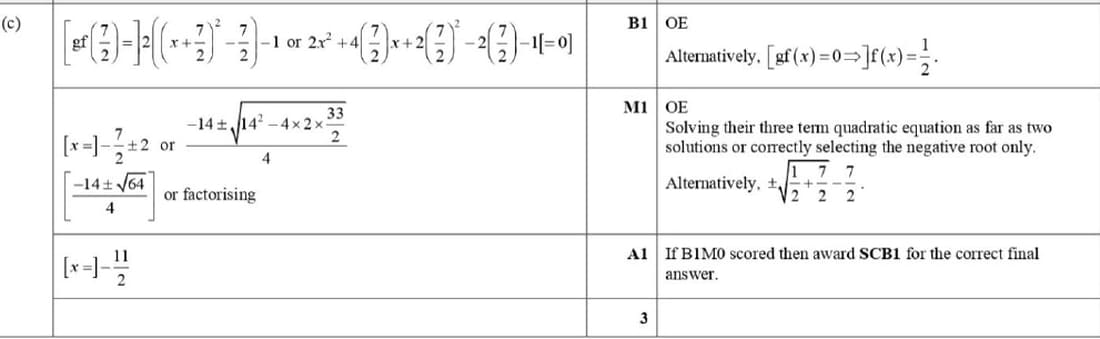
\(f(x) = (x + a)^2 - a\) for \(x \leq -a\),
\(g(x) = 2x - 1\) for \(x \in \mathbb{R}\),
where \(a\) is a positive constant.
Given that \(a = \frac{7}{2}\), solve the equation \(gf(x) = 0\).
9709 P11 - Jun 2020 - Q6
Functions f and g are defined for \(x \in \mathbb{R}\) by
\(f : x \mapsto \frac{1}{2}x - a\),
\(g : x \mapsto 3x + b\),
where \(a\) and \(b\) are constants.
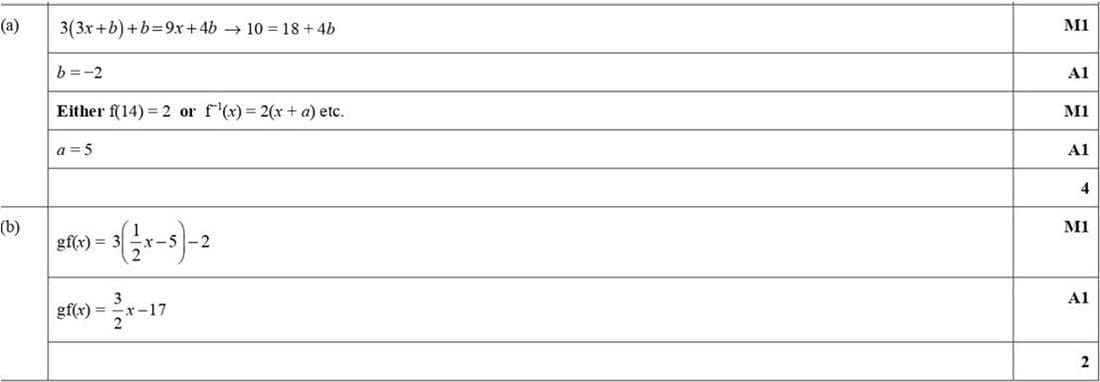
(a) Given that \(gg(2) = 10\) and \(f^{-1}(2) = 14\), find the values of \(a\) and \(b\).
(b) Using these values of \(a\) and \(b\), find an expression for \(gf(x)\) in the form \(cx + d\), where \(c\) and \(d\) are constants.
9709 P12 - Mar 2020 - Q9
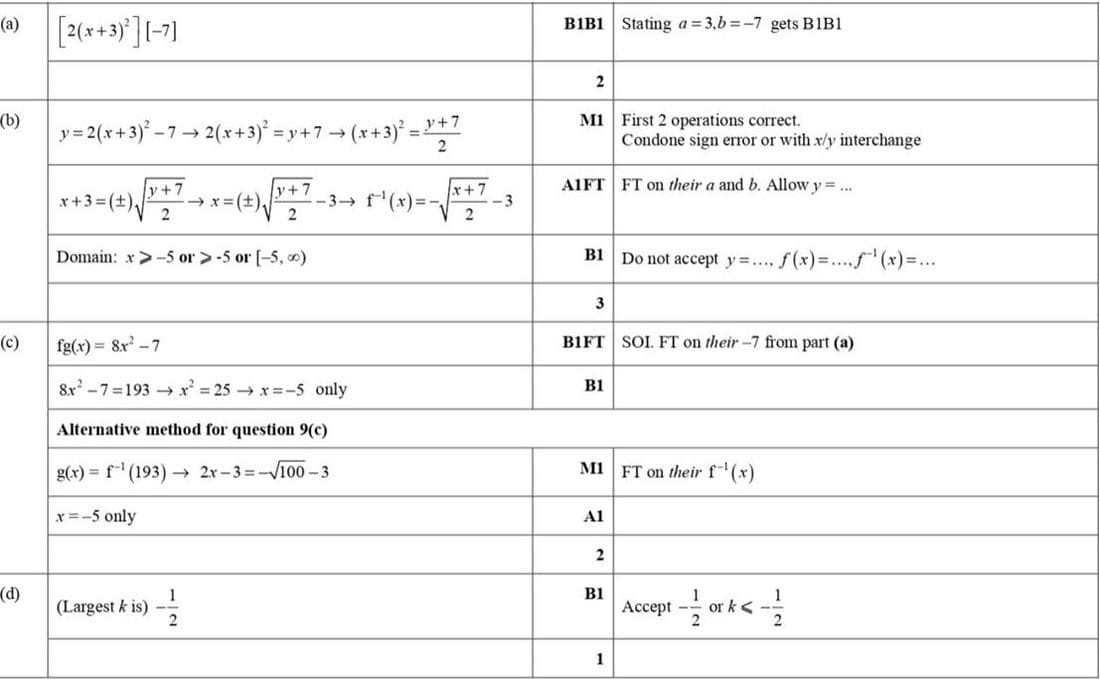
(a) Express \(2x^2 + 12x + 11\) in the form \(2(x + a)^2 + b\), where \(a\) and \(b\) are constants.
The function \(f\) is defined by \(f(x) = 2x^2 + 12x + 11\) for \(x \leq -4\).
(b) Find an expression for \(f^{-1}(x)\) and state the domain of \(f^{-1}\).
The function \(g\) is defined by \(g(x) = 2x - 3\) for \(x \leq k\).
(c) For the case where \(k = -1\), solve the equation \(fg(x) = 193\).
(d) State the largest value of \(k\) possible for the composition \(fg\) to be defined.
9709 P12 - Nov 2019 - Q9
Functions f and g are defined by
\(f(x) = 2x^2 + 8x + 1\) for \(x \in \mathbb{R}\),
\(g(x) = 2x - k\) for \(x \in \mathbb{R}\),
where \(k\) is a constant.
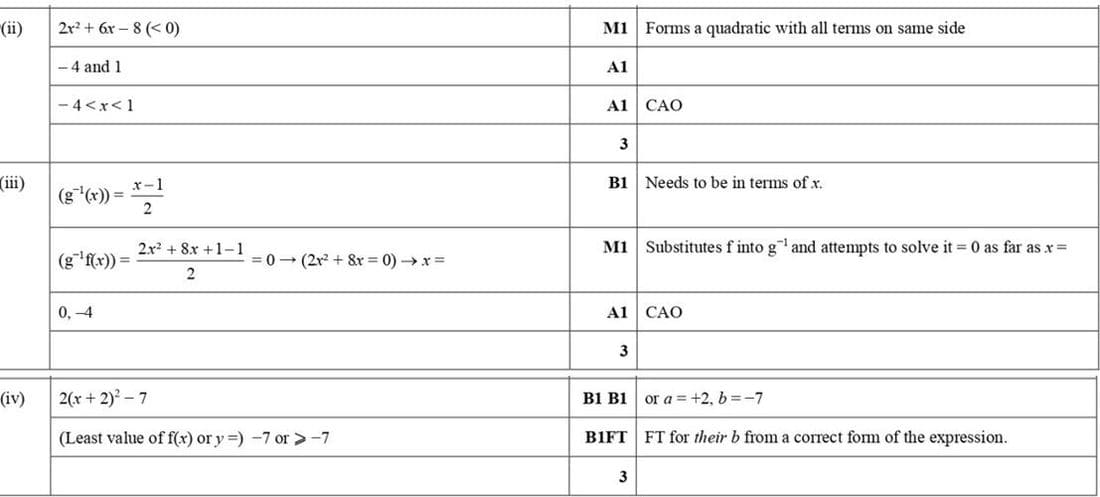
(ii) In the case where \(k = -9\), find the set of values of \(x\) for which \(f(x) < g(x)\).
(iii) In the case where \(k = -1\), find \(g^{-1}f(x)\) and solve the equation \(g^{-1}f(x) = 0\).
(iv) Express \(f(x)\) in the form \(2(x + a)^2 + b\), where \(a\) and \(b\) are constants, and hence state the least value of \(f(x)\).
9709 P11 - Nov 2019 - Q7
Functions f and g are defined by
\(f : x \mapsto \frac{3}{2x+1}\) for \(x > 0\),
\(g : x \mapsto \frac{1}{x} + 2\) for \(x > 0\).
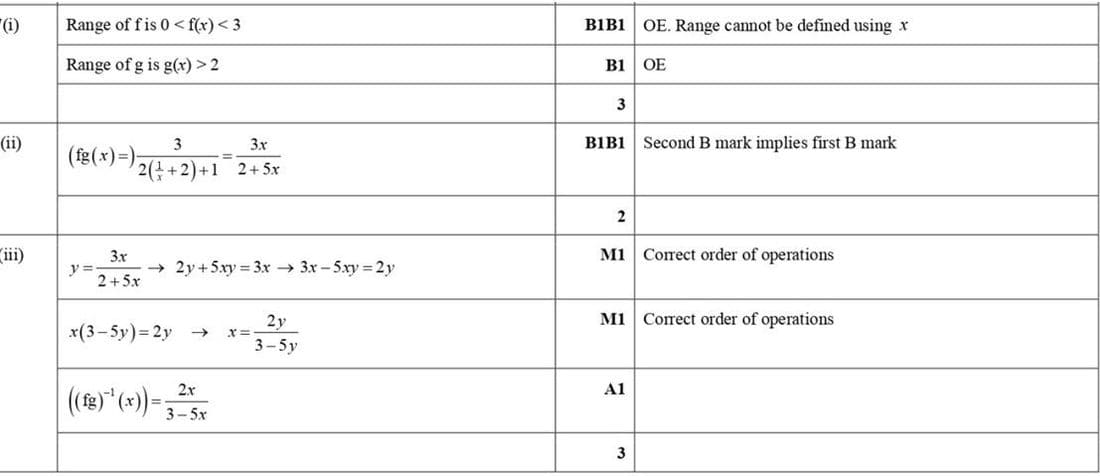
(i) Find the range of \(f\) and the range of \(g\).
(ii) Find an expression for \(fg(x)\), giving your answer in the form \(\frac{ax}{bx+c}\), where \(a, b\) and \(c\) are integers.
(iii) Find an expression for \((fg)^{-1}(x)\), giving your answer in the same form as for part (ii).
9709 P12 - Jun 2019 - Q7
Functions f and g are defined by
\(f : x \mapsto 3x - 2, \; x \in \mathbb{R},\)
\(g : x \mapsto \frac{2x + 3}{x - 1}, \; x \in \mathbb{R}, \; x \neq 1.\)
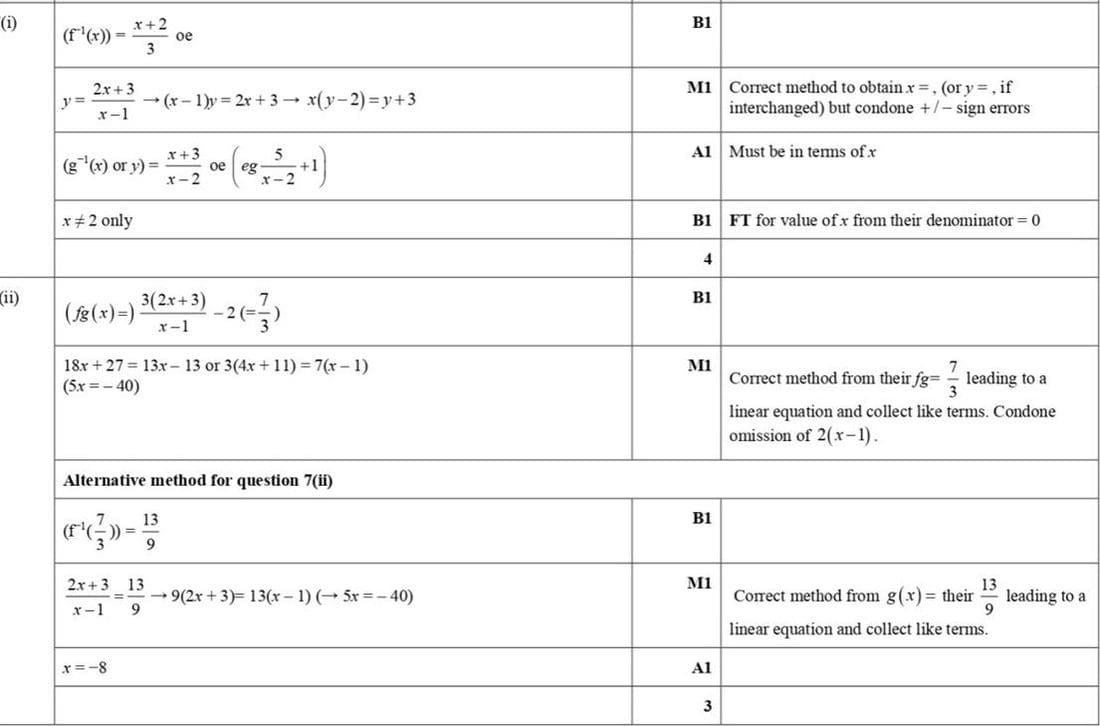
(i) Obtain expressions for \(f^{-1}(x)\) and \(g^{-1}(x)\), stating the value of \(x\) for which \(g^{-1}(x)\) is not defined.
(ii) Solve the equation \(fg(x) = \frac{7}{3}.\)
9709 P11 - Jun 2019 - Q5
The function \(f\) is defined by \(f(x) = -2x^2 + 12x - 3\) for \(x \in \mathbb{R}\).
(i) Express \(-2x^2 + 12x - 3\) in the form \(-2(x+a)^2 + b\), where \(a\) and \(b\) are constants.
(ii) State the greatest value of \(f(x)\).
The function \(g\) is defined by \(g(x) = 2x + 5\) for \(x \in \mathbb{R}\).
(iii) Find the values of \(x\) for which \(gf(x) + 1 = 0\).

9709 P12 - Mar 2019 - Q8
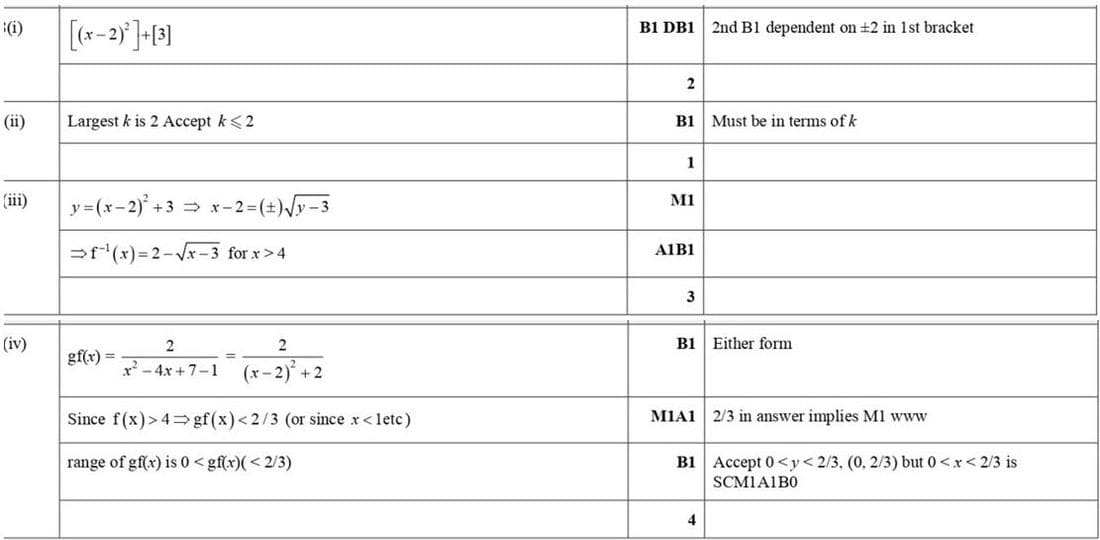
(i) Express \(x^2 - 4x + 7\) in the form \((x + a)^2 + b\).
The function \(f\) is defined by \(f(x) = x^2 - 4x + 7\) for \(x < k\), where \(k\) is a constant.
(ii) State the largest value of \(k\) for which \(f\) is a decreasing function.
The value of \(k\) is now given to be 1.
(iii) Find an expression for \(f^{-1}(x)\) and state the domain of \(f^{-1}\).
(iv) The function \(g\) is defined by \(g(x) = \frac{2}{x-1}\) for \(x > 1\). Find an expression for \(gf(x)\) and state the range of \(gf\).
9709 P13 - Nov 2017 - Q6
The functions f and g are defined by
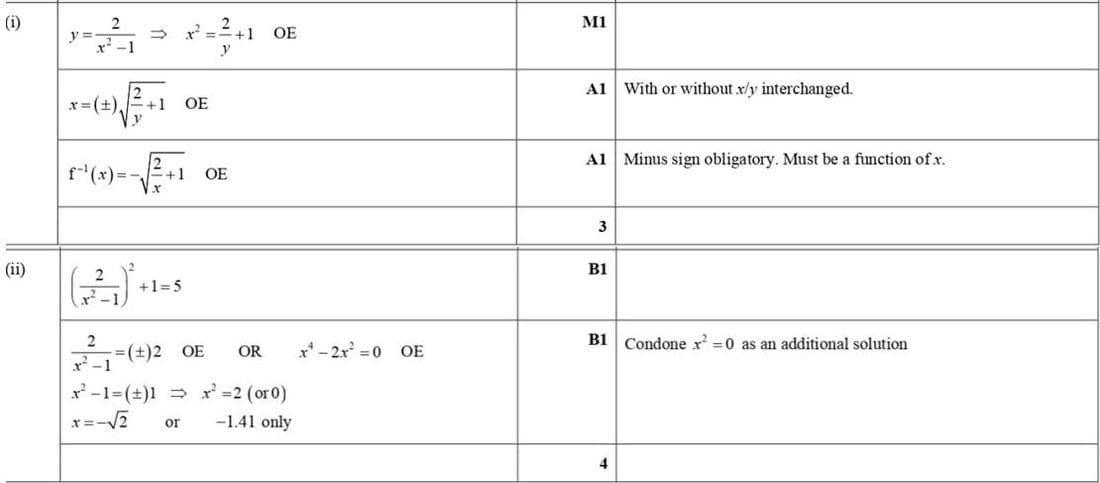
\(f(x) = \frac{2}{x^2 - 1}\) for \(x < -1\),
\(g(x) = x^2 + 1\) for \(x > 0\).
(i) Find an expression for \(f^{-1}(x)\).
(ii) Solve the equation \(gf(x) = 5\).
9709 P11 - Nov 2017 - Q9
Functions f and g are defined for \(x > 3\) by
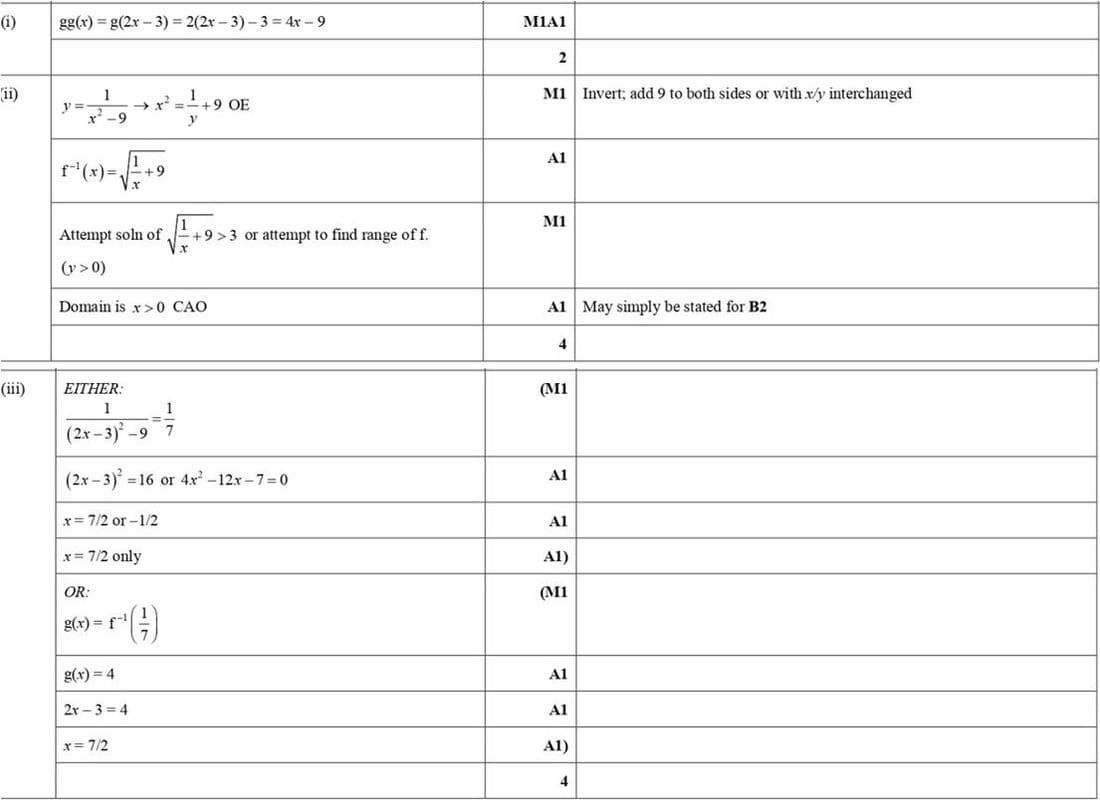
\(f : x \mapsto \frac{1}{x^2 - 9}\),
\(g : x \mapsto 2x - 3\).
- Find and simplify an expression for \(gg(x)\).
- Find an expression for \(f^{-1}(x)\) and state the domain of \(f^{-1}\).
- Solve the equation \(fg(x) = \frac{1}{7}\).
9709 P12 - Mar 2017 - Q8
The functions f and g are defined for \(x > 0\) by
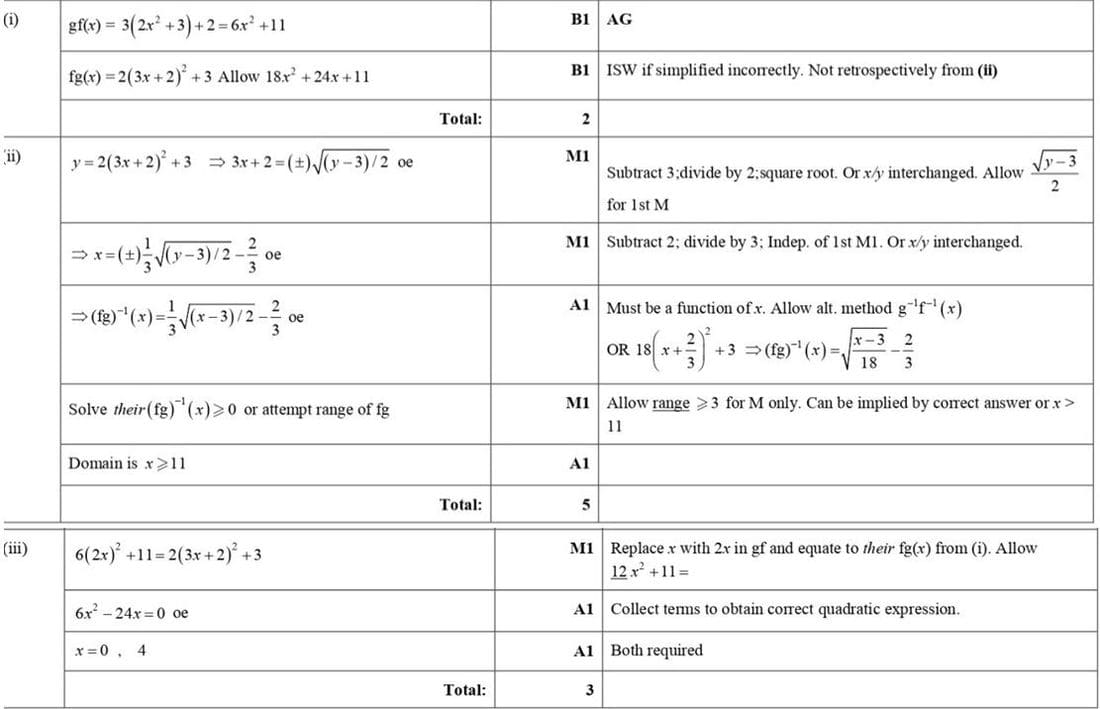
\(f : x \mapsto 2x^2 + 3\),
\(g : x \mapsto 3x + 2\).
(i) Show that \(gf(x) = 6x^2 + 11\) and obtain an unsimplified expression for \(fg(x)\). [2]
(ii) Find an expression for \((fg)^{-1}(x)\) and determine the domain of \((fg)^{-1}\). [5]
(iii) Solve the equation \(gf(2x) = fg(x)\). [3]
9709 P11 - Nov 2023 - Q9
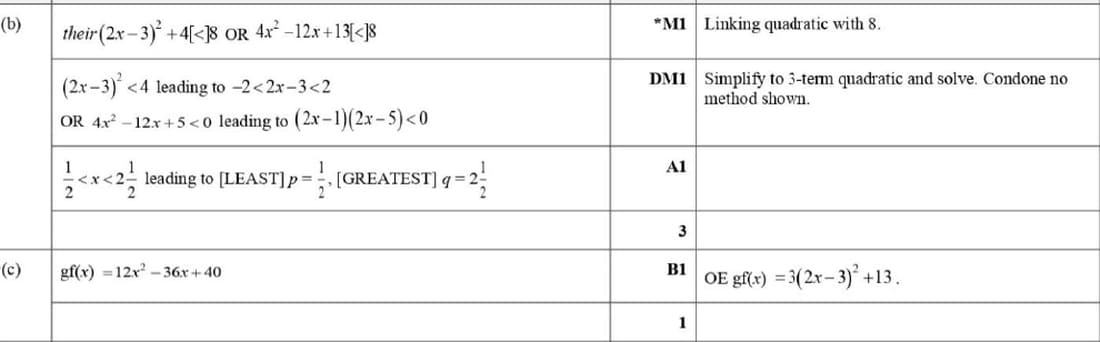
The function f is defined by \(f(x) = 4x^2 - 12x + 13\) for \(p < x < q\), where \(p\) and \(q\) are constants. The function g is defined by \(g(x) = 3x + 1\) for \(x < 8\).
(b) Given that it is possible to form the composite function gf, find the least possible value of \(p\) and the greatest possible value of \(q\).
(c) Find an expression for \(gf(x)\).
9709 P11 - Nov 2016 - Q8
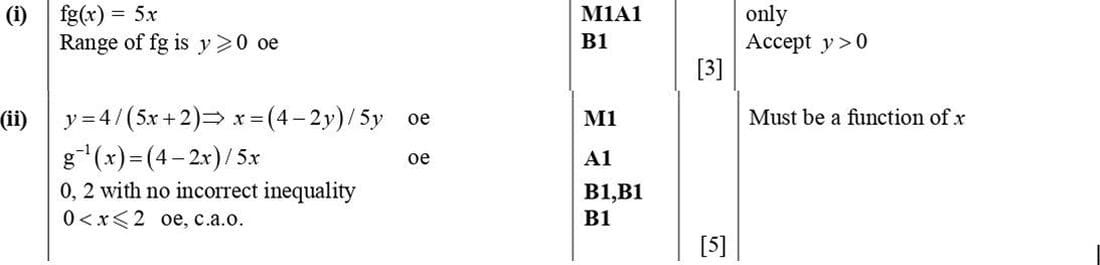
The functions f and g are defined by
\(f(x) = \frac{4}{x} - 2\) for \(x > 0\),
\(g(x) = \frac{4}{5x + 2}\) for \(x \geq 0\).
(i) Find and simplify an expression for \(fg(x)\) and state the range of \(fg\).
(ii) Find an expression for \(g^{-1}(x)\) and find the domain of \(g^{-1}\).
9709 P12 - Jun 2016 - Q1
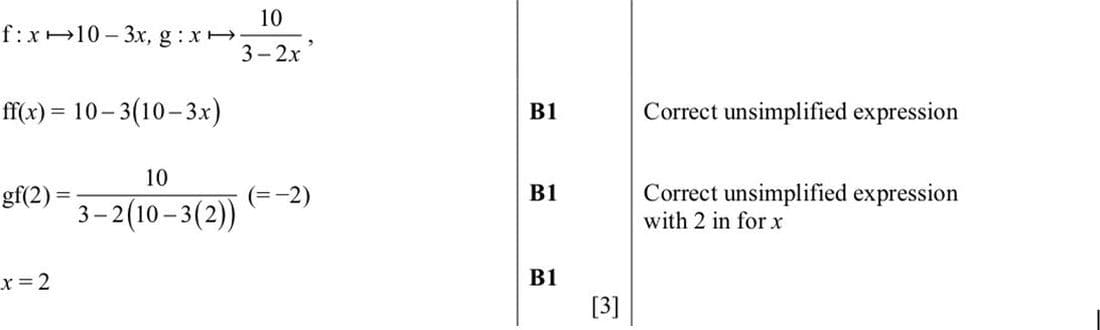
Functions f and g are defined by
\(f : x \mapsto 10 - 3x, \quad x \in \mathbb{R},\)
\(g : x \mapsto \frac{10}{3 - 2x}, \quad x \in \mathbb{R}, \; x \neq \frac{3}{2}.\)
Solve the equation \(ff(x) = gf(2)\).
9709 P12 - Nov 2015 - Q1
Functions f and g are defined by
\(f : x \mapsto 3x + 2, \quad x \in \mathbb{R}\)
\(g : x \mapsto 4x - 12, \quad x \in \mathbb{R}\)
Solve the equation \(f^{-1}(x) = gf(x)\).

9709 P12 - Jun 2014 - Q10
Functions f and g are defined by
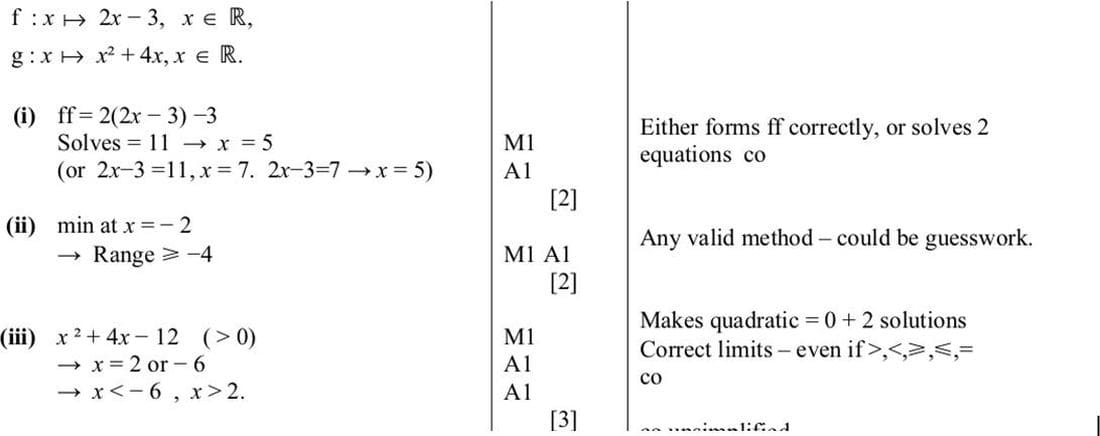
\(f: x \mapsto 2x - 3, \; x \in \mathbb{R},\)
\(g: x \mapsto x^2 + 4x, \; x \in \mathbb{R}.\)
- Solve the equation \(ff(x) = 11.\)
- Find the range of \(g.\)
- Find the set of values of \(x\) for which \(g(x) > 12.\)
9709 P11 - Nov 2013 - Q5
The function f is defined by
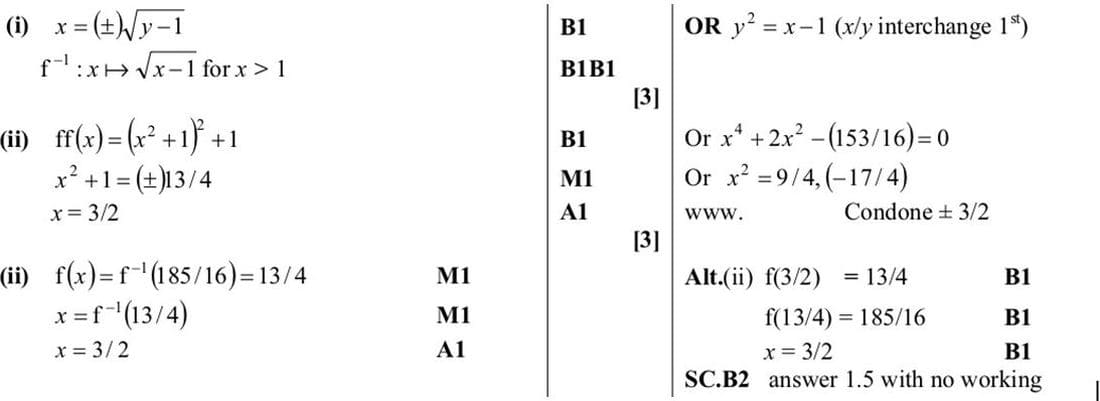
\(f : x \mapsto x^2 + 1\) for \(x \geq 0\).
(i) Define in a similar way the inverse function \(f^{-1}\).
(ii) Solve the equation \(ff(x) = \frac{185}{16}\).
9709 P13 - Nov 2011 - Q9
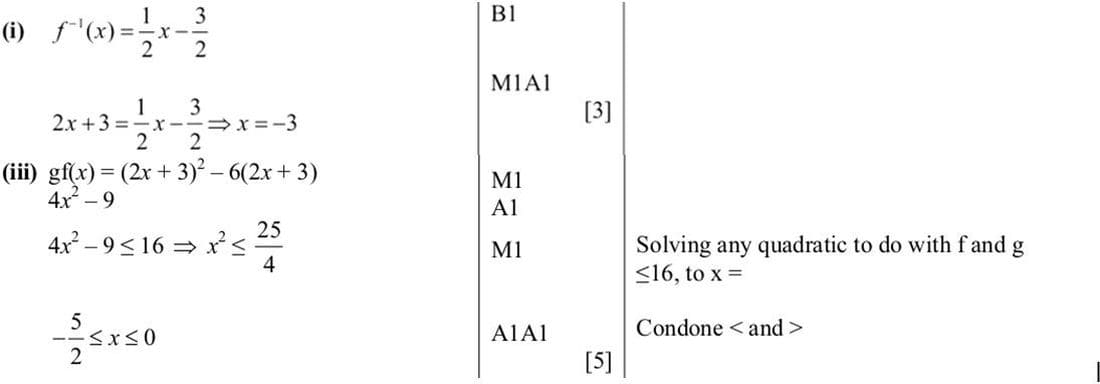
Functions f and g are defined by
\(f : x \mapsto 2x + 3\) for \(x \leq 0\),
\(g : x \mapsto x^2 - 6x\) for \(x \leq 3\).
(i) Express \(f^{-1}(x)\) in terms of \(x\) and solve the equation \(f(x) = f^{-1}(x)\).
(iii) Find the set of values of \(x\) which satisfy \(gf(x) \leq 16\).
9709 P12 - Nov 2011 - Q2
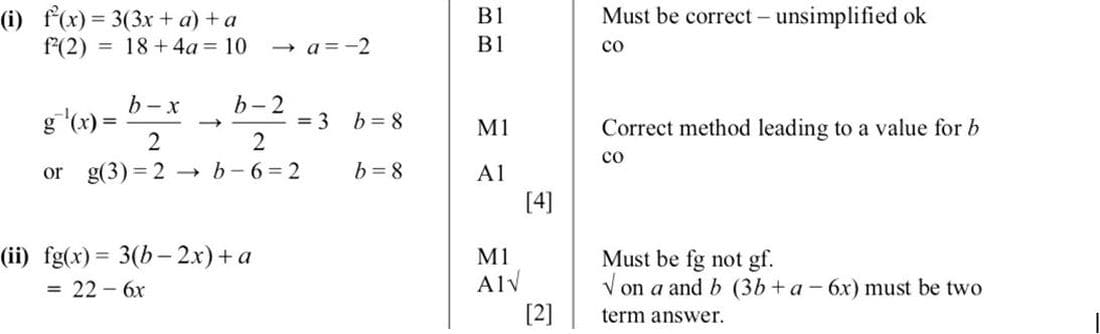
The functions f and g are defined for \(x \in \mathbb{R}\) by
\(f : x \mapsto 3x + a,\)
\(g : x \mapsto b - 2x,\)
where \(a\) and \(b\) are constants. Given that \(ff(2) = 10\) and \(g^{-1}(2) = 3\), find
- the values of \(a\) and \(b\),
- an expression for \(fg(x)\).
9709 P13 - Jun 2011 - Q10
Functions f and g are defined by
\(f : x \mapsto 3x - 4, \quad x \in \mathbb{R},\)
\(g : x \mapsto 2(x - 1)^3 + 8, \quad x > 1.\)
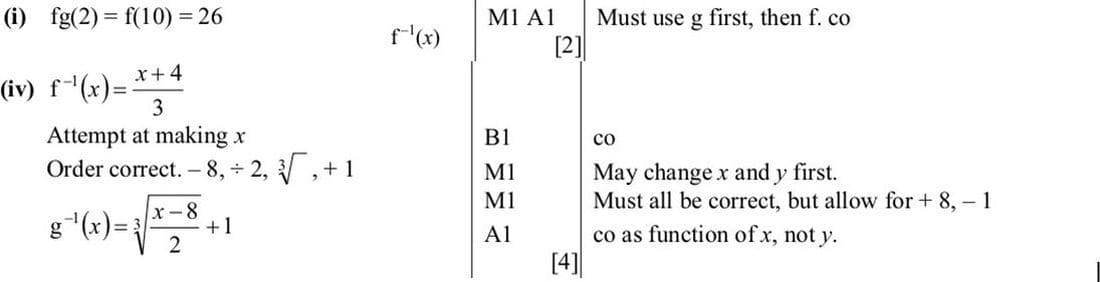
(i) Evaluate \(fg(2)\).
(iv) Express each of \(f^{-1}(x)\) and \(g^{-1}(x)\) in terms of \(x\).