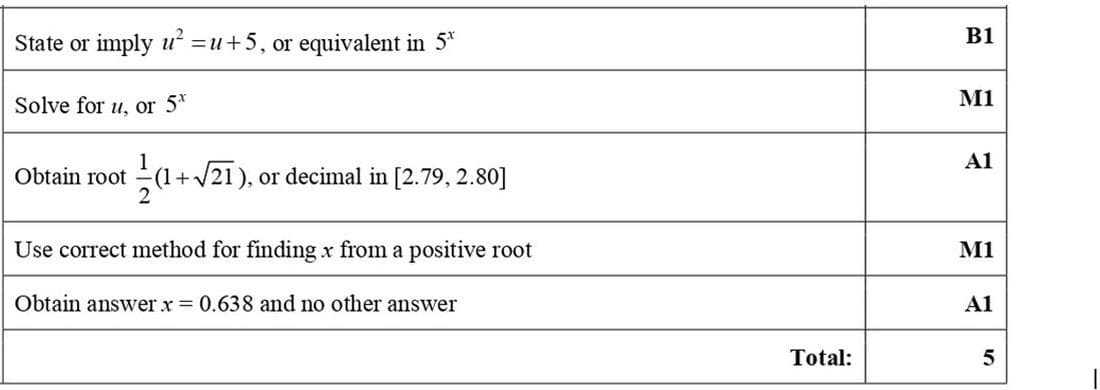
Let \(u = 5^x\). Then the equation becomes \(u^2 = u + 5\).
Rearrange to form a quadratic equation: \(u^2 - u - 5 = 0\).
Use the quadratic formula \(u = \frac{-b \pm \sqrt{b^2 - 4ac}}{2a}\), where \(a = 1\), \(b = -1\), \(c = -5\).
Calculate the discriminant: \(b^2 - 4ac = (-1)^2 - 4 \times 1 \times (-5) = 1 + 20 = 21\).
Thus, \(u = \frac{1 \pm \sqrt{21}}{2}\).
Since \(u = 5^x\) must be positive, choose the positive root: \(u = \frac{1 + \sqrt{21}}{2}\).
Now, solve for \(x\): \(5^x = \frac{1 + \sqrt{21}}{2}\).
Take the logarithm of both sides: \(x \log 5 = \log \left(\frac{1 + \sqrt{21}}{2}\right)\).
Thus, \(x = \frac{\log \left(\frac{1 + \sqrt{21}}{2}\right)}{\log 5}\).
Calculate \(x\) to 3 decimal places: \(x \approx 0.638\).