Past Exam Questions
← Back9709 P12 - Jun 2011 - Q6
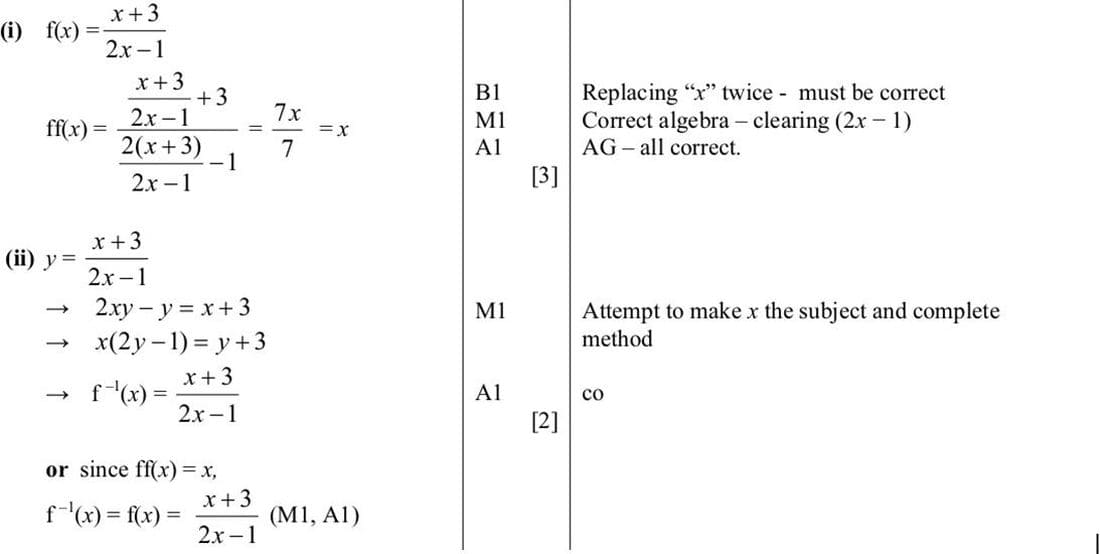
The function \(f\) is defined by \(f : x \mapsto \frac{x+3}{2x-1}\), \(x \in \mathbb{R}, x \neq \frac{1}{2}\).
(i) Show that \(ff(x) = x\).
(ii) Hence, or otherwise, obtain an expression for \(f^{-1}(x)\).
9709 P11 - Jun 2011 - Q11
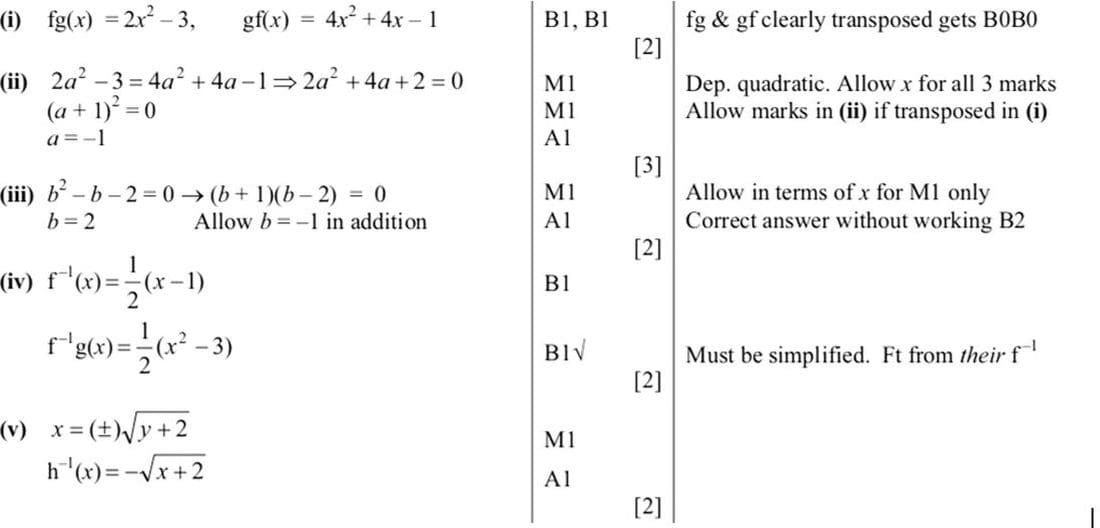
Functions f and g are defined for \(x \in \mathbb{R}\) by
\(f : x \mapsto 2x + 1,\)
\(g : x \mapsto x^2 - 2.\)
- Find and simplify expressions for \(fg(x)\) and \(gf(x)\).
- Hence find the value of \(a\) for which \(fg(a) = gf(a)\).
- Find the value of \(b\) (\(b \neq a\)) for which \(g(b) = b\).
- Find and simplify an expression for \(f^{-1}g(x)\).
The function \(h\) is defined by
\(h : x \mapsto x^2 - 2,\) for \(x \leq 0.\)
- Find an expression for \(h^{-1}(x)\).
9709 P13 - Jun 2023 - Q7
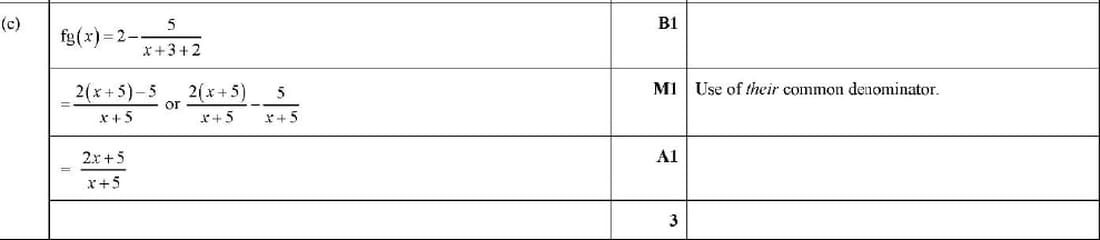
The function f is defined by \(f(x) = 2 - \frac{5}{x+2}\) for \(x > -2\).
The function g is defined by \(g(x) = x + 3\) for \(x > 0\).
Obtain an expression for \(fg(x)\) giving your answer in the form \(\frac{ax+b}{cx+d}\), where \(a, b, c\) and \(d\) are integers.
9709 P11 - Nov 2010 - Q3
Functions f and g are defined for \(x \in \mathbb{R}\) by
\(f : x \mapsto 2x + 3\),
\(g : x \mapsto x^2 - 2x\).
Express \(gf(x)\) in the form \(a(x + b)^2 + c\), where \(a, b\) and \(c\) are constants.

9709 P1 - Nov 2008 - Q10
The function f is defined by
\(f : x \mapsto 3x - 2\) for \(x \in \mathbb{R}\).
The function g is defined by
\(g : x \mapsto 6x - x^2\) for \(x \in \mathbb{R}\).
Express \(gf(x)\) in terms of \(x\), and hence show that the maximum value of \(gf(x)\) is 9.

9709 P1 - Nov 2003 - Q10
Functions f and g are defined by
\(f : x \mapsto 2x - 5, \quad x \in \mathbb{R},\)
\(g : x \mapsto \frac{4}{2-x}, \quad x \in \mathbb{R}, \; x \neq 2.\)
Find the value of \(x\) for which \(fg(x) = 7.\)

9709 P1 - Jun 2003 - Q5
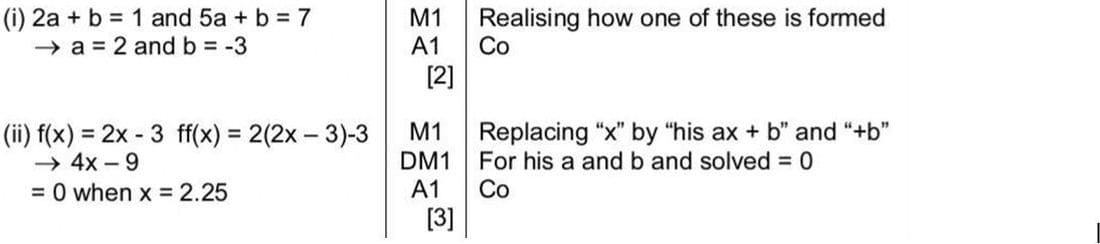
The function f is defined by \(f : x \mapsto ax + b\), for \(x \in \mathbb{R}\), where \(a\) and \(b\) are constants. It is given that \(f(2) = 1\) and \(f(5) = 7\).
- Find the values of \(a\) and \(b\).
- Solve the equation \(ff(x) = 0\).
9709 P1 - Jun 2002 - Q10
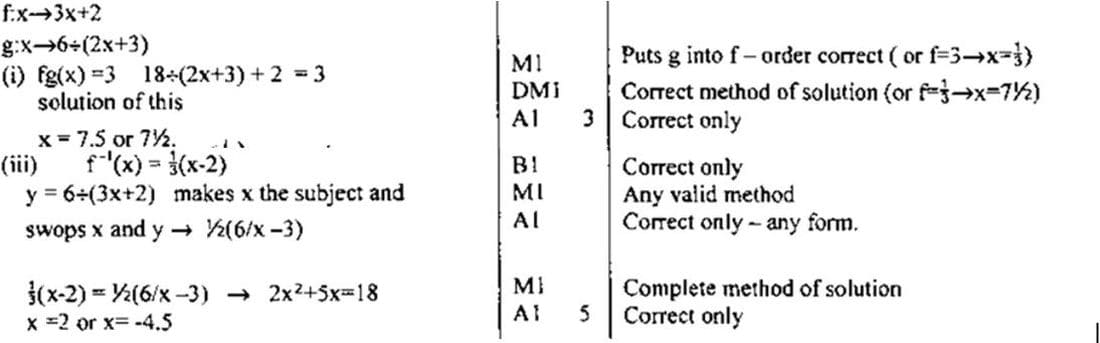
The functions f and g are defined by
\(f : x \mapsto 3x + 2, \quad x \in \mathbb{R},\)
\(g : x \mapsto \frac{6}{2x + 3}, \quad x \in \mathbb{R}, \; x \neq -1.5.\)
(i) Find the value of \(x\) for which \(fg(x) = 3.\)
(iii) Express each of \(f^{-1}(x)\) and \(g^{-1}(x)\) in terms of \(x\), and solve the equation \(f^{-1}(x) = g^{-1}(x).\)
9709 P11 - Jun 2023 - Q8
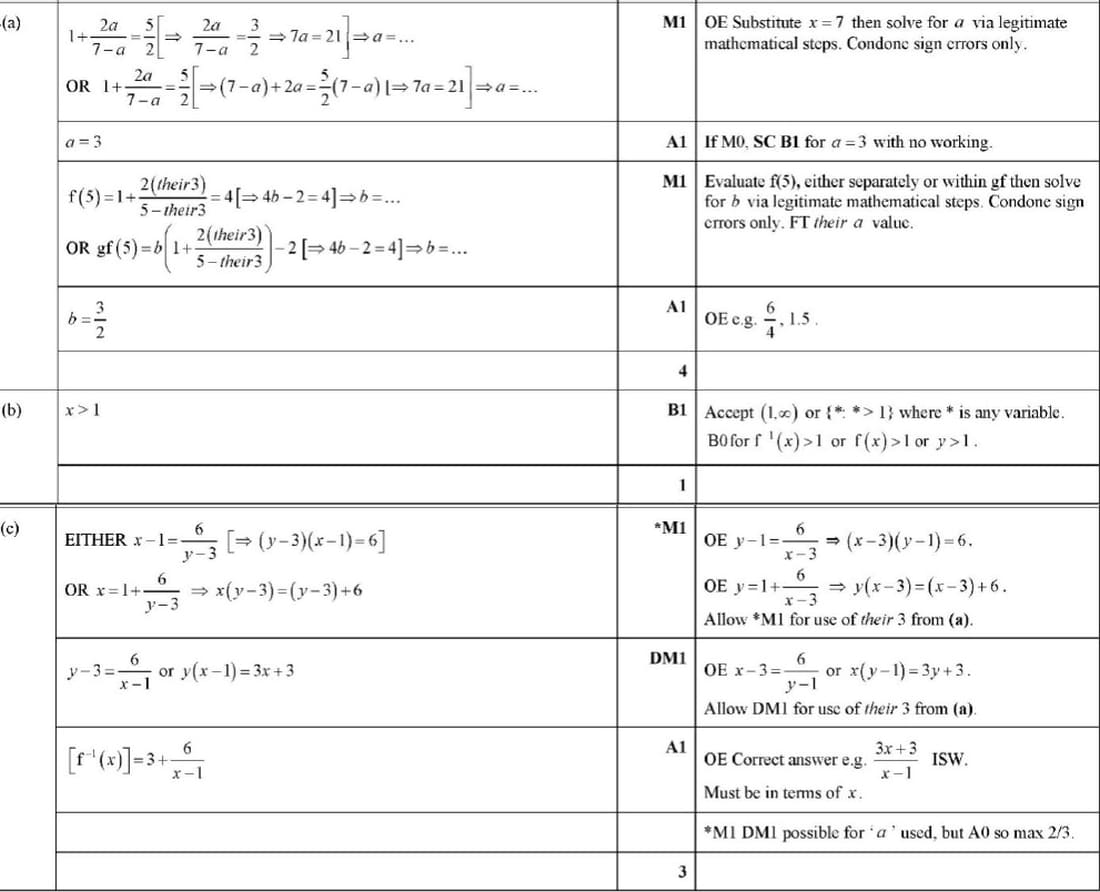
The functions \(f\) and \(g\) are defined as follows, where \(a\) and \(b\) are constants.
\(f(x) = 1 + \frac{2a}{x-a}\) for \(x > a\)
\(g(x) = bx - 2\) for \(x \in \mathbb{R}\)
(a) Given that \(f(7) = \frac{5}{2}\) and \(gf(5) = 4\), find the values of \(a\) and \(b\).
For the rest of this question, you should use the value of \(a\) which you found in (a).
(b) Find the domain of \(f^{-1}\).
(c) Find an expression for \(f^{-1}(x)\).
Question #707
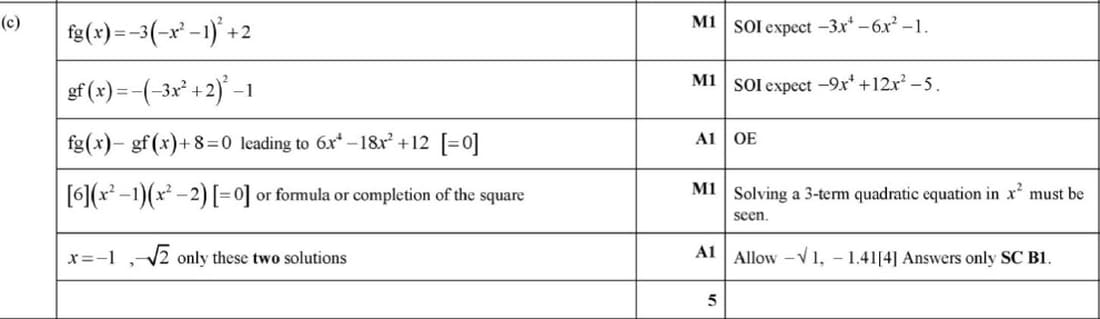
\(The function f is defined by f(x) = -3x2 + 2 for x ≤ -1.\)
\(The function g is defined by g(x) = -x2 - 1 for x ≤ -1.\)
\(Solve the equation fg(x) - gf(x) + 8 = 0.\)
9709 P12 - Nov 2022 - Q9
Functions f and g are defined by
\(f(x) = x + \frac{1}{x}\) for \(x > 0\),
\(g(x) = ax + 1\) for \(x \in \mathbb{R}\),
where \(a\) is a constant.
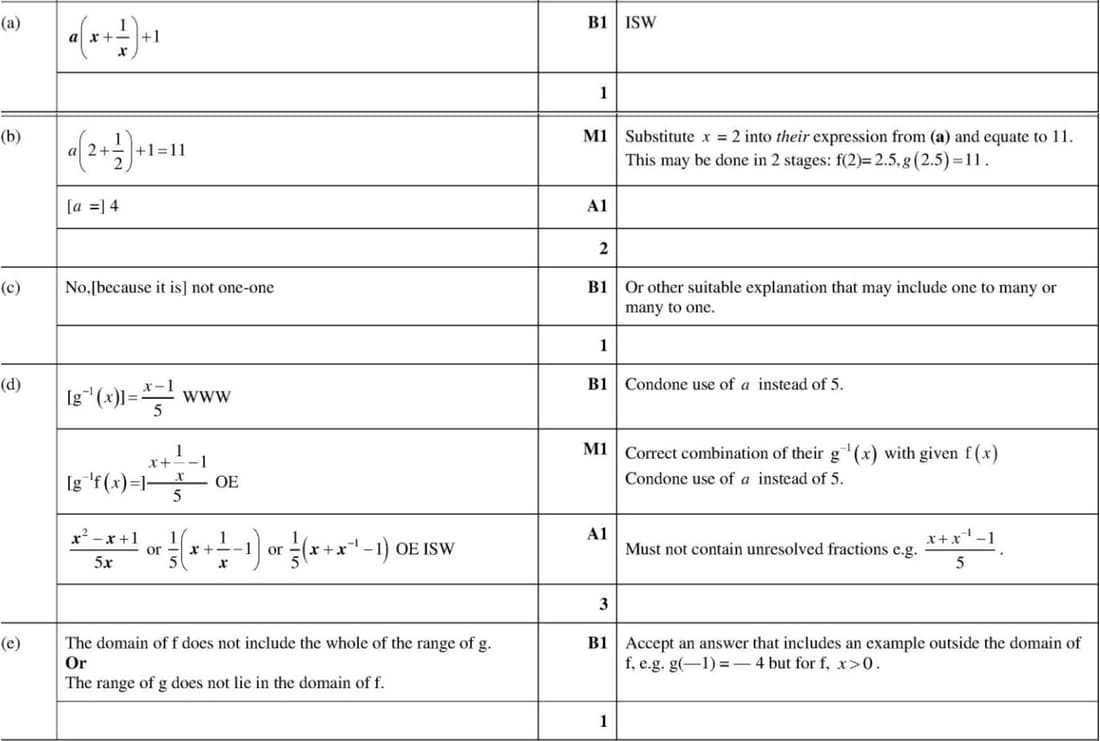
(a) Find an expression for \(gf(x)\).
(b) Given that \(gf(2) = 11\), find the value of \(a\).
(c) Given that the graph of \(y = f(x)\) has a minimum point when \(x = 1\), explain whether or not \(f\) has an inverse.
It is given instead that \(a = 5\).
(d) Find and simplify an expression for \(g^{-1}f(x)\).
(e) Explain why the composite function \(fg\) cannot be formed.
9709 P13 - Jun 2022 - Q6
The function f is defined by \(f(x) = 2x^2 - 16x + 23\) for \(x < 3\).
The function g is defined by \(g(x) = 2x + 4\) for \(x < -1\).
Find and simplify an expression for \(fg(x)\).

9709 P12 - Jun 2022 - Q10
Functions f and g are defined as follows:
\(f(x) = \frac{2x+1}{2x-1}\) for \(x \neq \frac{1}{2}\),
\(g(x) = x^2 + 4\) for \(x \in \mathbb{R}\).
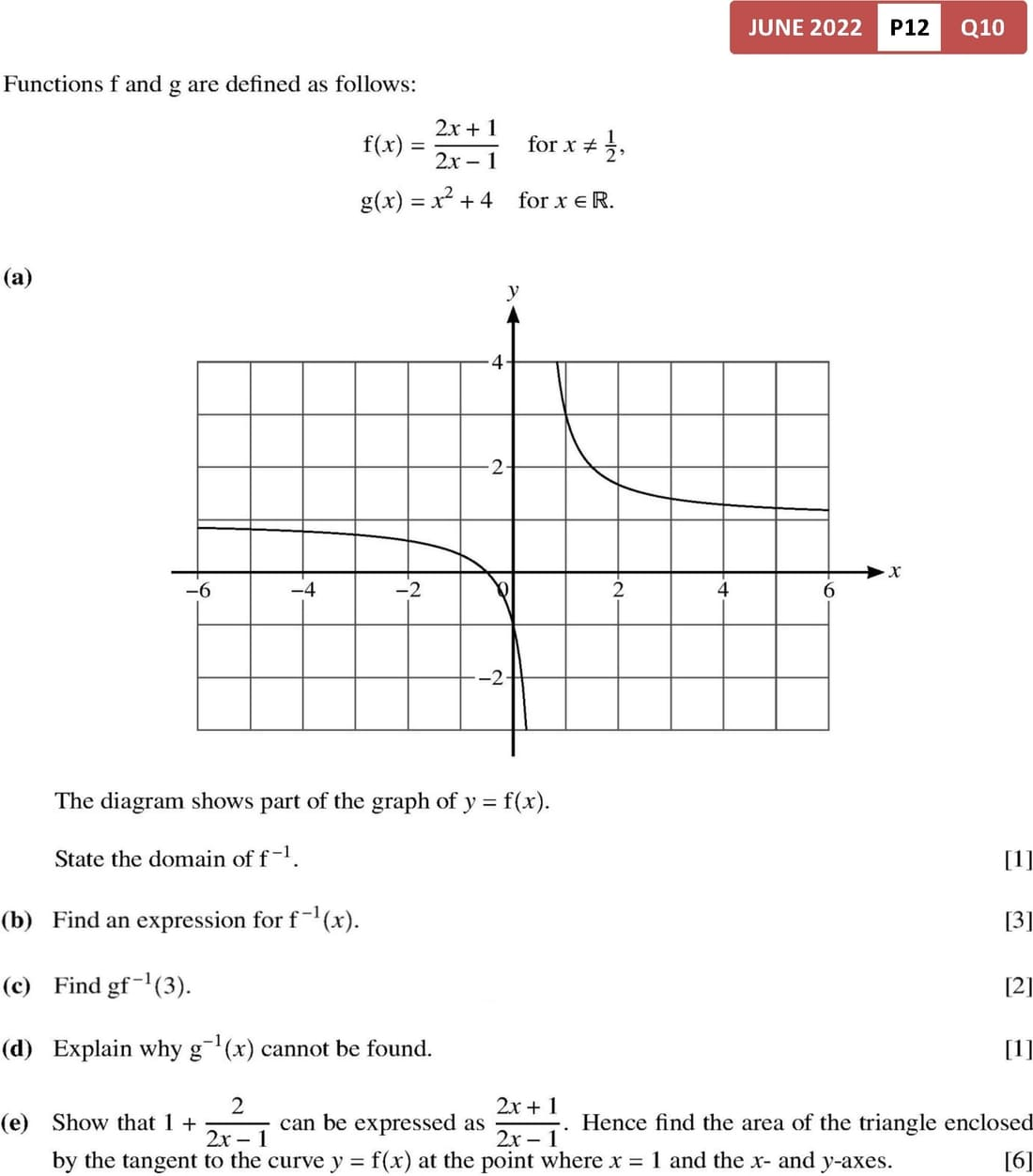
(a) The diagram shows part of the graph of \(y = f(x)\). State the domain of \(f^{-1}\).
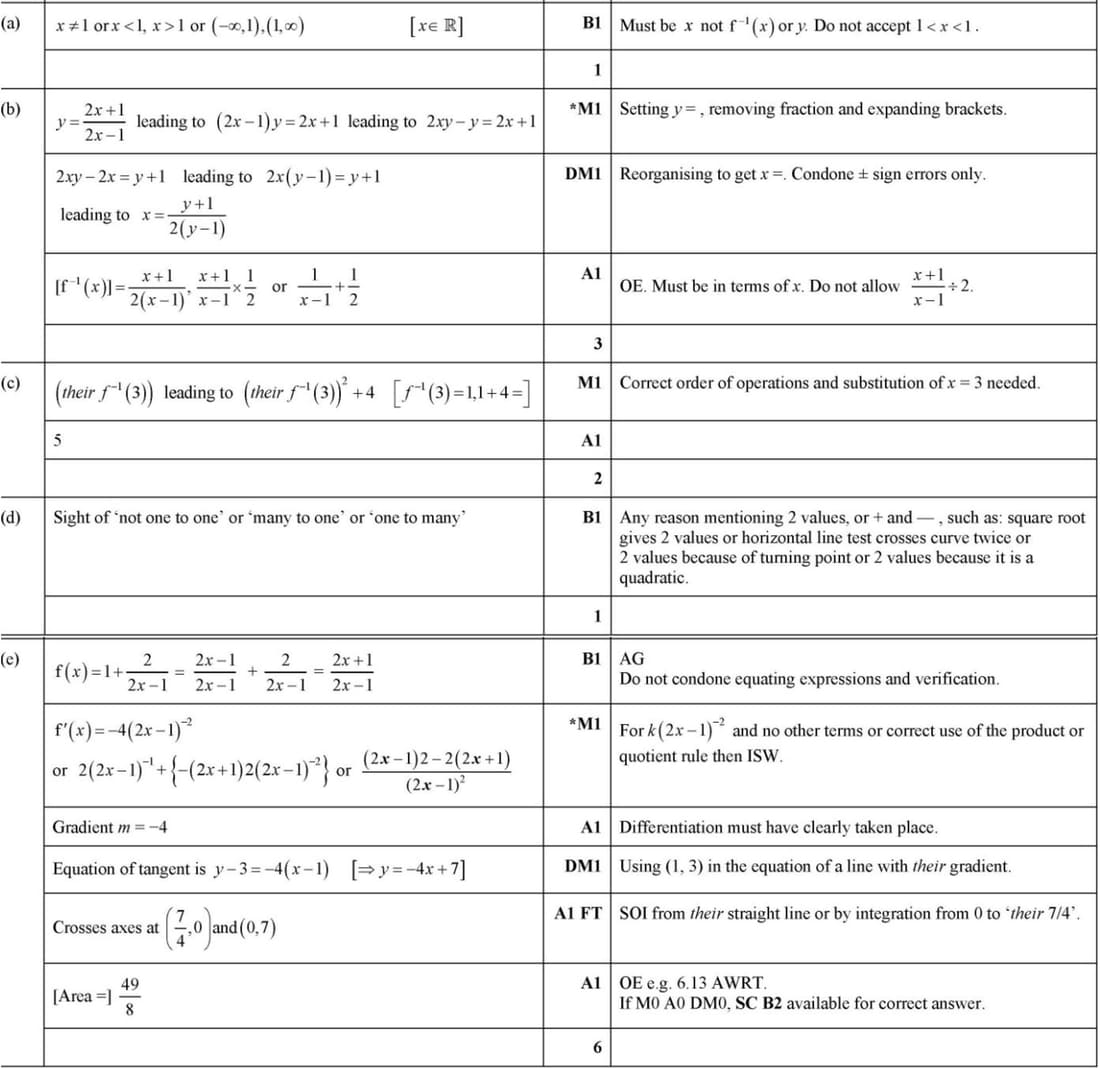
(b) Find an expression for \(f^{-1}(x)\).
(c) Find \(gf^{-1}(3)\).
(d) Explain why \(g^{-1}(x)\) cannot be found.
(e) Show that \(1 + \frac{2}{2x-1}\) can be expressed as \(\frac{2x+1}{2x-1}\). Hence find the area of the triangle enclosed by the tangent to the curve \(y = f(x)\) at the point where \(x = 1\) and the x- and y-axes.
9709 P12 - Nov 2019 - Q9
Functions f and g are defined by
\(f(x) = 2x^2 + 8x + 1\) for \(x \in \mathbb{R}\),
\(g(x) = 2x - k\) for \(x \in \mathbb{R}\),
where \(k\) is a constant.
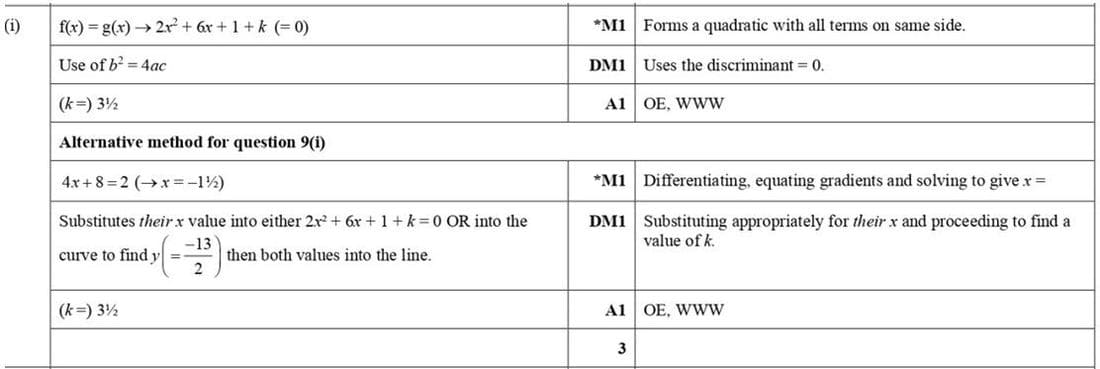
Find the value of \(k\) for which the line \(y = g(x)\) is a tangent to the curve \(y = f(x)\).
9709 P1 - Jun 2008 - Q8
Functions f and g are defined by
\(f : x \mapsto 4x - 2k\) for \(x \in \mathbb{R}\), where \(k\) is a constant,
\(g : x \mapsto \frac{9}{2-x}\) for \(x \in \mathbb{R}, x \neq 2\).
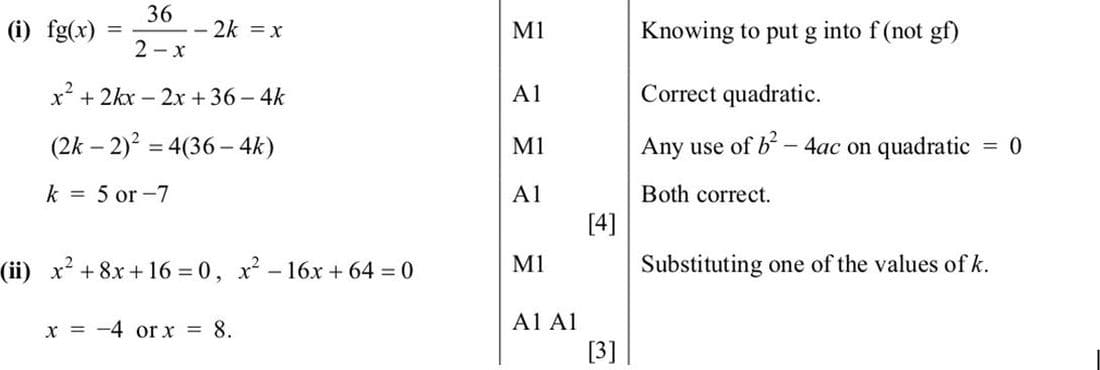
(i) Find the values of \(k\) for which the equation \(fg(x) = x\) has two equal roots. [4]
(ii) Determine the roots of the equation \(fg(x) = x\) for the values of \(k\) found in part (i). [3]
9709 P1 - Jun 2006 - Q11
Functions f and g are defined by
\(f : x \mapsto k - x\) for \(x \in \mathbb{R}\), where \(k\) is a constant,
\(g : x \mapsto \frac{9}{x+2}\) for \(x \in \mathbb{R}, x \neq -2\).
- Find the values of \(k\) for which the equation \(f(x) = g(x)\) has two equal roots and solve the equation \(f(x) = g(x)\) in these cases. [6]
- Solve the equation \(fg(x) = 5\) when \(k = 6\). [3]
- Express \(g^{-1}(x)\) in terms of \(x\). [2]

9709 P1 - Nov 2004 - Q9
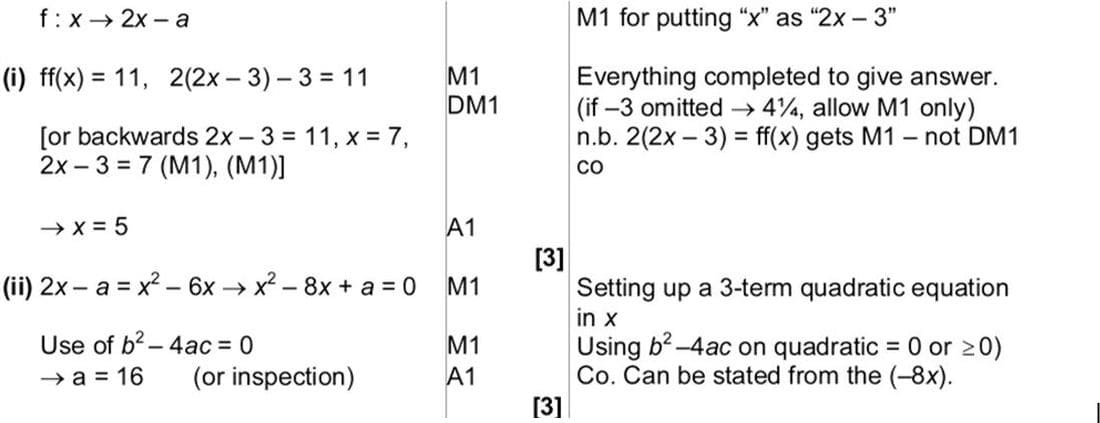
The function \(f : x \mapsto 2x - a\), where \(a\) is a constant, is defined for all real \(x\).
(i) In the case where \(a = 3\), solve the equation \(ff(x) = 11\).
The function \(g : x \mapsto x^2 - 6x\) is defined for all real \(x\).
(ii) Find the value of \(a\) for which the equation \(f(x) = g(x)\) has exactly one real solution.
9709 P1 - Jun 2004 - Q10
The functions f and g are defined as follows:
\(f : x \mapsto x^2 - 2x, \quad x \in \mathbb{R},\)
\(g : x \mapsto 2x + 3, \quad x \in \mathbb{R}.\)
Show that the equation \(gf(x) = 0\) has no real solutions.

9709 P1 - Nov 2003 - Q10
Functions f and g are defined by
\(f : x \mapsto 2x - 5, \; x \in \mathbb{R},\)
\(g : x \mapsto \frac{4}{2-x}, \; x \in \mathbb{R}, \; x \neq 2.\)
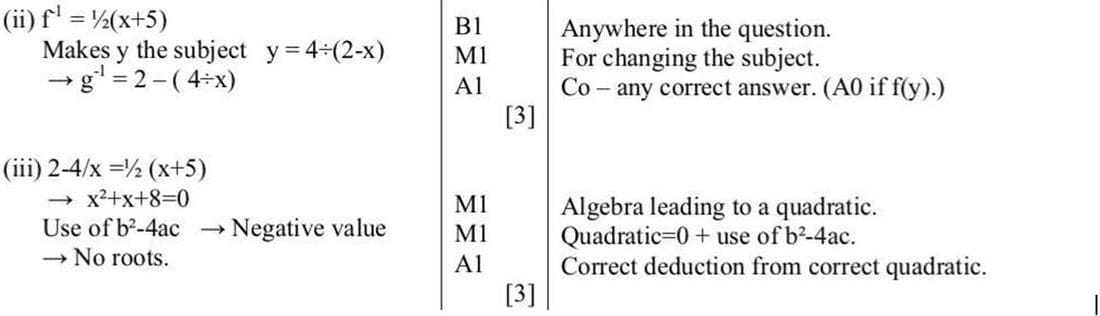
(ii) Express each of \(f^{-1}(x)\) and \(g^{-1}(x)\) in terms of \(x\).
(iii) Show that the equation \(f^{-1}(x) = g^{-1}(x)\) has no real roots.
9709 P11 - Jun 2017 - Q9
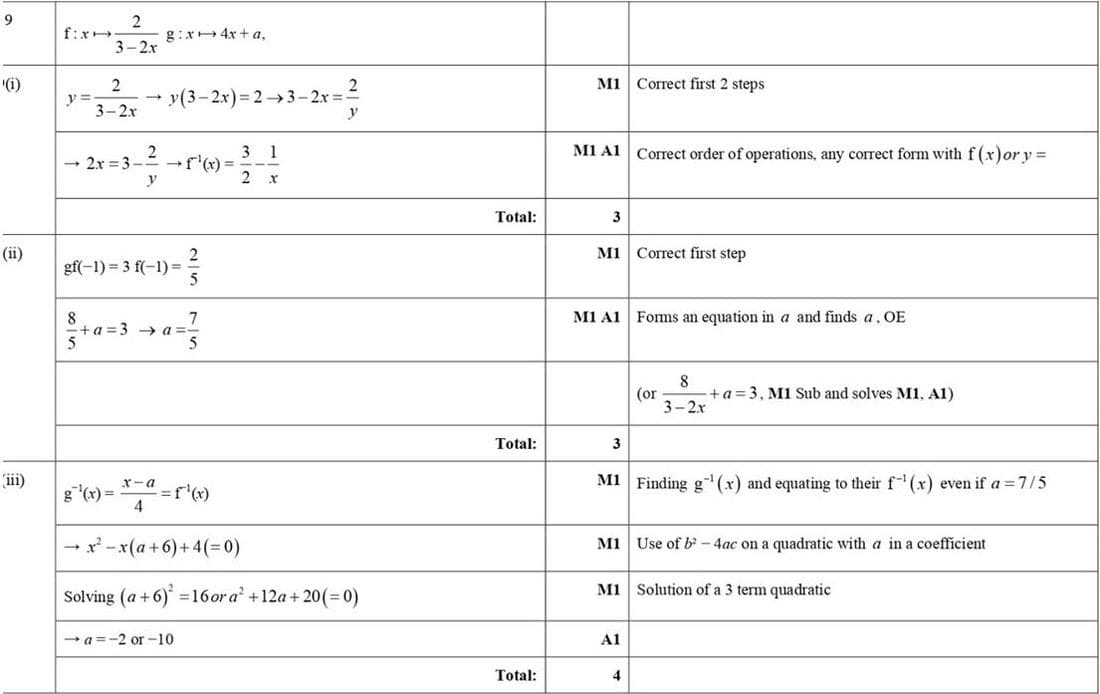
The function f is defined by \(f : x \mapsto \frac{2}{3 - 2x}\) for \(x \in \mathbb{R}, x \neq \frac{3}{2}\).
(i) Find an expression for \(f^{-1}(x)\).
The function g is defined by \(g : x \mapsto 4x + a\) for \(x \in \mathbb{R}\), where \(a\) is a constant.
(ii) Find the value of \(a\) for which \(gf(-1) = 3\).
(iii) Find the possible values of \(a\) given that the equation \(f^{-1}(x) = g^{-1}(x)\) has two equal roots.