Past Exam Questions
← Back9709 P1 - Jun 2003 - Q11
The equation of a curve is \(y = 8x - x^2\).
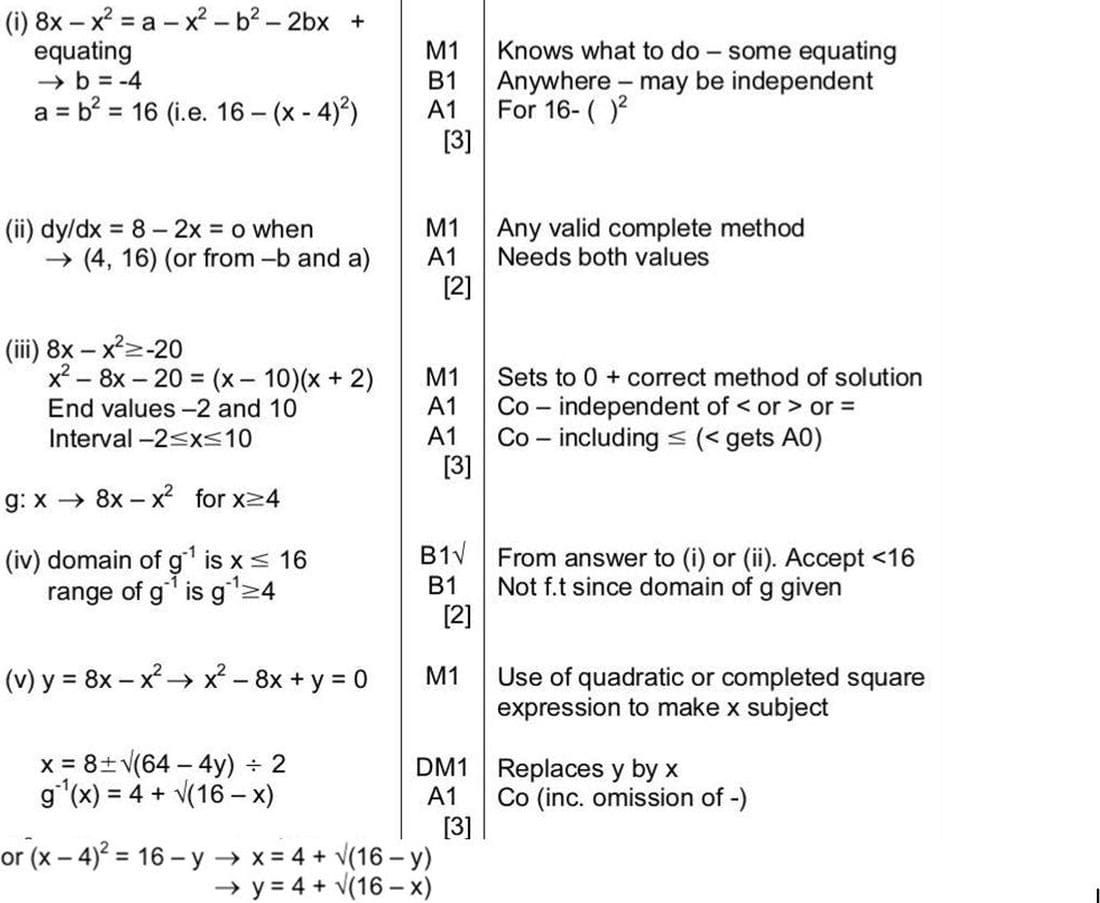
(i) Express \(8x - x^2\) in the form \(a - (x + b)^2\), stating the numerical values of \(a\) and \(b\).
(ii) Hence, or otherwise, find the coordinates of the stationary point of the curve.
(iii) Find the set of values of \(x\) for which \(y \geq -20\).
The function \(g\) is defined by \(g : x \mapsto 8x - x^2\), for \(x \geq 4\).
(iv) State the domain and range of \(g^{-1}\).
(v) Find an expression, in terms of \(x\), for \(g^{-1}(x)\).
9709 P12 - Nov 2023 - Q8
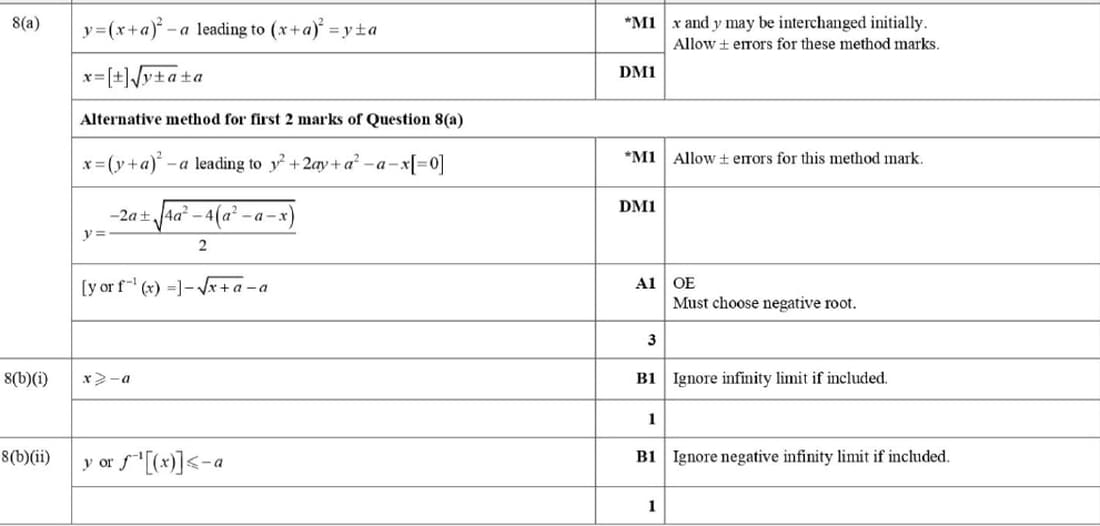
Given the function \(f(x) = (x + a)^2 - a\) for \(x \leq -a\), where \(a\) is a positive constant:
(a) Find an expression for \(f^{-1}(x)\).
(b) (i) State the domain of the function \(f^{-1}\).
(ii) State the range of the function \(f^{-1}\).
9709 P13 - Jun 2023 - Q7
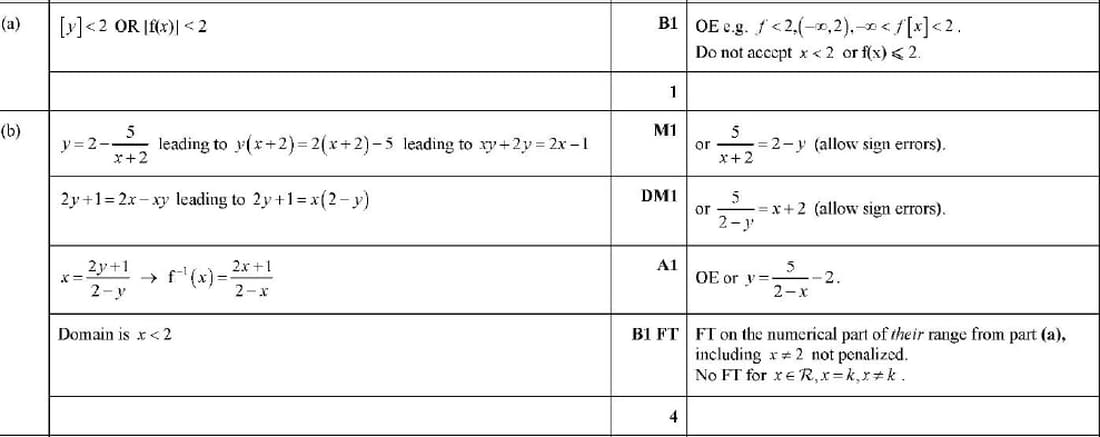
The function \(f\) is defined by \(f(x) = 2 - \frac{5}{x+2}\) for \(x > -2\).
(a) State the range of \(f\).
(b) Obtain an expression for \(f^{-1}(x)\) and state the domain of \(f^{-1}\).
9709 P13 - Nov 2019 - Q2
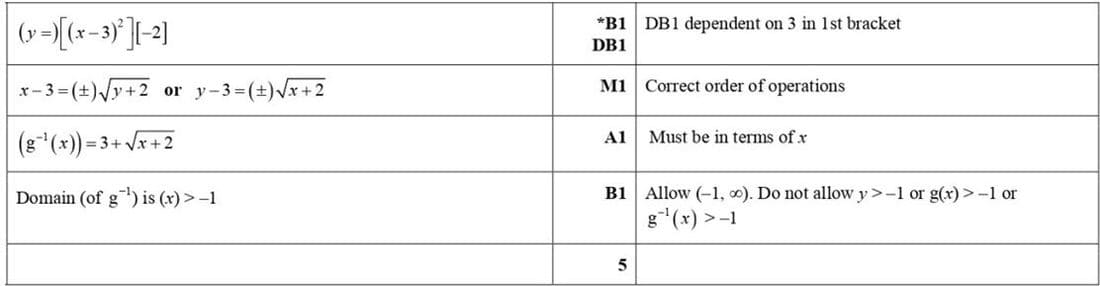
The function \(g\) is defined by \(g(x) = x^2 - 6x + 7\) for \(x > 4\). By first completing the square, find an expression for \(g^{-1}(x)\) and state the domain of \(g^{-1}\).
9709 P13 - Jun 2017 - Q9
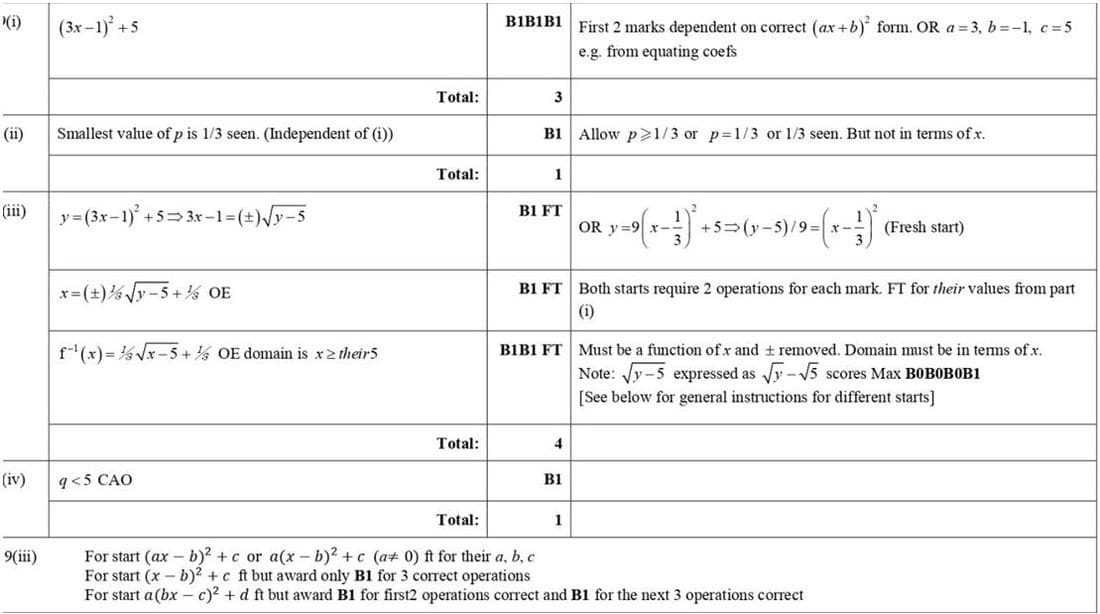
(i) Express \(9x^2 - 6x + 6\) in the form \((ax + b)^2 + c\), where \(a, b\) and \(c\) are constants.
The function \(f\) is defined by \(f(x) = 9x^2 - 6x + 6\) for \(x \geq p\), where \(p\) is a constant.
(ii) State the smallest value of \(p\) for which \(f\) is a one-one function.
(iii) For this value of \(p\), obtain an expression for \(f^{-1}(x)\), and state the domain of \(f^{-1}\).
(iv) State the set of values of \(q\) for which the equation \(f(x) = q\) has no solution.
9709 P11 - Nov 2015 - Q9
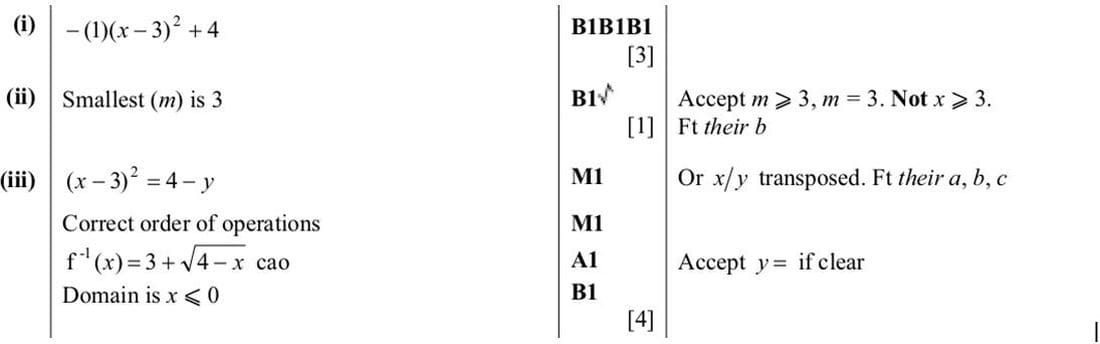
(i) Express \(-x^2 + 6x - 5\) in the form \(a(x + b)^2 + c\), where \(a, b\) and \(c\) are constants.
The function \(f : x \mapsto -x^2 + 6x - 5\) is defined for \(x \geq m\), where \(m\) is a constant.
(ii) State the smallest value of \(m\) for which \(f\) is one-one.
(iii) For the case where \(m = 5\), find an expression for \(f^{-1}(x)\) and state the domain of \(f^{-1}\).
9709 P13 - Jun 2014 - Q5
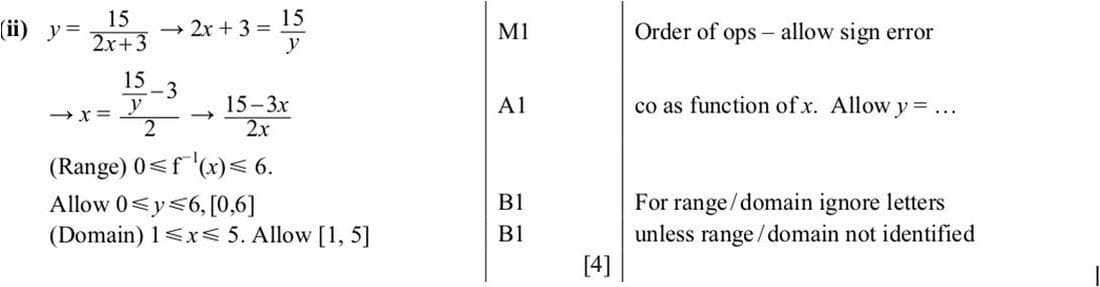
A function \(f\) is such that \(f(x) = \frac{15}{2x+3}\) for \(0 \leq x \leq 6\).
Find an expression for \(f^{-1}(x)\), and state the domain and range of \(f^{-1}\).
9709 P12 - Jun 2013 - Q9
A function \(f\) is defined by \(f(x) = \frac{5}{1 - 3x}\), for \(x \geq 1\).
Find an expression for \(f^{-1}(x)\), and state the domain and range of \(f^{-1}\).

9709 P11 - Jun 2013 - Q8
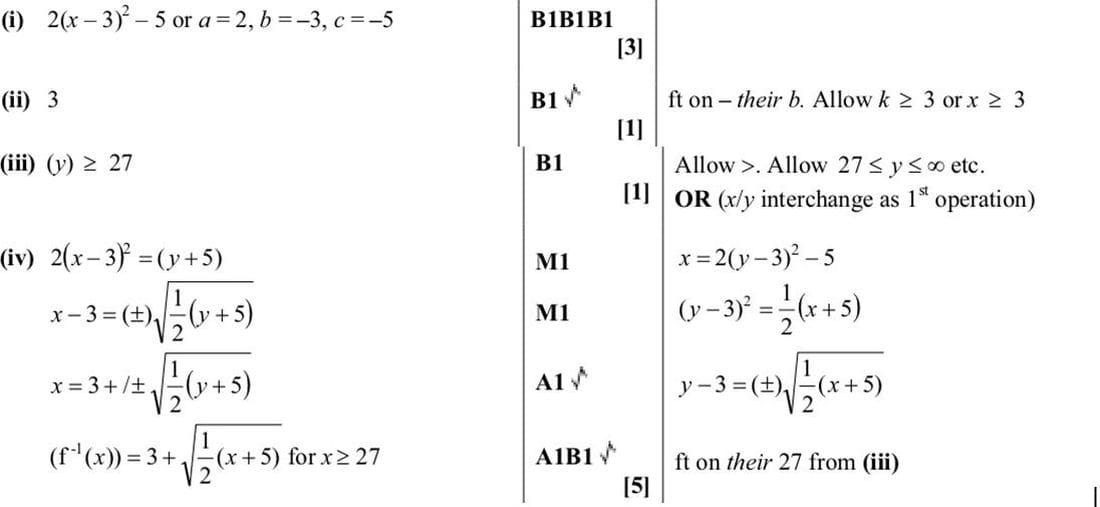
(i) Express \(2x^2 - 12x + 13\) in the form \(a(x + b)^2 + c\), where \(a, b\) and \(c\) are constants.
(ii) The function \(f\) is defined by \(f(x) = 2x^2 - 12x + 13\) for \(x \geq k\), where \(k\) is a constant. It is given that \(f\) is a one-one function. State the smallest possible value of \(k\).
The value of \(k\) is now given to be 7.
(iii) Find the range of \(f\).
(iv) Find an expression for \(f^{-1}(x)\) and state the domain of \(f^{-1}\).
9709 P13 - Nov 2023 - Q7
The function f is defined by \(f(x) = 1 + \frac{3}{x-2}\) for \(x > 2\).
The function g is defined by \(g(x) = 2x - 2\) for \(x > 0\).
Obtain a simplified expression for \(gf(x)\).

9709 P12 - Mar 2022 - Q9
Functions f, g and h are defined as follows:
\(f : x ↦ x - 4x^{\frac{1}{2}} + 1 \text{ for } x \geq 0,\)
g : x ↦ mx^2 + n \text{ for } x \geq -2, \text{ where } m \text{ and } n \text{ are constants,}
\(h : x ↦ x^{\frac{1}{2}} - 2 \text{ for } x \geq 0.\)
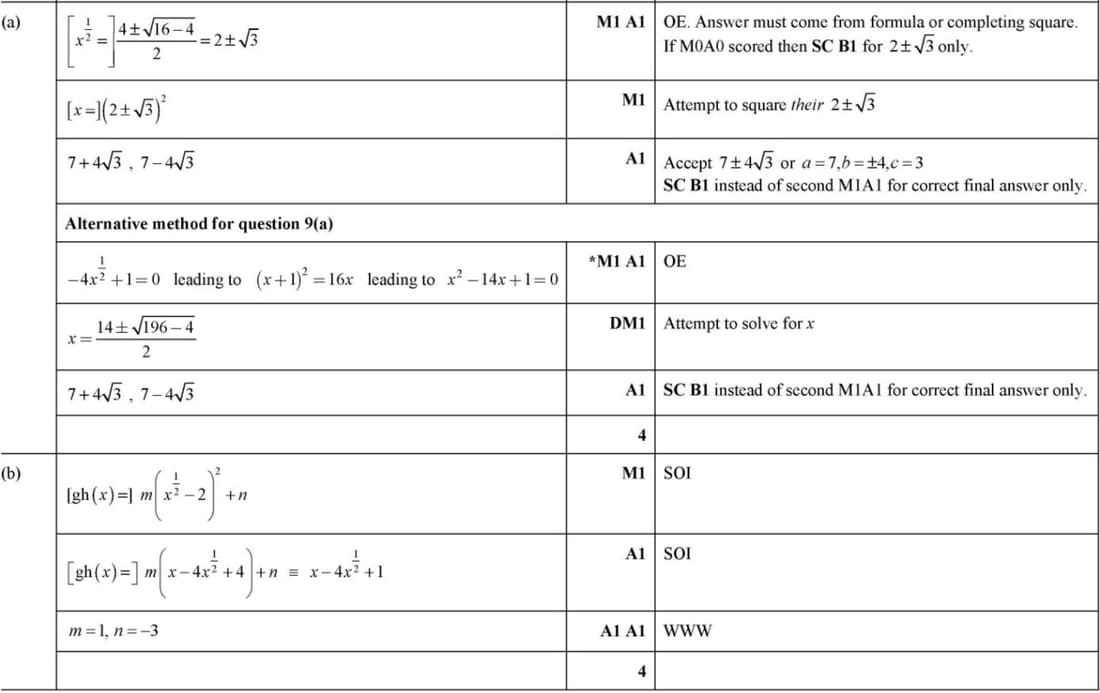
\((a) Solve the equation f(x) = 0, giving your solutions in the form x = a + b\sqrt{c}, where a, b and c are integers. [4]\)
(b) Given that f(x) \equiv gh(x), find the values of m and n. [4]
9709 P13 - Nov 2021 - Q6
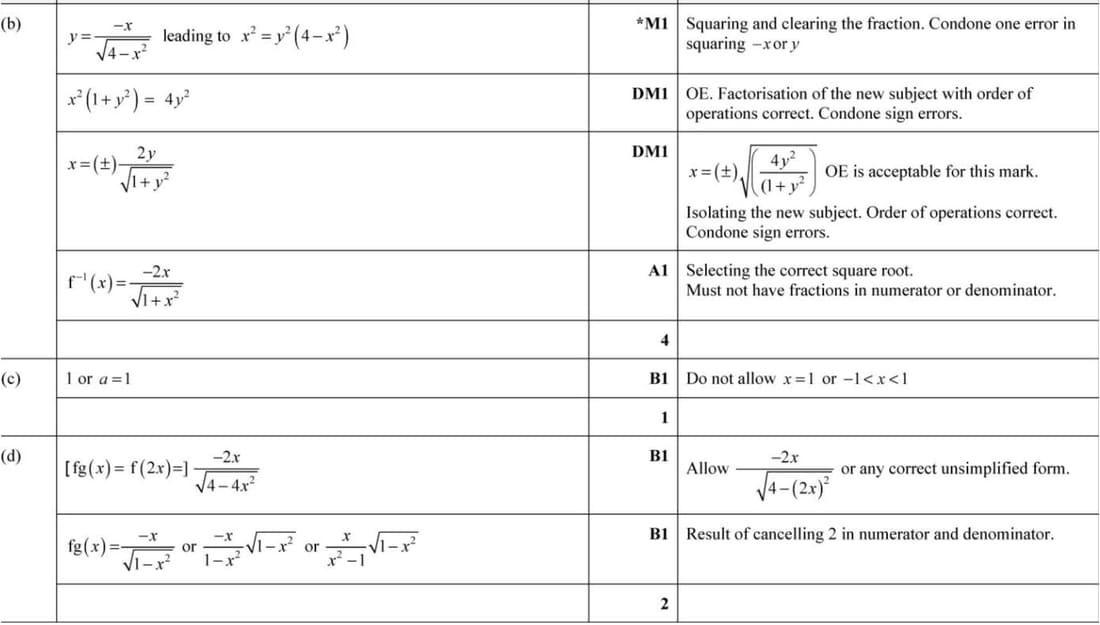
It is now given that \(f(x) = \frac{-x}{\sqrt{4-x^2}}\) where \(-2 < x < 2\).
(b) Find an expression for \(f^{-1}(x)\).
The function \(g\) is defined by \(g(x) = 2x\) for \(-a < x < a\), where \(a\) is a constant.
(c) State the maximum possible value of \(a\) for which \(fg\) can be formed.
(d) Assuming that \(fg\) can be formed, find and simplify an expression for \(fg(x)\).
9709 P12 - Nov 2021 - Q3
The function \(f\) is defined as follows:
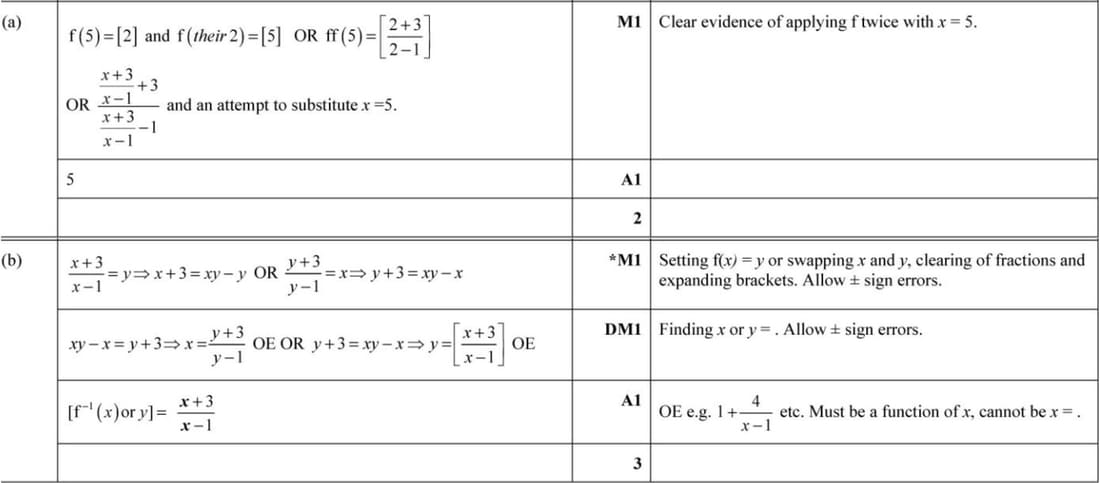
\(f(x) = \frac{x+3}{x-1}\) for \(x > 1\).
(a) Find the value of \(ff(5)\).
(b) Find an expression for \(f^{-1}(x)\).
9709 P13 - Jun 2021 - Q8
Functions f and g are defined as follows:
\(f : x \mapsto x^2 - 1\) for \(x < 0\),
\(g : x \mapsto \frac{1}{2x+1}\) for \(x < -\frac{1}{2}\).
(a) Solve the equation \(fg(x) = 3\).
(b) Find an expression for \((fg)^{-1}(x)\).

9709 P12 - Jun 2021 - Q5
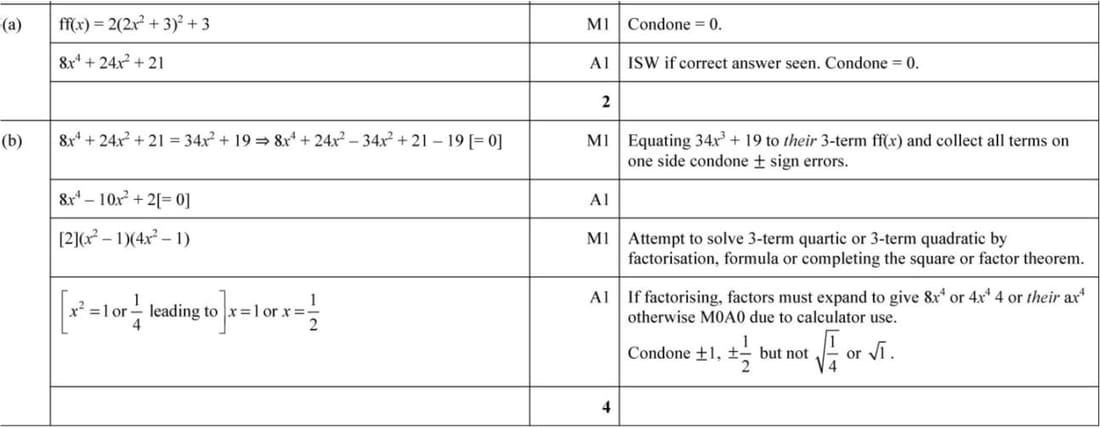
The function \(f\) is defined by \(f(x) = 2x^2 + 3\) for \(x \geq 0\).
(a) Find and simplify an expression for \(ff(x)\).
(b) Solve the equation \(ff(x) = 34x^2 + 19\).
9709 P11 - Jun 2021 - Q9
Functions f and g are defined as follows:
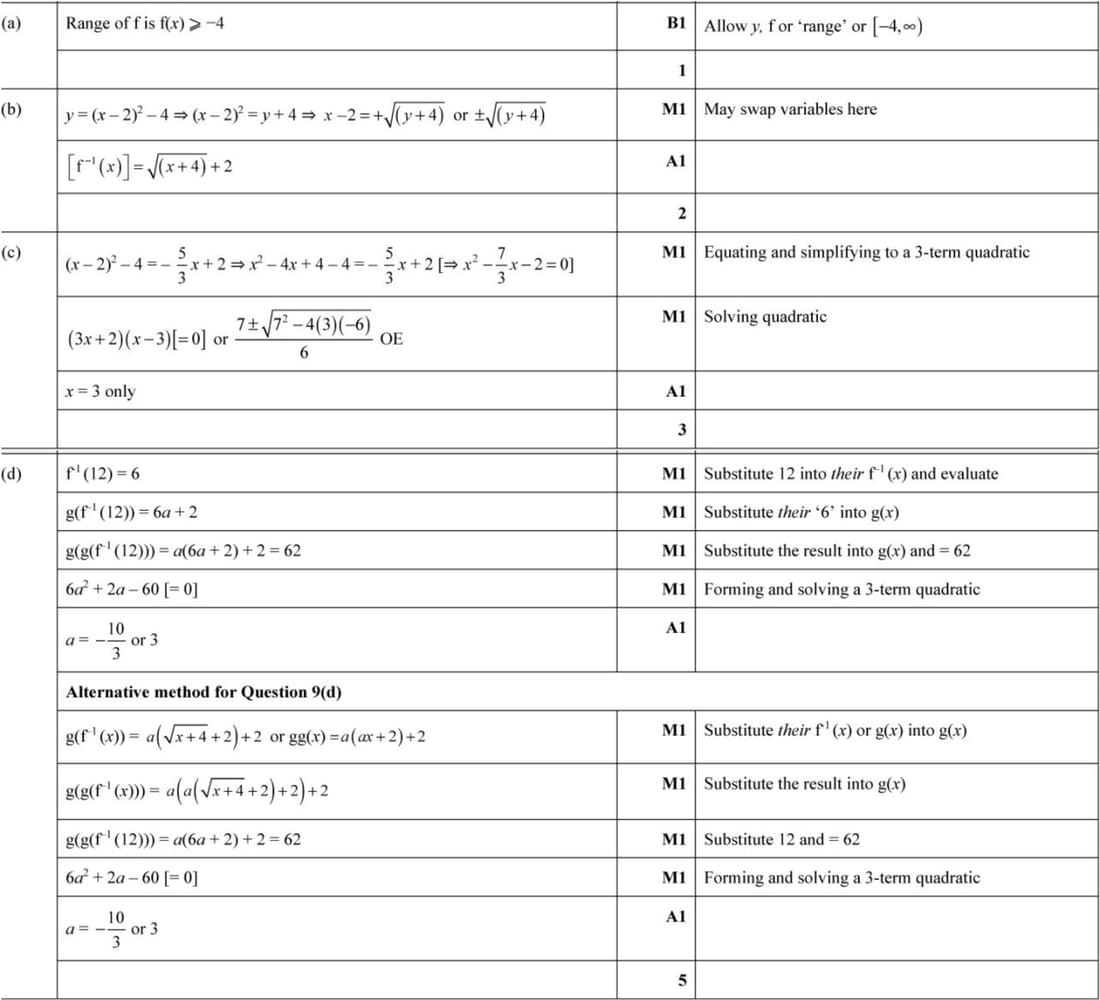
\(f(x) = (x - 2)^2 - 4\) for \(x \geq 2\),
\(g(x) = ax + 2\) for \(x \in \mathbb{R}\),
where \(a\) is a constant.
(a) State the range of \(f\).
(b) Find \(f^{-1}(x)\).
(c) Given that \(a = -\frac{5}{3}\), solve the equation \(f(x) = g(x)\).
(d) Given instead that \(gg f^{-1}(12) = 62\), find the possible values of \(a\).
9709 P12 - Mar 2021 - Q7
Functions f and g are defined as follows:
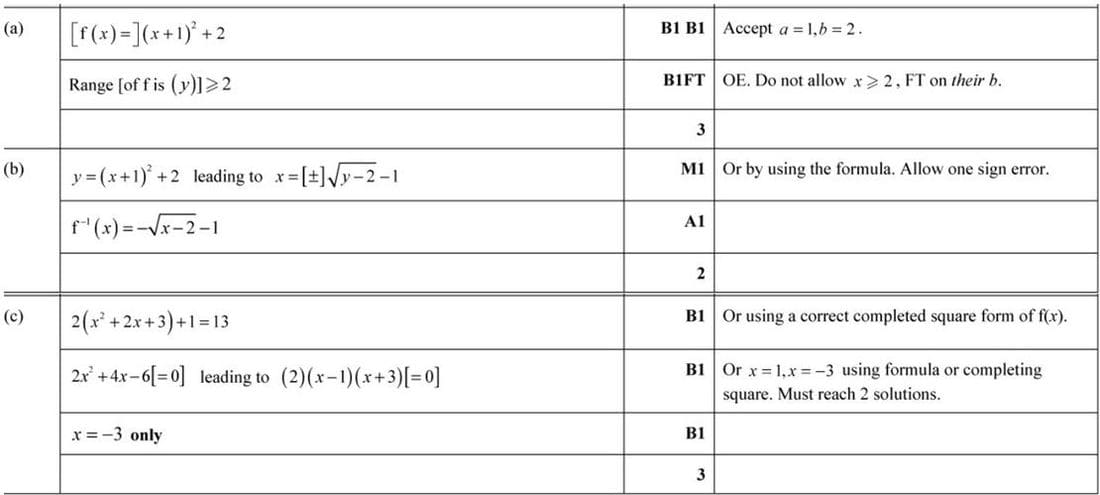
\(f : x \mapsto x^2 + 2x + 3\) for \(x \leq -1\),
\(g : x \mapsto 2x + 1\) for \(x \geq -1\).
(a) Express \(f(x)\) in the form \((x+a)^2 + b\) and state the range of \(f\).
(b) Find an expression for \(f^{-1}(x)\).
(c) Solve the equation \(gf(x) = 13\).
9709 P12 - Nov 2020 - Q5
Functions f and g are defined by
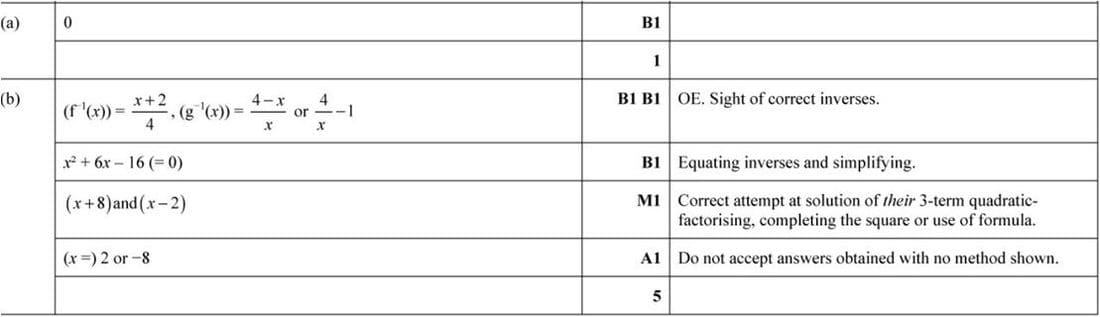
\(f(x) = 4x - 2, \text{ for } x \in \mathbb{R},\)
\(g(x) = \frac{4}{x+1}, \text{ for } x \in \mathbb{R}, x \neq -1.\)
(a) Find the value of \(fg(7)\).
(b) Find the values of \(x\) for which \(f^{-1}(x) = g^{-1}(x)\).
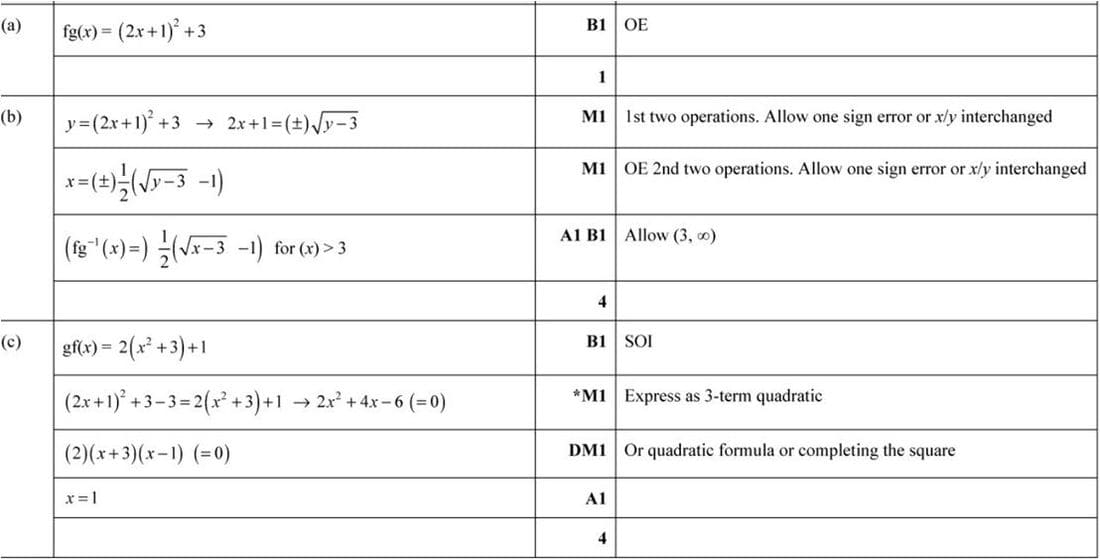
9709 P11 - Nov 2020 - Q11
The functions f and g are defined by
\(f(x) = x^2 + 3\) for \(x > 0\),
\(g(x) = 2x + 1\) for \(x > -\frac{1}{2}\).
(a) Find an expression for \(fg(x)\).
(b) Find an expression for \((fg)^{-1}(x)\) and state the domain of \((fg)^{-1}\).
(c) Solve the equation \(fg(x) - 3 = gf(x)\).
9709 P12 - Jun 2020 - Q5
The function \(f\) is defined for \(x \in \mathbb{R}\) by
\(f : x \mapsto a - 2x\),
where \(a\) is a constant.
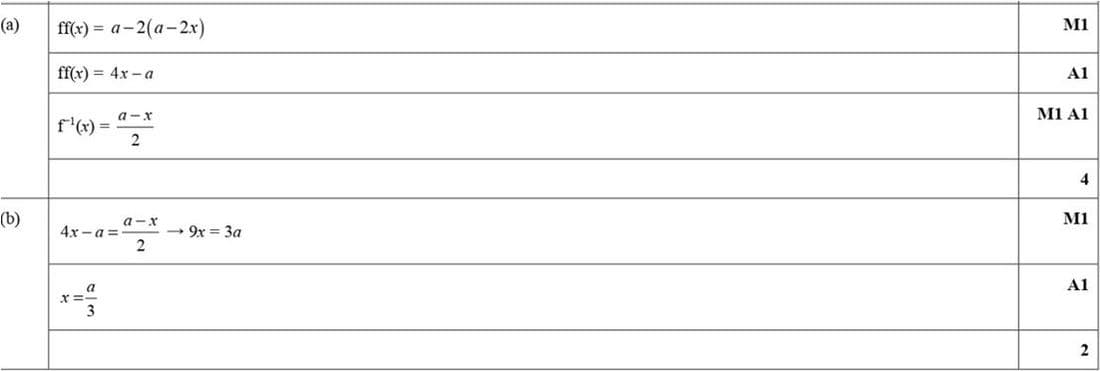
(a) Express \(ff(x)\) and \(f^{-1}(x)\) in terms of \(a\) and \(x\).
(b) Given that \(ff(x) = f^{-1}(x)\), find \(x\) in terms of \(a\).