Browsing as Guest. Progress, bookmarks and attempts are disabled.
Log in to track your work.
Feb/Mar 2023 p12 q2
662
A function f is defined by \(f(x) = x^2 - 2x + 5\) for \(x \in \mathbb{R}\). A sequence of transformations is applied in the following order to the graph of \(y = f(x)\) to give the graph of \(y = g(x)\).
1. Stretch parallel to the x-axis with scale factor \(\frac{1}{2}\)
2. Reflection in the y-axis
3. Stretch parallel to the y-axis with scale factor 3
Find \(g(x)\), giving your answer in the form \(ax^2 + bx + c\), where \(a, b\) and \(c\) are constants.
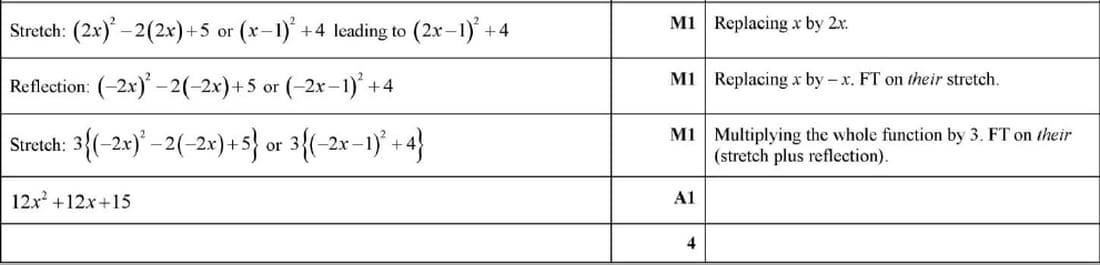
Solution
Start with the function \(f(x) = x^2 - 2x + 5\).
1. Stretch parallel to the x-axis with scale factor \(\frac{1}{2}\): Replace \(x\) with \(2x\). The function becomes \((2x)^2 - 2(2x) + 5 = 4x^2 - 4x + 5\).
2. Reflection in the y-axis: Replace \(x\) with \(-x\). The function becomes \((-2x)^2 - 2(-2x) + 5 = 4x^2 + 4x + 5\).
3. Stretch parallel to the y-axis with scale factor 3: Multiply the entire function by 3. The function becomes \(3(4x^2 + 4x + 5) = 12x^2 + 12x + 15\).