Browsing as Guest. Progress, bookmarks and attempts are disabled.
Log in to track your work.
June 2023 p13 q1
660
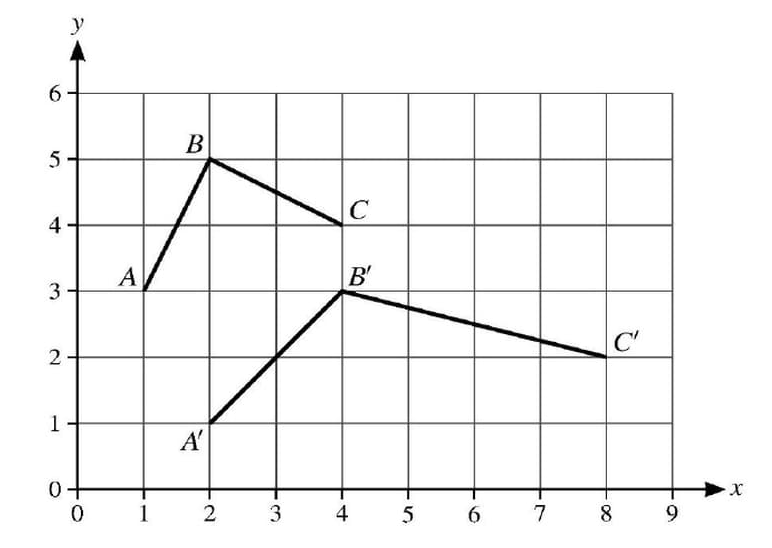
The diagram shows the graph of \(y = f(x)\), which consists of the two straight lines \(AB\) and \(BC\). The lines \(A'B'\) and \(B'C'\) form the graph of \(y = g(x)\), which is the result of applying a sequence of two transformations, in either order, to \(y = f(x)\).
State fully the two transformations.
Solution
The transformation from \(y = f(x)\) to \(y = g(x)\) involves two steps:
1. **Translation**: The graph is translated vertically downwards by 2 units. This is represented by the vector \(\begin{pmatrix} 0 \\ -2 \end{pmatrix}\).
2. **Stretch**: The graph is stretched parallel to the x-axis with a scale factor of 2. This means that each x-coordinate is multiplied by 2, effectively widening the graph horizontally.
These transformations can be applied in either order to achieve the graph of \(y = g(x)\).
