Past Exam Questions
← Back9709 P1 - Nov 2008 - Q10
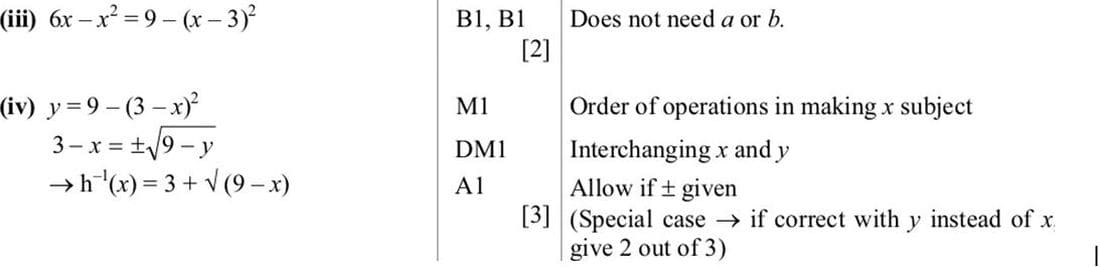
The function h is defined by
\(h : x \mapsto 6x - x^2\) for \(x \geq 3\).
(iii) Express \(6x - x^2\) in the form \(a - (x-b)^2\), where \(a\) and \(b\) are positive constants.
(iv) Express \(h^{-1}(x)\) in terms of \(x\).
9709 P1 - Nov 2006 - Q10
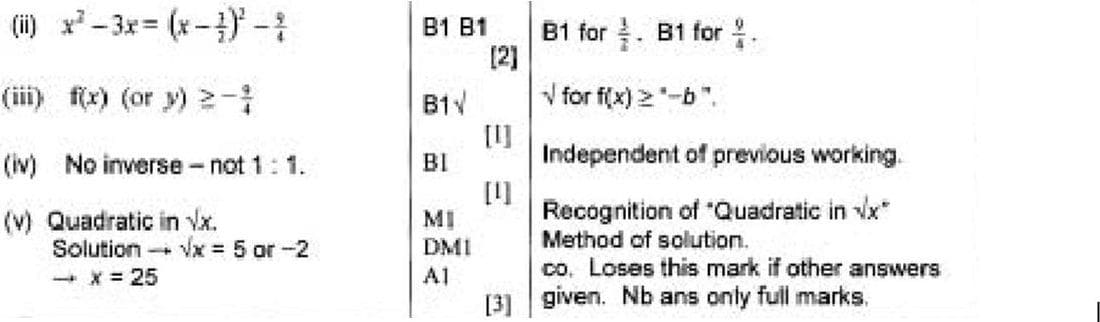
The function f is defined by \(f : x \mapsto x^2 - 3x\) for \(x \in \mathbb{R}\).
(ii) Express \(f(x)\) in the form \((x-a)^2 - b\), stating the values of \(a\) and \(b\).
(iii) Write down the range of \(f\).
(iv) State, with a reason, whether \(f\) has an inverse.
The function \(g\) is defined by \(g : x \mapsto x - 3\sqrt{x}\) for \(x \geq 0\).
(v) Solve the equation \(g(x) = 10\).
9709 P1 - Jun 2004 - Q10
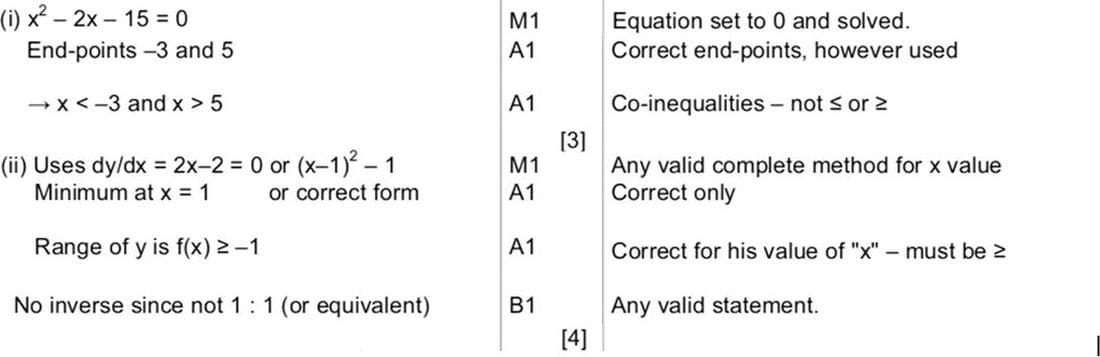
Let \(f : x \mapsto x^2 - 2x\), where \(x \in \mathbb{R}\).
(i) Find the set of values of \(x\) for which \(f(x) > 15\).
(ii) Find the range of \(f\) and state, with a reason, whether \(f\) has an inverse.
9709 P12 - Mar 2023 - Q9 - 4 marks
The function \(f\) is defined by \(f(x) = -3x^2 + 2\) for \(x \leq -1\).
(a) State the range of \(f\).
(b) Find an expression for \(f^{-1}(x)\).

9709 P1 - Nov 2002 - Q11
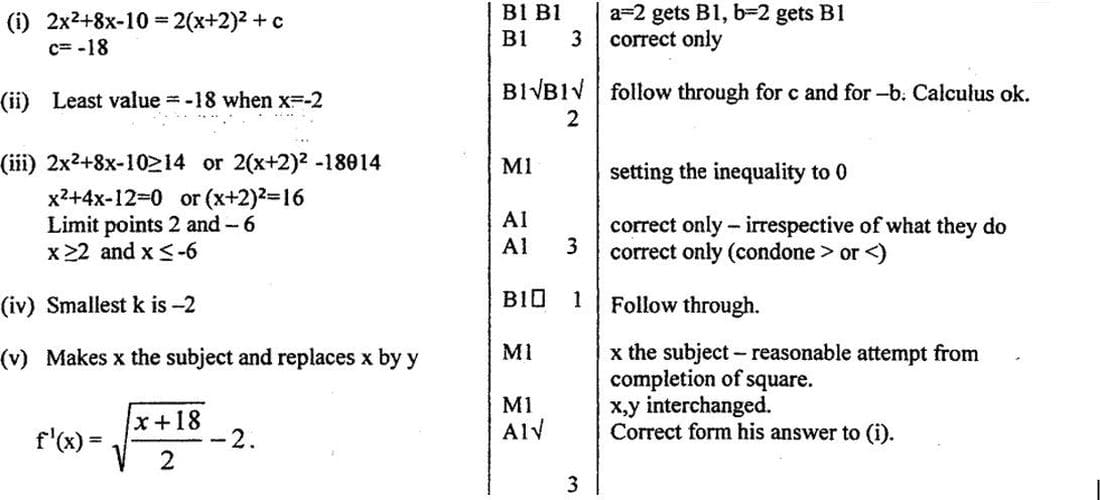
(i) Express \(2x^2 + 8x - 10\) in the form \(a(x + b)^2 + c\).
(ii) For the curve \(y = 2x^2 + 8x - 10\), state the least value of \(y\) and the corresponding value of \(x\).
(iii) Find the set of values of \(x\) for which \(y \geq 14\).
Given that \(f : x \mapsto 2x^2 + 8x - 10\) for the domain \(x \geq k\),
(iv) find the least value of \(k\) for which \(f\) is one-one,
(v) express \(f^{-1}(x)\) in terms of \(x\) in this case.
9709 P13 - Nov 2022 - Q2
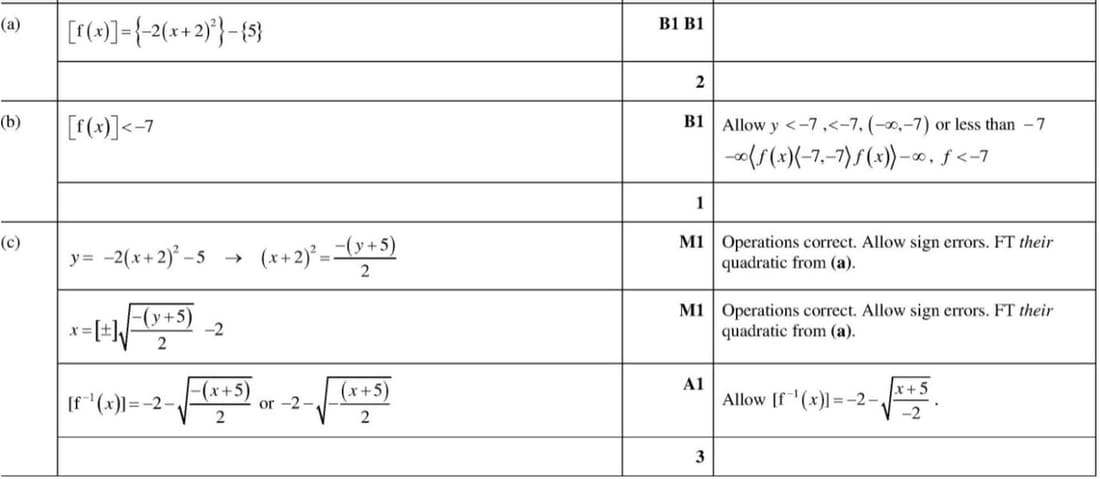
The function f is defined by \(f(x) = -2x^2 - 8x - 13\) for \(x < -3\).
(a) Express \(f(x)\) in the form \(-2(x + a)^2 + b\), where \(a\) and \(b\) are integers.
(b) Find the range of \(f\).
(c) Find an expression for \(f^{-1}(x)\).
9709 P11 - Nov 2022 - Q8
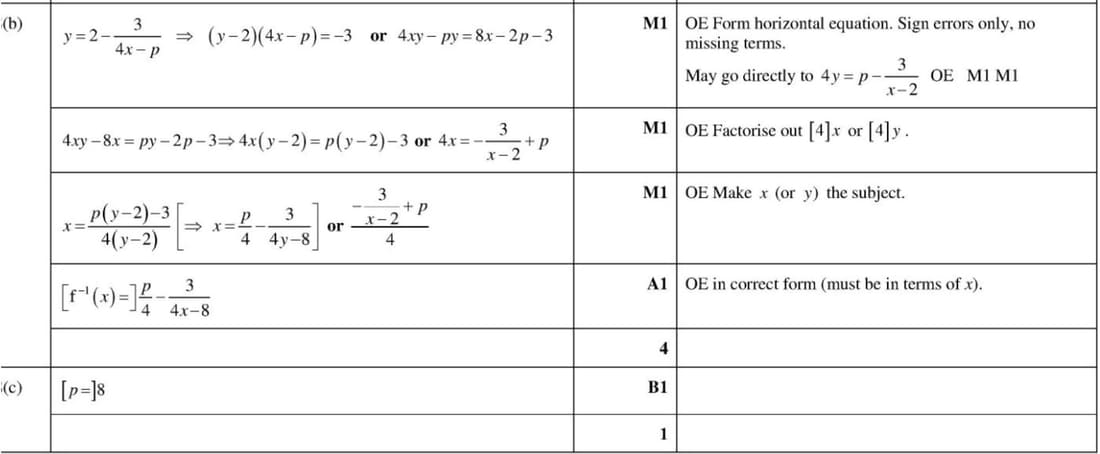
The function \(f\) is defined by \(f(x) = 2 - \frac{3}{4x - p}\) for \(x > \frac{p}{4}\), where \(p\) is a constant.
(b) Express \(f^{-1}(x)\) in the form \(\frac{p}{a} - \frac{b}{cx - d}\), where \(a, b, c\) and \(d\) are integers.
(c) Hence state the value of \(p\) for which \(f^{-1}(x) \equiv f(x)\).
9709 P13 - Jun 2022 - Q6
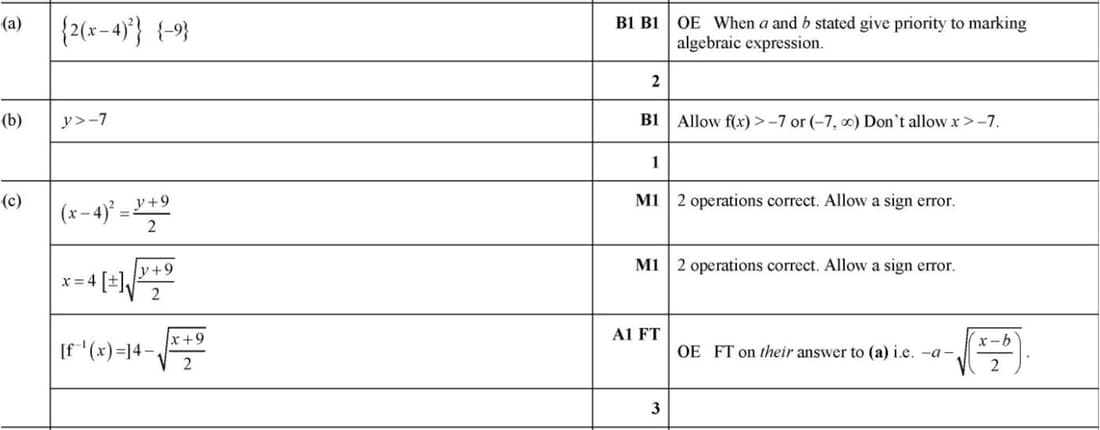
The function \(f\) is defined by \(f(x) = 2x^2 - 16x + 23\) for \(x < 3\).
(a) Express \(f(x)\) in the form \(2(x + a)^2 + b\).
(b) Find the range of \(f\).
(c) Find an expression for \(f^{-1}(x)\).
9709 P11 - Jun 2022 - Q6
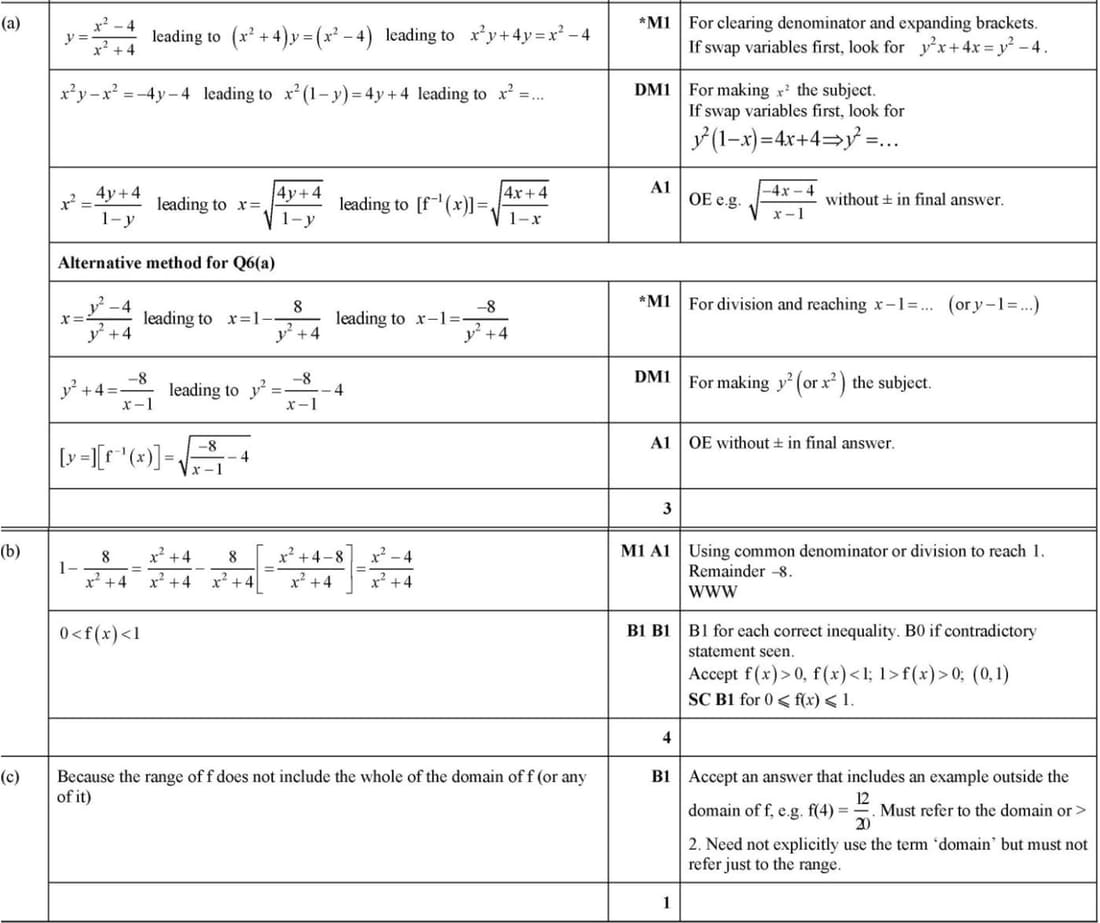
The function f is defined as follows:
\(f(x) = \frac{x^2 - 4}{x^2 + 4}\) for \(x > 2\).
(a) Find an expression for \(f^{-1}(x)\).
(b) Show that \(1 - \frac{8}{x^2 + 4}\) can be expressed as \(\frac{x^2 - 4}{x^2 + 4}\) and hence state the range of \(f\).
(c) Explain why the composite function \(ff\) cannot be formed.
9709 P11 - Nov 2021 - Q8
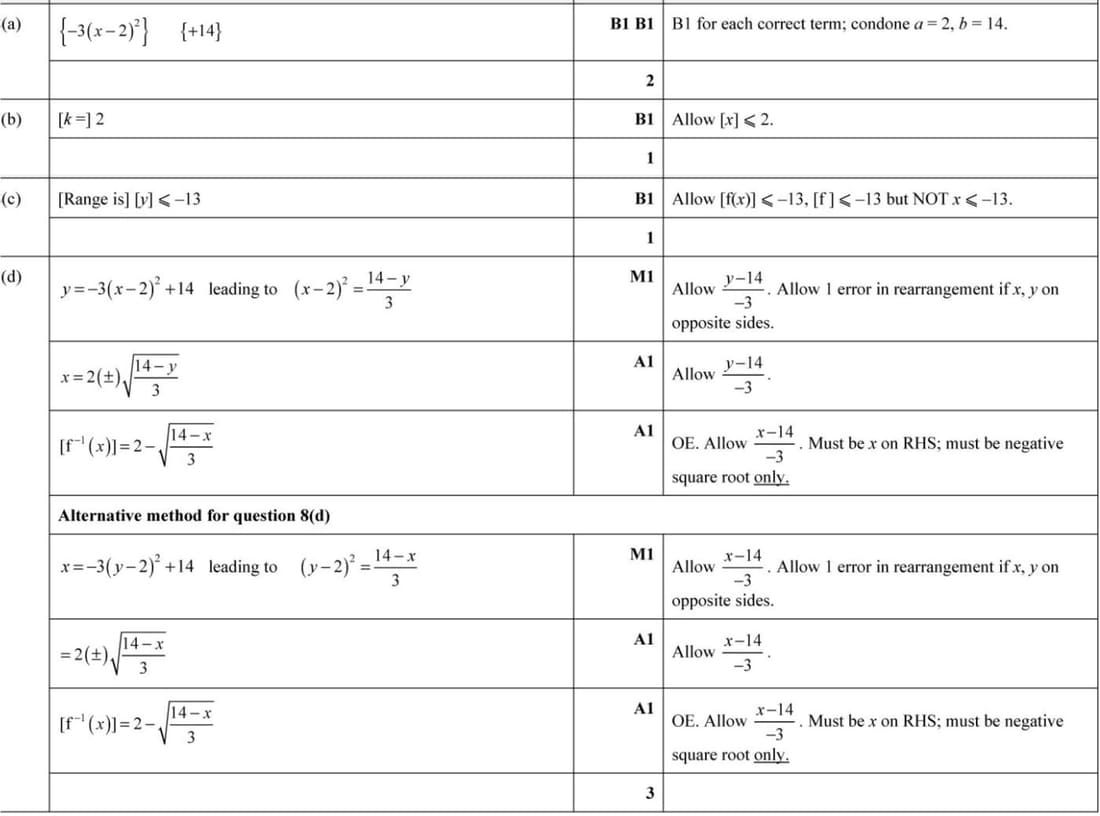
(a) Express \(-3x^2 + 12x + 2\) in the form \(-3(x-a)^2 + b\), where \(a\) and \(b\) are constants.
The one-one function \(f\) is defined by \(f : x \mapsto -3x^2 + 12x + 2\) for \(x \leq k\).
(b) State the largest possible value of the constant \(k\).
It is now given that \(k = -1\).
(c) State the range of \(f\).
(d) Find an expression for \(f^{-1}(x)\).
9709 P13 - Nov 2020 - Q6
The function f is defined by \(f(x) = \frac{2x}{3x-1}\) for \(x > \frac{1}{3}\).
(a) Find an expression for \(f^{-1}(x)\).
(b) Show that \(\frac{2}{3} + \frac{2}{3(3x-1)}\) can be expressed as \(\frac{2x}{3x-1}\).
(c) State the range of \(f\).

9709 P12 - Nov 2018 - Q9
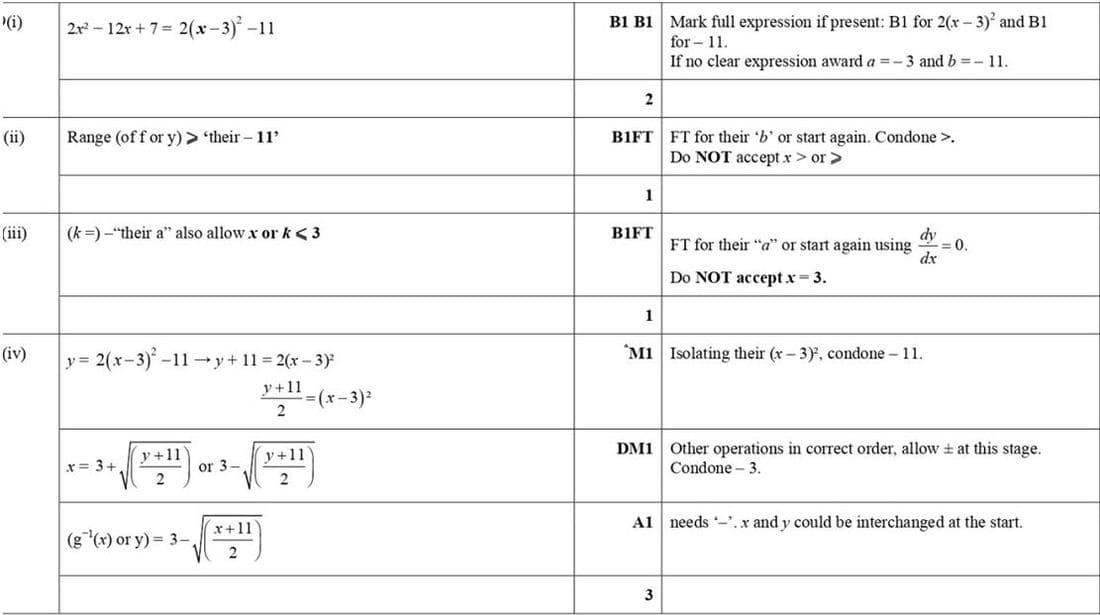
The function f is defined by \(f : x \mapsto 2x^2 - 12x + 7\) for \(x \in \mathbb{R}\).
- Express \(2x^2 - 12x + 7\) in the form \(2(x + a)^2 + b\), where \(a\) and \(b\) are constants.
- State the range of \(f\).
The function \(g\) is defined by \(g : x \mapsto 2x^2 - 12x + 7\) for \(x \leq k\).
- State the largest value of \(k\) for which \(g\) has an inverse.
- Given that \(g\) has an inverse, find an expression for \(g^{-1}(x)\).
9709 P13 - Nov 2023 - Q7
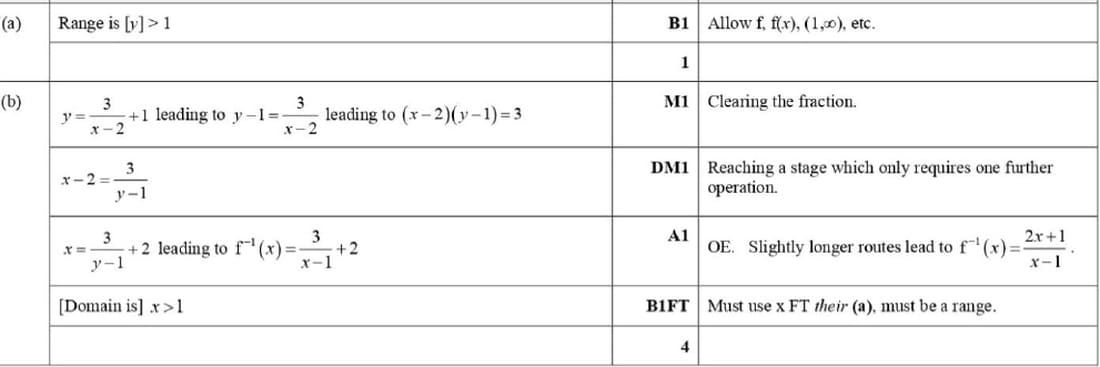
The function \(f\) is defined by \(f(x) = 1 + \frac{3}{x-2}\) for \(x > 2\).
(a) State the range of \(f\).
(b) Obtain an expression for \(f^{-1}(x)\) and state the domain of \(f^{-1}\).
9709 P12 - Nov 2012 - Q2
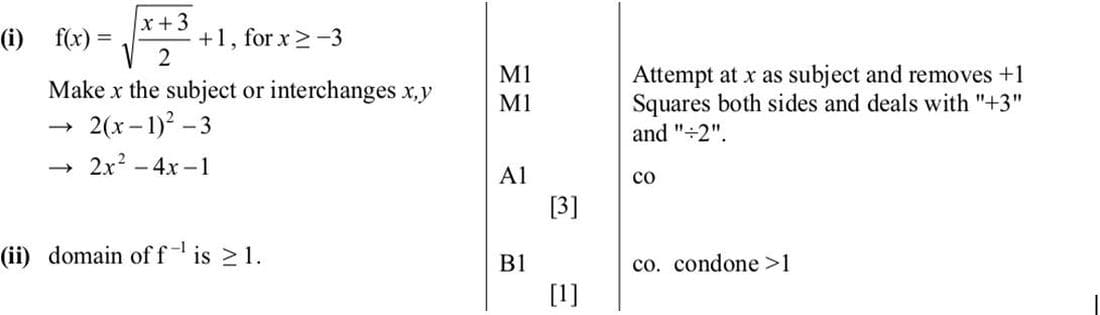
A function \(f\) is such that \(f(x) = \sqrt{\frac{x+3}{2}} + 1\), for \(x \geq -3\). Find
(i) \(f^{-1}(x)\) in the form \(ax^2 + bx + c\), where \(a, b\) and \(c\) are constants,
(ii) the domain of \(f^{-1}\).
9709 P11 - Nov 2012 - Q10
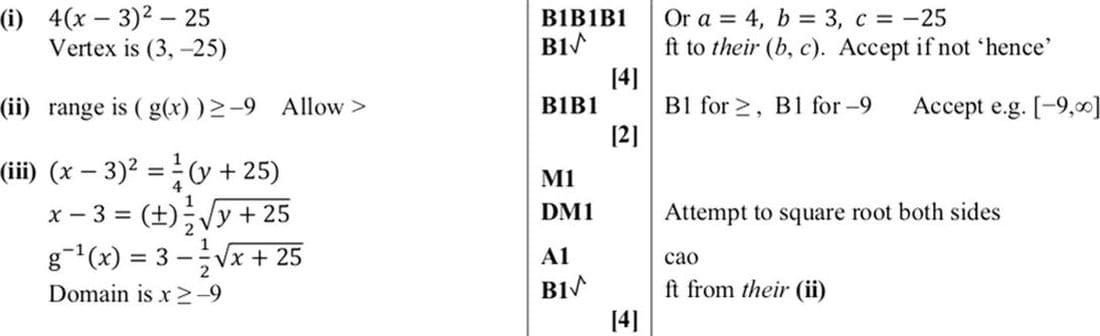
The function f is defined by \(f(x) = 4x^2 - 24x + 11\), for \(x \in \mathbb{R}\).
(i) Express \(f(x)\) in the form \(a(x-b)^2 + c\) and hence state the coordinates of the vertex of the graph of \(y = f(x)\). [4]
The function g is defined by \(g(x) = 4x^2 - 24x + 11\), for \(x \leq 1\).
(ii) State the range of \(g\). [2]
(iii) Find an expression for \(g^{-1}(x)\) and state the domain of \(g^{-1}\). [4]
9709 P12 - Nov 2009 - Q8
The function \(f\) is such that \(f(x) = \frac{3}{2x+5}\) for \(x \in \mathbb{R}, x \neq -2.5\).
Obtain an expression for \(f^{-1}(x)\).

9709 P1 - Jun 2008 - Q6
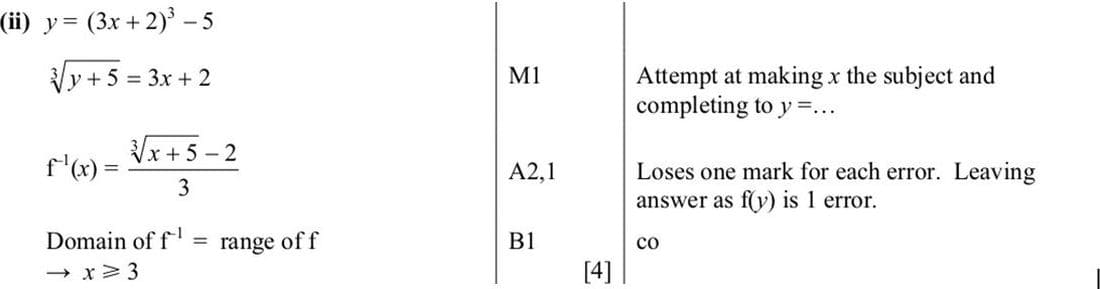
The function \(f\) is such that \(f(x) = (3x + 2)^3 - 5\) for \(x \geq 0\).
Obtain an expression for \(f^{-1}(x)\) and state the domain of \(f^{-1}\).
9709 P1 - Nov 2007 - Q11
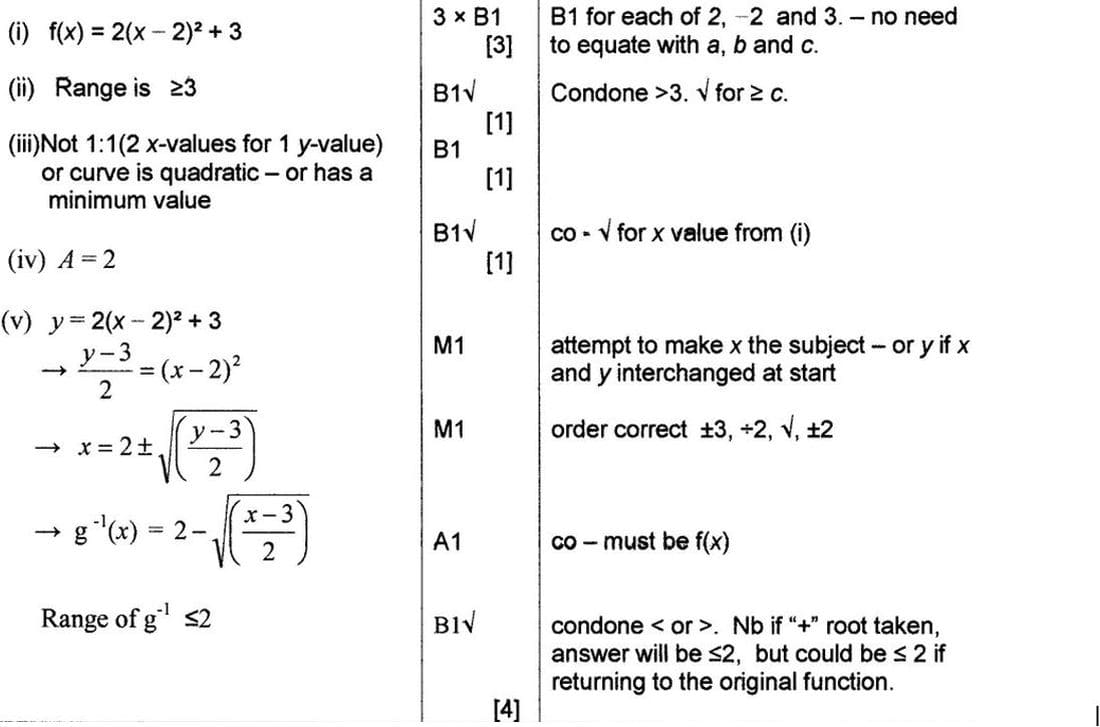
The function f is defined by \(f : x \mapsto 2x^2 - 8x + 11\) for \(x \in \mathbb{R}\).
(i) Express \(f(x)\) in the form \(a(x + b)^2 + c\), where \(a, b\) and \(c\) are constants.
(ii) State the range of \(f\).
(iii) Explain why \(f\) does not have an inverse.
The function \(g\) is defined by \(g : x \mapsto 2x^2 - 8x + 11\) for \(x \leq A\), where \(A\) is a constant.
(iv) State the largest value of \(A\) for which \(g\) has an inverse.
(v) When \(A\) has this value, obtain an expression, in terms of \(x\), for \(g^{-1}(x)\) and state the range of \(g^{-1}\).
9709 P1 - Nov 2005 - Q8
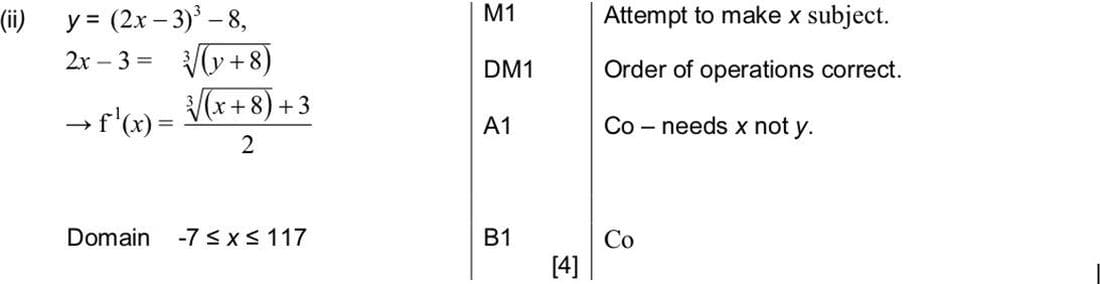
A function f is defined by f : x ↦ (2x − 3)3 − 8, for 2 ≤ x ≤ 4.
Find an expression, in terms of x, for f−1(x) and find the domain of f−1.
9709 P1 - Nov 2004 - Q9
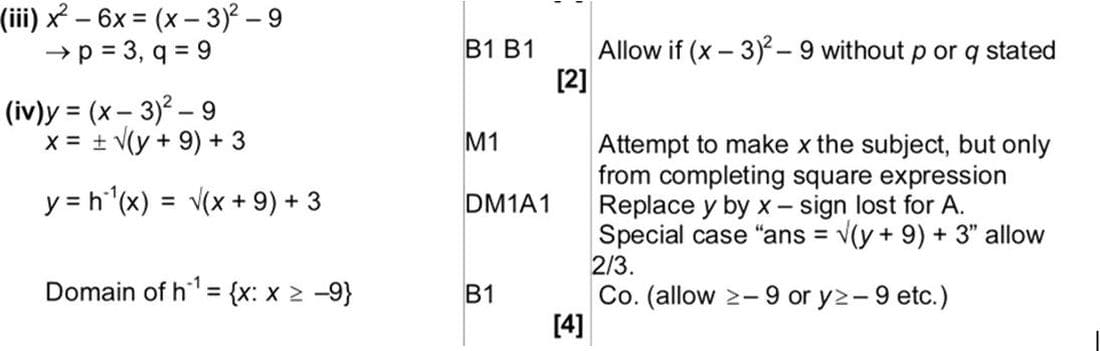
The function \(h : x \mapsto x^2 - 6x\) is defined for the domain \(x \geq 3\).
(iii) Express \(x^2 - 6x\) in the form \((x-p)^2 - q\), where \(p\) and \(q\) are constants.
(iv) Find an expression for \(h^{-1}(x)\) and state the domain of \(h^{-1}\).