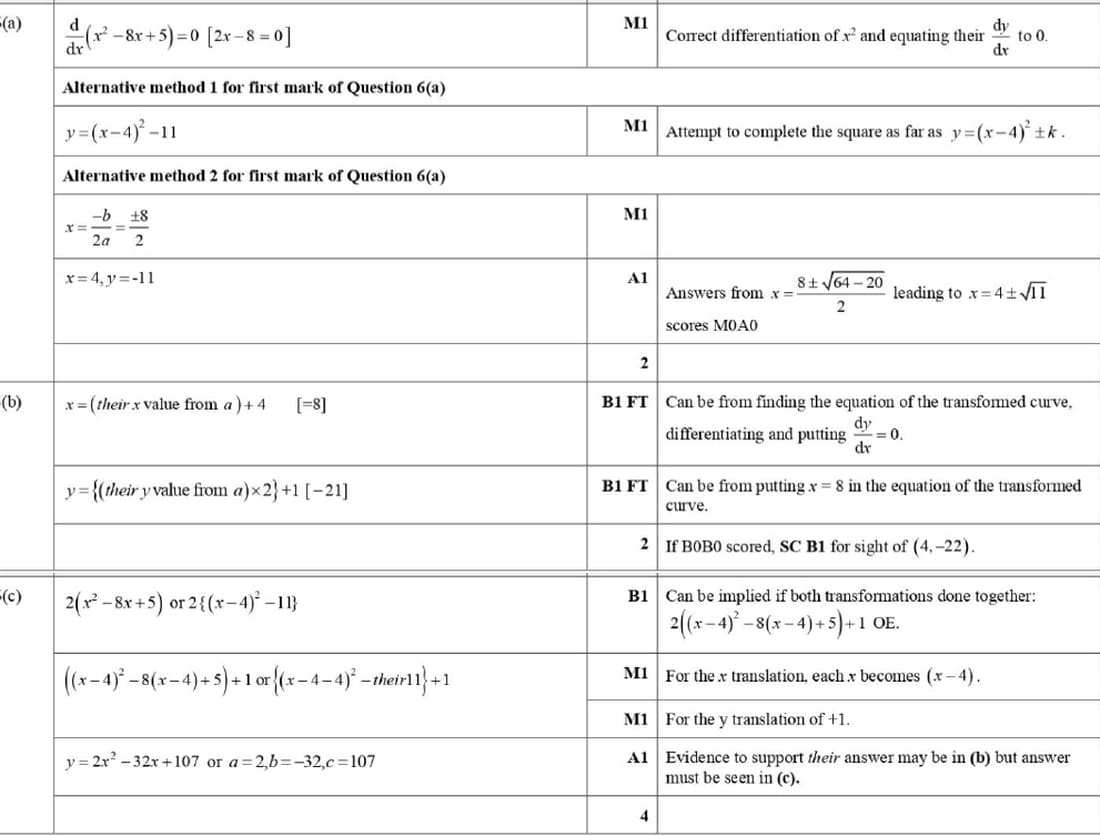
(a) To find the minimum point, complete the square for \(y = x^2 - 8x + 5\):
\(y = (x-4)^2 - 16 + 5 = (x-4)^2 - 11\).
The minimum point is at \(x = 4\), giving \(y = -11\). Thus, the coordinates are \((4, -11)\).
(b) The curve is stretched by a factor of 2 parallel to the y-axis, so the y-coordinate of the minimum point becomes \(-11 \times 2 = -22\). Then, the curve is translated by \(\begin{pmatrix} 4 \\ 1 \end{pmatrix}\), so the x-coordinate becomes \(4 + 4 = 8\) and the y-coordinate becomes \(-22 + 1 = -21\). Thus, the coordinates of the minimum point of the transformed curve are \((8, -21)\).
(c) The equation of the transformed curve is found by applying the transformations to the original equation:
First, stretch by a factor of 2: \(y = 2(x^2 - 8x + 5) = 2x^2 - 16x + 10\).
Then, translate by \(\begin{pmatrix} 4 \\ 1 \end{pmatrix}\):
Replace \(x\) with \(x - 4\): \(y = 2((x-4)^2 - 11) + 1\).
Expand: \(y = 2(x^2 - 8x + 16 - 11) + 1 = 2x^2 - 16x + 10 + 1 = 2x^2 - 16x + 11\).
Thus, the equation of the transformed curve is \(y = 2x^2 - 32x + 107\).