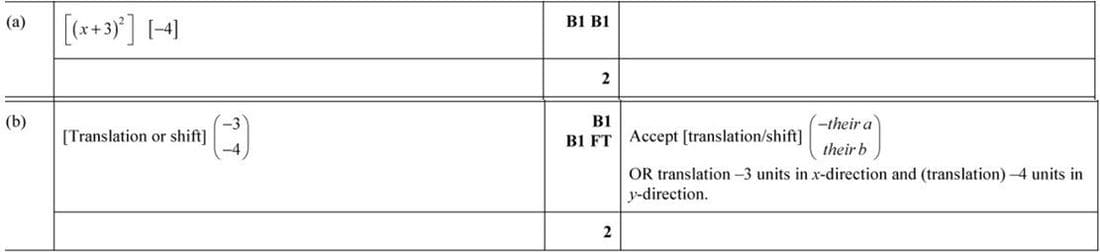
Now, include the constant term 5: \((x + 3)^2 - 9 + 5 = (x + 3)^2 - 4\).
Thus, \(x^2 + 6x + 5 = (x + 3)^2 - 4\).
(b) The transformation from \(y = x^2\) to \(y = x^2 + 6x + 5\) involves completing the square as shown in part (a): \(y = (x + 3)^2 - 4\).
This represents a translation of the graph of \(y = x^2\) by \(\begin{pmatrix} -3 \\ -4 \end{pmatrix}\), which means 3 units to the left and 4 units down.