Browsing as Guest. Progress, bookmarks and attempts are disabled.
Log in to track your work.
June 2021 p13 q6
653
Functions f and g are both defined for \(x \in \mathbb{R}\) and are given by
\(f(x) = x^2 - 2x + 5\),
\(g(x) = x^2 + 4x + 13\).
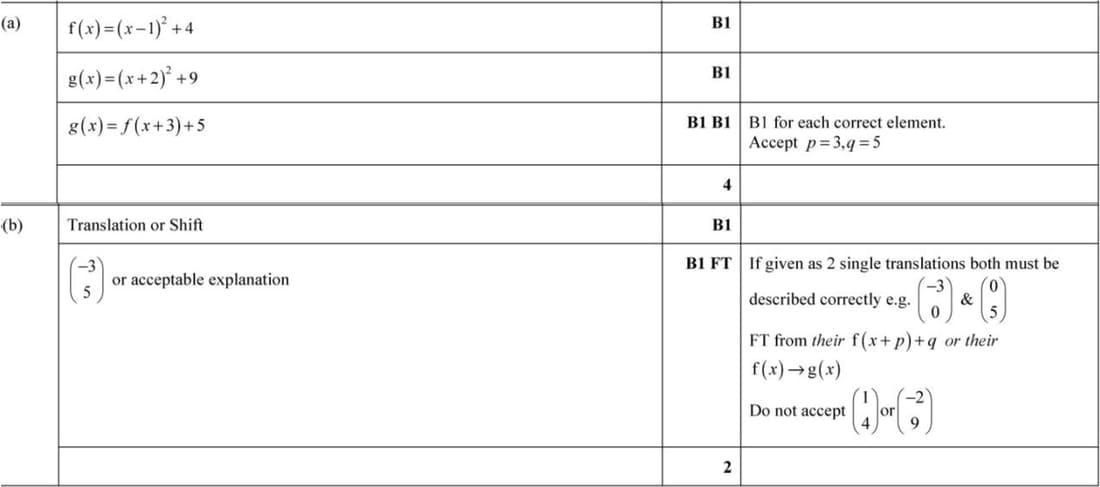
(a) By first expressing each of \(f(x)\) and \(g(x)\) in completed square form, express \(g(x)\) in the form \(f(x + p) + q\), where \(p\) and \(q\) are constants.
(b) Describe fully the transformation which transforms the graph of \(y = f(x)\) to the graph of \(y = g(x)\).
Solution
(a) To express \(f(x) = x^2 - 2x + 5\) in completed square form, we complete the square:
\(f(x) = (x-1)^2 + 4\).
For \(g(x) = x^2 + 4x + 13\), complete the square:
(b) The transformation from \(y = f(x)\) to \(y = g(x)\) is a translation. The completed square forms show a horizontal shift by \(-3\) and a vertical shift by \(5\). Therefore, the transformation is a translation by \(\begin{pmatrix} -3 \\ 5 \end{pmatrix}\).