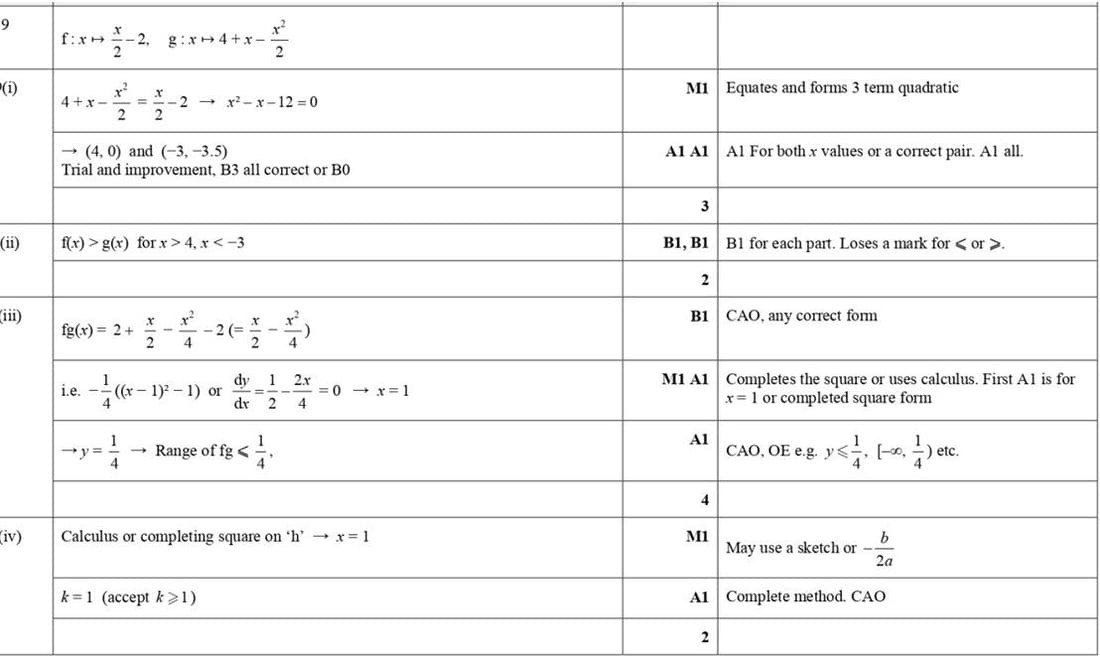
(i) To find the points of intersection, set \(f(x) = g(x)\):
\(\frac{1}{2}x - 2 = 4 + x - \frac{1}{2}x^2\)
Rearrange to form a quadratic equation:
\(\frac{1}{2}x^2 - \frac{1}{2}x - 2 = 4 + x\)
\(\frac{1}{2}x^2 - \frac{3}{2}x - 6 = 0\)
Multiply through by 2 to clear fractions:
\(x^2 - 3x - 12 = 0\)
Factorize or use the quadratic formula to find \(x = 4\) and \(x = -3\).
Substitute back to find \(y\) values: \((4, 0)\) and \((-3, -3.5)\).
(ii) Solve \(f(x) > g(x)\):
\(\frac{1}{2}x - 2 > 4 + x - \frac{1}{2}x^2\)
Rearrange to form a quadratic inequality:
\(\frac{1}{2}x^2 - \frac{3}{2}x - 6 < 0\)
Factorize or use the quadratic formula to find intervals: \(x > 4\) and \(x < -3\).
(iii) Find \(fg(x) = f(x) \cdot g(x)\):
\(fg(x) = \left(\frac{1}{2}x - 2\right)\left(4 + x - \frac{1}{2}x^2\right)\)
Expand and simplify:
\(fg(x) = 2 + \frac{x}{2} - \frac{x^2}{4}\)
Complete the square or use calculus to find the range:
\(y \leq \frac{1}{4}\)
(iv) For \(h(x)\) to have an inverse, it must be one-to-one. Find the vertex of the parabola:
\(x = -\frac{b}{2a} = 1\)
Thus, \(k = 1\) (accept \(k \geq 1\)).