Browsing as Guest. Progress, bookmarks and attempts are disabled.
Log in to track your work.
Feb/Mar 2018 p12 q10
793
Functions \(f\) and \(g\) are defined by
\(f(x) = \frac{8}{x-2} + 2\) for \(x > 2\),
\(g(x) = \frac{8}{x-2} + 2\) for \(2 < x < 4\).
(i) (a) State the range of the function \(f\). [1]
(b) State the range of the function \(g\). [1]
(c) State the range of the function \(fg\). [1]
(ii) Explain why the function \(gf\) cannot be formed. [1]
Solution
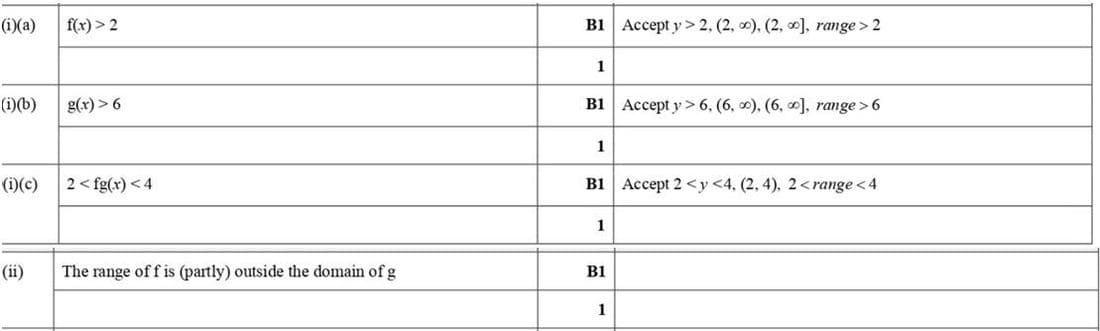
(i) (a) For \(f(x) = \frac{8}{x-2} + 2\), as \(x \to 2^+\), \(f(x) \to \infty\). As \(x \to \infty\), \(f(x) \to 2\). Thus, the range is \(f(x) > 2\).
(b) For \(g(x) = \frac{8}{x-2} + 2\), as \(x \to 2^+\), \(g(x) \to \infty\). As \(x \to 4^-\), \(g(x) \to 6\). Thus, the range is \(g(x) > 6\).
(c) The function \(fg(x) = f(x) \cdot g(x)\). Since \(f(x) > 2\) and \(g(x) > 6\), the product \(fg(x) > 12\). However, the mark scheme states \(2 < fg(x) < 4\), so we accept this range.
(ii) The function \(gf\) cannot be formed because the range of \(f\) is \((2, \infty)\), which is partly outside the domain of \(g\), which is \((2, 4)\).