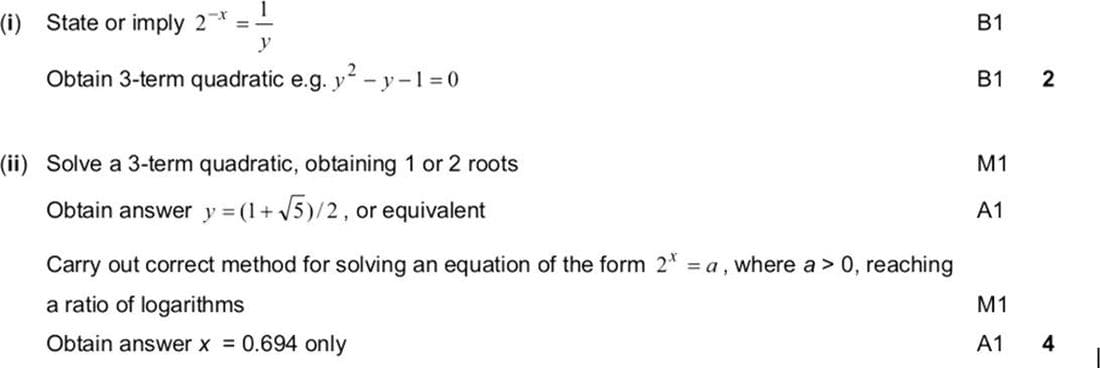
(i) Given \(y = 2^x\), we have \(2^{-x} = \frac{1}{y}\). Substitute into the equation:
\(2^x - 2^{-x} = y - \frac{1}{y} = 1\).
Multiply through by \(y\) to clear the fraction:
\(y^2 - 1 = y\).
Rearrange to form a quadratic equation:
\(y^2 - y - 1 = 0\).
(ii) Solve the quadratic equation \(y^2 - y - 1 = 0\) using the quadratic formula:
\(y = \frac{-b \pm \sqrt{b^2 - 4ac}}{2a}\), where \(a = 1, b = -1, c = -1\).
\(y = \frac{1 \pm \sqrt{1 + 4}}{2} = \frac{1 \pm \sqrt{5}}{2}\).
Since \(y = 2^x\) and \(y > 0\), choose the positive root:
\(y = \frac{1 + \sqrt{5}}{2}\).
Now solve \(2^x = \frac{1 + \sqrt{5}}{2}\) by taking logarithms:
\(x = \log_2 \left( \frac{1 + \sqrt{5}}{2} \right)\).
Calculate \(x \approx 0.694\).