Past Exam Questions
← Back9709 P12 - Jun 2014 - Q10
Functions f and g are defined by
\(f : x \mapsto 2x - 3, \; x \in \mathbb{R}\)
\(g : x \mapsto x^2 + 4x, \; x \in \mathbb{R}\)
Find the value of the constant \(p\) for which the equation \(gf(x) = p\) has two equal roots.

9709 P12 - Nov 2013 - Q10
The functions f and g are defined for all real values of x by
\(f(x) = 2x^2 - 3x\) and \(g(x) = 3x + k\),
where \(k\) is a constant.
Find the value of \(k\) for which the equation \(gf(x) = 0\) has equal roots.

9709 P13 - Jun 2013 - Q10
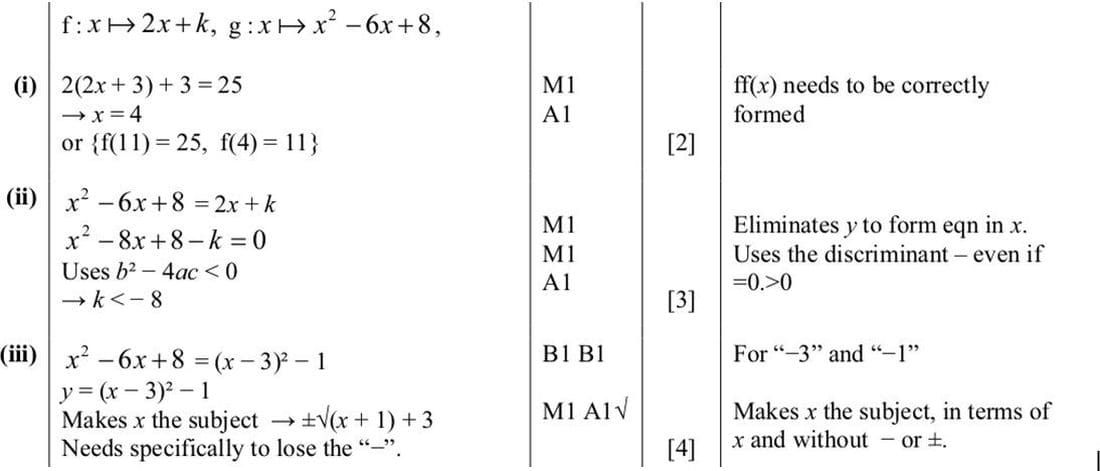
The function f is defined by \(f : x \mapsto 2x + k, \ x \in \mathbb{R}\), where \(k\) is a constant.
(i) In the case where \(k = 3\), solve the equation \(ff(x) = 25\).
The function g is defined by \(g : x \mapsto x^2 - 6x + 8, \ x \in \mathbb{R}\).
(ii) Find the set of values of \(k\) for which the equation \(f(x) = g(x)\) has no real solutions.
The function h is defined by \(h : x \mapsto x^2 - 6x + 8, \ x > 3\).
(iii) Find an expression for \(h^{-1}(x)\).
9709 P12 - Jun 2012 - Q10
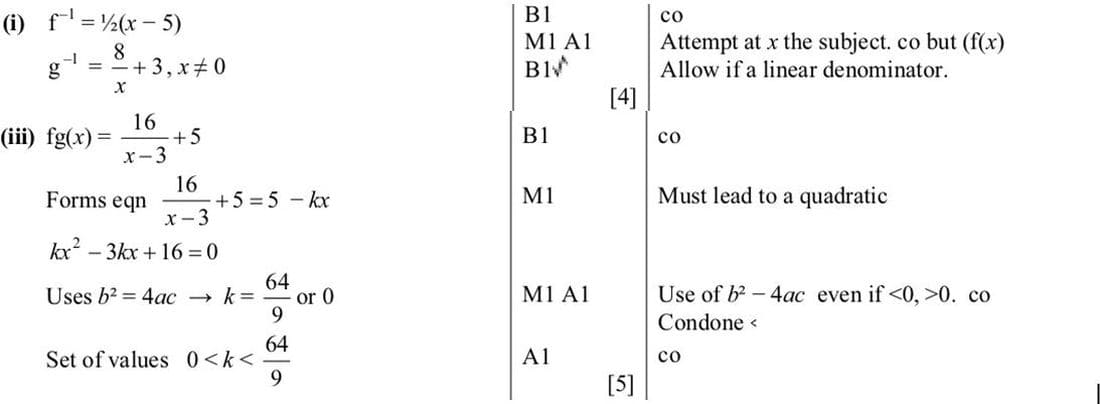
Functions f and g are defined by
\(f : x \mapsto 2x + 5\) for \(x \in \mathbb{R}\),
\(g : x \mapsto \frac{8}{x-3}\) for \(x \in \mathbb{R}, x \neq 3\).
(i) Obtain expressions, in terms of \(x\), for \(f^{-1}(x)\) and \(g^{-1}(x)\), stating the value of \(x\) for which \(g^{-1}(x)\) is not defined. [4]
(ii) Given that the equation \(fg(x) = 5 - kx\), where \(k\) is a constant, has no solutions, find the set of possible values of \(k\). [5]
9709 P12 - Jun 2010 - Q3
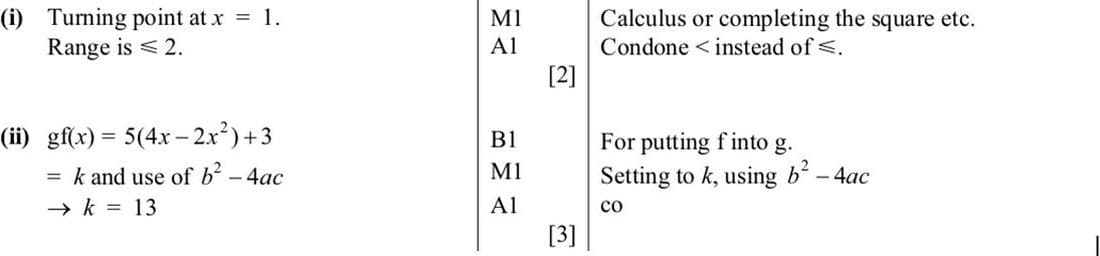
The functions f and g are defined for x ∈ ℝ by
f : x ↦ 4x − 2x2,
g : x ↦ 5x + 3.
(i) Find the range of f.
\((ii) Find the value of the constant k for which the equation gf(x) = k has equal roots.\)
9709 P11 - Jun 2010 - Q9
The function f is defined by \(f : x \mapsto 2x^2 - 12x + 7\) for \(x \in \mathbb{R}\).
The function g is defined by \(g : x \mapsto 2x + k\) for \(x \in \mathbb{R}\).
Find the value of the constant \(k\) for which the equation \(gf(x) = 0\) has two equal roots.

9709 P11 - Nov 2009 - Q10
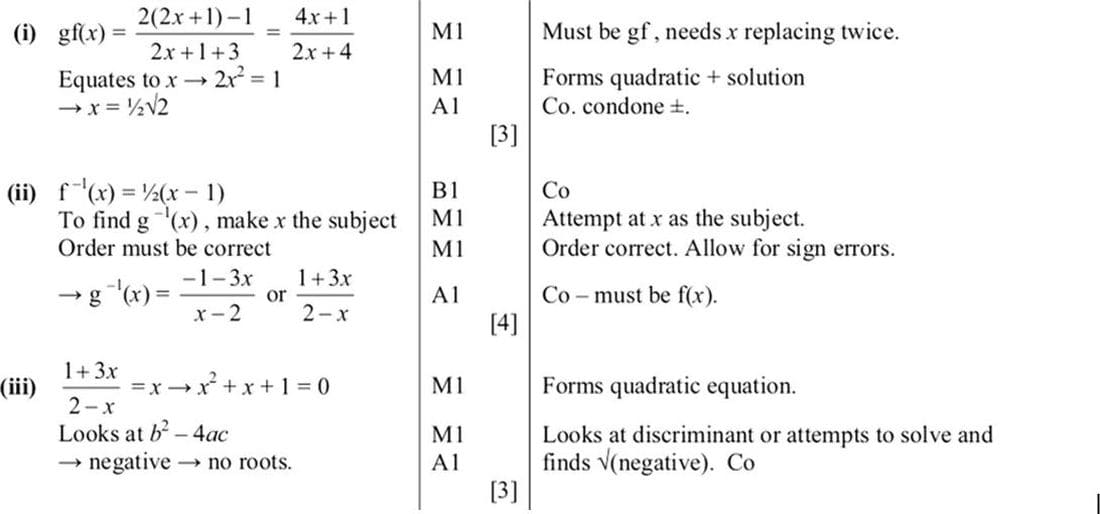
Functions f and g are defined by
\(f : x \mapsto 2x + 1, \quad x \in \mathbb{R}, \quad x > 0\)
\(g : x \mapsto \frac{2x - 1}{x + 3}, \quad x \in \mathbb{R}, \quad x \neq -3\)
- Solve the equation \(gf(x) = x\).
- Express \(f^{-1}(x)\) and \(g^{-1}(x)\) in terms of \(x\).
- Show that the equation \(g^{-1}(x) = x\) has no solutions.
9709 P12 - Nov 2017 - Q2
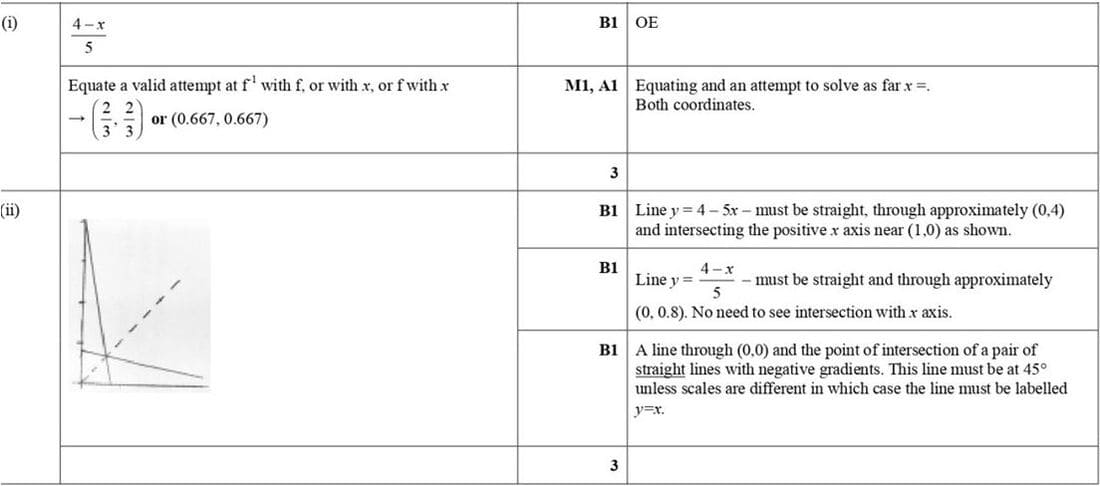
A function \(f\) is defined by \(f : x \mapsto 4 - 5x\) for \(x \in \mathbb{R}\).
(i) Find an expression for \(f^{-1}(x)\) and find the point of intersection of the graphs of \(y = f(x)\) and \(y = f^{-1}(x)\).
(ii) Sketch, on the same diagram, the graphs of \(y = f(x)\) and \(y = f^{-1}(x)\), making clear the relationship between the graphs.
9709 P13 - Nov 2021 - Q6
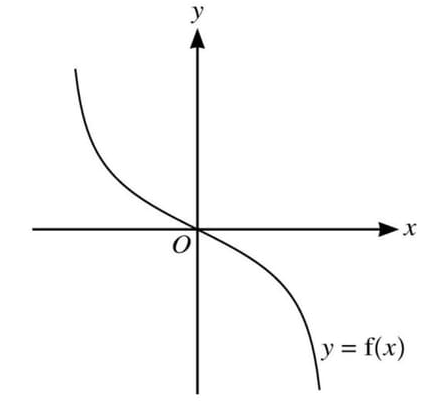
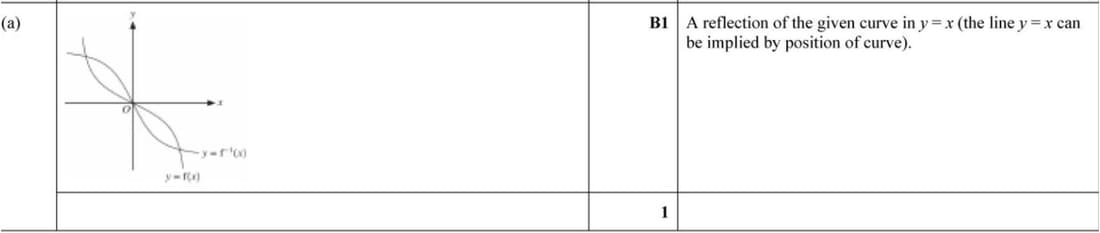
The diagram shows the graph of \(y = f(x)\).
On this diagram sketch the graph of \(y = f^{-1}(x)\).
9709 P13 - Jun 2012 - Q11
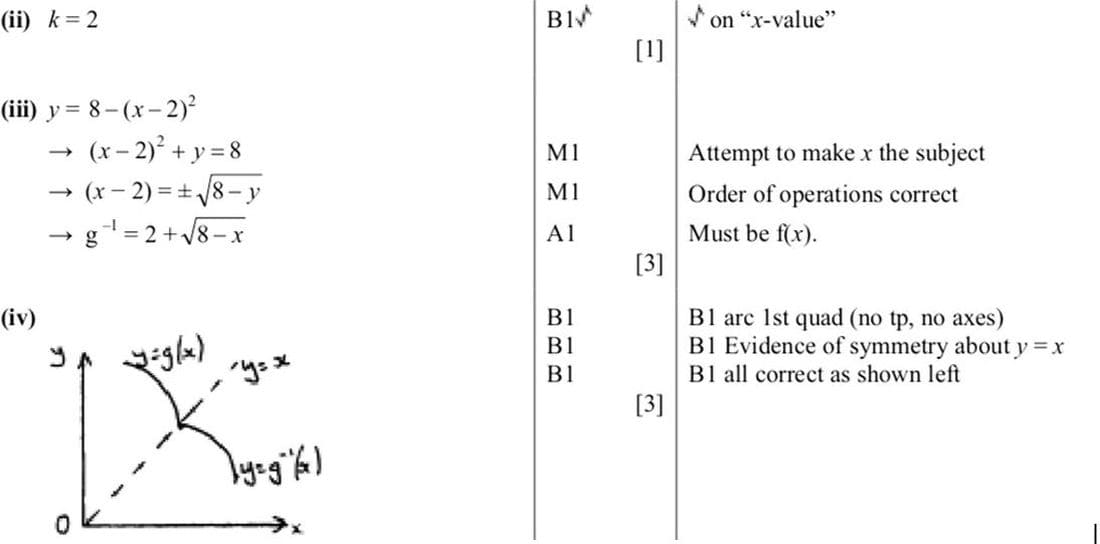
The function g is such that \(g(x) = 8 - (x - 2)^2\), for \(k \leq x \leq 4\), where \(k\) is a constant.
(ii) State the smallest value of \(k\) for which \(g\) has an inverse.
For this value of \(k\),
(iii) find an expression for \(g^{-1}(x)\),
(iv) sketch, on the same diagram, the graphs of \(y = g(x)\) and \(y = g^{-1}(x)\).
9709 P11 - Nov 2011 - Q11
Functions f and g are defined by
\(f : x \mapsto 2x^2 - 8x + 10\) for \(0 \leq x \leq 2\),
\(g : x \mapsto x\) for \(0 \leq x \leq 10\).
- Express \(f(x)\) in the form \(a(x + b)^2 + c\), where \(a, b\) and \(c\) are constants.
- State the range of \(f\).
- State the domain of \(f^{-1}\).
- Sketch on the same diagram the graphs of \(y = f(x)\), \(y = g(x)\) and \(y = f^{-1}(x)\), making clear the relationship between the graphs.
- Find an expression for \(f^{-1}(x)\).
9709 P1 - Jun 2007 - Q11
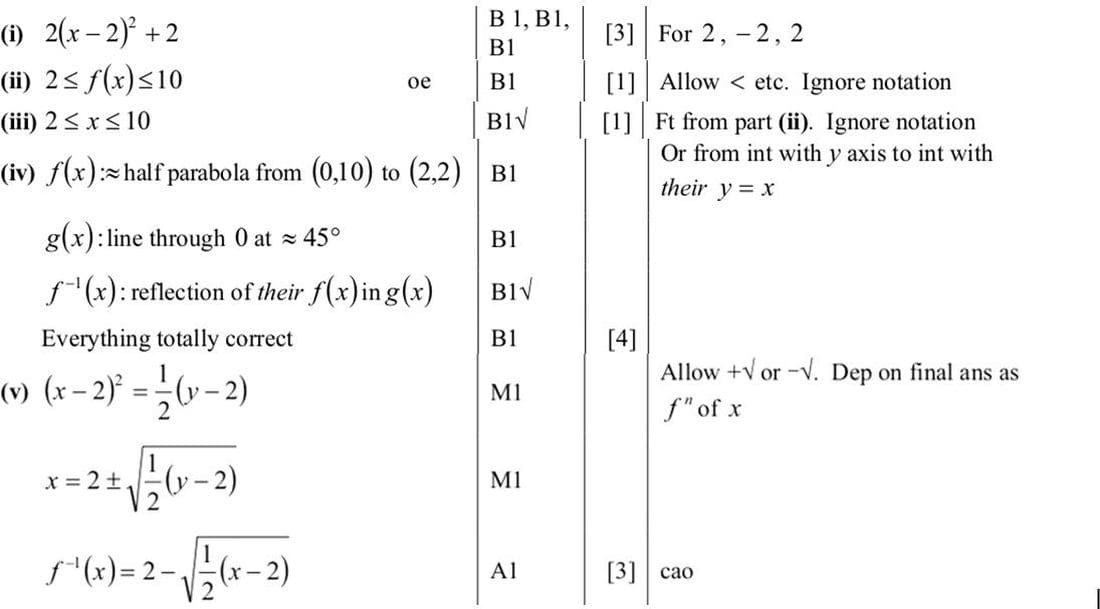
The diagram shows the graph of \(y = f(x)\), where \(f : x \mapsto \frac{6}{2x+3}\) for \(x \geq 0\).
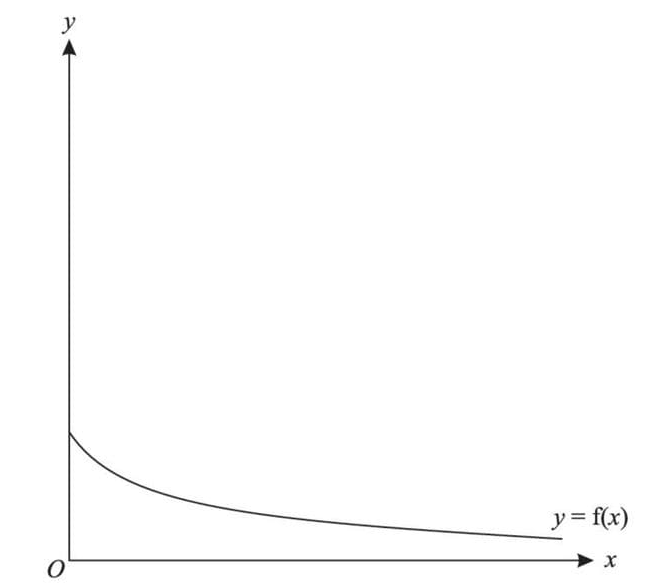
(ii) Find an expression, in terms of \(x\), for \(f^{-1}(x)\) and find the domain of \(f^{-1}\).
(iii) Copy the diagram and, on your copy, sketch the graph of \(y = f^{-1}(x)\), making clear the relationship between the graphs.
The function \(g\) is defined by \(g : x \mapsto \frac{1}{2}x\) for \(x \geq 0\).
(iv) Solve the equation \(fg(x) = \frac{3}{2}\).
9709 P12 - Jun 2012 - Q10
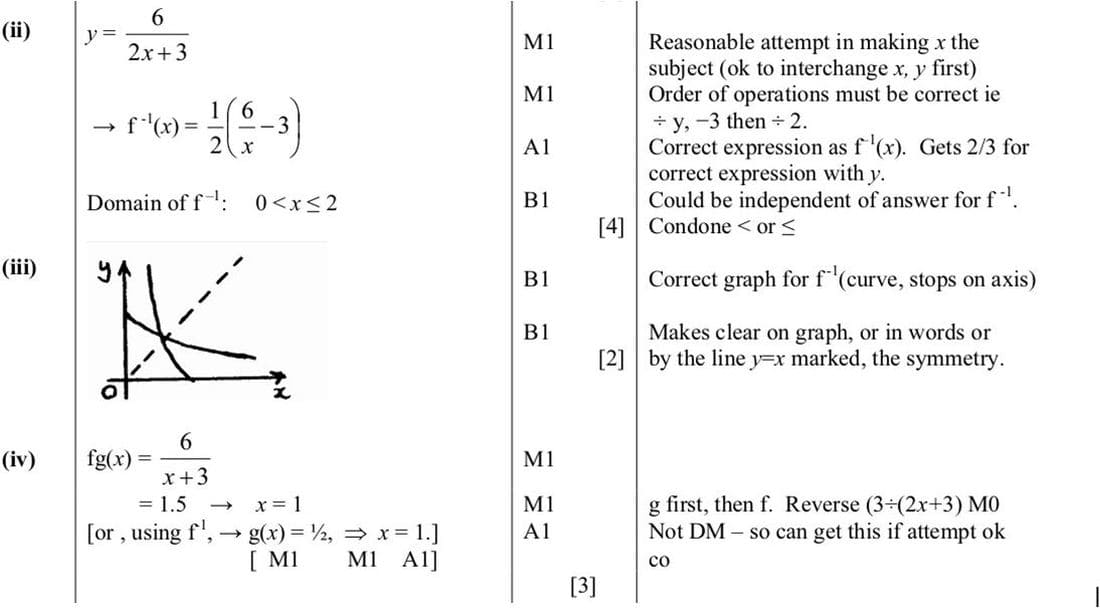
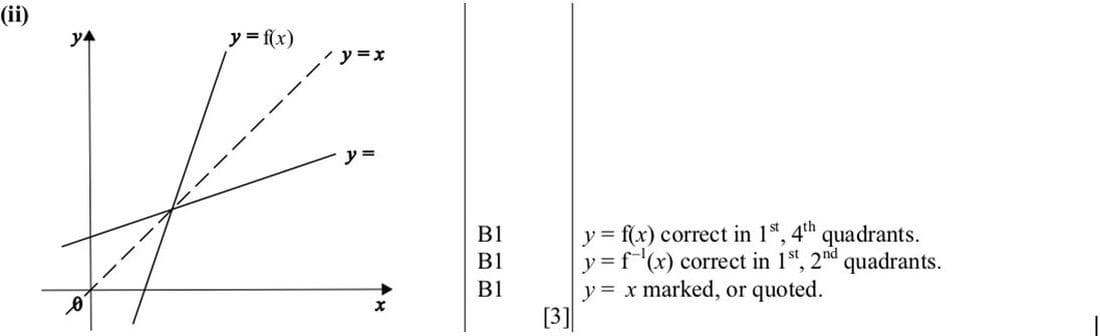
Given the function \(f : x \mapsto 2x + 5\) for \(x \in \mathbb{R}\), sketch the graphs of \(y = f(x)\) and \(y = f^{-1}(x)\) on the same diagram, making clear the relationship between the two graphs.

9709 P13 - Nov 2011 - Q9
Given the function \(f : x \mapsto 2x + 3\) for \(x \leq 0\), on the same diagram sketch the graphs of \(y = f(x)\) and \(y = f^{-1}(x)\), showing the coordinates of their point of intersection and the relationship between the graphs.

9709 P13 - Jun 2011 - Q10
Let \(f : x \mapsto 3x - 4, \; x \in \mathbb{R}\).
Sketch in a single diagram the graphs of \(y = f(x)\) and \(y = f^{-1}(x)\), making clear the relationship between the graphs.
9709 P11 - Nov 2009 - Q10
Let \(f : x \mapsto 2x + 1\), \(x \in \mathbb{R}\), \(x > 0\).
Sketch in a single diagram the graphs of \(y = f(x)\) and \(y = f^{-1}(x)\), making clear the relationship between the graphs.

9709 P1 - Nov 2008 - Q10
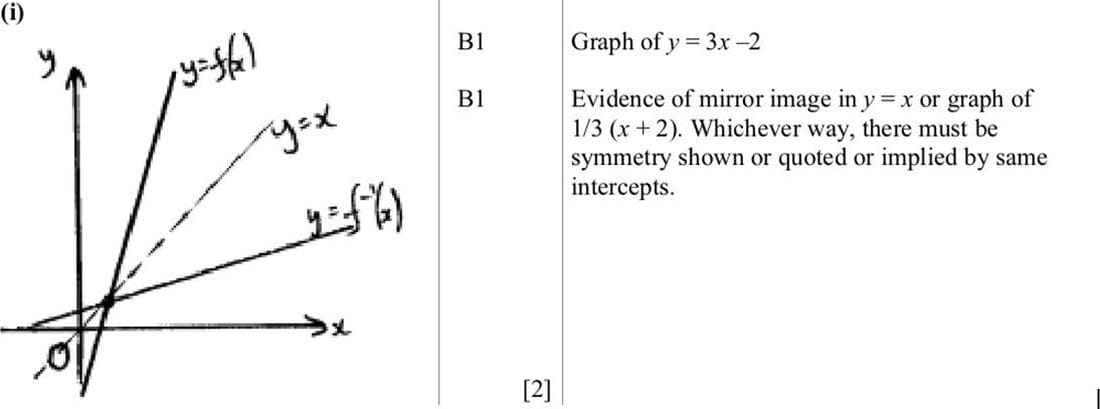
The function \(f\) is defined by \(f : x \mapsto 3x - 2\) for \(x \in \mathbb{R}\).
Sketch, in a single diagram, the graphs of \(y = f(x)\) and \(y = f^{-1}(x)\), making clear the relationship between the two graphs.
9709 P1 - Jun 2004 - Q10
Given the function \(g : x \mapsto 2x + 3\), where \(x \in \mathbb{R}\), sketch, in a single diagram, the graphs of \(y = g(x)\) and \(y = g^{-1}(x)\), making clear the relationship between the graphs.

9709 P1 - Nov 2003 - Q10
Given the function \(f: x \mapsto 2x - 5\), \(x \in \mathbb{R}\), sketch, on a single diagram, the graphs of \(y = f(x)\) and \(y = f^{-1}(x)\), making clear the relationship between these two graphs.

9709 P1 - Jun 2002 - Q10
Given the function \(f : x \mapsto 3x + 2\), \(x \in \mathbb{R}\), sketch, in a single diagram, the graphs of \(y = f(x)\) and \(y = f^{-1}(x)\), making clear the relationship between the two graphs.
