Let \(y = e^{2x}\). Then \(e^{-2x} = \frac{1}{y}\).
The equation becomes:
\(3y - \frac{4}{y} = 5\).
Multiply through by \(y\) to clear the fraction:
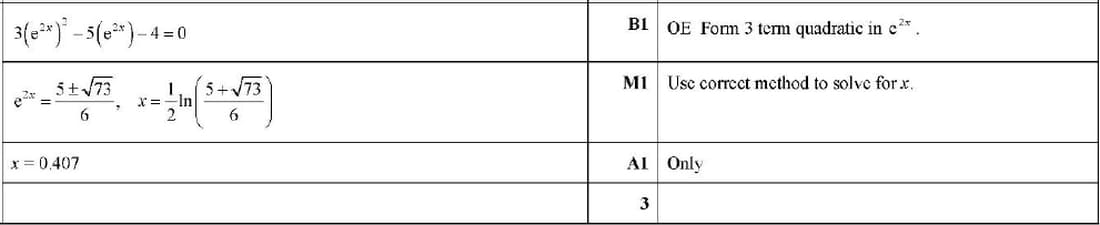
\(3y^2 - 5y - 4 = 0\).
This is a quadratic equation in \(y\). Solve using the quadratic formula:
\(y = \frac{-b \pm \sqrt{b^2 - 4ac}}{2a}\), where \(a = 3\), \(b = -5\), \(c = -4\).
\(y = \frac{5 \pm \sqrt{(-5)^2 - 4 \cdot 3 \cdot (-4)}}{2 \cdot 3}\)
\(y = \frac{5 \pm \sqrt{25 + 48}}{6}\)
\(y = \frac{5 \pm \sqrt{73}}{6}\)
Since \(y = e^{2x}\), we have:
\(e^{2x} = \frac{5 + \sqrt{73}}{6}\)
Take the natural logarithm of both sides:
\(2x = \ln\left(\frac{5 + \sqrt{73}}{6}\right)\)
\(x = \frac{1}{2} \ln\left(\frac{5 + \sqrt{73}}{6}\right)\)
Calculating this gives:
\(x \approx 0.407\)