Past Exam Questions
← Back9709 P63 - Jun 2011 - Q6
The probability that Sue completes a Sudoku puzzle correctly is 0.75.
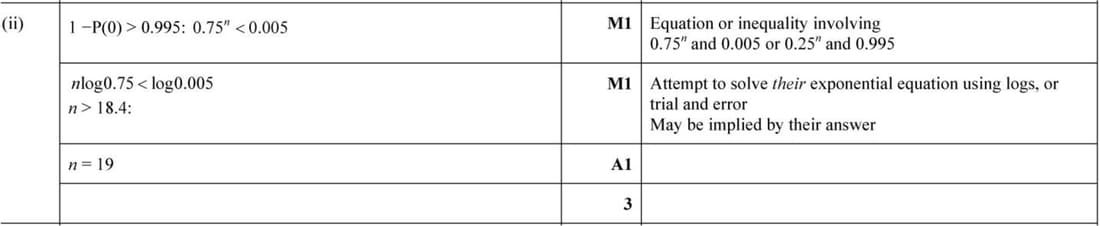
Sue attempts n Sudoku puzzles. Find the least value of n for which the probability that she completes all n puzzles correctly is less than 0.06.

9709 P61 - Jun 2011 - Q7
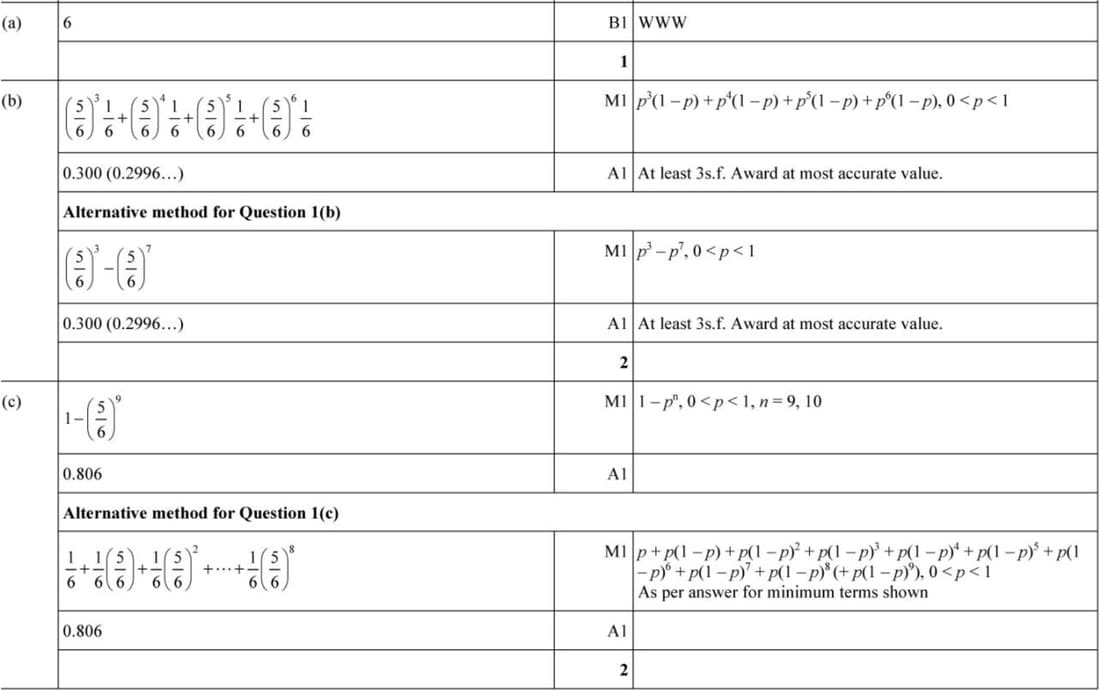
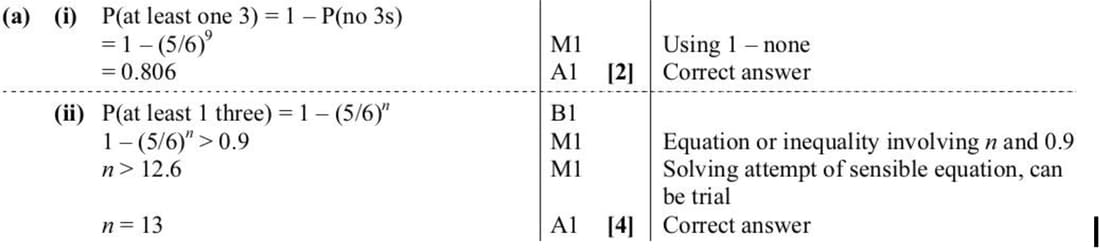
(i) Find the probability of getting at least one 3 when 9 fair dice are thrown.
(ii) When n fair dice are thrown, the probability of getting at least one 3 is greater than 0.9. Find the smallest possible value of n.
9709 P6 - Nov 2007 - Q6
On any occasion when a particular gymnast performs a certain routine, the probability that she will perform it correctly is 0.65, independently of all other occasions.
(i) Find the probability that she will perform the routine correctly on exactly 5 occasions out of 7.
(iii) On another day she performs the routine n times. Find the smallest value of n for which the expected number of correct performances is at least 8.

9709 P6 - Jun 2004 - Q7
A shop sells old video tapes, of which 1 in 5 on average are known to be damaged.
Find the smallest value of n if there is a probability of at least 0.85 that a random sample of n tapes contains at least one damaged tape.

9709 P62 - Jun 2019 - Q3
The probability that Janice will buy an item online in any week is 0.35. Janice does not buy more than one item online in any week.
The probability that Janice buys at least one item online in a period of n weeks is greater than 0.99. Find the smallest possible value of n.

9709 P62 - Mar 2019 - Q6
The results of a survey by a large supermarket show that 35% of its customers shop online.
For a random sample of n customers, the probability that at least one of them shops online is greater than 0.95. Find the least possible value of n.

Question #3085
In a certain country, 60% of mobile phones sold are made by Company A, 35% are made by Company B, and 5% are made by other companies.
A random sample of n mobile phones sold is chosen. The probability that at least one of these phones is made by Company B is more than 0.98. Find the least possible value of n.

9709 P62 - Mar 2018 - Q8
The results of a survey at a certain large college show that the proportion of students who own a car is \(\frac{1}{4}\).
For a random sample of \(n\) students at the college, the probability that at least one of the students owns a car is greater than 0.995. Find the least possible value of \(n\).
9709 P61 - Jun 2017 - Q5
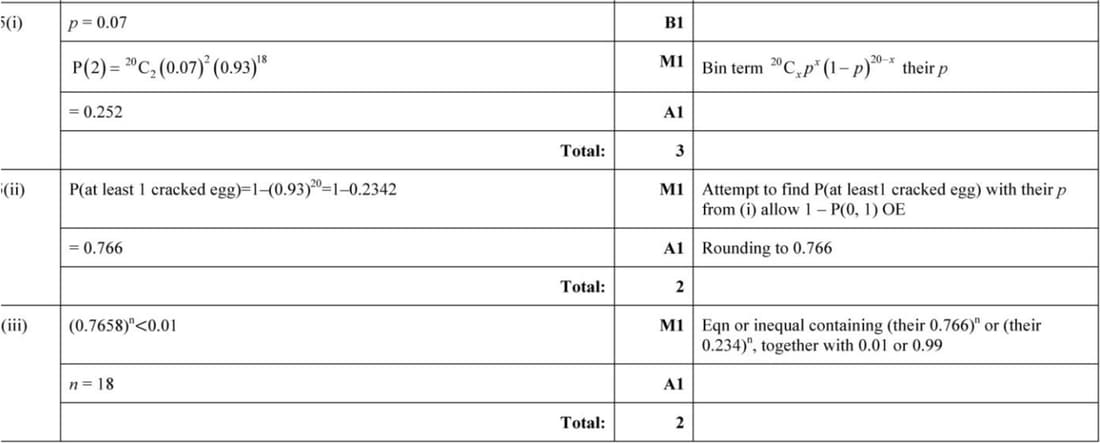
Eggs are sold in boxes of 20. Cracked eggs occur independently and the mean number of cracked eggs in a box is 1.4.
- Calculate the probability that a randomly chosen box contains exactly 2 cracked eggs.
- Calculate the probability that a randomly chosen box contains at least 1 cracked egg.
- A shop sells n of these boxes of eggs. Find the smallest value of n such that the probability of there being at least 1 cracked egg in each box sold is less than 0.01.
9709 P62 - Nov 2016 - Q4
12% of people take more than t minutes to cook an egg.
A random sample of n people is taken. Find the smallest possible value of n if the probability that none of these people takes more than t minutes to cook an egg is less than 0.003.

9709 P62 - Jun 2016 - Q4
When people visit a certain large shop, on average 34% of them do not buy anything, 53% spend less than $50 and 13% spend at least $50.
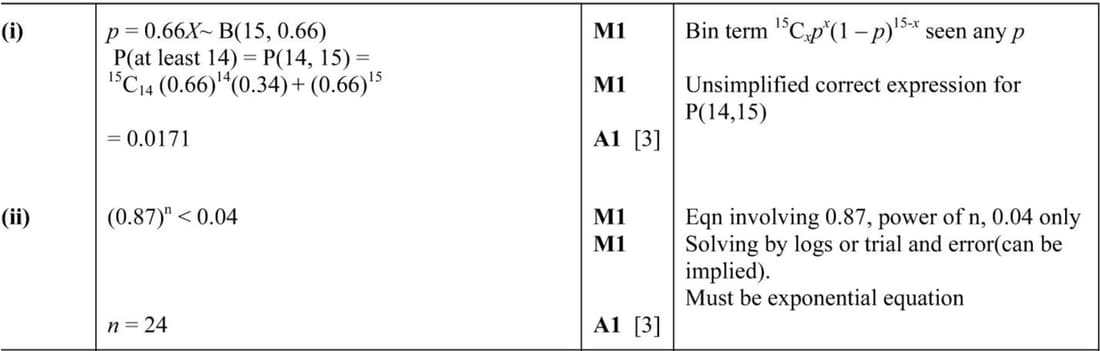
(i) 15 people visiting the shop are chosen at random. Calculate the probability that at least 14 of them buy something.
(ii) n people visiting the shop are chosen at random. The probability that none of them spends at least $50 is less than 0.04. Find the smallest possible value of n.
9709 P62 - Mar 2016 - Q5
In a certain town, 35% of the people take a holiday abroad and 65% take a holiday in their own country. Of those going abroad 80% go to the seaside, 15% go camping and 5% take a city break. Of those taking a holiday in their own country, 20% go to the seaside and the rest are divided equally between camping and a city break.
A group of n people is chosen randomly. The probability of all the people in the group taking a holiday in their own country is less than 0.002. Find the smallest possible value of n.

9709 P53 - Nov 2023 - Q5
The probability that a driver passes an advanced driving test is 0.3 on any given attempt.
Dipak keeps taking the test until he passes. The random variable \(X\) denotes the number of attempts required for Dipak to pass the test.
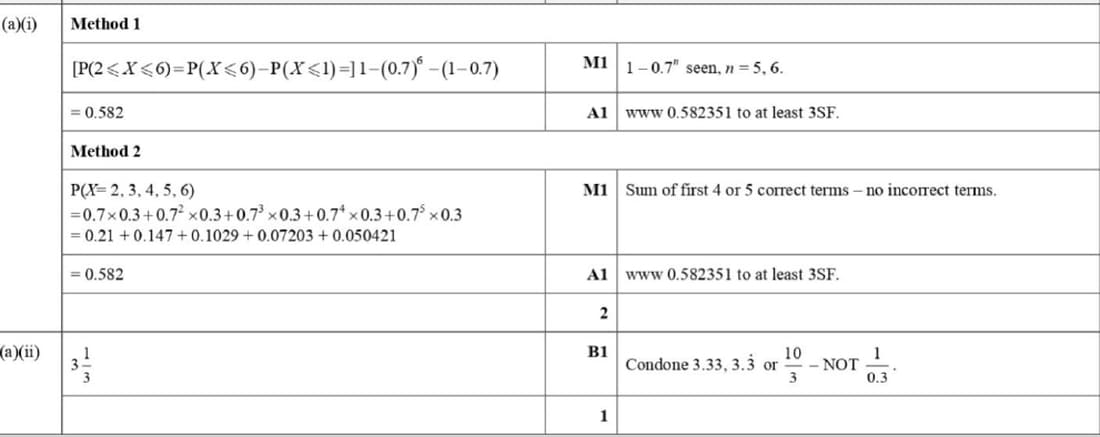
- Find \(P(2 \leq X \leq 6)\).
- Find \(E(X)\).
9709 P52 - Nov 2022 - Q3
Three fair 6-sided dice, each with faces marked 1, 2, 3, 4, 5, 6, are thrown at the same time repeatedly. The score on each throw is the sum of the numbers on the uppermost faces.
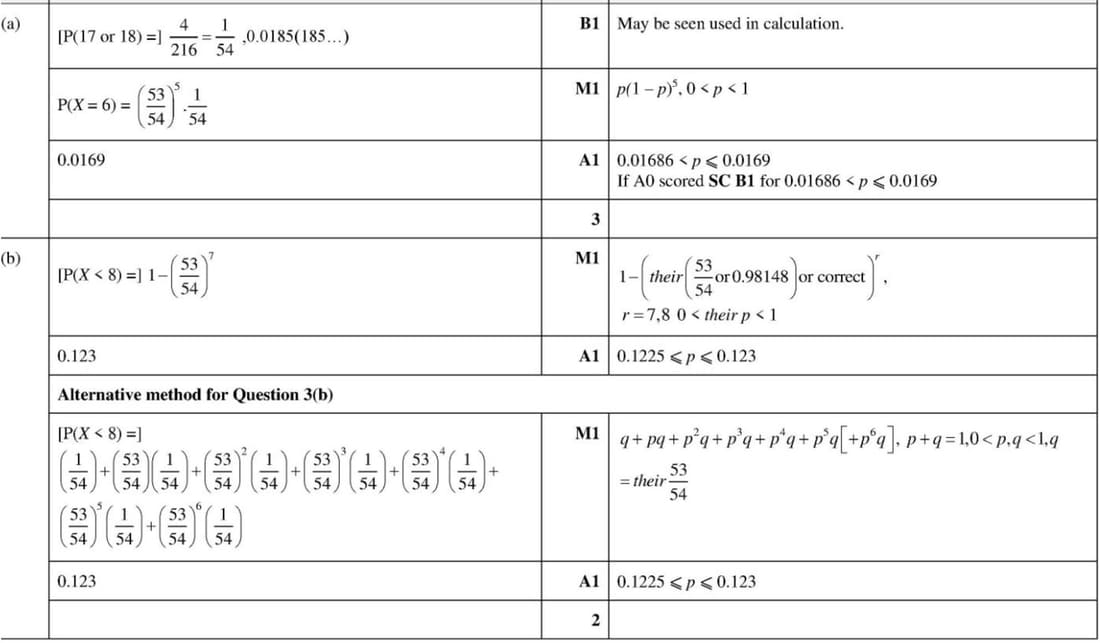
(a) Find the probability that a score of 17 or more is first obtained on the 6th throw.
(b) Find the probability that a score of 17 or more is obtained in fewer than 8 throws.
9709 P53 - Jun 2022 - Q4
Ramesh throws an ordinary fair 6-sided die.
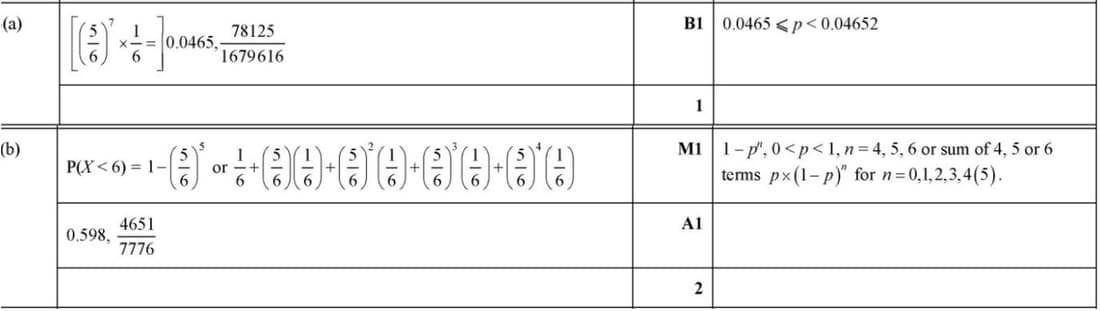
(a) Find the probability that he obtains a 4 for the first time on his 8th throw.
(b) Find the probability that it takes no more than 5 throws for Ramesh to obtain a 4.
9709 P52 - Mar 2022 - Q6
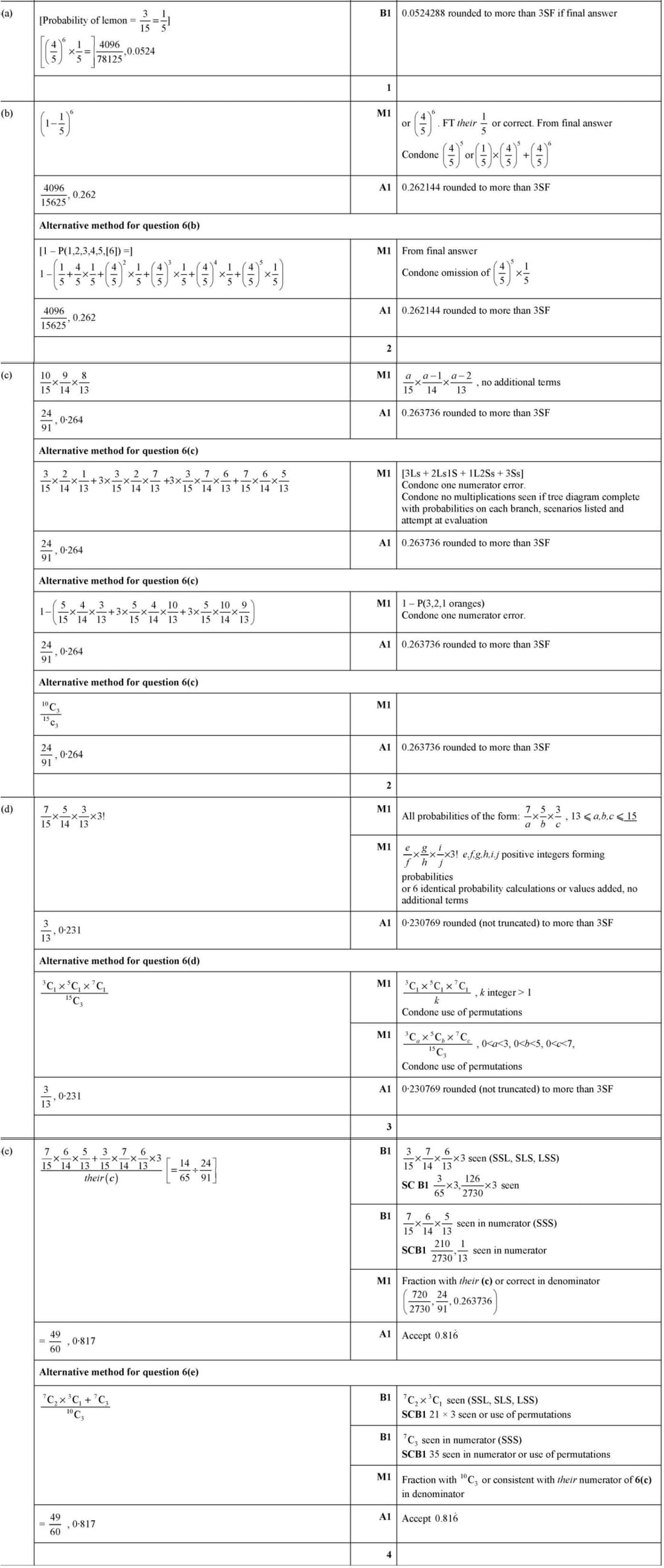
A factory produces chocolates in three flavours: lemon, orange, and strawberry in the ratio 3:5:7 respectively. Nell checks the chocolates on the production line by choosing chocolates randomly one at a time.
- (a) Find the probability that the first chocolate with lemon flavour that Nell chooses is the 7th chocolate that she checks.
- (b) Find the probability that the first chocolate with lemon flavour that Nell chooses is after she has checked at least 6 chocolates.
‘Surprise’ boxes of chocolates each contain 15 chocolates: 3 are lemon, 5 are orange, and 7 are strawberry. Petra has a box of Surprise chocolates. She chooses 3 chocolates at random from the box. She eats each chocolate before choosing the next one.
- (c) Find the probability that none of Petra’s 3 chocolates has orange flavour.
- (d) Find the probability that each of Petra’s 3 chocolates has a different flavour.
- (e) Find the probability that at least 2 of Petra’s 3 chocolates have strawberry flavour given that none of them has orange flavour.
9709 P52 - Nov 2021 - Q5
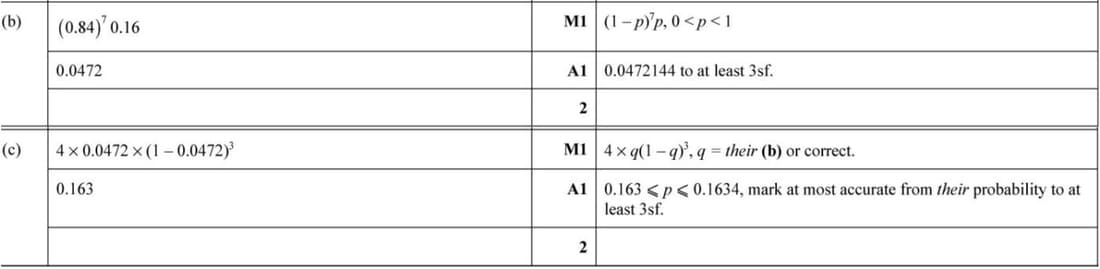
In a certain region, the probability that any given day in October is wet is 0.16, independently of other days.
(b) Find the probability that the first wet day in October is 8 October.
(c) For 4 randomly chosen years, find the probability that in exactly 1 of these years the first wet day in October is 8 October.
9709 P51 - Nov 2021 - Q1
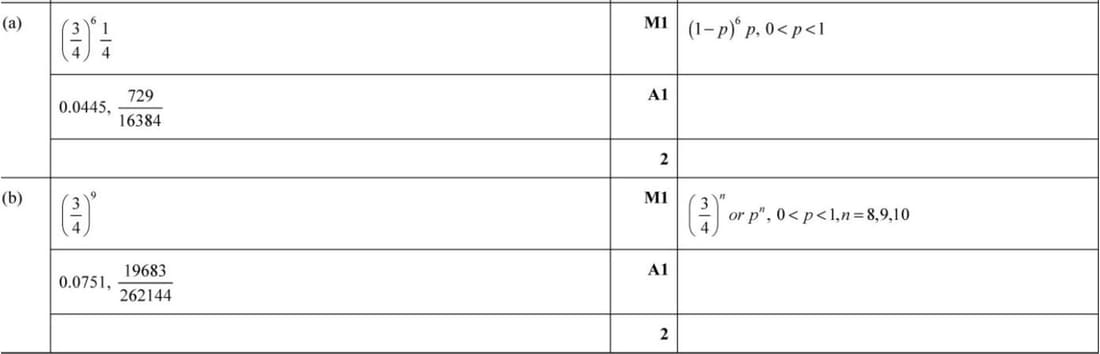
Two fair coins are thrown at the same time. The random variable \(X\) is the number of throws of the two coins required to obtain two tails at the same time.
(a) Find the probability that two tails are obtained for the first time on the 7th throw.
(b) Find the probability that it takes more than 9 throws to obtain two tails for the first time.
9709 P53 - Jun 2021 - Q4
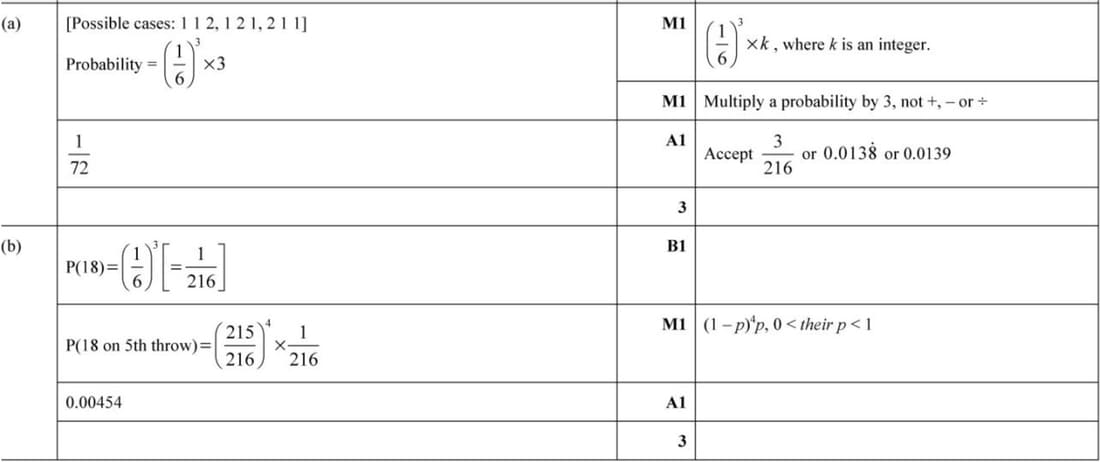
Three fair six-sided dice, each with faces marked 1, 2, 3, 4, 5, 6, are thrown at the same time, repeatedly. For a single throw of the three dice, the score is the sum of the numbers on the top faces.
(a) Find the probability that the score is 4 on a single throw of the three dice.
(b) Find the probability that a score of 18 is obtained for the first time on the 5th throw of the three dice.
9709 P52 - Jun 2021 - Q1
An ordinary fair die is thrown repeatedly until a 5 is obtained. The number of throws taken is denoted by the random variable X.
(a) Write down the mean of X.
(b) Find the probability that a 5 is first obtained after the 3rd throw but before the 8th throw.
(c) Find the probability that a 5 is first obtained in fewer than 10 throws.