Past Exam Questions
← Back9709 P52 - Mar 2021 - Q1
A fair spinner with 5 sides numbered 1, 2, 3, 4, 5 is spun repeatedly. The score on each spin is the number on the side on which the spinner lands.
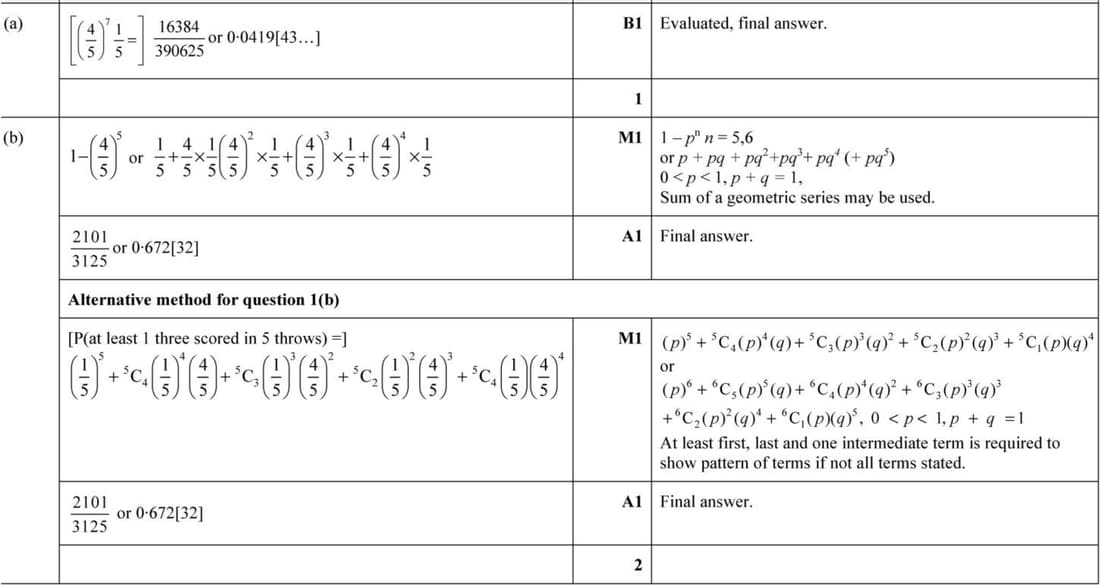
(a) Find the probability that a score of 3 is obtained for the first time on the 8th spin.
(b) Find the probability that fewer than 6 spins are required to obtain a score of 3 for the first time.
9709 P53 - Nov 2020 - Q2
An ordinary fair die is thrown until a 6 is obtained.
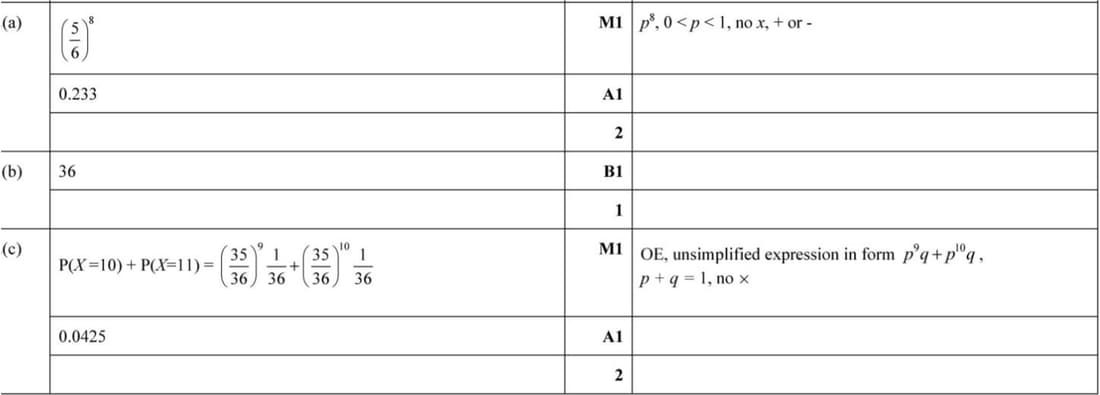
(a) Find the probability that obtaining a 6 takes more than 8 throws.
Two ordinary fair dice are thrown together until a pair of 6s is obtained. The number of throws taken is denoted by the random variable X.
(b) Find the expected value of X.
(c) Find the probability that obtaining a pair of 6s takes either 10 or 11 throws.
9709 P53 - Jun 2020 - Q5
A pair of fair coins is thrown repeatedly until a pair of tails is obtained. The random variable X denotes the number of throws required to obtain a pair of tails.
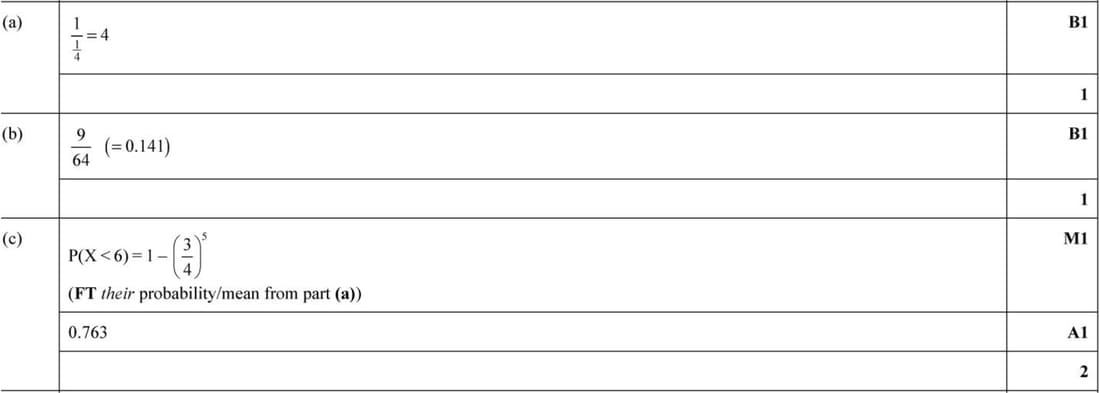
(a) Find the expected value of X. [1]
(b) Find the probability that exactly 3 throws are required to obtain a pair of tails. [1]
(c) Find the probability that fewer than 6 throws are required to obtain a pair of tails. [2]
9709 P52 - Nov 2023 - Q2
George has a fair 5-sided spinner with sides labelled 1, 2, 3, 4, 5. He spins the spinner and notes the number on the side on which the spinner lands.
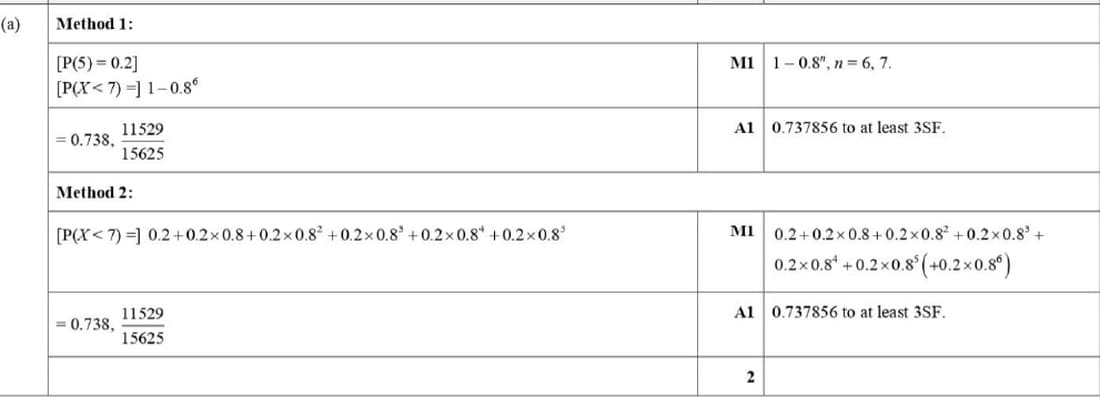
Find the probability that it takes fewer than 7 spins for George to obtain a 5.
9709 P51 - Jun 2020 - Q1
The score when two fair six-sided dice are thrown is the sum of the two numbers on the upper faces.
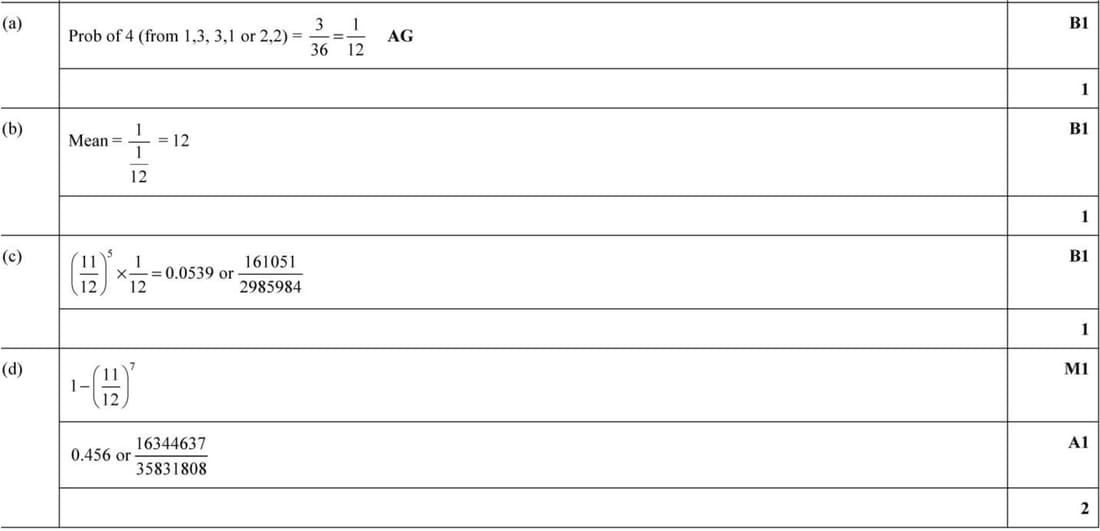
(a) Show that the probability that the score is 4 is \(\frac{1}{12}\).
(b) The two dice are thrown repeatedly until a score of 4 is obtained. The number of throws taken is denoted by the random variable \(X\). Find the mean of \(X\).
(c) Find the probability that a score of 4 is first obtained on the 6th throw.
(d) Find \(P(X < 8)\).
9709 P52 - Mar 2020 - Q2
An ordinary fair die is thrown repeatedly until a 1 or a 6 is obtained.
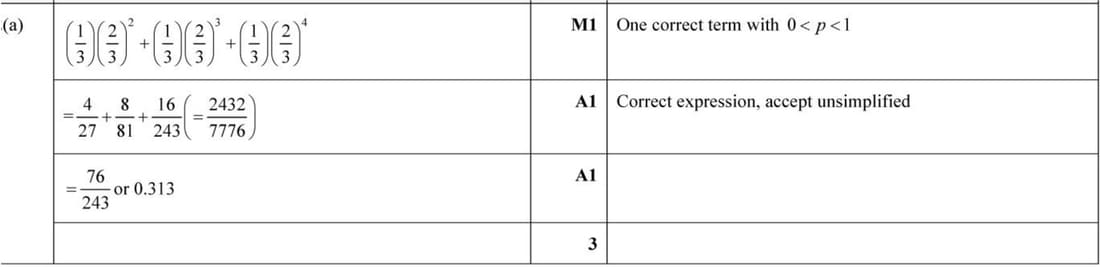
Find the probability that it takes at least 3 throws but no more than 5 throws to obtain a 1 or a 6.
9709 P51 - Nov 2023 - Q5
A red spinner has four sides labelled 1, 2, 3, 4. When the spinner is spun, the score is the number on the side on which it lands. The random variable X denotes this score. The probability distribution table for X is given below.
| x | 1 | 2 | 3 | 4 |
|---|---|---|---|---|
| P(X = x) | 0.28 | p | 2p | 3p |
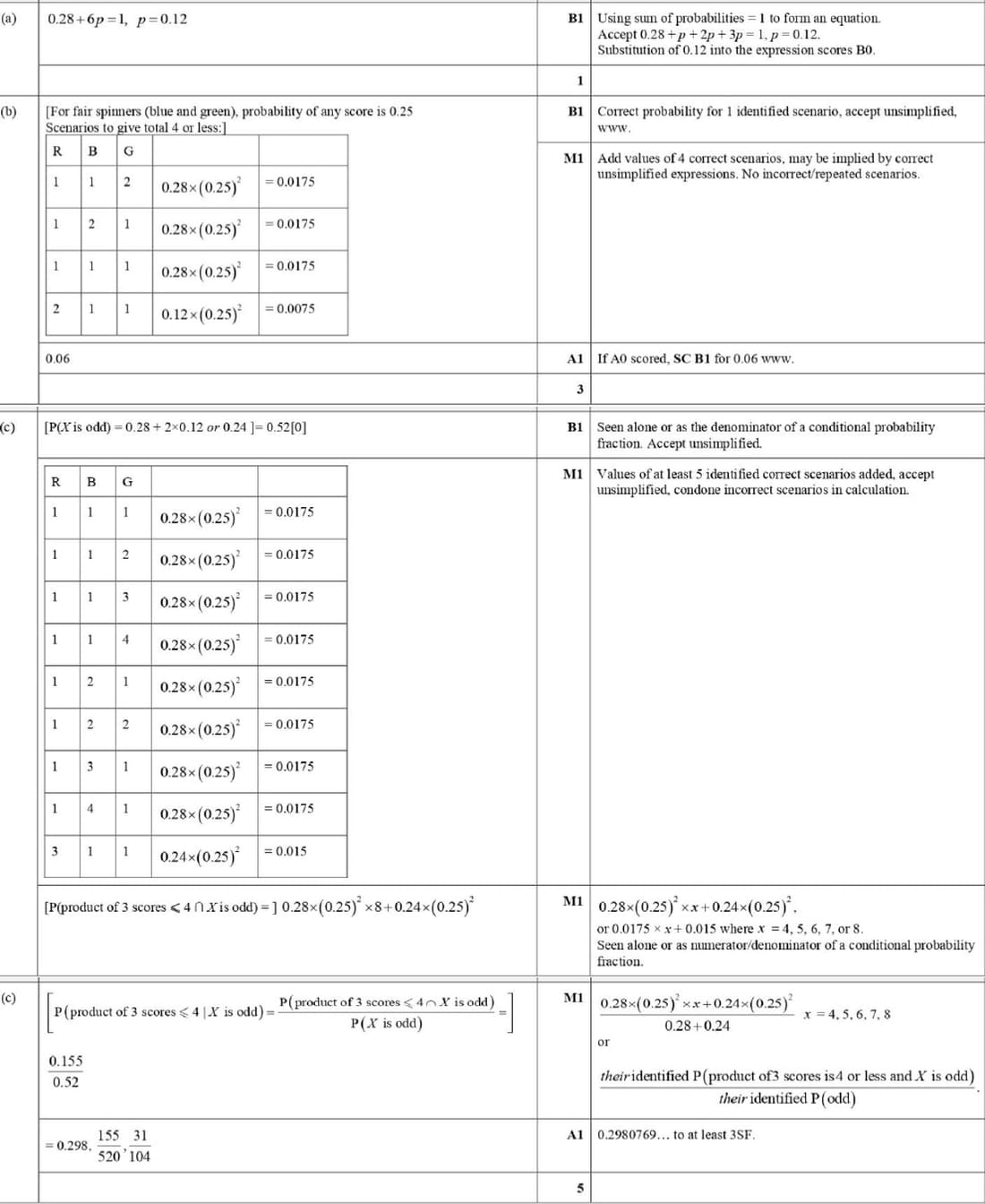
(a) Show that \(p = 0.12\).
A fair blue spinner and a fair green spinner each have four sides labelled 1, 2, 3, 4. All three spinners (red, blue and green) are spun at the same time.
(b) Find the probability that the sum of the three scores is 4 or less.
(c) Find the probability that the product of the three scores is 4 or less given that X is odd.
9709 P51 - Nov 2023 - Q2
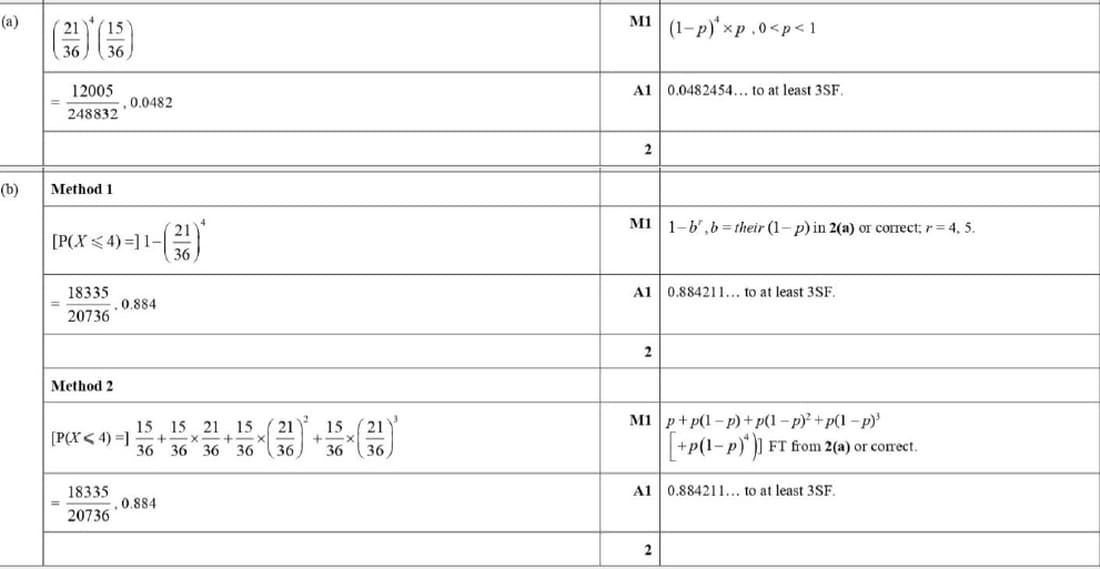
Hazeem repeatedly throws two ordinary fair 6-sided dice at the same time. On each occasion, the score is the sum of the two numbers that she obtains.
(a) Find the probability that it takes exactly 5 throws of the two dice for Hazeem to obtain a score of 8 or more.
(b) Find the probability that it takes no more than 4 throws of the two dice for Hazeem to obtain a score of 8 or more.
9709 P53 - Jun 2023 - Q1
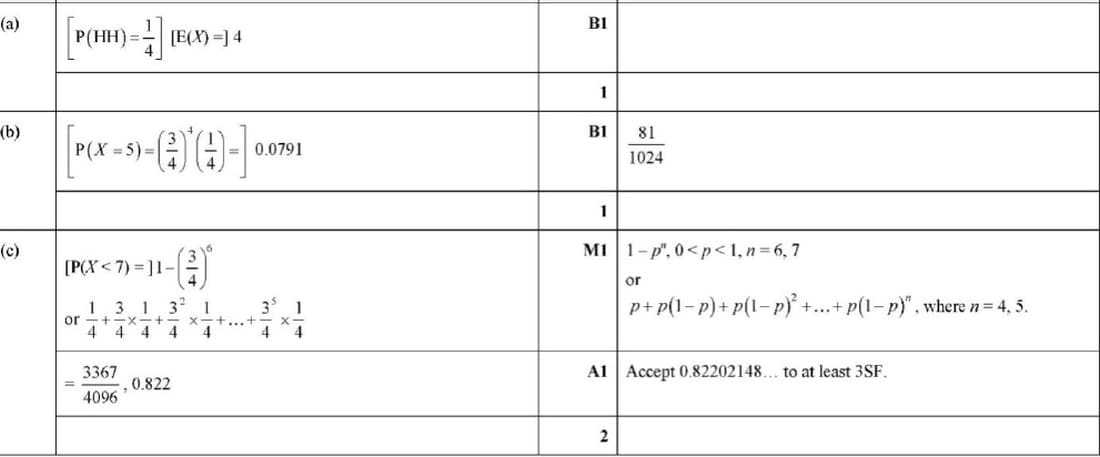
Two fair coins are thrown at the same time repeatedly until a pair of heads is obtained. The number of throws taken is denoted by the random variable X.
(a) State the value of \(E(X)\).
(b) Find the probability that exactly 5 throws are required to obtain a pair of heads.
(c) Find the probability that fewer than 7 throws are required to obtain a pair of heads.
9709 P52 - Jun 2023 - Q4
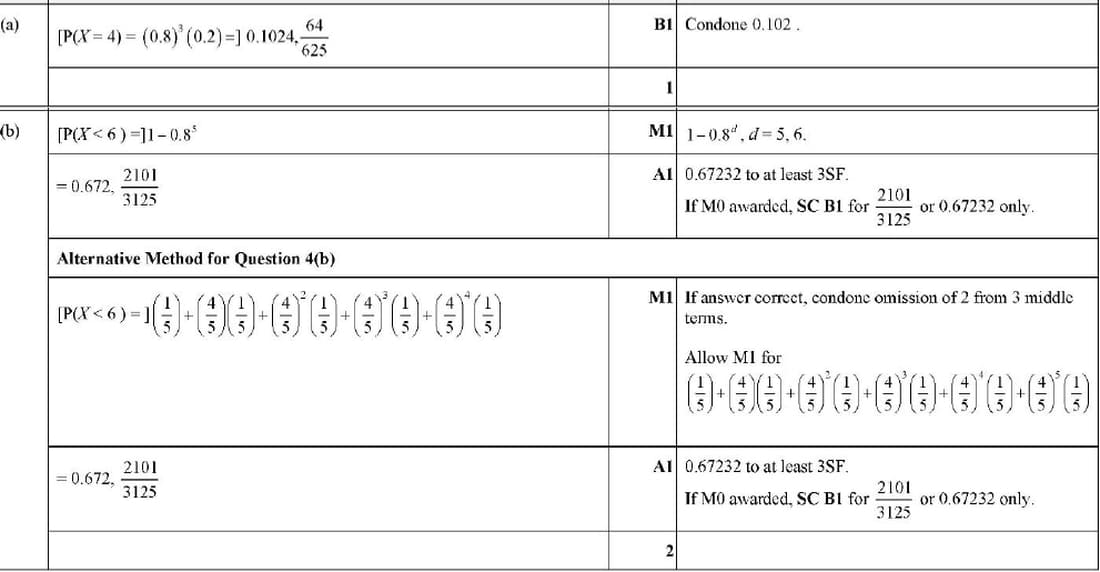
A fair 5-sided spinner has sides labelled 1, 2, 3, 4, 5. The spinner is spun repeatedly until a 2 is obtained on the side on which the spinner lands. The random variable X denotes the number of spins required.
(a) Find \(P(X = 4)\).
(b) Find \(P(X < 6)\).
9709 P51 - Jun 2023 - Q7
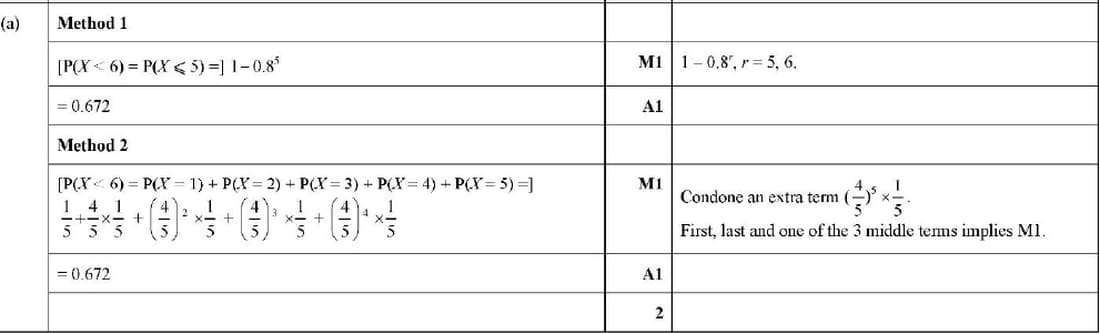
A children's wildlife magazine is published every Monday. For the next 12 weeks it will include a model animal as a free gift. There are five different models: tiger, leopard, rhinoceros, elephant and buffalo, each with the same probability of being included in the magazine.
Sahim buys one copy of the magazine every Monday.
Find the probability that the first time that the free gift is an elephant is before the 6th Monday.
9709 P52 - Mar 2023 - Q3
80% of the residents of Kinwawa are in favour of a leisure centre being built in the town.
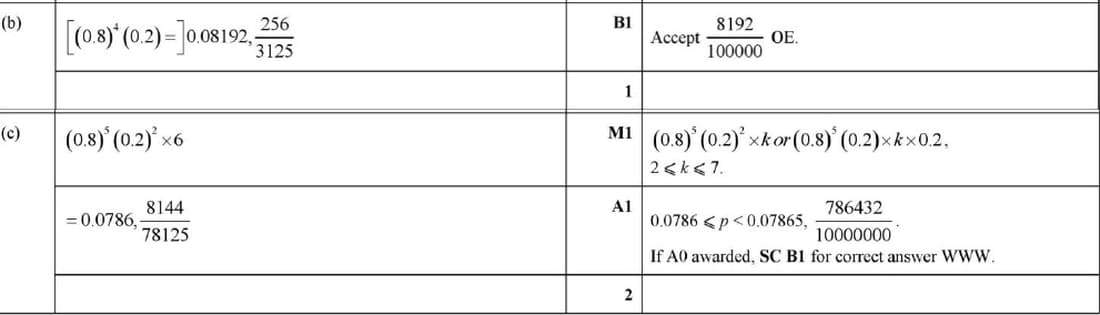
(b) Find the probability that the 5th person asked is the first person who is not in favour of the leisure centre.
(c) Find the probability that the 7th person asked is the second person who is not in favour of the leisure centre.
9709 P53 - Nov 2022 - Q4
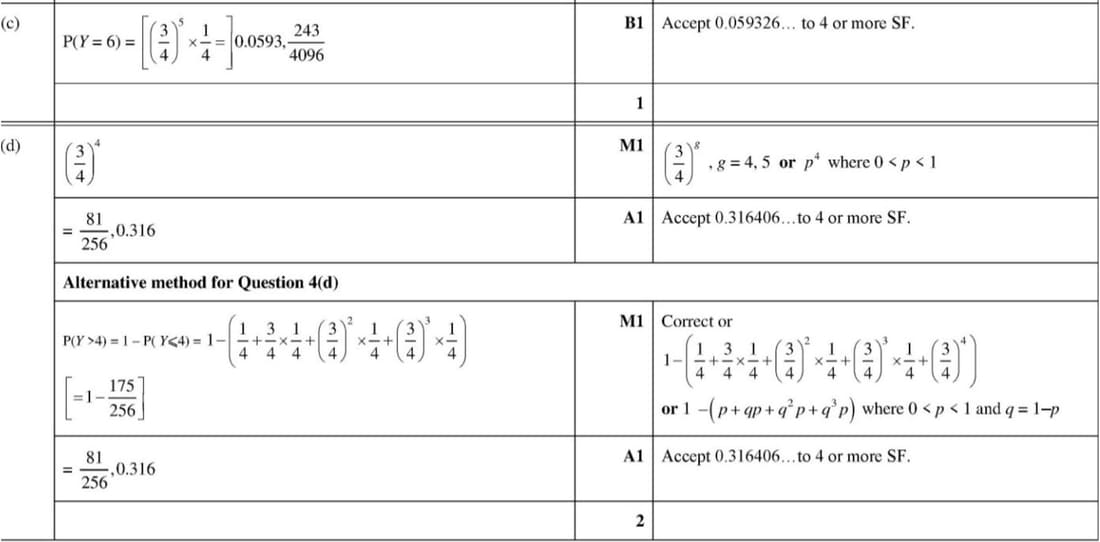
On another occasion, one of the fair 4-sided spinners is spun repeatedly until a 3 is obtained. The random variable \(Y\) is the number of spins required to obtain a 3.
(c) Find \(P(Y = 6)\).
(d) Find \(P(Y > 4)\).
9709 P53 - Nov 2023 - Q2
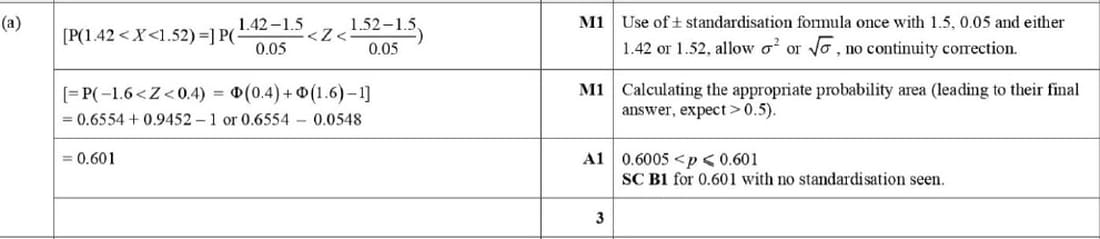
The weights of large bags of pasta produced by a company are normally distributed with mean 1.5 kg and standard deviation 0.05 kg.
Find the probability that a randomly chosen large bag of pasta weighs between 1.42 kg and 1.52 kg.
9709 P53 - Nov 2021 - Q4
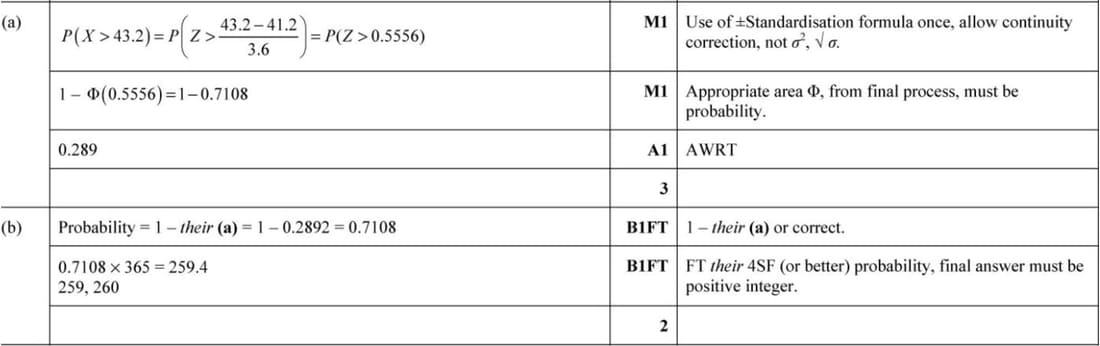
Raj wants to improve his fitness, so every day he goes for a run. The times, in minutes, of his runs have a normal distribution with mean 41.2 and standard deviation 3.6.
(a) Find the probability that on a randomly chosen day Raj runs for more than 43.2 minutes.
(b) Find an estimate for the number of days in a year (365 days) on which Raj runs for less than 43.2 minutes.
9709 P52 - Nov 2021 - Q6
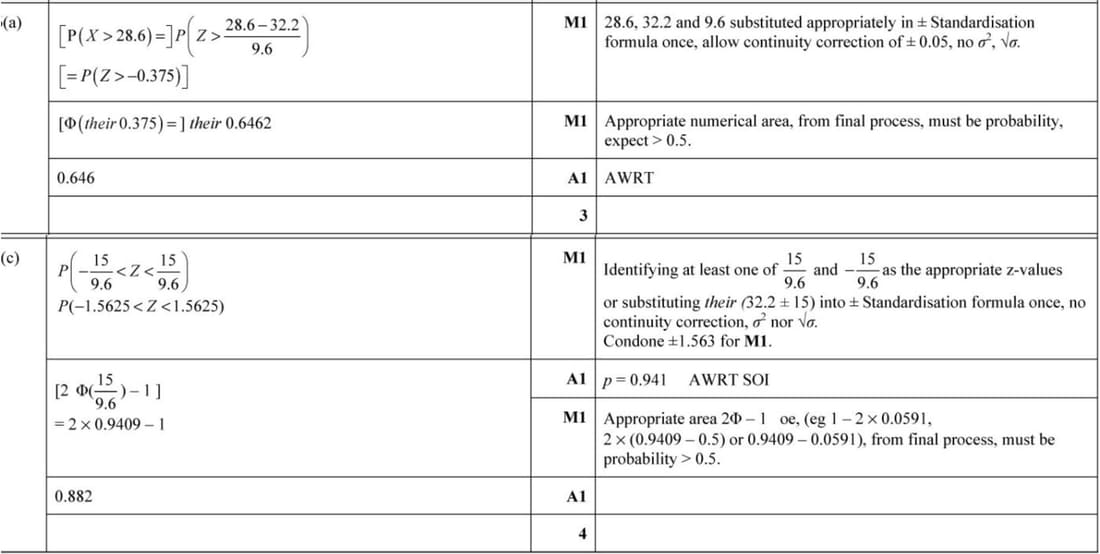
The times taken, in minutes, to complete a particular task by employees at a large company are normally distributed with mean 32.2 and standard deviation 9.6.
(a) Find the probability that a randomly chosen employee takes more than 28.6 minutes to complete the task.
(c) Find the probability that the time taken to complete the task by a randomly chosen employee differs from the mean by less than 15.0 minutes.
9709 P51 - Nov 2021 - Q7
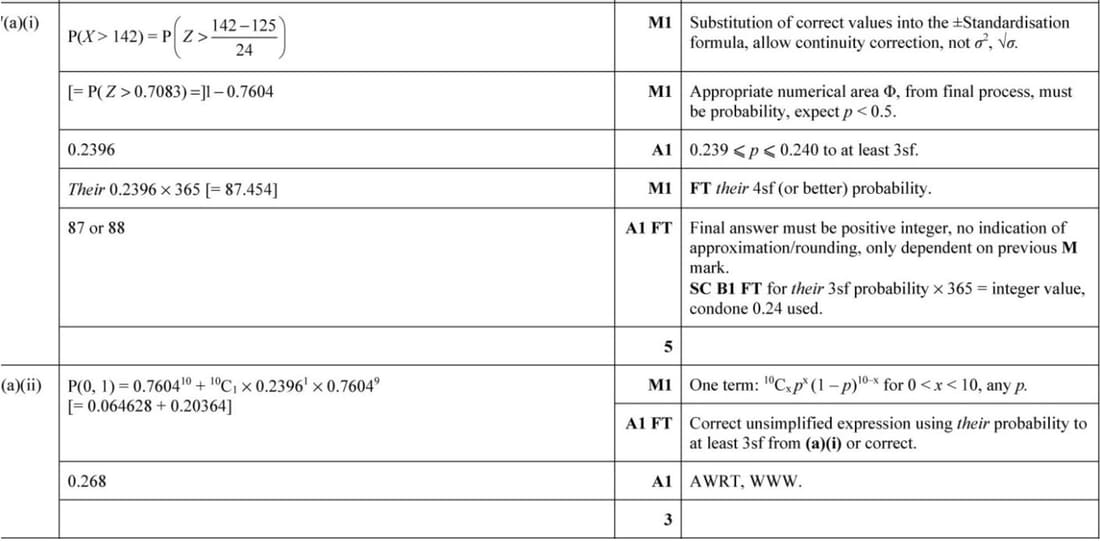
The times, in minutes, that Karli spends each day on social media are normally distributed with mean 125 and standard deviation 24.
(i) On how many days of the year (365 days) would you expect Karli to spend more than 142 minutes on social media?
(ii) Find the probability that Karli spends more than 142 minutes on social media on fewer than 2 of 10 randomly chosen days.
9709 P51 - Jun 2021 - Q2
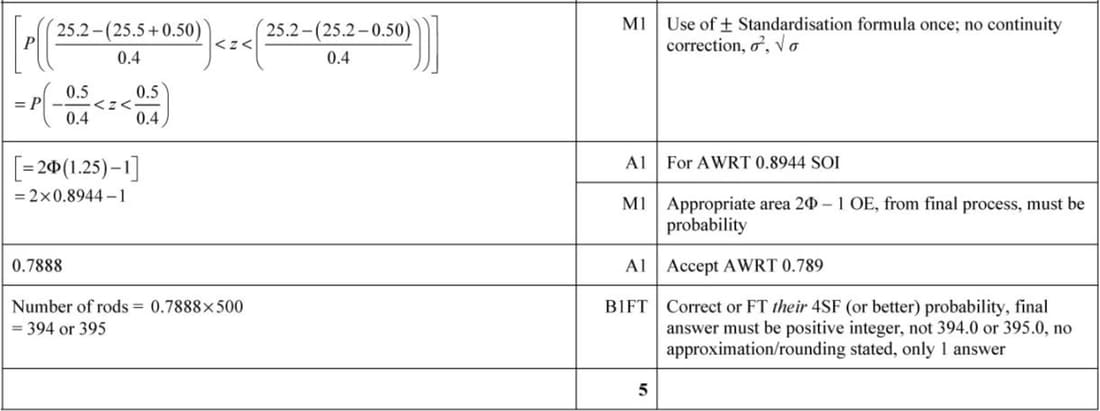
A company produces a particular type of metal rod. The lengths of these rods are normally distributed with mean 25.2 cm and standard deviation 0.4 cm. A random sample of 500 of these rods is chosen.
How many rods in this sample would you expect to have a length that is within 0.5 cm of the mean length?
9709 P52 - Mar 2021 - Q3
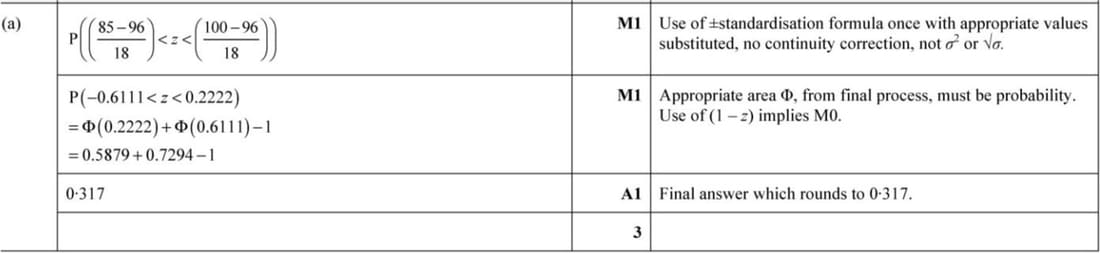
The time spent by shoppers in a large shopping centre has a normal distribution with mean 96 minutes and standard deviation 18 minutes.
Find the probability that a shopper chosen at random spends between 85 and 100 minutes in the shopping centre.
9709 P53 - Nov 2020 - Q1
The times taken to swim 100 metres by members of a large swimming club have a normal distribution with mean 62 seconds and standard deviation 5 seconds.
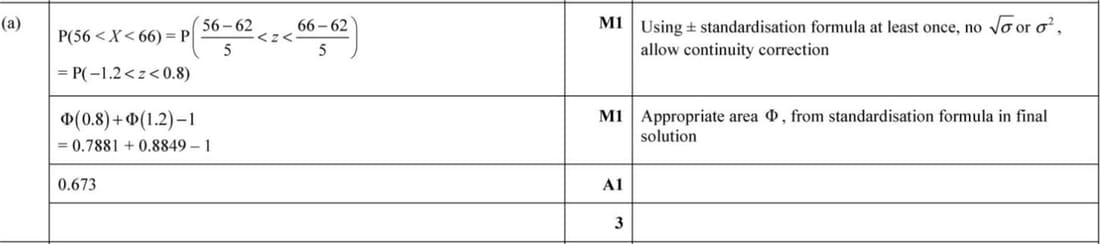
Find the probability that a randomly chosen member of the club takes between 56 and 66 seconds to swim 100 metres.