Browsing as Guest. Progress, bookmarks and attempts are disabled.
Log in to track your work.
9709 P53 - Nov 2020 - Q2
3100
An ordinary fair die is thrown until a 6 is obtained.
(a) Find the probability that obtaining a 6 takes more than 8 throws.
Two ordinary fair dice are thrown together until a pair of 6s is obtained. The number of throws taken is denoted by the random variable X.
(b) Find the expected value of X.
(c) Find the probability that obtaining a pair of 6s takes either 10 or 11 throws.
Solution
Checked by expert
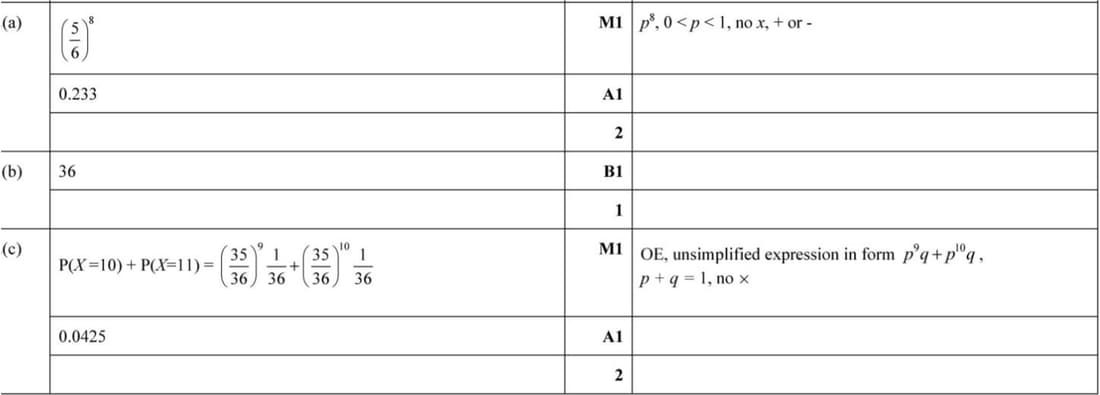
(a) The probability of not obtaining a 6 on a single throw is \(\frac{5}{6}\). The probability of not obtaining a 6 for 8 consecutive throws is \(\left( \frac{5}{6} \right)^8\). Therefore, the probability that obtaining a 6 takes more than 8 throws is \(\left( \frac{5}{6} \right)^8 = 0.233\).
(b) For two dice, the probability of obtaining a pair of 6s on a single throw is \(\frac{1}{36}\). The expected number of throws to get a pair of 6s is the reciprocal of this probability, which is \(\frac{1}{\frac{1}{36}} = 36\).
(c) The probability of obtaining a pair of 6s on the 10th throw is \(\left( \frac{35}{36} \right)^9 \times \frac{1}{36}\). The probability of obtaining a pair of 6s on the 11th throw is \(\left( \frac{35}{36} \right)^{10} \times \frac{1}{36}\). Therefore, the probability that obtaining a pair of 6s takes either 10 or 11 throws is \(\left( \frac{35}{36} \right)^9 \times \frac{1}{36} + \left( \frac{35}{36} \right)^{10} \times \frac{1}{36} = 0.0425\).