Past Exam Questions
← Back9709 P62 - Mar 2017 - Q7
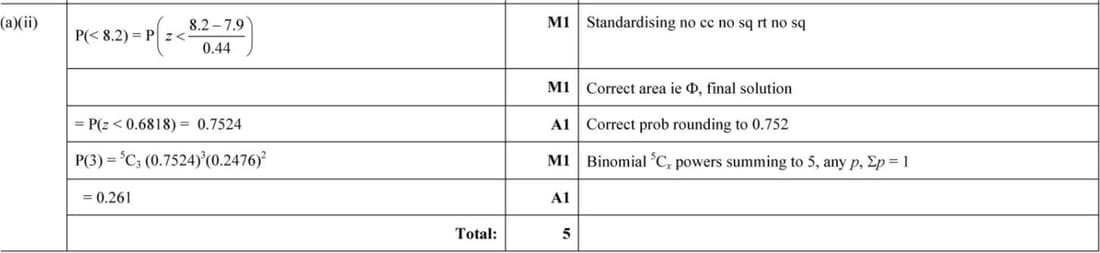
The lengths, in centimetres, of middle fingers of women in Snoland have a normal distribution with mean 7.9 and standard deviation 0.44. A random sample of 5 women from Snoland is chosen.
(ii) Find the probability that exactly 3 of these women have middle fingers shorter than 8.2 cm.
9709 P62 - Nov 2016 - Q4
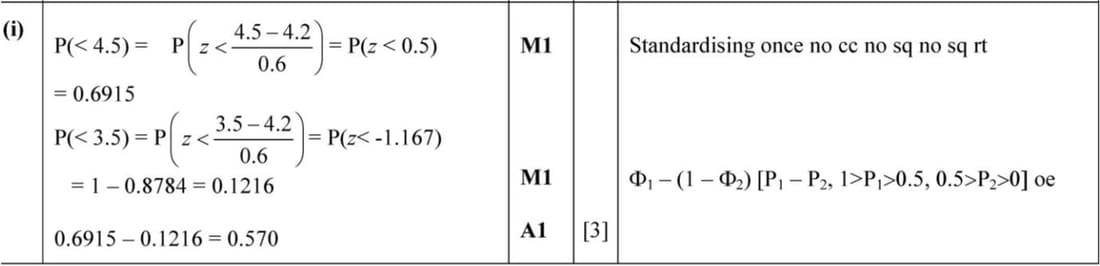
The time taken to cook an egg by people living in a certain town has a normal distribution with mean 4.2 minutes and standard deviation 0.6 minutes.
Find the probability that a person chosen at random takes between 3.5 and 4.5 minutes to cook an egg.
9709 P62 - Jun 2016 - Q6
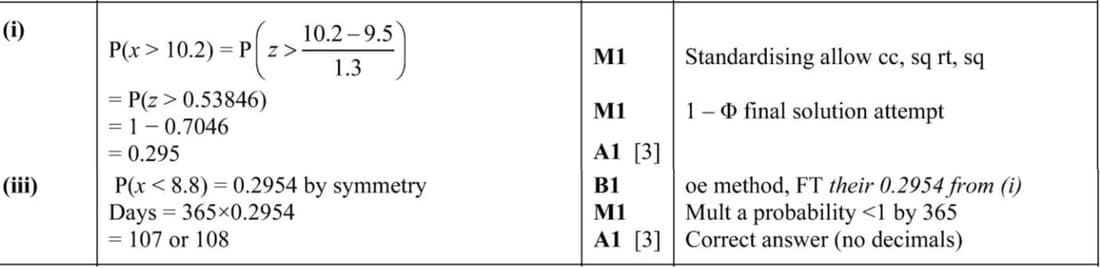
The time in minutes taken by Peter to walk to the shop and buy a newspaper is normally distributed with mean 9.5 and standard deviation 1.3.
- Find the probability that on a randomly chosen day Peter takes longer than 10.2 minutes.
- Calculate an estimate of the number of days in a year (365 days) on which Peter takes less than 8.8 minutes to walk to the shop and buy a newspaper.
9709 P62 - Mar 2016 - Q7
The times in hours taken by another garage to fit a tow bar onto a car have the distribution \(N(\mu, \sigma^2)\) where \(\mu = 3\sigma\).
Find the probability that it takes more than \(0.6\mu\) hours to fit a tow bar onto a randomly chosen car at this garage.

9709 P62 - Nov 2015 - Q7
The random variable \(Y\) is normally distributed with mean \(\mu\) and standard deviation \(\sigma\). Given that \(\sigma = \frac{2}{3} \mu\), find the probability that a random value of \(Y\) is less than \(2\mu\).

9709 P61 - Nov 2015 - Q4
Amy’s friend Marok measured her pulse rate every day after running for half an hour. Marok’s pulse rate, in beats per minute, was found to have a mean of 148.6 and a standard deviation of 18.5. Assuming that pulse rates have a normal distribution, find what proportion of Marok’s pulse rates, after running for half an hour, were above 160 beats per minute.

9709 P52 - Mar 2023 - Q6
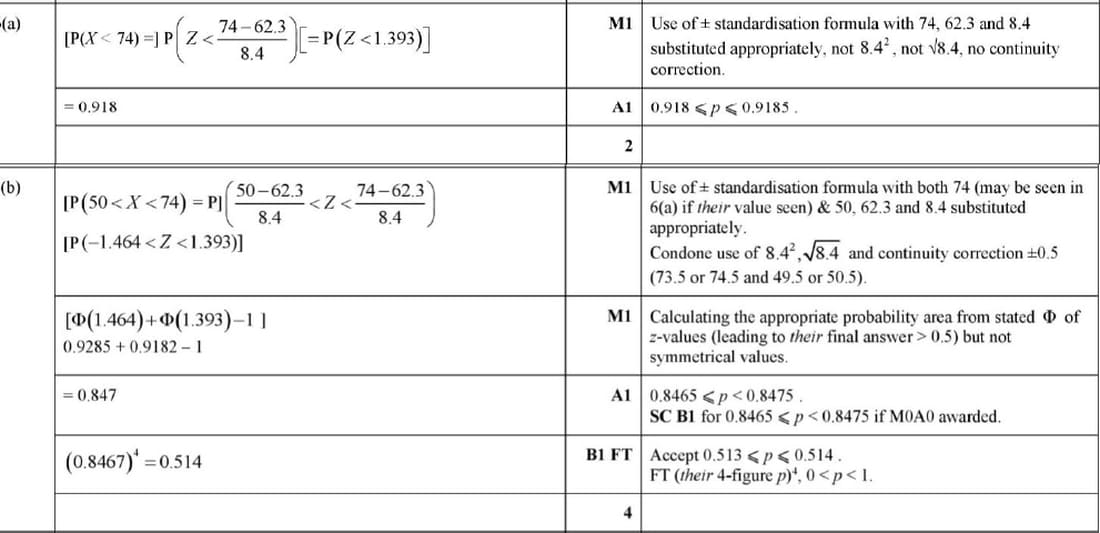
In a cycling event the times taken to complete a course are modelled by a normal distribution with mean 62.3 minutes and standard deviation 8.4 minutes.
(a) Find the probability that a randomly chosen cyclist has a time less than 74 minutes.
(b) Find the probability that 4 randomly chosen cyclists all have times between 50 and 74 minutes.
9709 P63 - Jun 2015 - Q5
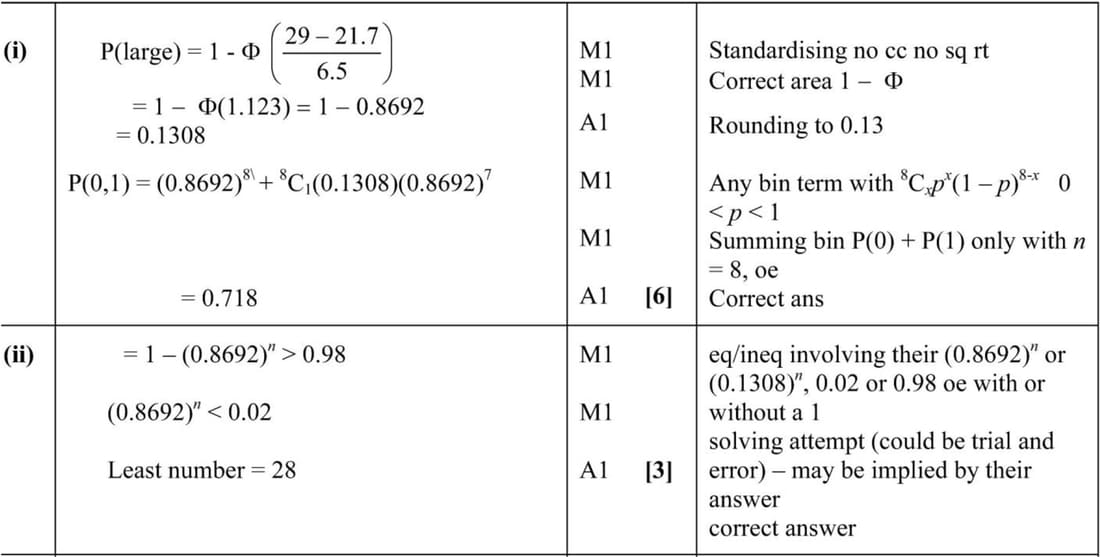
The heights of books in a library, in cm, have a normal distribution with mean 21.7 and standard deviation 6.5. A book with a height of more than 29 cm is classified as ‘large’.
(i) Find the probability that, of 8 books chosen at random, fewer than 2 books are classified as large.
(ii) n books are chosen at random. The probability of there being at least 1 large book is more than 0.98. Find the least possible value of n.
9709 P62 - Nov 2014 - Q5
The random variable \(Y\) has the distribution \(N(\mu, \sigma^2)\), where \(2\sigma = 3\mu\) and \(\mu \neq 0\). Find \(P(Y > 4\mu)\).

9709 P61 - Nov 2014 - Q6
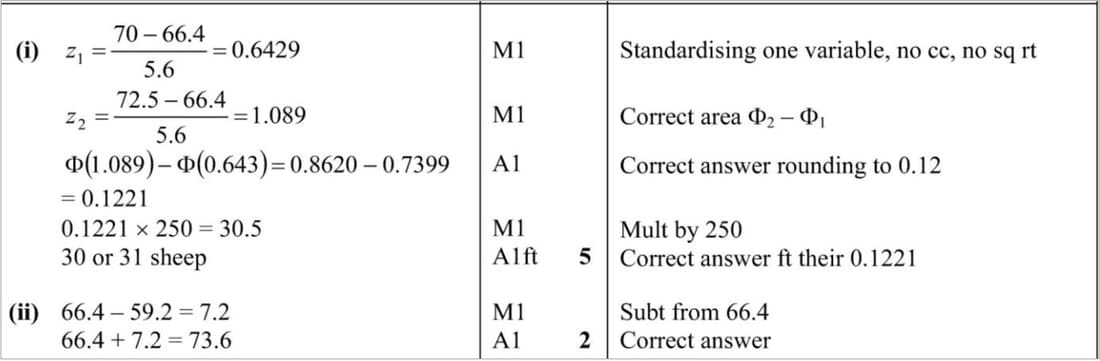
A farmer finds that the weights of sheep on his farm have a normal distribution with mean 66.4 kg and standard deviation 5.6 kg.
(i) 250 sheep are chosen at random. Estimate the number of sheep which have a weight of between 70 kg and 72.5 kg.
(ii) The proportion of sheep weighing less than 59.2 kg is equal to the proportion weighing more than y kg. Find the value of y.
9709 P61 - Jun 2014 - Q1
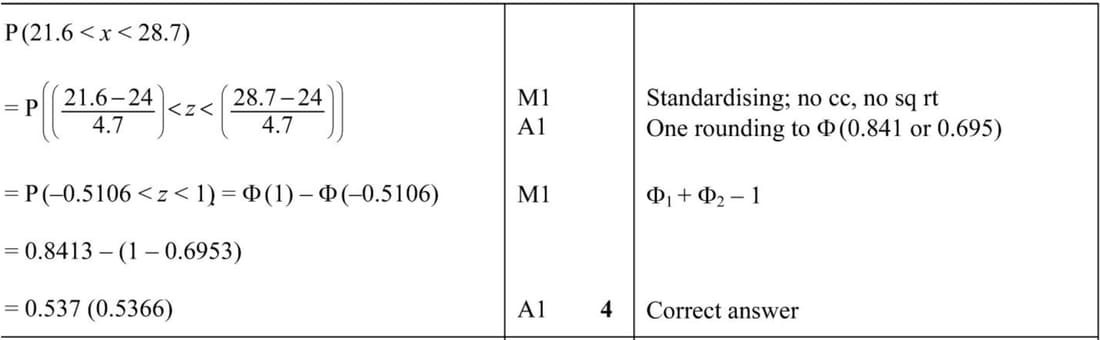
The petrol consumption of a certain type of car has a normal distribution with mean 24 kilometres per litre and standard deviation 4.7 kilometres per litre. Find the probability that the petrol consumption of a randomly chosen car of this type is between 21.6 kilometres per litre and 28.7 kilometres per litre.
9709 P63 - Nov 2013 - Q2
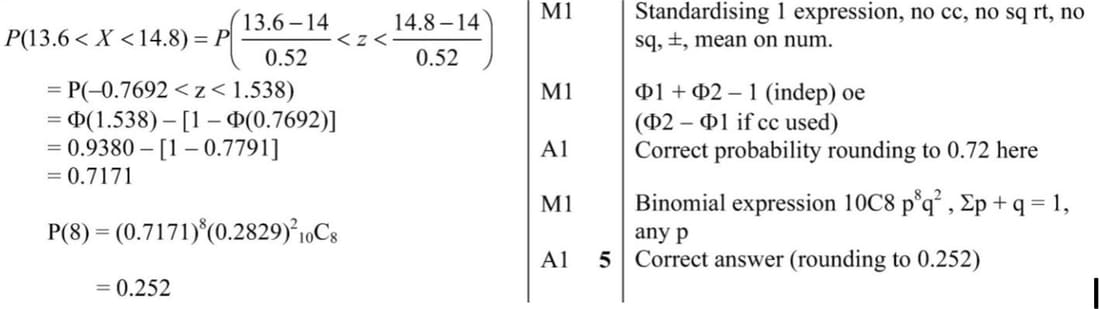
A factory produces flower pots. The base diameters have a normal distribution with mean 14 cm and standard deviation 0.52 cm. Find the probability that the base diameters of exactly 8 out of 10 randomly chosen flower pots are between 13.6 cm and 14.8 cm.
9709 P62 - Nov 2013 - Q1
It is given that \(X \sim N(1.5, 3.2^2)\). Find the probability that a randomly chosen value of \(X\) is less than \(-2.4\).

9709 P61 - Nov 2013 - Q1
It is given that \(X \sim N(30, 49)\), \(Y \sim N(30, 16)\) and \(Z \sim N(50, 16)\). On a single diagram, with the horizontal axis going from 0 to 70, sketch three curves to represent the distributions of \(X, Y\) and \(Z\).


9709 P61 - Jun 2013 - Q4
The random variable Y is normally distributed with positive mean μ and standard deviation \(\frac{1}{2} \mu\). Find the probability that a randomly chosen value of Y is negative.

9709 P63 - Nov 2012 - Q5
The random variable X is such that X ~ N(82, 126).
A value of X is chosen at random and rounded to the nearest whole number. Find the probability that this whole number is 84.

9709 P62 - Nov 2012 - Q2
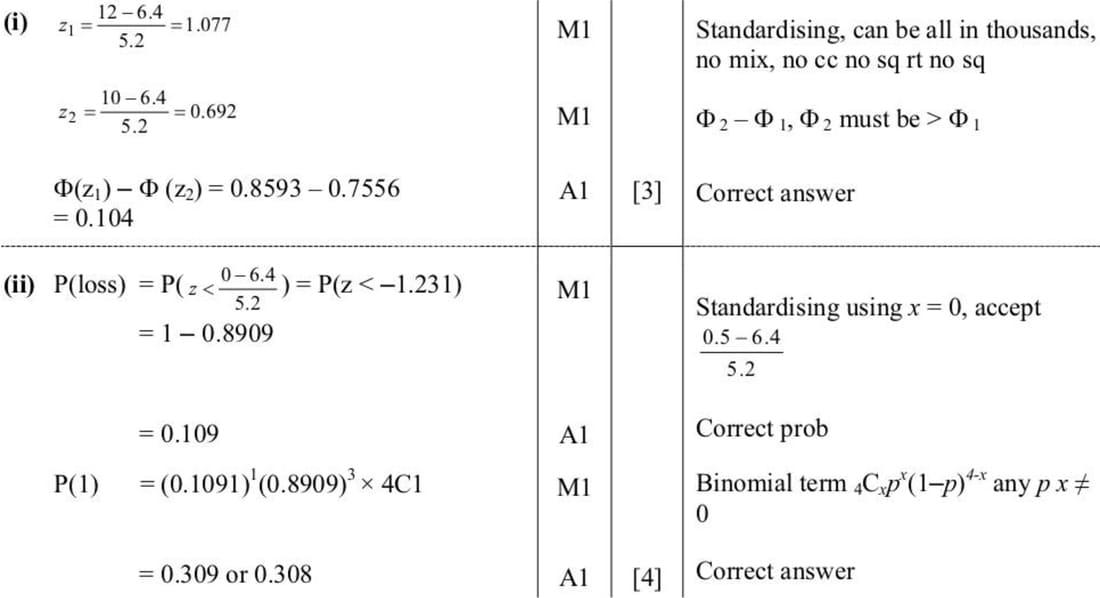
The random variable X is the daily profit, in thousands of dollars, made by a company. X is normally distributed with mean 6.4 and standard deviation 5.2.
(i) Find the probability that, on a randomly chosen day, the company makes a profit between $10,000 and $12,000.
(ii) Find the probability that the company makes a loss on exactly 1 of the next 4 consecutive days.
9709 P53 - Nov 2022 - Q5
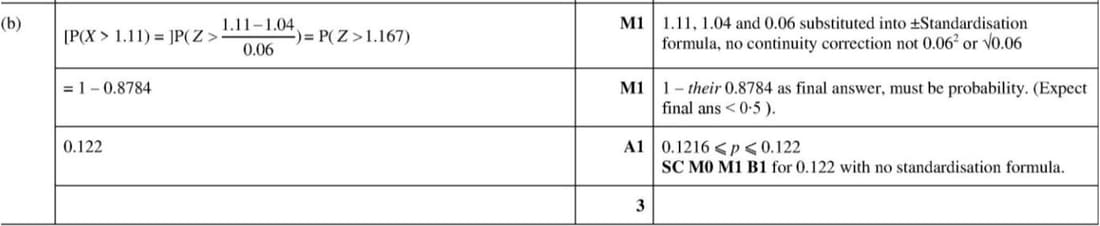
The weights of the bags of sugar produced by company B are normally distributed with mean 1.04 kg and standard deviation 0.06 kg.
Find the probability that a randomly chosen bag produced by company B weighs more than 1.11 kg.
9709 P63 - Jun 2012 - Q6
In another fish farm, the lengths of salmon, X cm, are normally distributed with mean 32.9 cm and standard deviation 2.4 cm.
Find the probability that a randomly chosen salmon is 34 cm long, correct to the nearest centimetre.

9709 P61 - Jun 2012 - Q1
It is given that \(X \sim N(28.3, 4.5)\). Find the probability that a randomly chosen value of \(X\) lies between 25 and 30.
