Past Exam Questions
← Back0606 P21 - Nov 2021 - Q7 - 9 marks
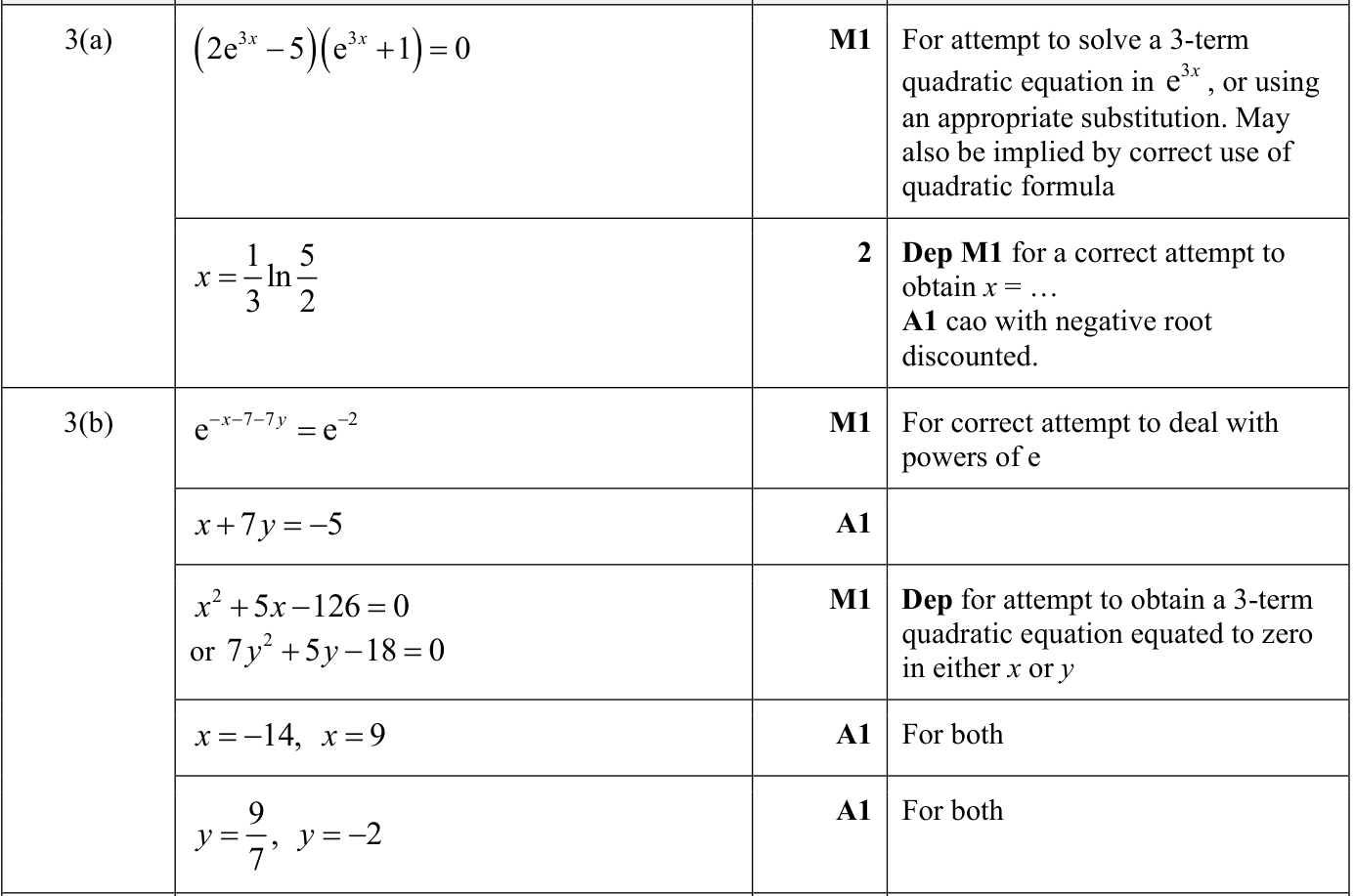
(a) Using logarithms, solve the equation
\(5^{x-2}=3\times 2^{2x+3}.\)
Give your answer correct to 1 decimal place.
(b) Solve the equation
\(\log_3(y^2+11)-2=\log_3(y-1).\)
0606 P23 - Nov 2021 - Q4 - 8 marks
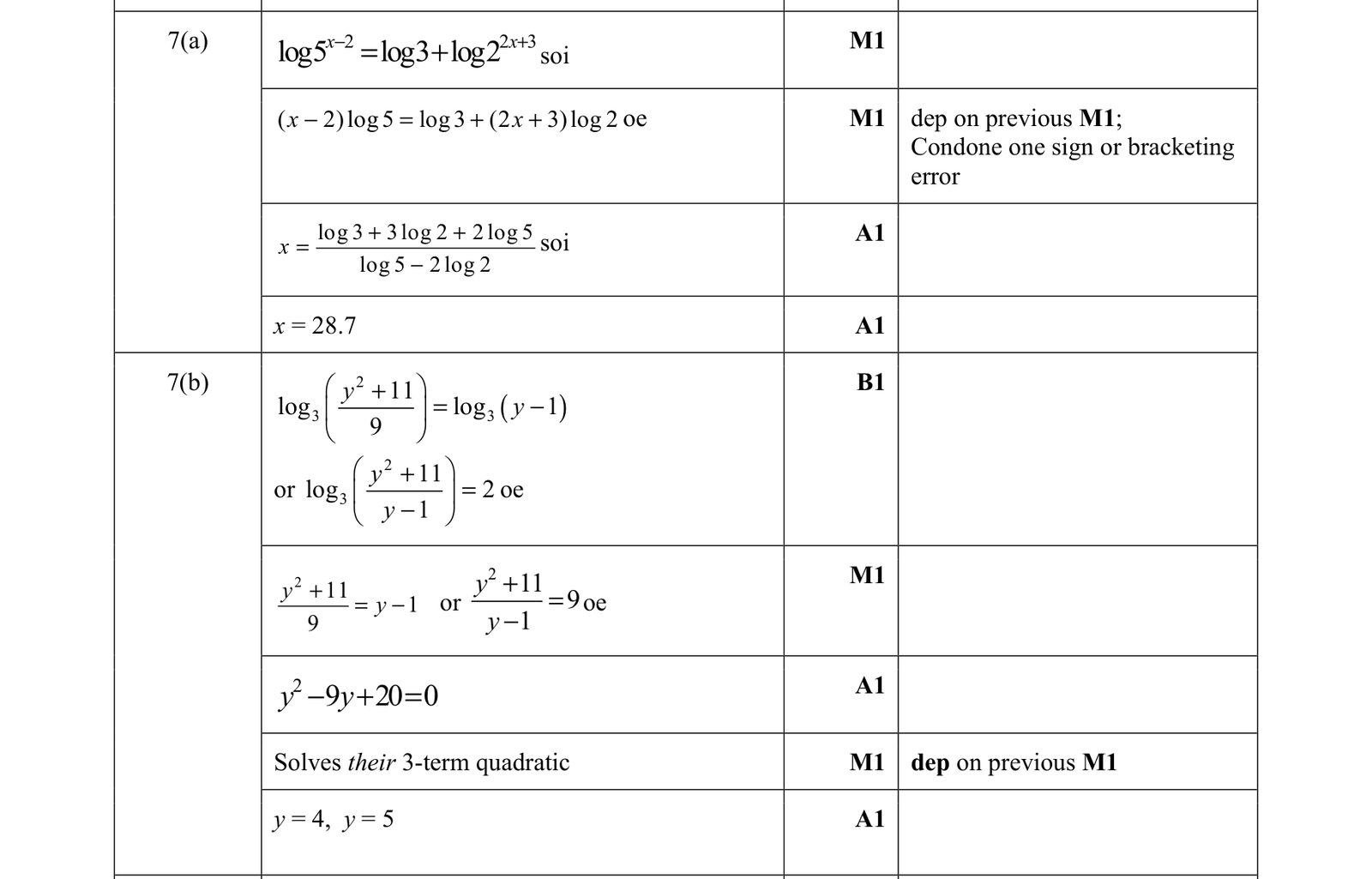
(a) Solve the equation
\(\log_6(2x-3)=\frac12.\)
Give your answer in exact form.
(b) Solve the equation
\(\ln 2u-\ln(u-4)=1.\)
Give your answer in exact form.
(c) Solve the equation
\(\frac{3^v}{27^{2v-5}}=9.\)
0606 P22 - Nov 2020 - Q4 - 6 marks
Solve the simultaneous equations
\(\log_3(x+y)=2,\)
\(2\log_3(x+1)=\log_3(y+2).\)

0606 P23 - Nov 2020 - Q8 - 10 marks
Do not use a calculator in this question.
It is given that
\(\log_2(y+1)=3-2\log_2 x\)
and
\(\log_2(x+2)=2+\log_2 y.\)
(a) Show that \(x^3+6x^2-32=0\).
(b) Find the roots of the equation \(x^3+6x^2-32=0\).
(c) Hence find the value of \(y\).

0606 P11 - Jun 2019 - Q7 - 8 marks
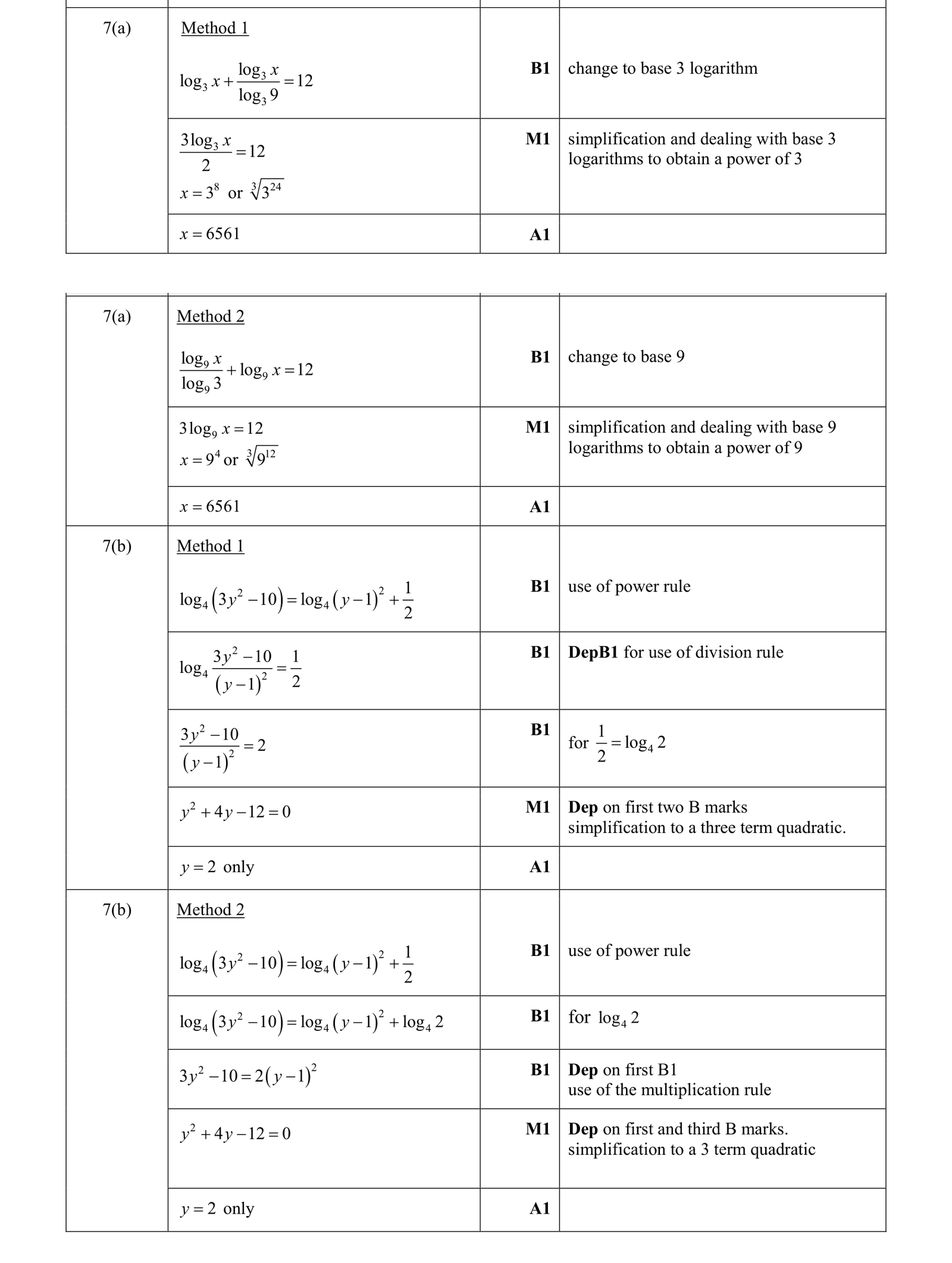
(a) Solve \(\log_3 x+\log_9 x=12\).
(b) Solve \(\log_4(3y^2-10)=2\log_4(y-1)+\frac12\).
0606 P12 - Nov 2019 - Q6 - 7 marks
(a) Write
\(\frac{\sqrt{p}\left(\frac{qp}{r}\right)^2}{p^{-1}\sqrt[3]{qr}}\)
in the form \(p^aq^br^c\), where \(a\), \(b\) and \(c\) are constants.
(b) Solve
\(\log_7x+2\log_x7=3.\)

0606 P21 - Nov 2019 - Q3 - 8 marks
(a) Solve
\(e^{2x+1}=3e^{4-3x}.\)
(b) Solve
\(\lg(y-6)+\lg(y+15)=2.\)

0606 P22 - Mar 2018 - Q8 - 8 marks
(a) Solve the following equations.
(i) \(5e^{3x+4}=14\).
(ii) \(\lg(2y-7)+\lg y=2\lg3\).
(b) Write \(\dfrac{\log_2p-\log_2q}{(\log_2r)(\log_r2)}\) as a single logarithm to base \(2\).

0606 P12 - Jun 2018 - Q9 - 9 marks
(a)(i) Solve \(\lg x=3\).
(a)(ii) Write \(\lg a-2\lg b+3\) as a single logarithm.
(b)(i) Solve \(x-5+\dfrac6x=0\).
(b)(ii) Hence, showing all your working, find the values of \(a\) such that
\(\log_4 a-5+6\log_a4=0.\)

0606 P23 - Nov 2018 - Q6 - 5 marks
Solve the simultaneous equations
\(\log_2(x+2y)=3, \qquad \log_2(3x)-\log_2y=1.\)

0606 P21 - Nov 2017 - Q3 - 4 marks
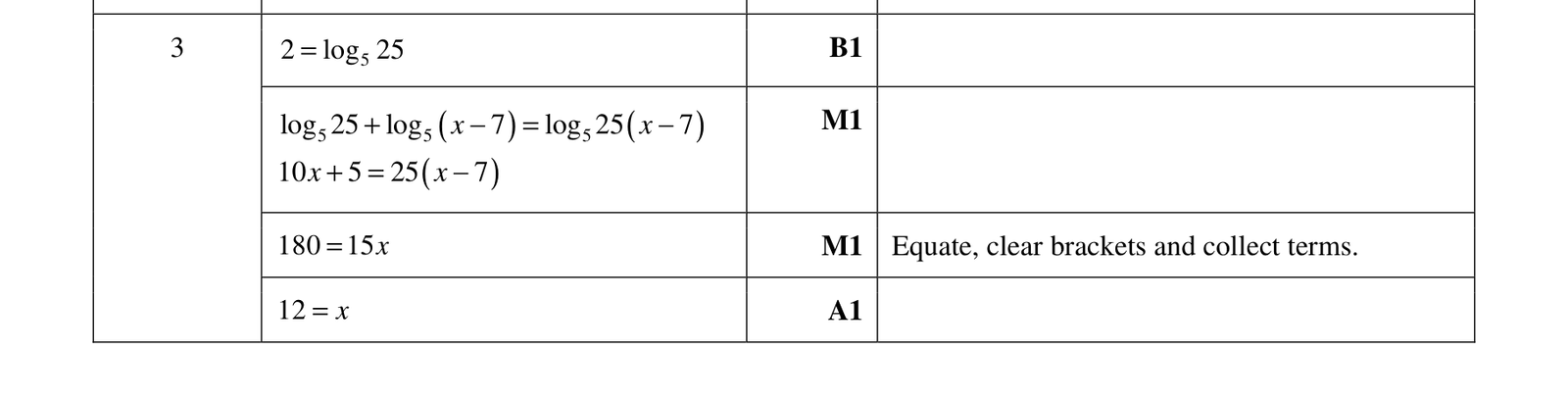
Solve the equation \(\log_5(10x+5)=2+\log_5(x-7)\).
0606 P22 - Nov 2017 - Q4 - 5 marks
Solve the simultaneous equations
\(\log_2(x+4)=2\log_2y,\)
\(\log_2(7y-x)=4.\)

0606 P23 - Nov 2017 - Q4 - 5 marks
Solve the simultaneous equations
\(\log_3(x+1)=1+\log_3 y,\)
\(\log_3(x-y)=2.\)

0606 P23 - Jun 2025 - Q13 - 4 marks
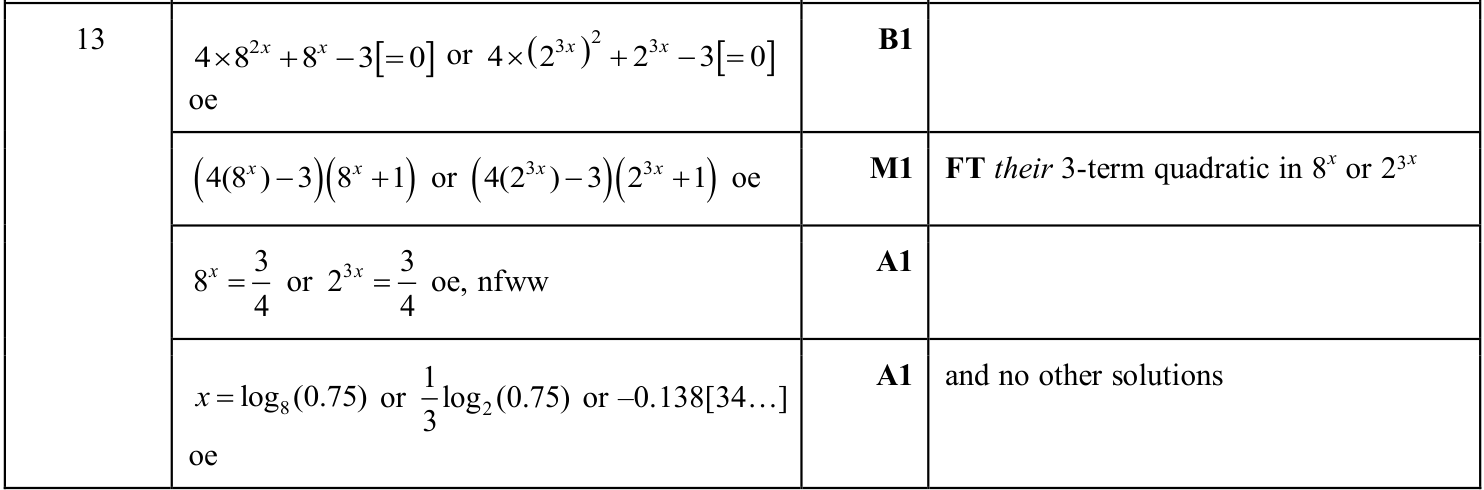
Solve the equation \(64^{x+\frac{1}{3}}+2^{3 x}-3=0\).
0606 P13 - Nov 2024 - Q3 - 10 marks
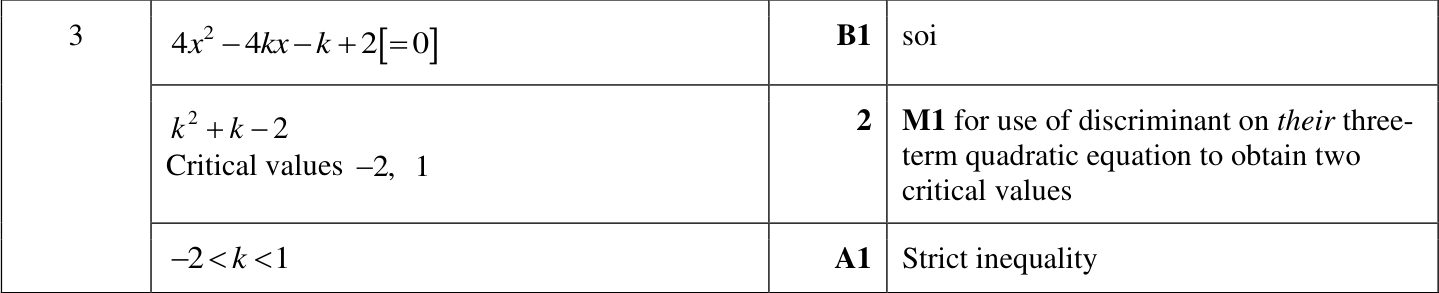
Find the values of \(k\) for which the equation \(4 x^{2}-k=4 k x-2\) has no real roots.
0606 P21 - Nov 2024 - Q3 - 10 marks
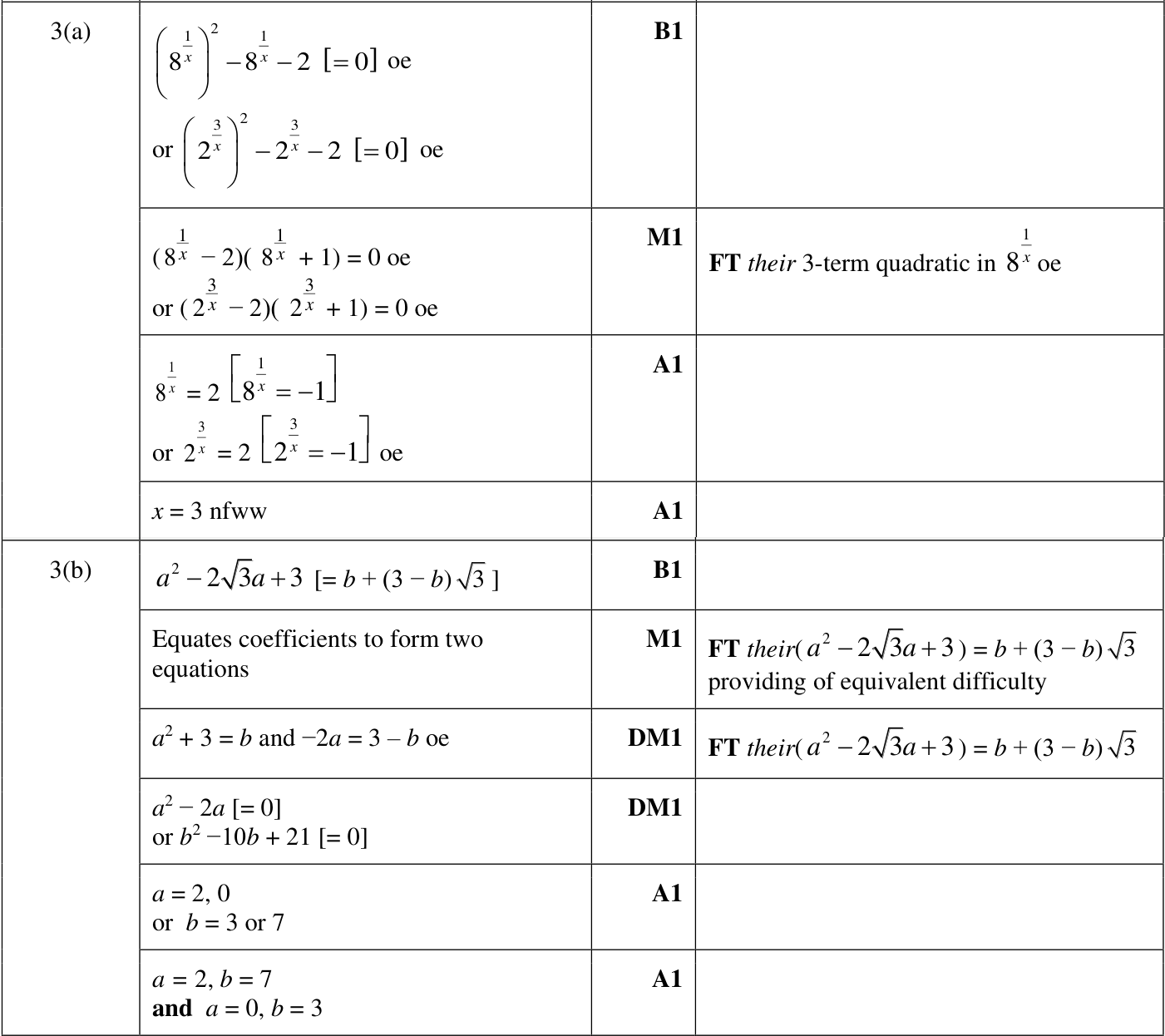
(a) Solve the equation \(8^{\frac{1}{x}}-2 \times 8^{-\frac{1}{x}}=1\). (b) It is given that \((a-\sqrt{3})^{2}=b+(3-b) \sqrt{3}\), where \(a\) and \(b\) are integers. Find the possible values of \(a\) and \(b\).
0606 P11 - Jun 2024 - Q9 - 9 marks
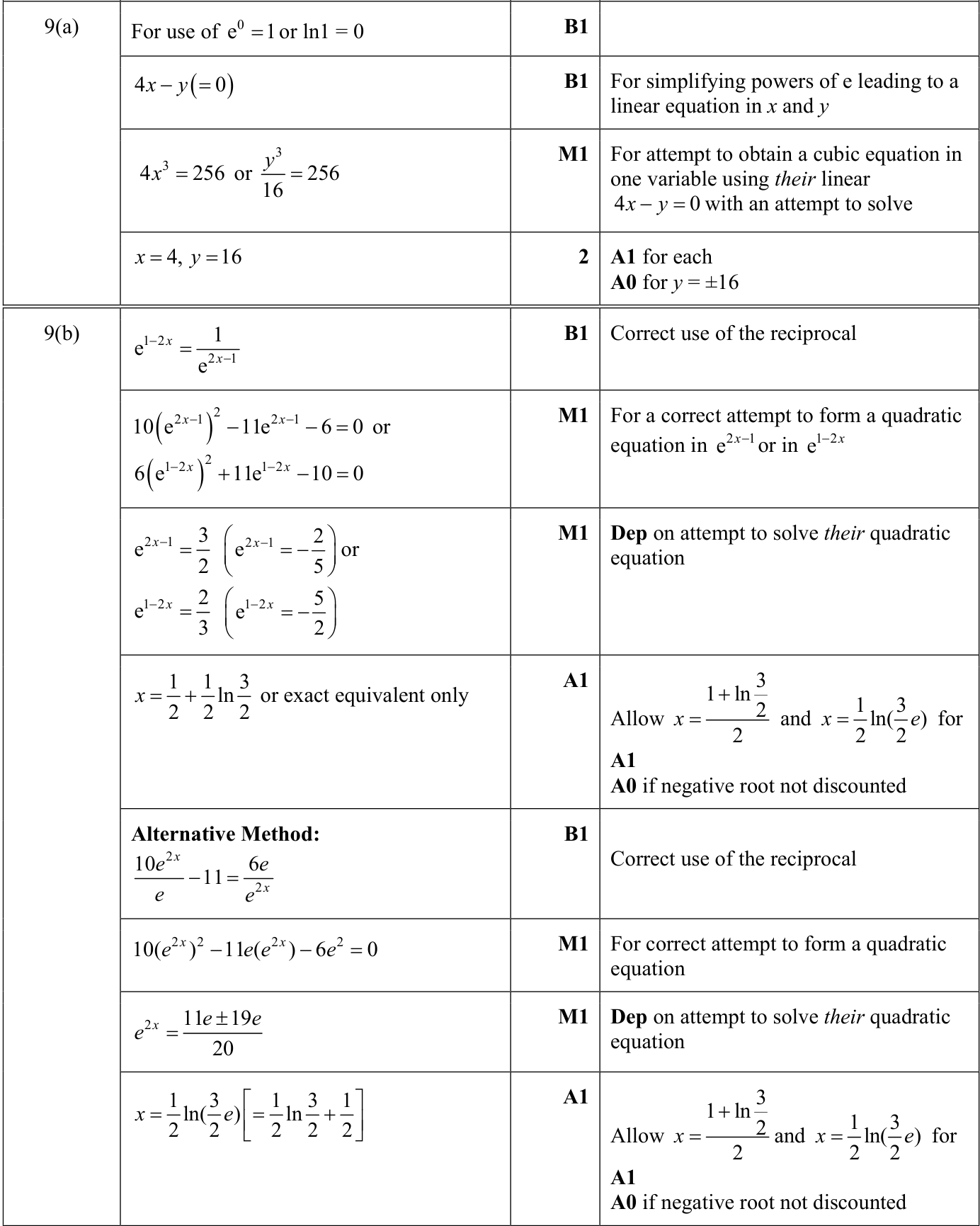
(a) Solve the following simultaneous equations. \(\begin{aligned} \mathrm{e}^{x+y} \times \mathrm{e}^{3 x-2 y} & =1 \\ x^{2} y & =256 \end{aligned}\) (b) Solve the equation \(10 \mathrm{e}^{(2 x-1)}-11=6 \mathrm{e}^{(1-2 x)}\), giving your answer in exact form.
0606 P13 - Jun 2024 - Q2 - 4 marks
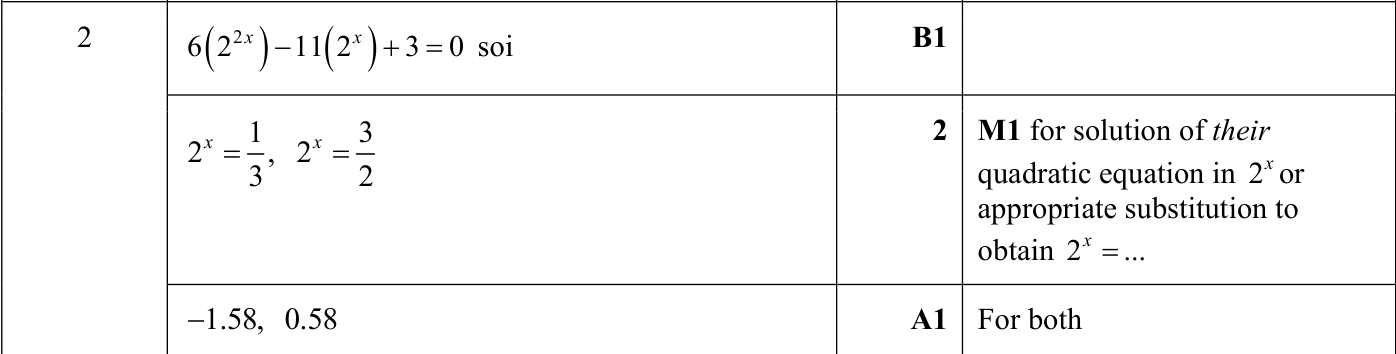
Solve the equation \(3\left(2^{2 x+1}\right)-11\left(2^{x}\right)+3=0\), giving your answers correct to 2 decimal places.
0606 P21 - Jun 2023 - Q4 - 7 marks
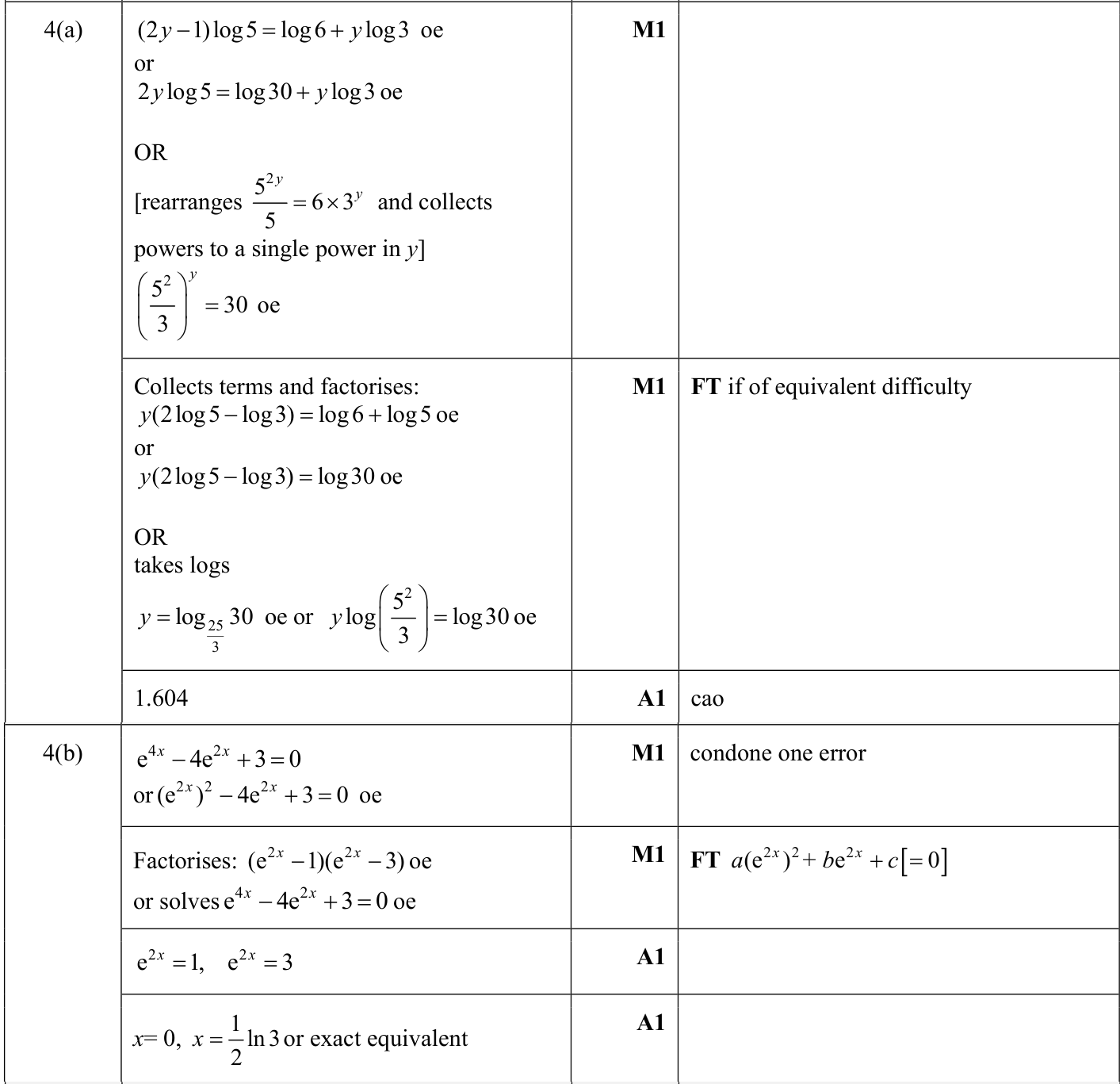
(a) Solve the equation
\(5^{2y-1}=6\times3^y,\)
giving your answer correct to 3 decimal places.
(b) Solve the equation
\(e^{2x}-4+3e^{-2x}=0,\)
giving your answers in exact form.
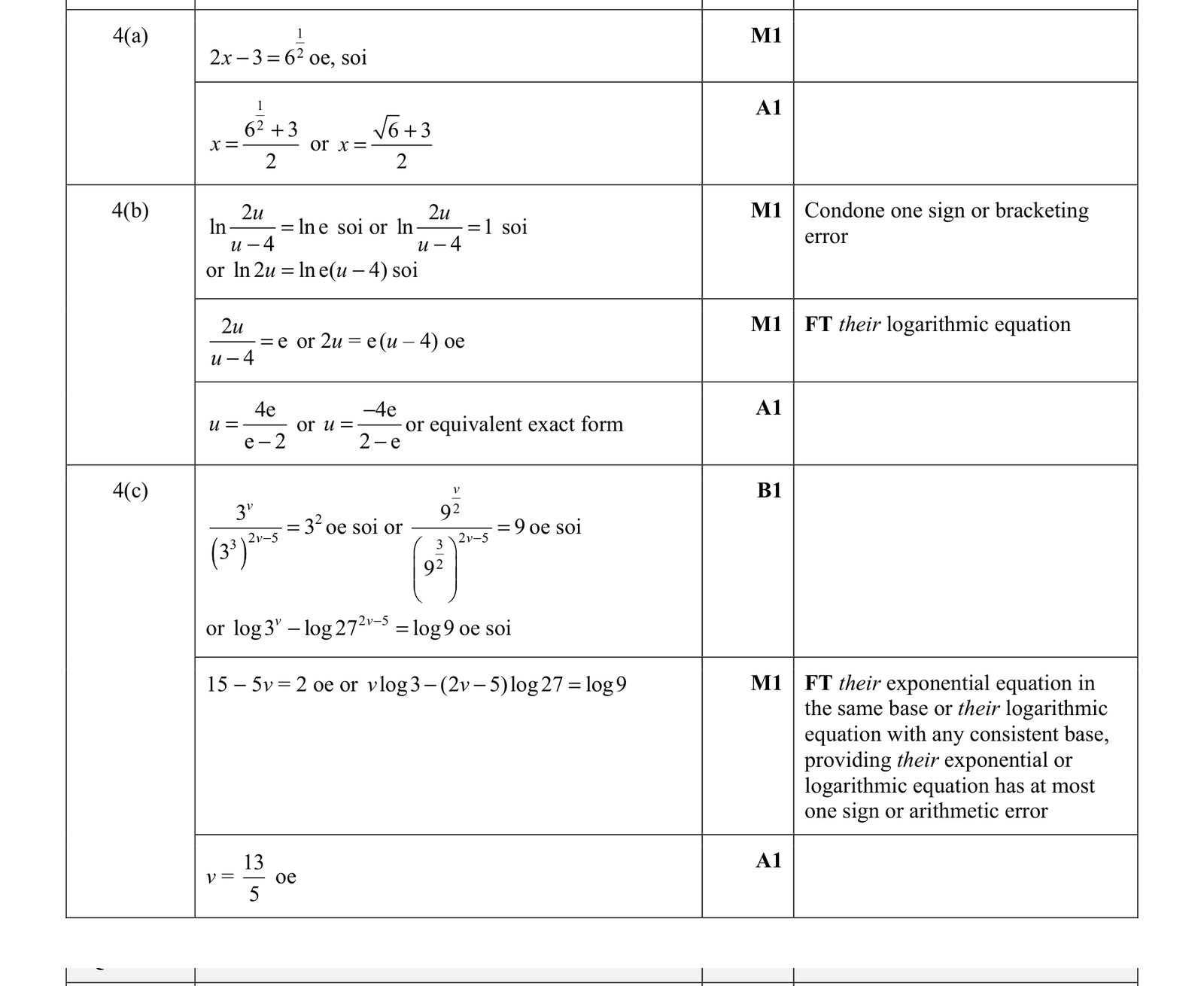
0606 P13 - Jun 2022 - Q3 - 8 marks
(a) Find the exact solution of the equation
\(2\mathrm e^{6x}-3\mathrm e^{3x}-5=0.\)
(b) Solve the simultaneous equations
\(\mathrm e^{4x-7}\div \mathrm e^{5x+7y}=\frac{1}{\mathrm e^2},\)
\(xy+18=0.\)