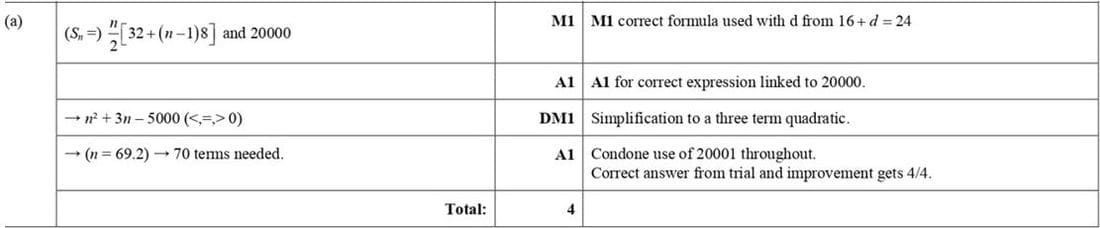
The first term of the arithmetic progression is 16, and the second term is 24. Therefore, the common difference is given by:
\(d = 24 - 16 = 8\)
The sum of the first \(n\) terms of an arithmetic progression is given by:
\(S_n = \frac{n}{2} \left( 2a + (n-1)d \right)\)
Substituting the known values \(a = 16\) and \(d = 8\), we have:
\(S_n = \frac{n}{2} \left( 32 + (n-1) \times 8 \right)\)
We need \(S_n > 20,000\):
\(\frac{n}{2} \left( 32 + 8n - 8 \right) > 20,000\)
\(\frac{n}{2} (24 + 8n) > 20,000\)
\(n(12 + 4n) > 20,000\)
\(4n^2 + 12n - 20,000 > 0\)
Dividing the entire inequality by 4:
\(n^2 + 3n - 5,000 > 0\)
Solving the quadratic equation \(n^2 + 3n - 5,000 = 0\) using the quadratic formula:
\(n = \frac{-b \pm \sqrt{b^2 - 4ac}}{2a}\)
where \(a = 1\), \(b = 3\), \(c = -5,000\):
\(n = \frac{-3 \pm \sqrt{3^2 - 4 \times 1 \times (-5,000)}}{2 \times 1}\)
\(n = \frac{-3 \pm \sqrt{9 + 20,000}}{2}\)
\(n = \frac{-3 \pm \sqrt{20,009}}{2}\)
Approximating the square root:
\(n \approx \frac{-3 + 141.42}{2}\)
\(n \approx 69.21\)
Since \(n\) must be an integer, we round up to the nearest whole number:
\(n = 70\)
Therefore, 70 terms are needed for the sum to exceed 20,000.