A water tank holds 2000 litres when full. A small hole in the base is gradually getting bigger so that each day a greater amount of water is lost.
On the first day after filling, 10 litres of water are lost and this increases by 2 litres each day.
(a) How many litres will be lost on the 30th day after filling?
(b) The tank becomes empty during the nth day after filling. Find the value of n.
Solution
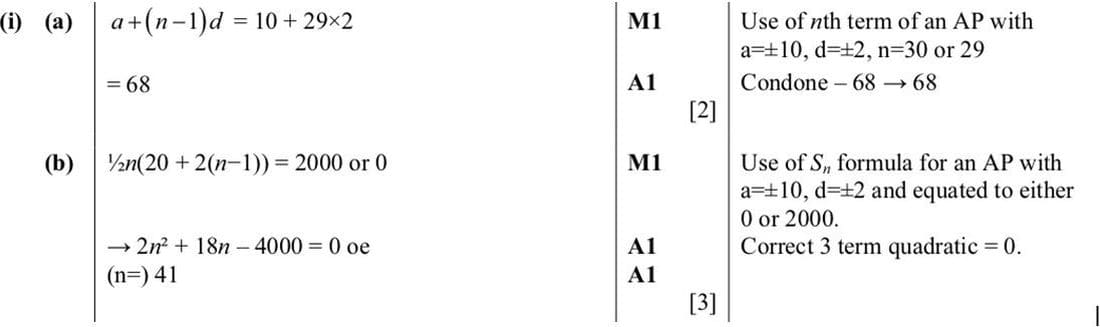
(a) The amount of water lost each day forms an arithmetic progression (AP) with the first term, \(a = 10\), and the common difference, \(d = 2\).
The formula for the nth term of an AP is \(a + (n-1)d\).
For the 30th day, \(n = 30\), so the amount lost is:
\(10 + (30-1) imes 2 = 10 + 29 imes 2 = 10 + 58 = 68\) litres.
(b) The total amount of water lost by the nth day is given by the sum of the first n terms of the AP:
\(S_n = \frac{n}{2} (2a + (n-1)d)\).
We need \(S_n = 2000\):
\(\frac{n}{2} (20 + 2(n-1)) = 2000\)
\(n(20 + 2n - 2) = 4000\)
\(n(18 + 2n) = 4000\)
\(2n^2 + 18n - 4000 = 0\)
Solving this quadratic equation gives \(n = 41\).
Log in to record attempts.