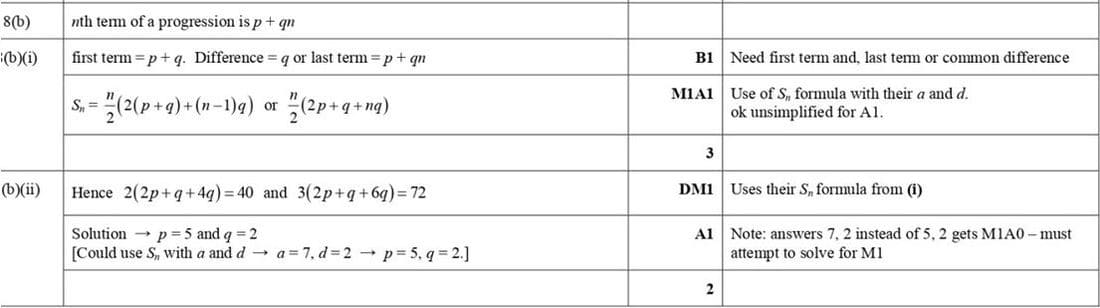
(i) The first term of the progression is \(p + q\) and the last term is \(p + qn\). The sum of the first n terms, \(S_n\), is given by the formula for the sum of an arithmetic series:
\(S_n = \frac{n}{2} \left( 2(p + q) + (n-1)q \right)\)
or equivalently,
\(S_n = \frac{n}{2} (2p + q + nq)\)
(ii) Using the expression for \(S_n\) from part (i), we have:
\(2(2p + q + 4q) = 40\)
\(3(2p + q + 6q) = 72\)
Solving these equations simultaneously:
From the first equation: \(2(2p + 5q) = 40\) gives \(2p + 5q = 20\).
From the second equation: \(3(2p + 7q) = 72\) gives \(2p + 7q = 24\).
Subtract the first equation from the second:
\((2p + 7q) - (2p + 5q) = 24 - 20\)
\(2q = 4\)
\(q = 2\)
Substitute \(q = 2\) back into \(2p + 5q = 20\):
\(2p + 5(2) = 20\)
\(2p + 10 = 20\)
\(2p = 10\)
\(p = 5\)
Thus, \(p = 5\) and \(q = 2\).