June 2019 p12 q10
827
In an arithmetic progression, the sum of the first ten terms is equal to the sum of the next five terms. The first term is \(a\).
(i) Show that the common difference of the progression is \(\frac{1}{3}a\).
(ii) Given that the tenth term is 36 more than the fourth term, find the value of \(a\).
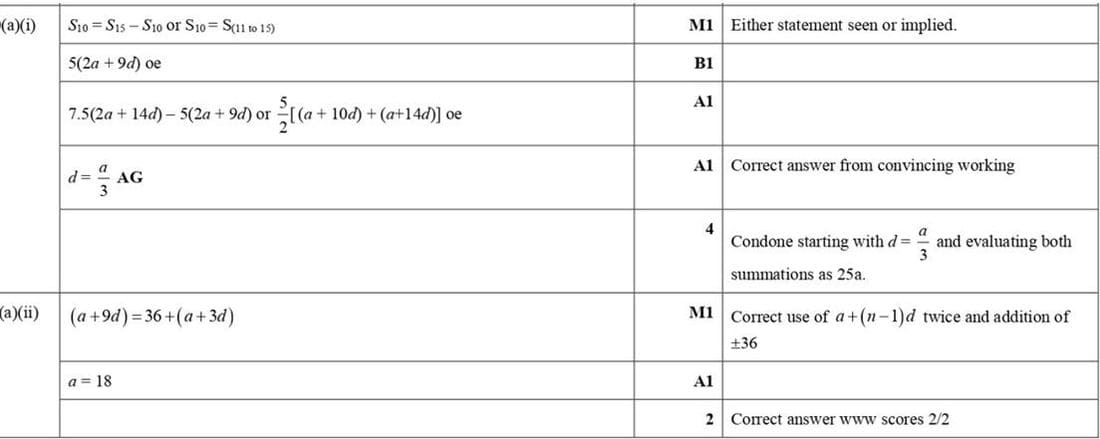
Solution
(i) Let the common difference be \(d\). The sum of the first ten terms \(S_{10}\) is given by:
\(S_{10} = \frac{10}{2} (2a + 9d) = 5(2a + 9d)\)
The sum of the next five terms \(S_{11 \text{ to } 15}\) is:
\(S_{11 \text{ to } 15} = \frac{5}{2} [(a + 10d) + (a + 14d)] = 5(a + 12d)\)
Given \(S_{10} = S_{11 \text{ to } 15}\), we have:
\(5(2a + 9d) = 5(a + 12d)\)
\(2a + 9d = a + 12d\)
\(a = 3d\)
Thus, \(d = \frac{a}{3}\).
(ii) The tenth term \(a + 9d\) is 36 more than the fourth term \(a + 3d\):
\(a + 9d = (a + 3d) + 36\)
\(6d = 36\)
\(d = 6\)
Since \(d = \frac{a}{3}\), we have:
\(\frac{a}{3} = 6\)
\(a = 18\)
Log in to record attempts.