Past Exam Questions
← Back0606 P22 - Jun 2022 - Q5 - 5 marks
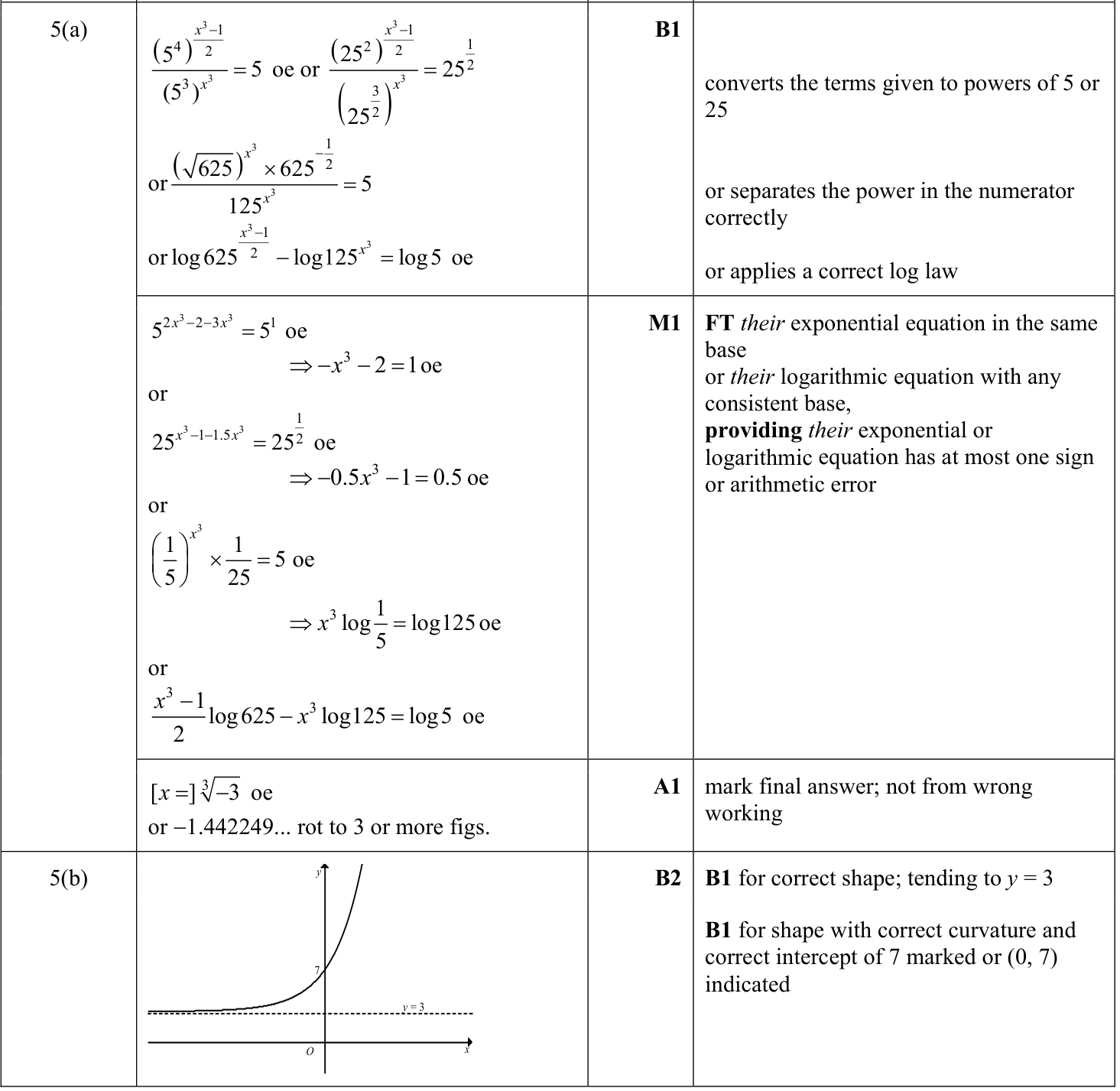
(a) Solve the equation \(\displaystyle \frac{625^{(x^3-1)/2}}{125^{x^3}}=5\).
(b) On the axes, sketch the graph of \(y=4\mathrm{e}^x+3\), showing the values of any intercepts with the coordinate axes.
0606 P21 - Nov 2022 - Q4 - 7 marks
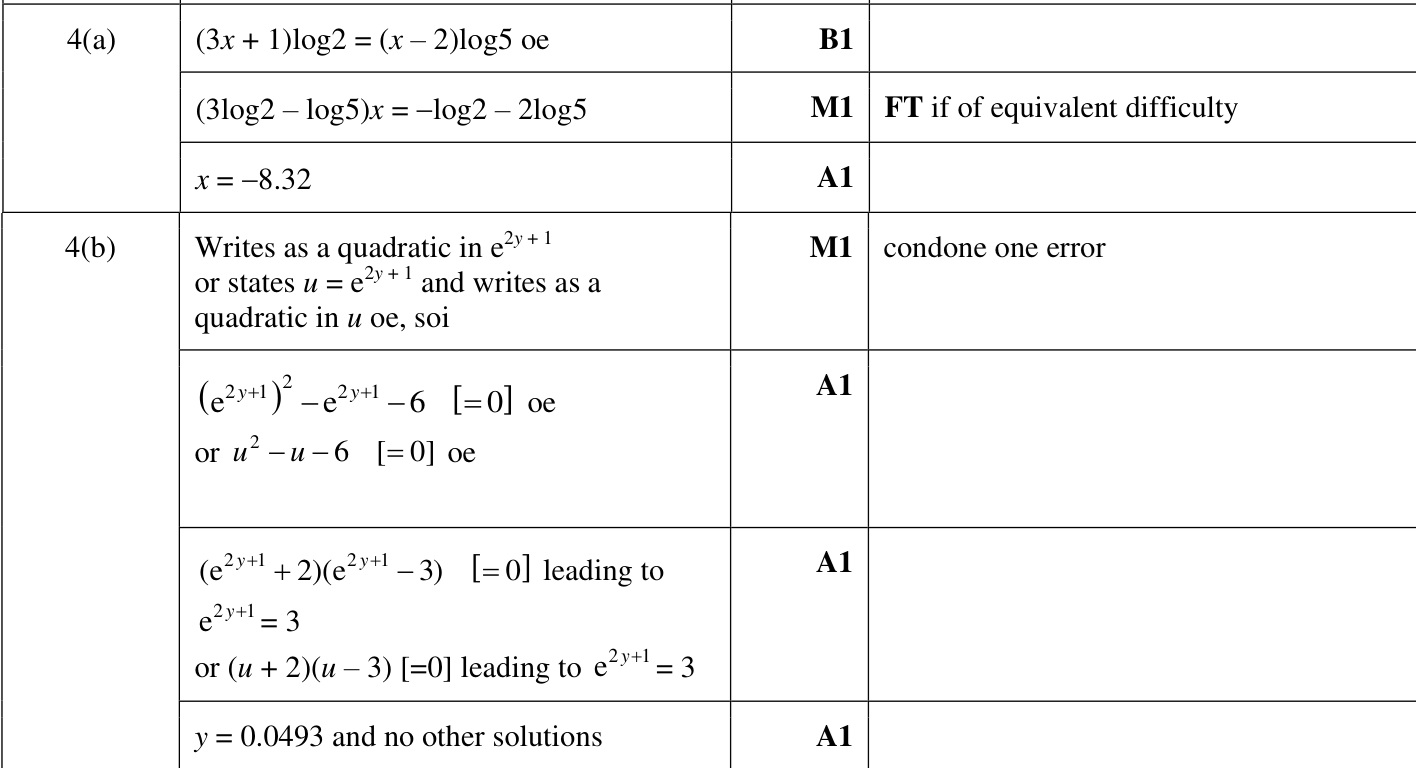
Solve the following equations, giving your answers to 3 significant figures.
(a)
\(2^{3x+1}=5^{x-2}\)
(b)
\(e^{2y+1}=1+\frac6{e^{2y+1}}\)
0606 P22 - Nov 2022 - Q2 - 4 marks
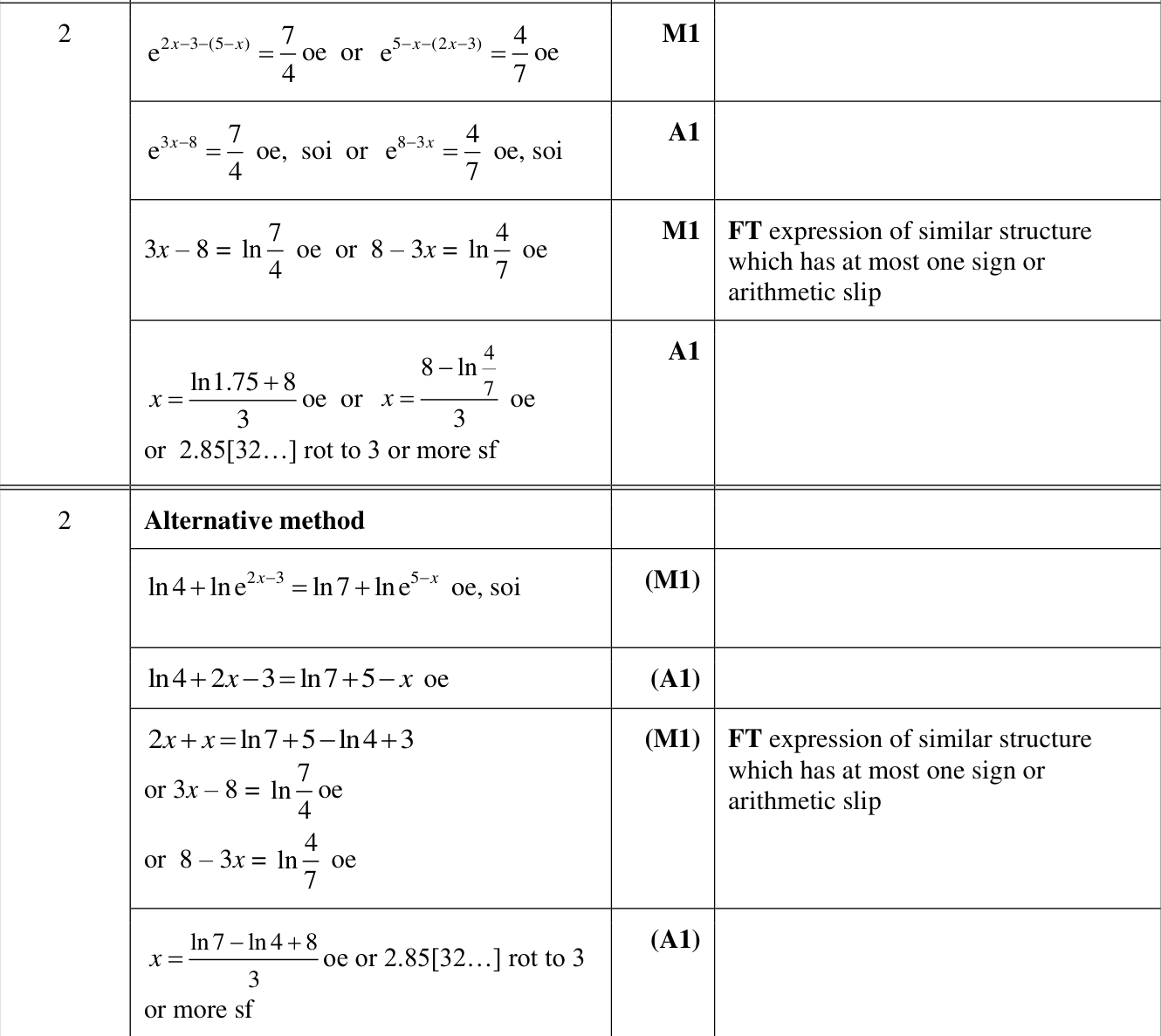
Solve the equation
\(4e^{2x-3}=7e^{5-x}.\)
0606 P12 - Jun 2021 - Q1 - 3 marks
Write
\(\frac{(pqr)^{-2}r^{\frac13}}{(p^2r)^{-1}q^3}\)
in the form \(p^a q^b r^c\), where \(a\), \(b\) and \(c\) are constants.

0606 P23 - Jun 2021 - Q2 - 4 marks
Given that
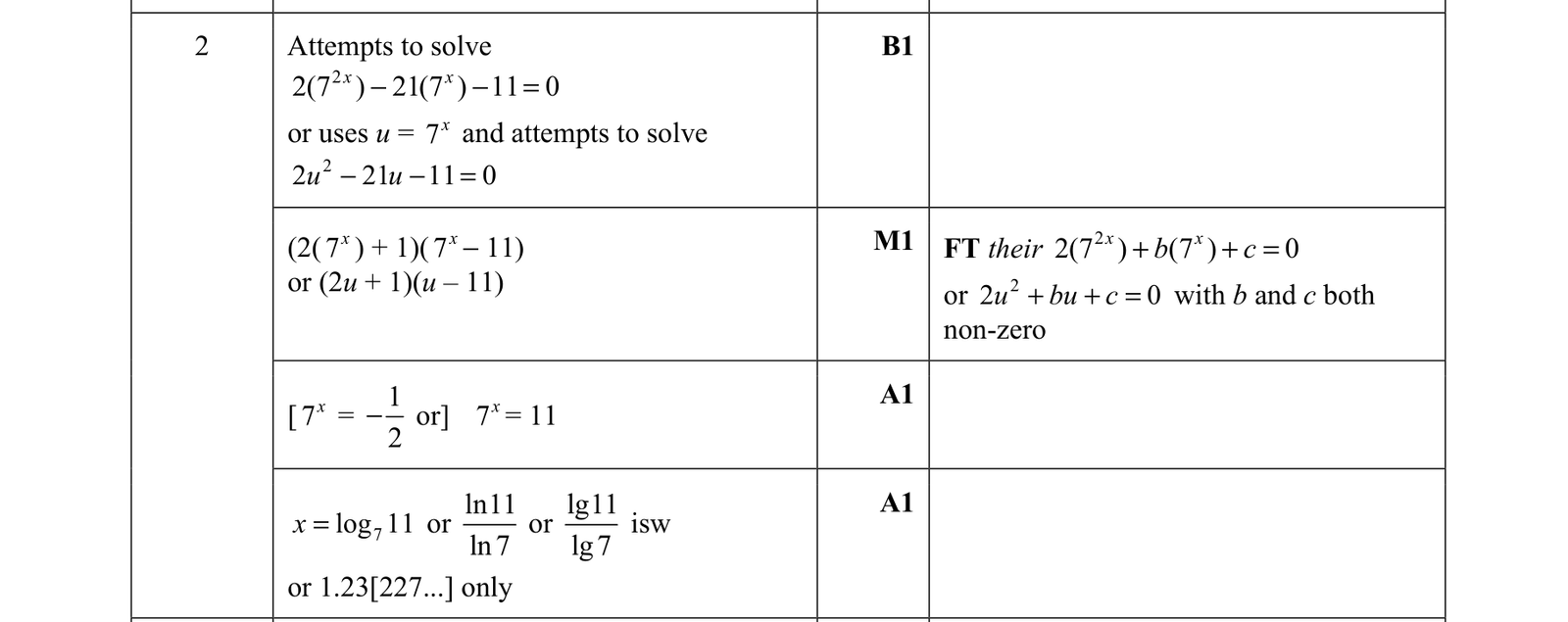
\(y=2(7^{2x})-3(7^{x+1})+19,\)
find the value of \(x\) when \(y=30\).
0606 P12 - Nov 2021 - Q2 - 7 marks
(a) Given that
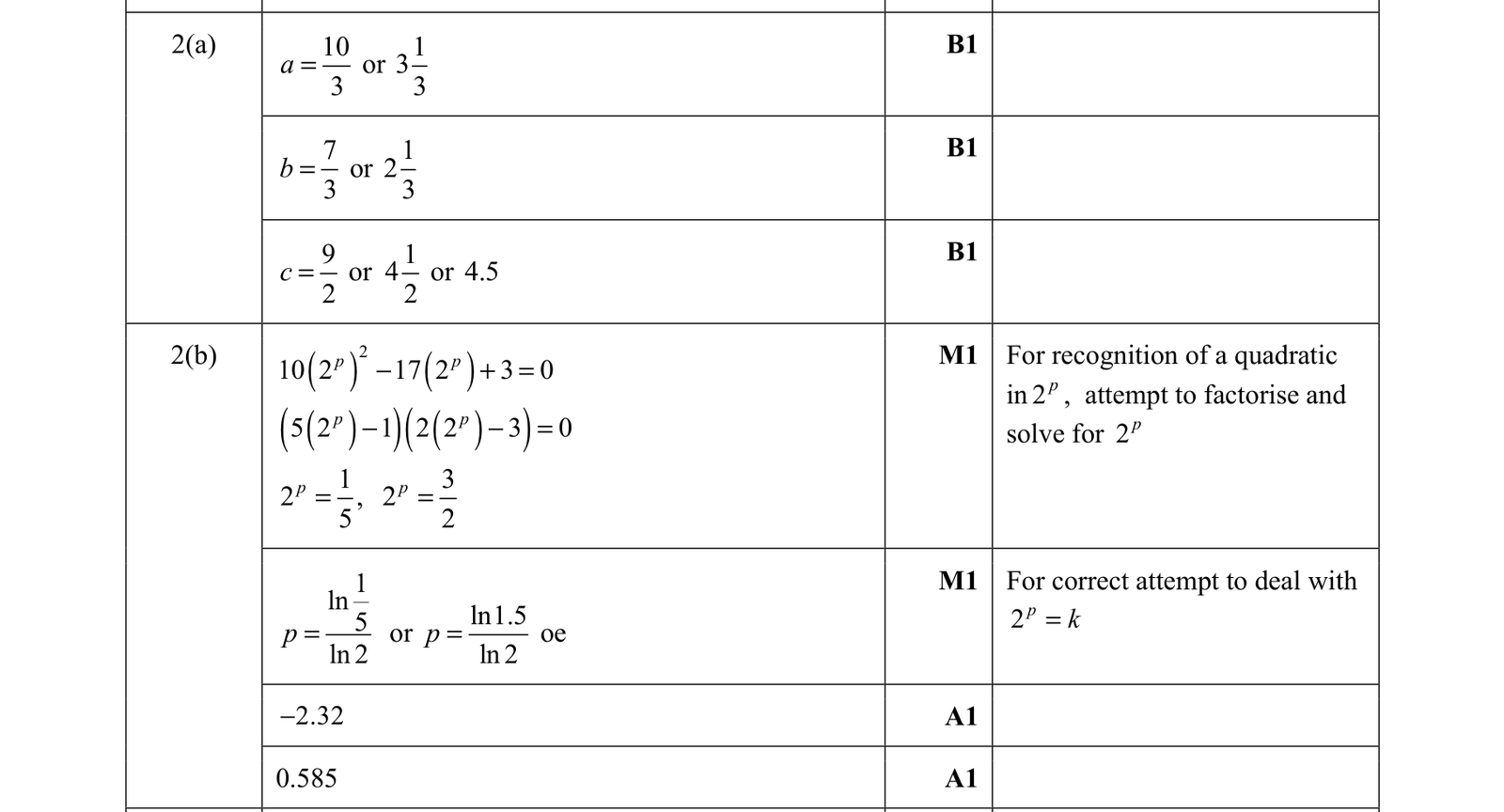
\(\frac{\sqrt[3]{xy}(zy)^2}{(xz)^{-3}\sqrt z}=x^ay^bz^c,\)
find the exact values of the constants \(a\), \(b\) and \(c\).
(b) Solve the equation
\(5\left(2^{2p+1}\right)-17\left(2^p\right)+3=0.\)
0606 P22 - Nov 2021 - Q5 - 9 marks
(a) Solve the simultaneous equations
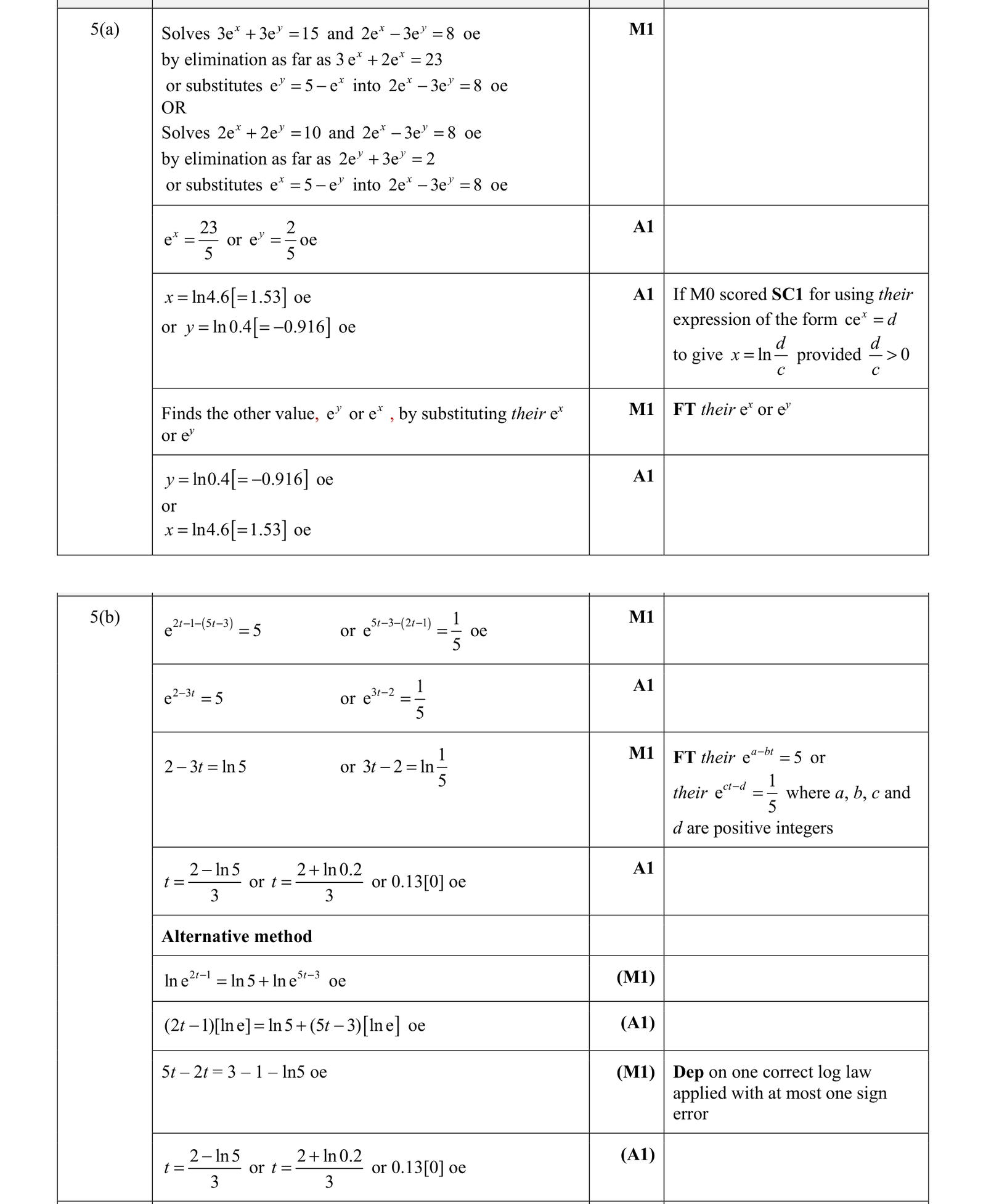
\(e^x+e^y=5,\qquad 2e^x-3e^y=8.\)
(b) Solve the equation
\(e^{2t-1}=5e^{5t-3}.\)
0606 P22 - Mar 2020 - Q3 - 4 marks
Solve the equation
\(3^{2x}-3^{x+1}-4=0,\)
giving your answer in an exact form.

0606 P13 - Jun 2020 - Q2 - 7 marks
(a) Given that
\(\log_2x+2\log_4y=8,\)
find the value of \(xy\).
(b) Using the substitution \(y=2^x\), or otherwise, solve
\(2^{2x+1}-2^{x+1}-2^x+1=0.\)

0606 P21 - Jun 2020 - Q7 - 7 marks
(a) Solve the simultaneous equations
\(10^{x+2y}=5,\qquad 10^{3x+4y}=50,\)
giving \(x\) and \(y\) in exact simplified form.
(b) Solve
\(2x^{\frac23}-x^{\frac13}-10=0.\)

0606 P22 - Nov 2020 - Q2 - 4 marks
Find the value of \(x\) such that
\(\frac{4^{x+1}}{2^{x-1}}=32^{x/3}\times8^{1/3}.\)

0606 P23 - Nov 2020 - Q5 - 5 marks
Solve the simultaneous equations
\(3^x\times 9^{y-1}=243,\)
\(8\times 2^{y-\frac12}=\frac{2^{2x+1}}{4\sqrt2}.\)

0606 P12 - Jun 2019 - Q3 - 6 marks
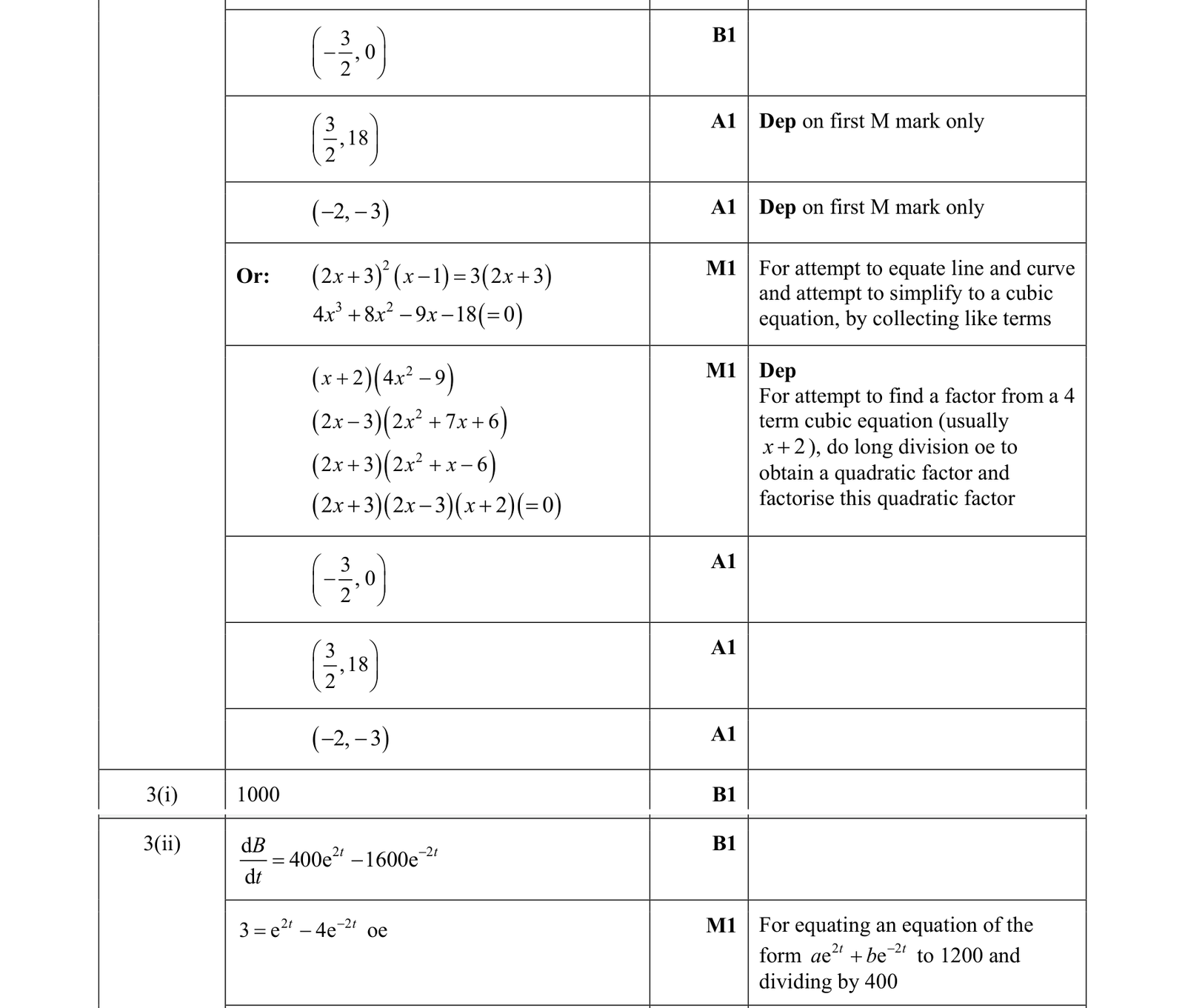
The number, \(B\), of a certain type of bacteria at time \(t\) days is described by \(B=200e^{2t}+800e^{-2t}\).
(i) Find \(B\) when \(t=0\).
(ii) At the instant when \(\frac{dB}{dt}=1200\), show that \(e^{4t}-3e^{2t}-4=0\).
(iii) Using the substitution \(u=e^{2t}\), or otherwise, solve \(e^{4t}-3e^{2t}-4=0\).
0606 P13 - Jun 2019 - Q2 - 3 marks
Given that \(\dfrac{\sqrt p(qr)^{-2}}{p^2q^{1/3}r}=\dfrac{1}{p^aq^br^c}\), find \(a\), \(b\) and \(c\).

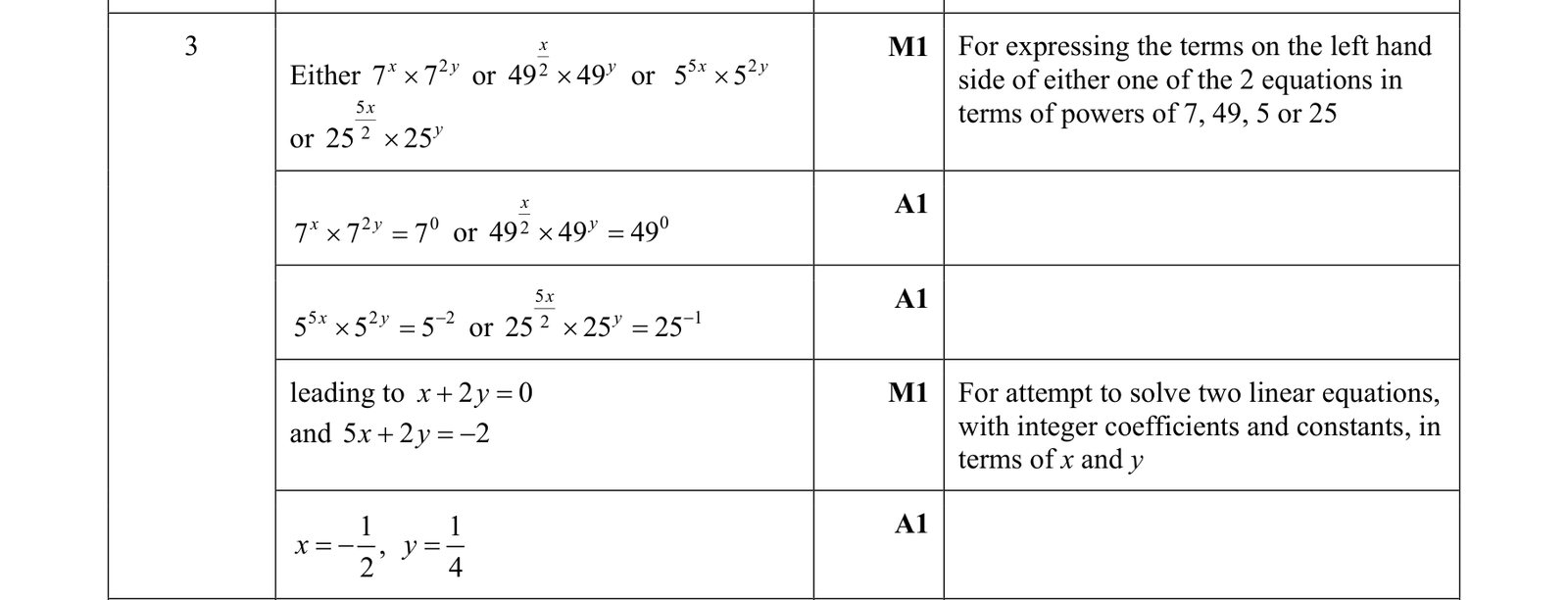
0606 P11 - Nov 2019 - Q3 - 5 marks
Given that
\(7^x\times49^y=1\)
and
\(5^{5x}\times125^{\frac23y}=\frac1{25},\)
calculate the value of \(x\) and of \(y\).
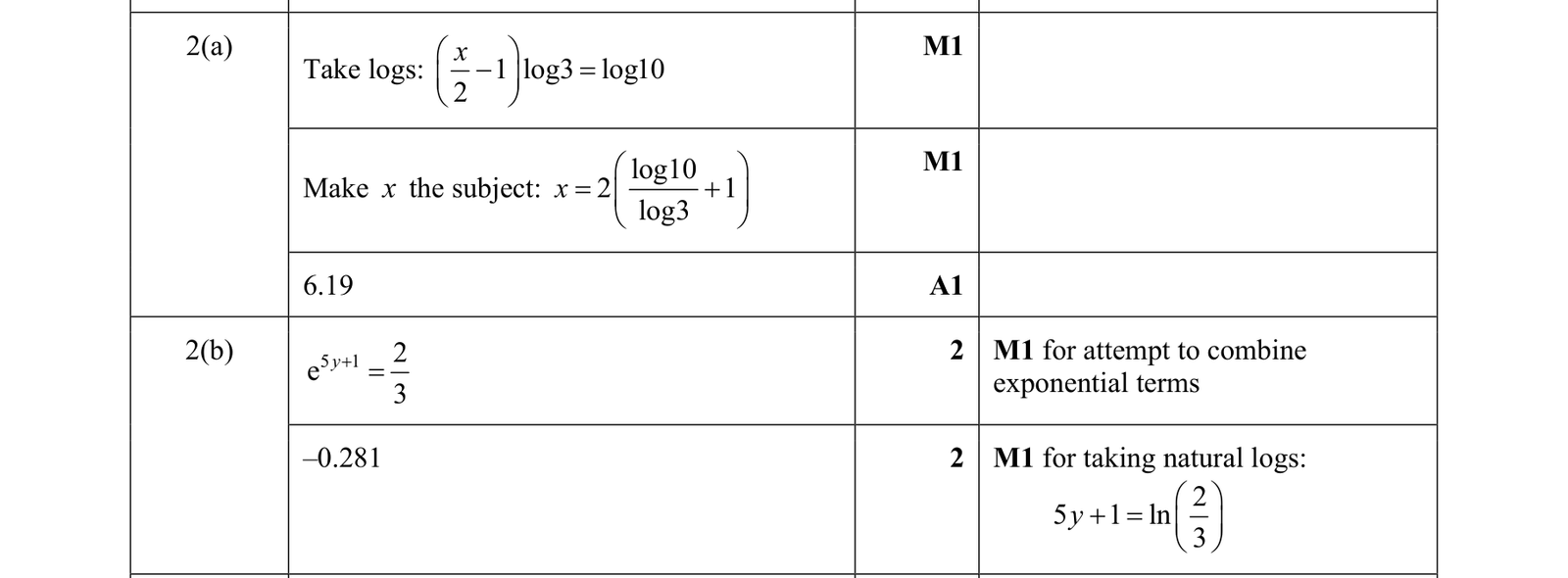
0606 P21 - Nov 2018 - Q2 - 7 marks
(a) Solve
\(3^{\left(\frac{x}{2}-1\right)}=10.\)
(b) Solve
\(2e^{1-2y}=3e^{3y+2}.\)
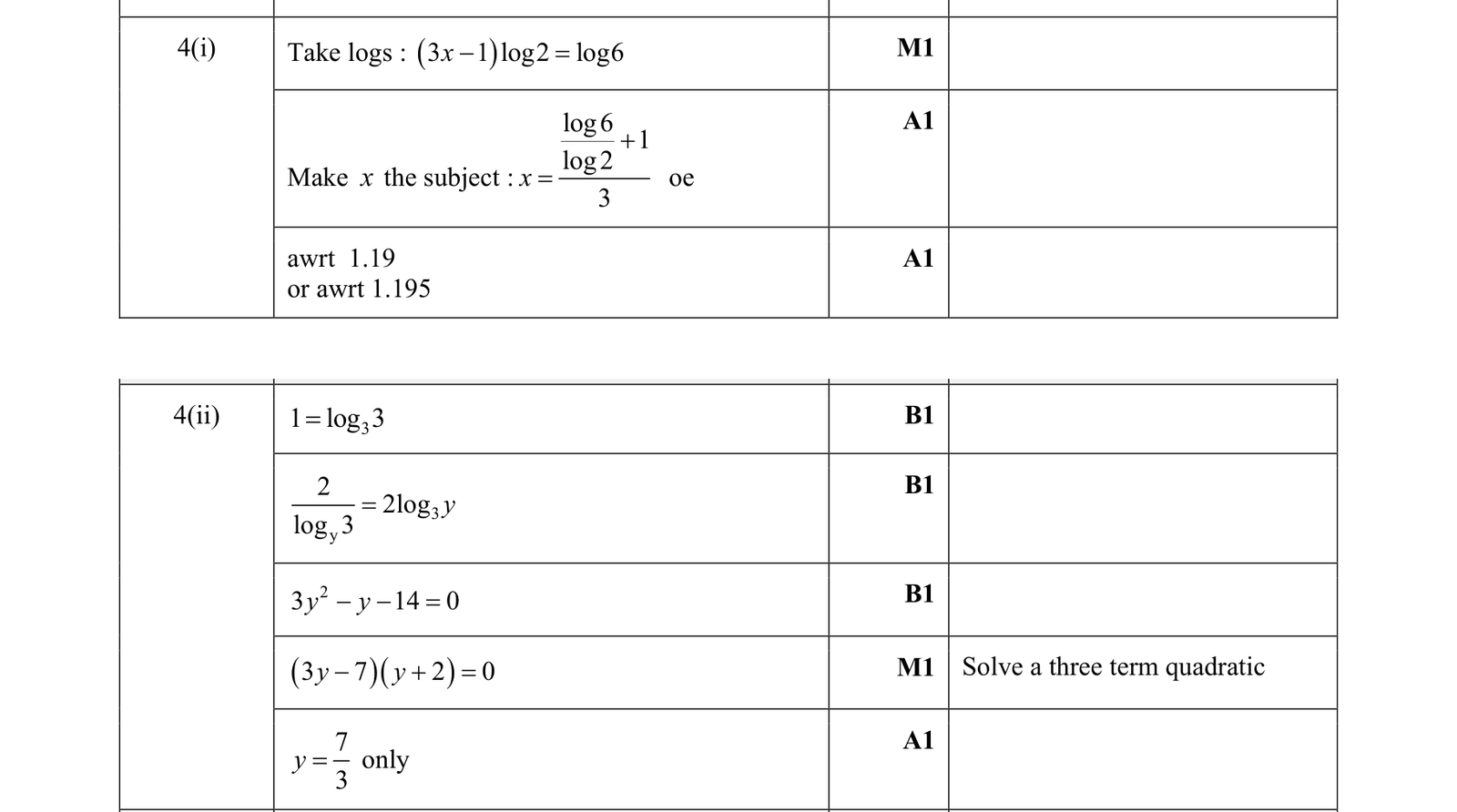
0606 P22 - Nov 2018 - Q4 - 8 marks
Solve
(i) \(2^{3x-1}=6,\)
(ii) \(\log_3(y+14)=1+\frac{2}{\log_y3}.\)
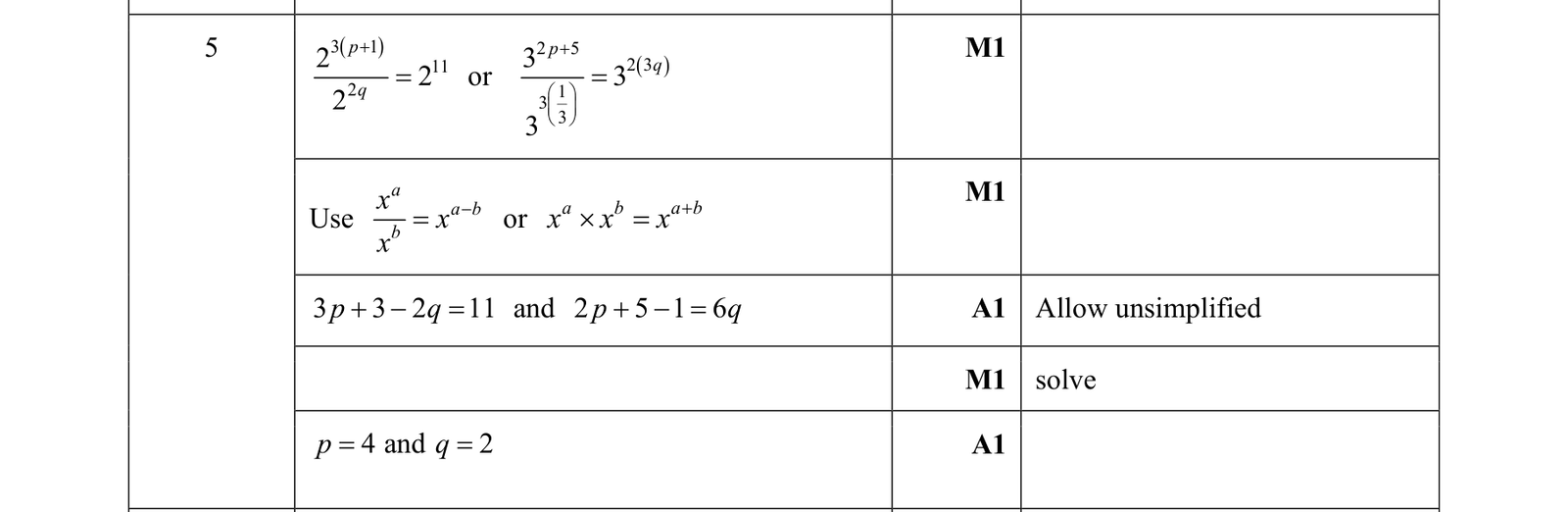
0606 P22 - Nov 2018 - Q5 - 5 marks
Solve the simultaneous equations
\(\frac{8^{p+1}}{4^q}=2^{11}, \qquad \frac{3^{2p+5}}{27^{1/3}}=9^{3q}.\)
0606 P22 - Jun 2017 - Q7 - 7 marks
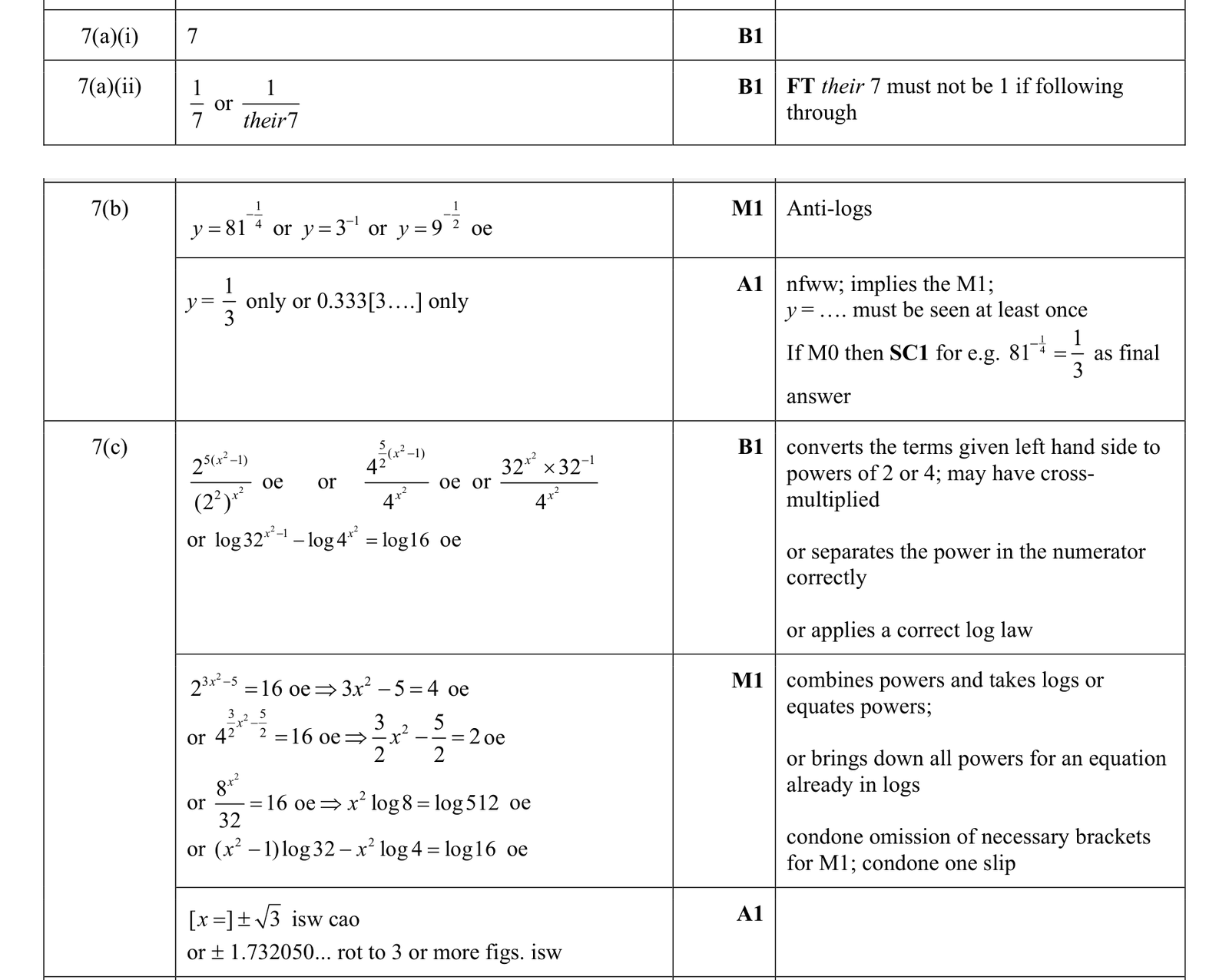
(a) Given that \(a^7=b\), where \(a\) and \(b\) are positive constants, find
(i) \(\log_a b\),
(ii) \(\log_b a\).
(b) Solve the equation \(\log_{81} y=-\dfrac14\).
(c) Solve the equation
\(\frac{32^{x^2-1}}{4^{x^2}}=16.\)
0606 P23 - Jun 2017 - Q1 - 6 marks
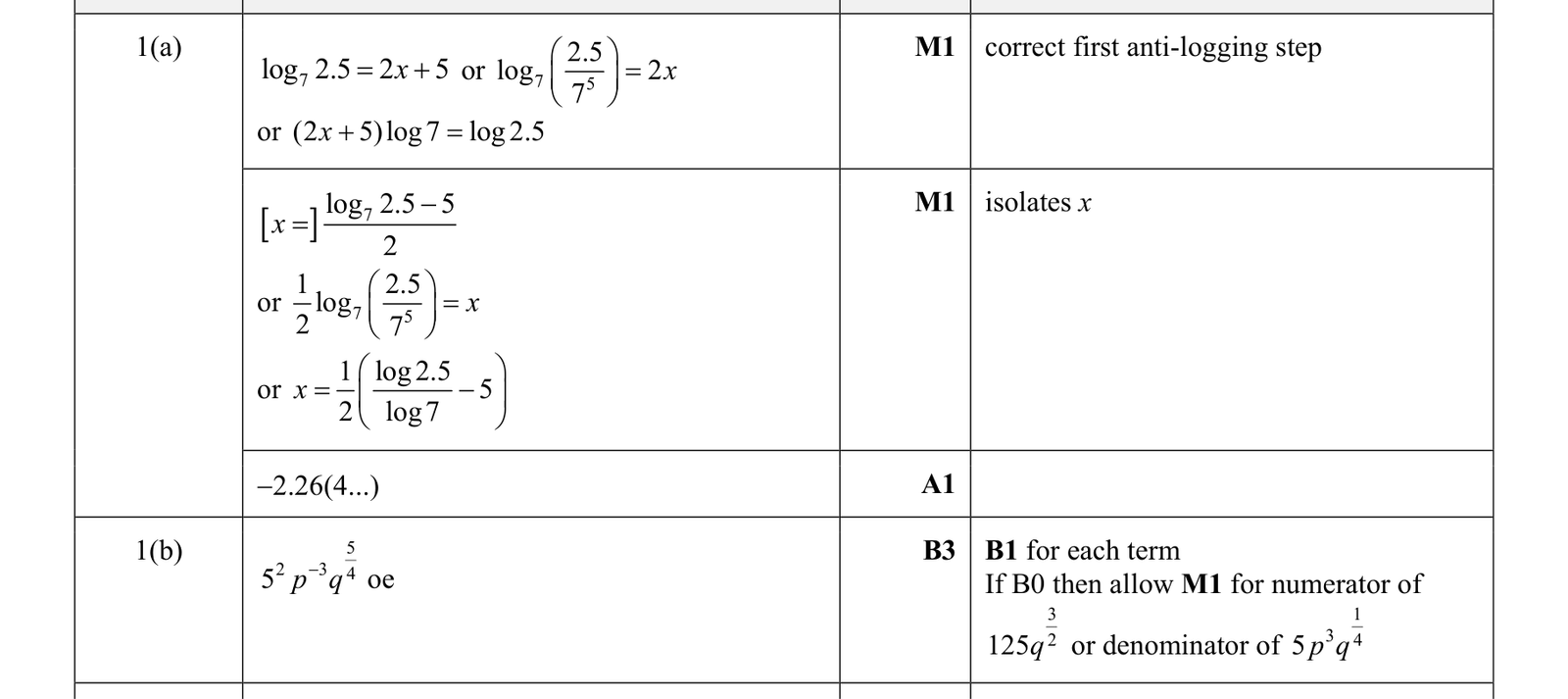
(a) Solve the equation \(7^{2x+5}=2.5\), giving your answer correct to \(2\) decimal places.
(b) Express
\(\frac{(5\sqrt q)^3}{(625p^{12}q)^{1/4}}\)
in the form \(5^ap^bq^c\), where \(a\), \(b\) and \(c\) are constants.