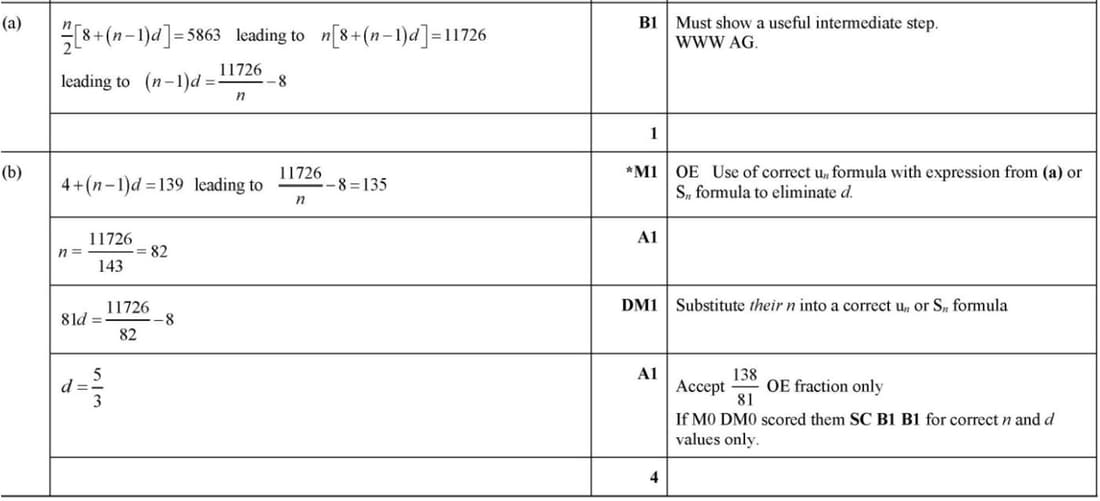
(a) The sum of the first \(n\) terms \(S_n\) of an arithmetic progression is given by:
\(S_n = \frac{n}{2} [2a + (n-1)d]\)
Substituting the given values, \(a = 4\) and \(S_n = 5863\):
\(\frac{n}{2} [8 + (n-1)d] = 5863\)
Multiply both sides by 2:
\(n[8 + (n-1)d] = 11726\)
Divide by \(n\):
\(8 + (n-1)d = \frac{11726}{n}\)
Rearrange to find \((n-1)d\):
\((n-1)d = \frac{11726}{n} - 8\)
(b) The \(n\)th term \(u_n\) is given by:
\(u_n = a + (n-1)d\)
Given \(u_n = 139\):
\(4 + (n-1)d = 139\)
Substitute \((n-1)d = \frac{11726}{n} - 8\):
\(\frac{11726}{n} - 8 = 135\)
\(\frac{11726}{n} = 143\)
\(n = \frac{11726}{143} = 82\)
Substitute \(n = 82\) back into \((n-1)d = \frac{11726}{n} - 8\):
\(81d = \frac{11726}{82} - 8\)
\(81d = 143 - 8\)
\(81d = 135\)
\(d = \frac{135}{81} = \frac{5}{3}\)