Past Exam Questions
← Back0606 P11 - Jun 2025 - Q8 - 7 marks
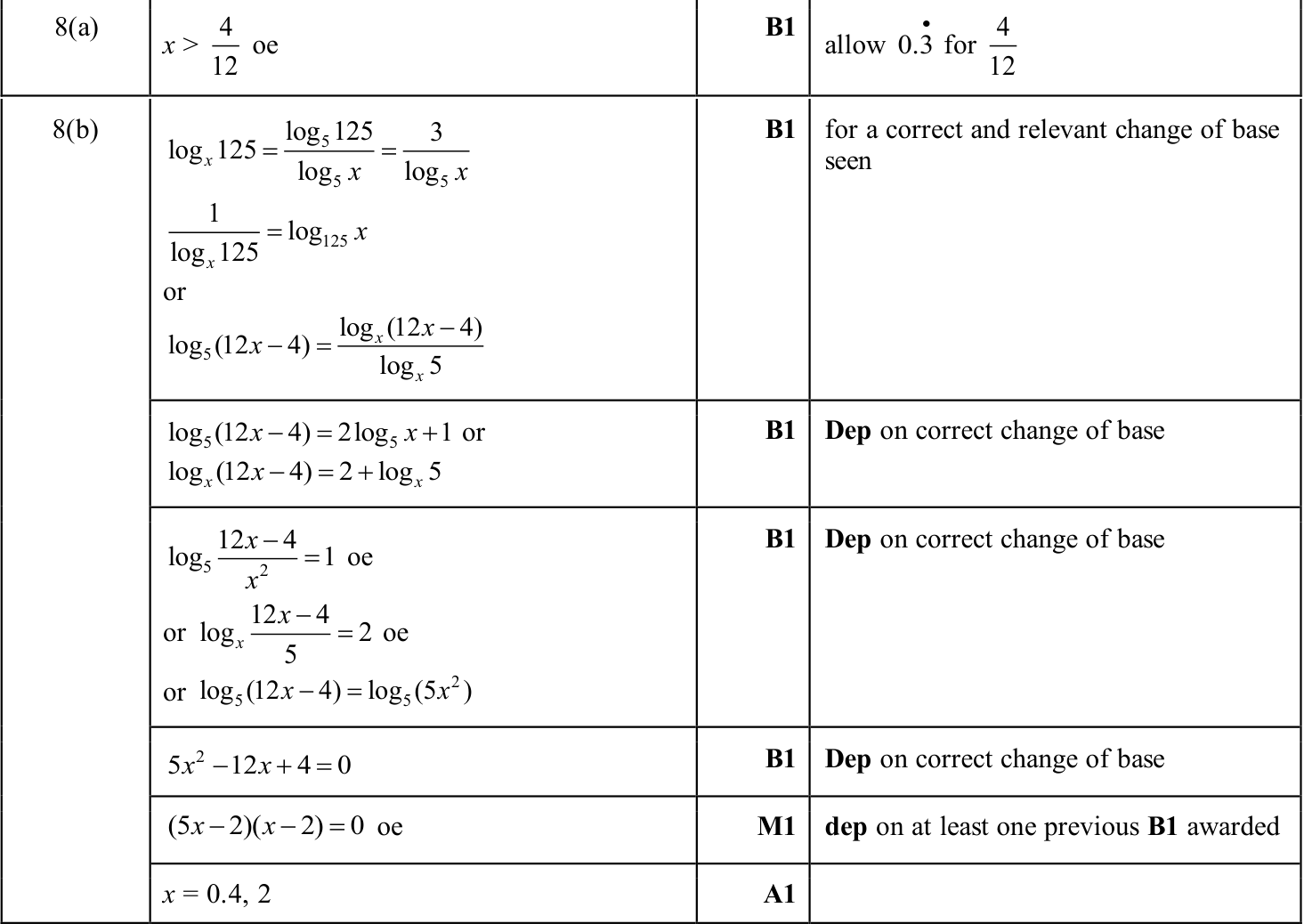
(a) Write down the set of values of \(x\) for which \(\log_5(12x-4)\) exists.
(b) Solve the equation \(\log_5(12x-4)=\frac{6}{\log_x125}+1\).
0606 P12 - Mar 2025 - Q9 - 5 marks
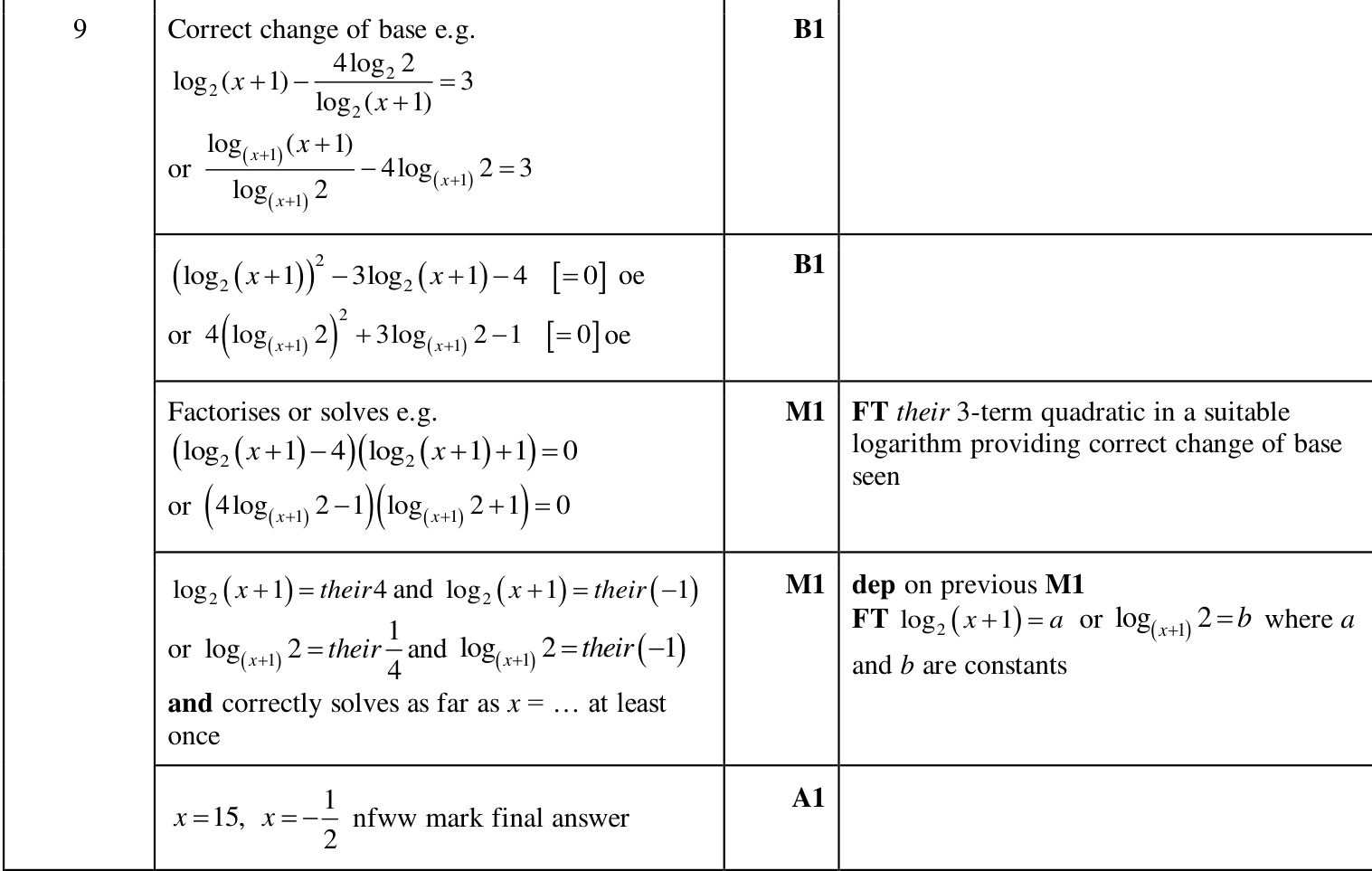
Solve the equation \(\log_2(x+1)-4\log_{(x+1)}2=3\).
0606 P11 - Nov 2022 - Q9 - 5 marks
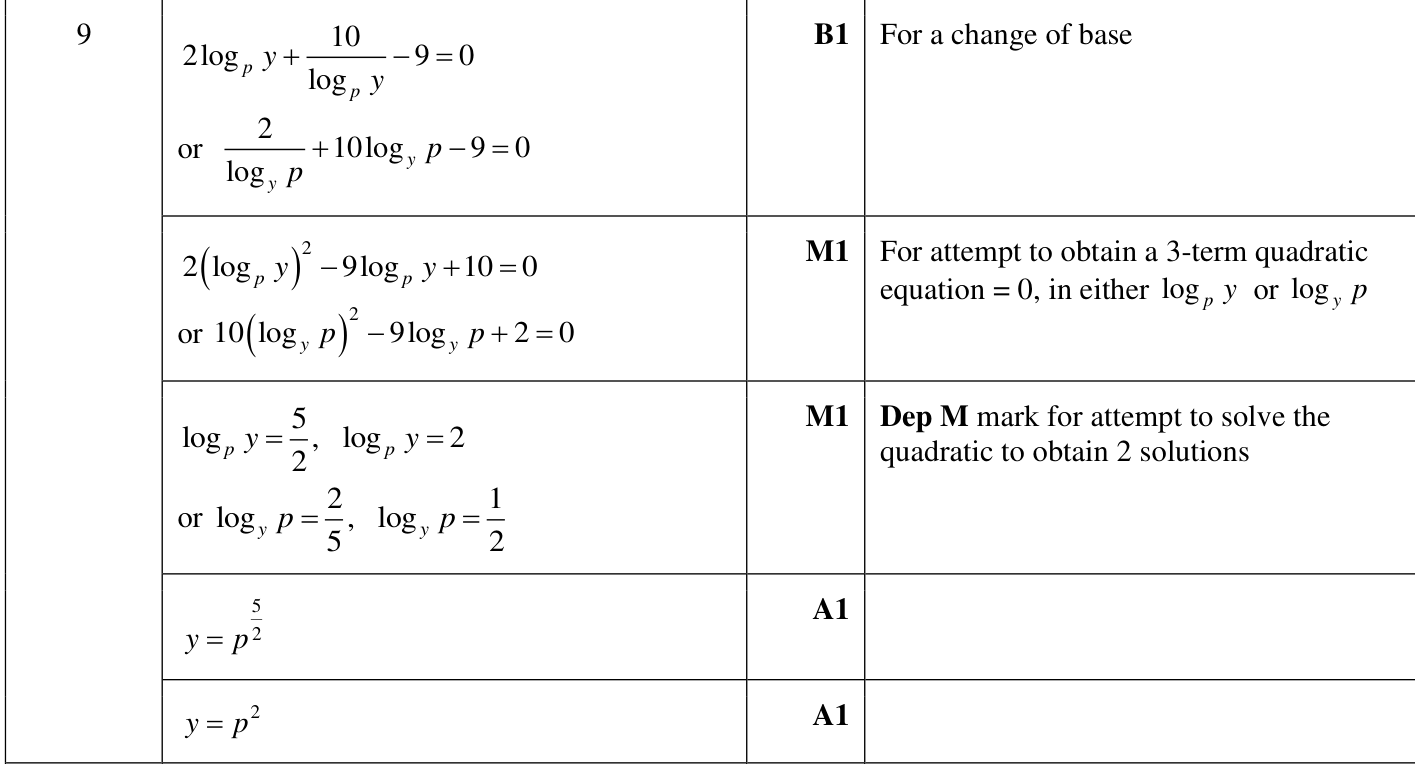
Solve the equation
\(2\log_p y+10\log_y p-9=0,\)
where \(p\) is a positive constant, giving \(y\) in terms of \(p\).
0606 P11 - Nov 2018 - Q7 - 9 marks
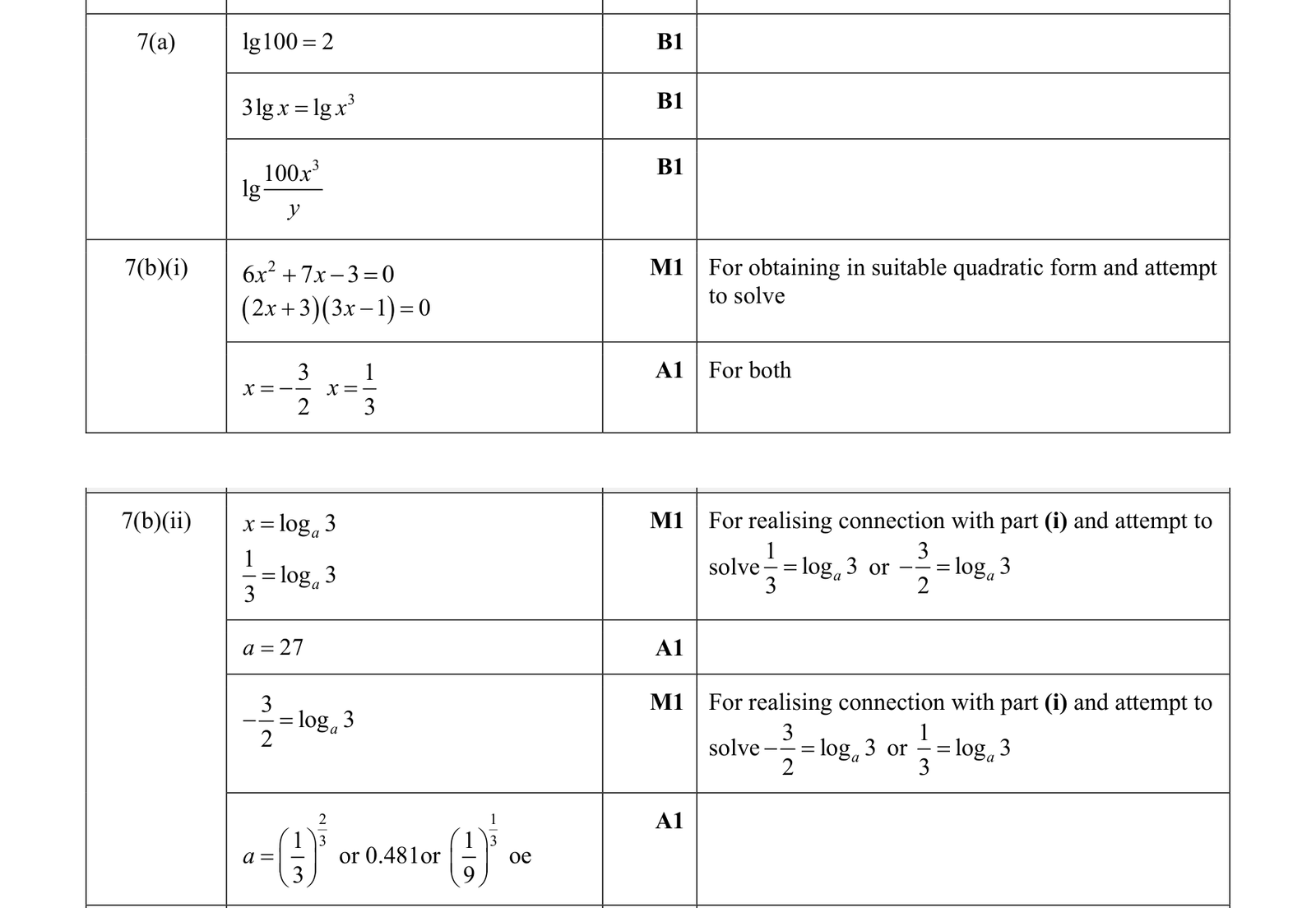
(a) Express \(2+3\lg x-\lg y\) as a single logarithm to base 10.
(b) (i) Solve \(6x+7-\dfrac3x=0\).
(ii) Hence, given that \(6\log_a3+7-3\log_3a=0\), find the possible values of \(a\).
0606 P13 - Nov 2018 - Q5 - 5 marks
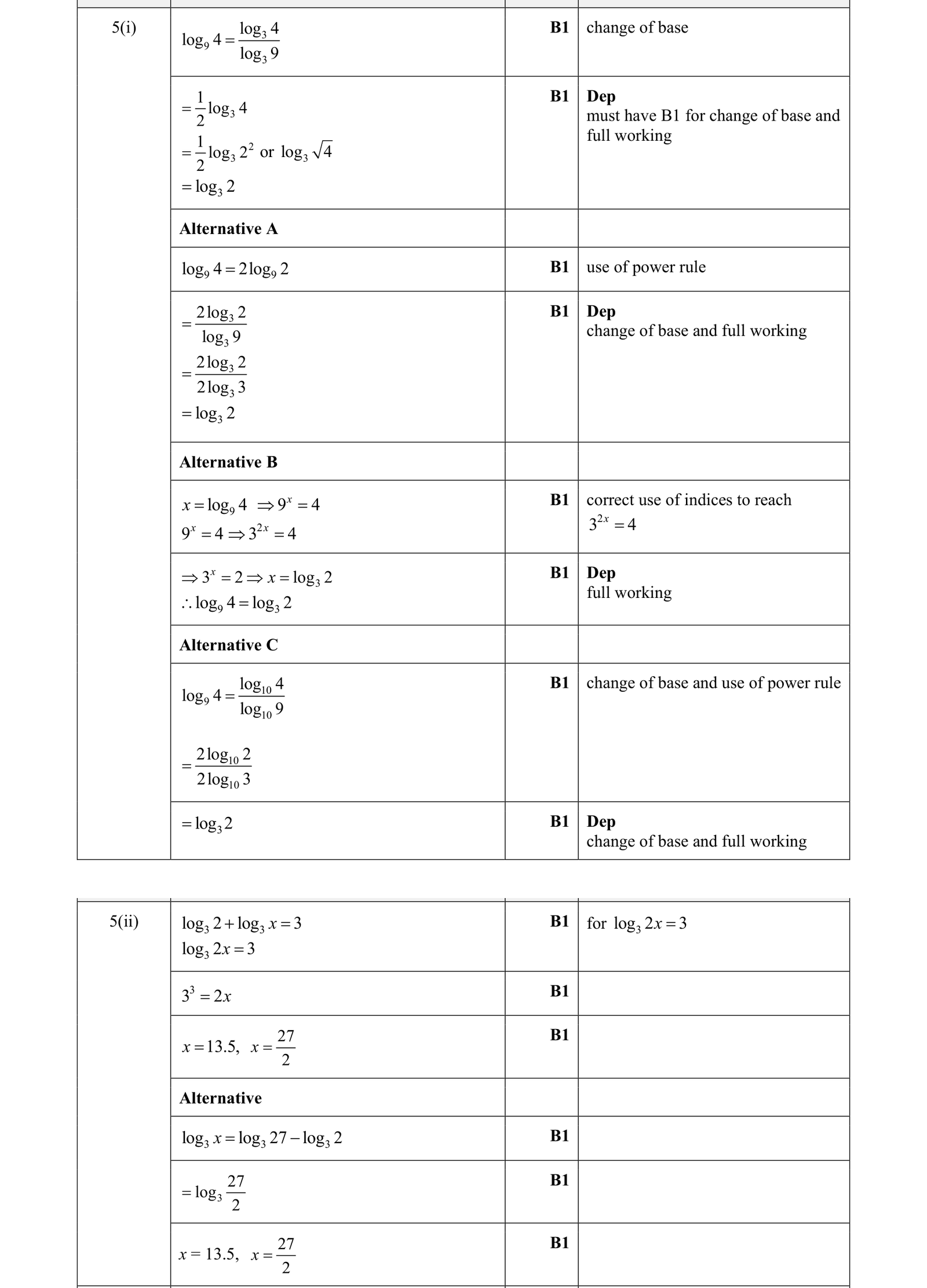
(i) Show that \(\log_9 4=\log_3 2\).
(ii) Hence solve \(\log_9 4+\log_3 x=3\).
0606 P13 - Jun 2025 - Q6 - 5 marks
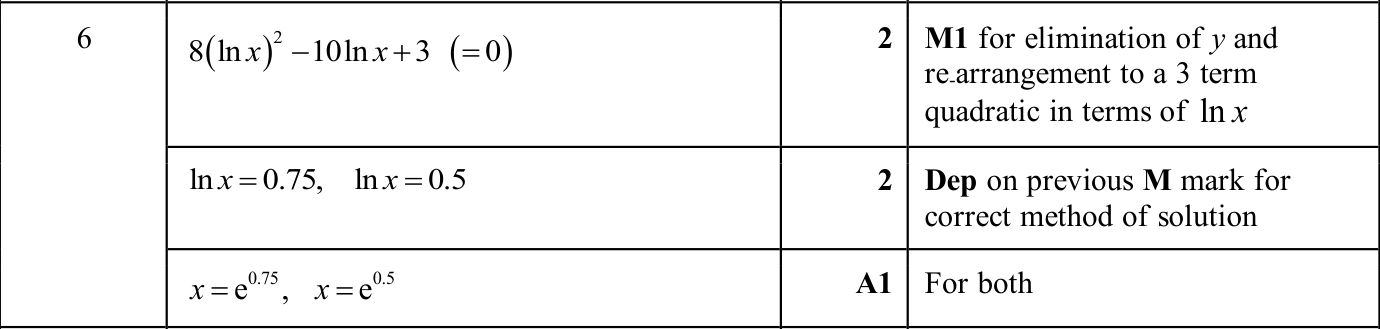
Find the \(x\)-coordinates of the points of intersection of the following curves. \(y=4 \ln x \quad \text { and } \quad y=5-\frac{3}{\ln \left(x^{2}\right)}\)
Give your answers in exact form.
0606 P21 - Nov 2020 - Q8 - 8 marks
A population, \(P\) million, is modelled by
\(P=Ab^t,\)
where \(t\) is the number of years after 1 January 2000. The population was \(40\) million on 1 January 2010 and \(45\) million on 1 January 2013.
(a) Find \(b\), correct to 2 decimal places, and find \(A\), correct to the nearest integer.
(b) Use your values of \(A\) and \(b\) to estimate the population on 1 January 2020.
(c) Use your values of \(A\) and \(b\) to find the first year in which the population is predicted to exceed \(100\) million.

0606 P22 - Nov 2020 - Q10 - 8 marks
The number, \(b\), of bacteria in a sample is given by
\(b=P+Qe^{2t},\)
where \(P\) and \(Q\) are constants and \(t\) is time in weeks. Initially there are \(500\) bacteria, which increase to \(600\) after \(1\) week.
(a) Find the value of \(P\) and of \(Q\).
(b) Find the number of bacteria present after \(2\) weeks.
(c) Find the first week in which the number of bacteria is greater than \(1000000\).

0606 P11 - Jun 2018 - Q5 - 6 marks
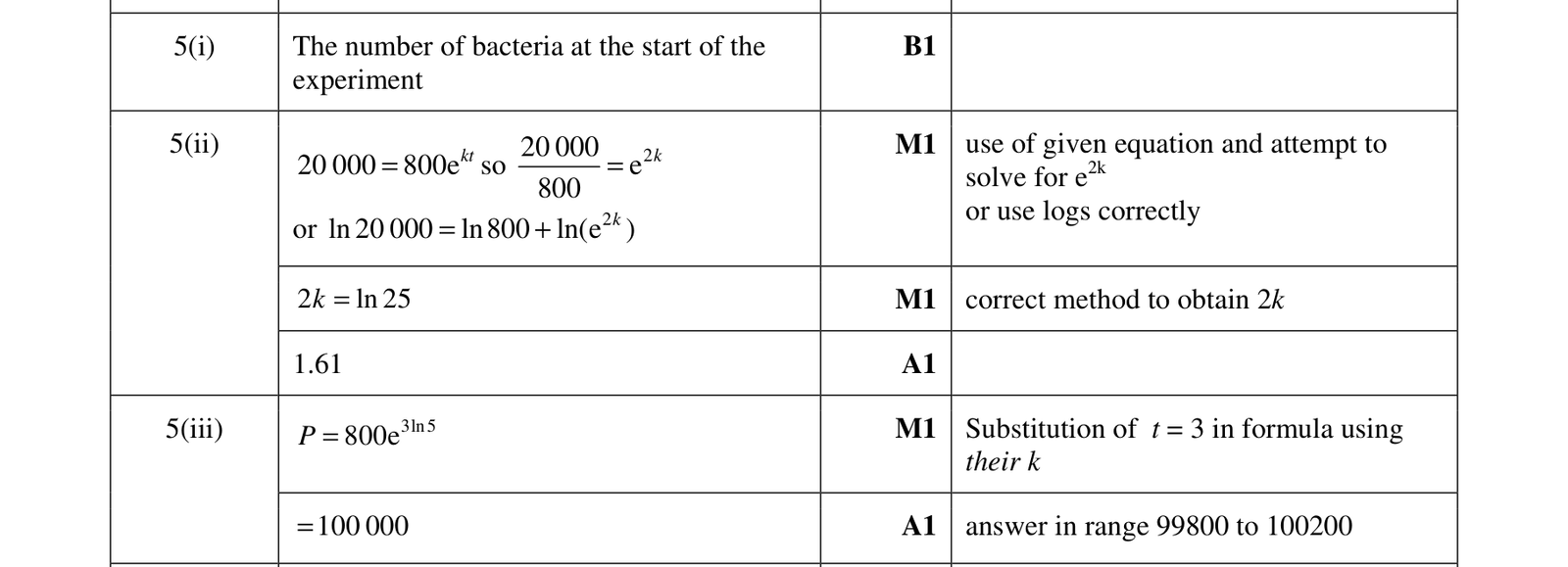
The population, \(P\), of a certain bacterium \(t\) days after the start of an experiment is modelled by
\(P=800e^{kt},\)
where \(k\) is a constant.
(i) State what the figure \(800\) represents in this experiment.
(ii) Given that the population is \(20000\) two days after the start of the experiment, calculate the value of \(k\).
(iii) Calculate the population three days after the start of the experiment.
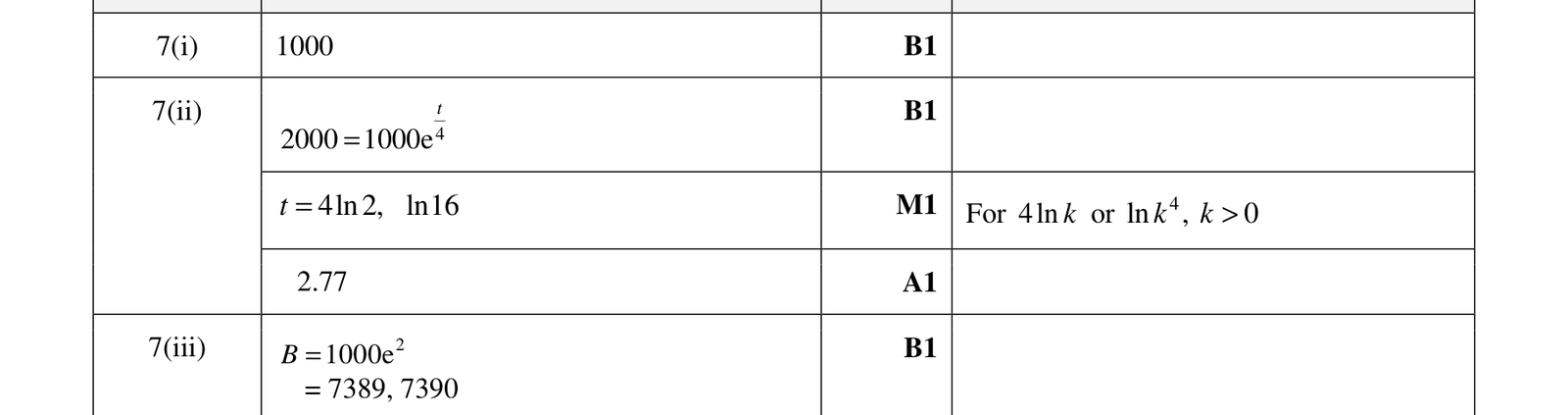
0606 P12 - Jun 2018 - Q7 - 5 marks
A population, \(B\), of a particular bacterium, \(t\) hours after measurements began, is given by
\(B=1000e^{t/4}.\)
(i) Find the value of \(B\) when \(t=0\).
(ii) Find the time taken for \(B\) to double in size.
(iii) Find the value of \(B\) when \(t=8\).
0606 P13 - Jun 2018 - Q5 - 6 marks
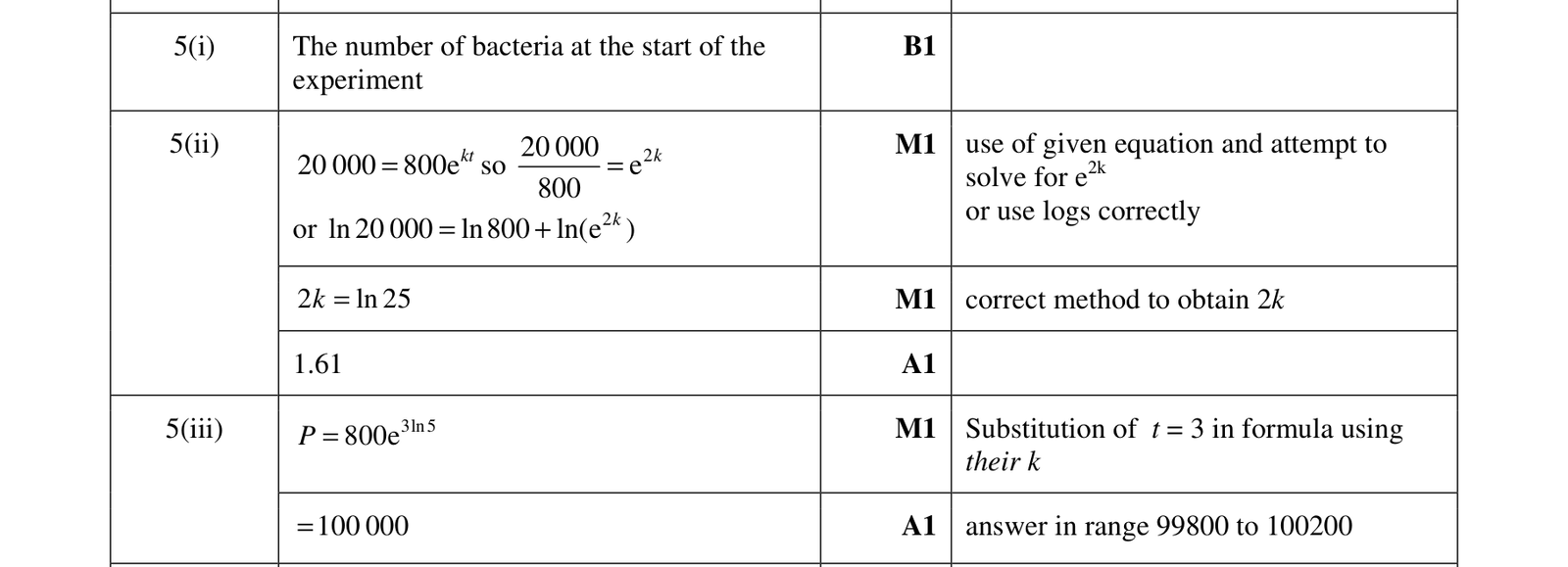
The population, \(P\), of a certain bacterium \(t\) days after the start of an experiment is modelled by
\(P=800e^{kt},\)
where \(k\) is a constant.
(i) State what the figure \(800\) represents in this experiment.
(ii) Given that the population is \(20000\) two days after the start of the experiment, calculate the value of \(k\).
(iii) Calculate the population three days after the start of the experiment.
0606 P12 - Nov 2025 - Q8 - 4 marks
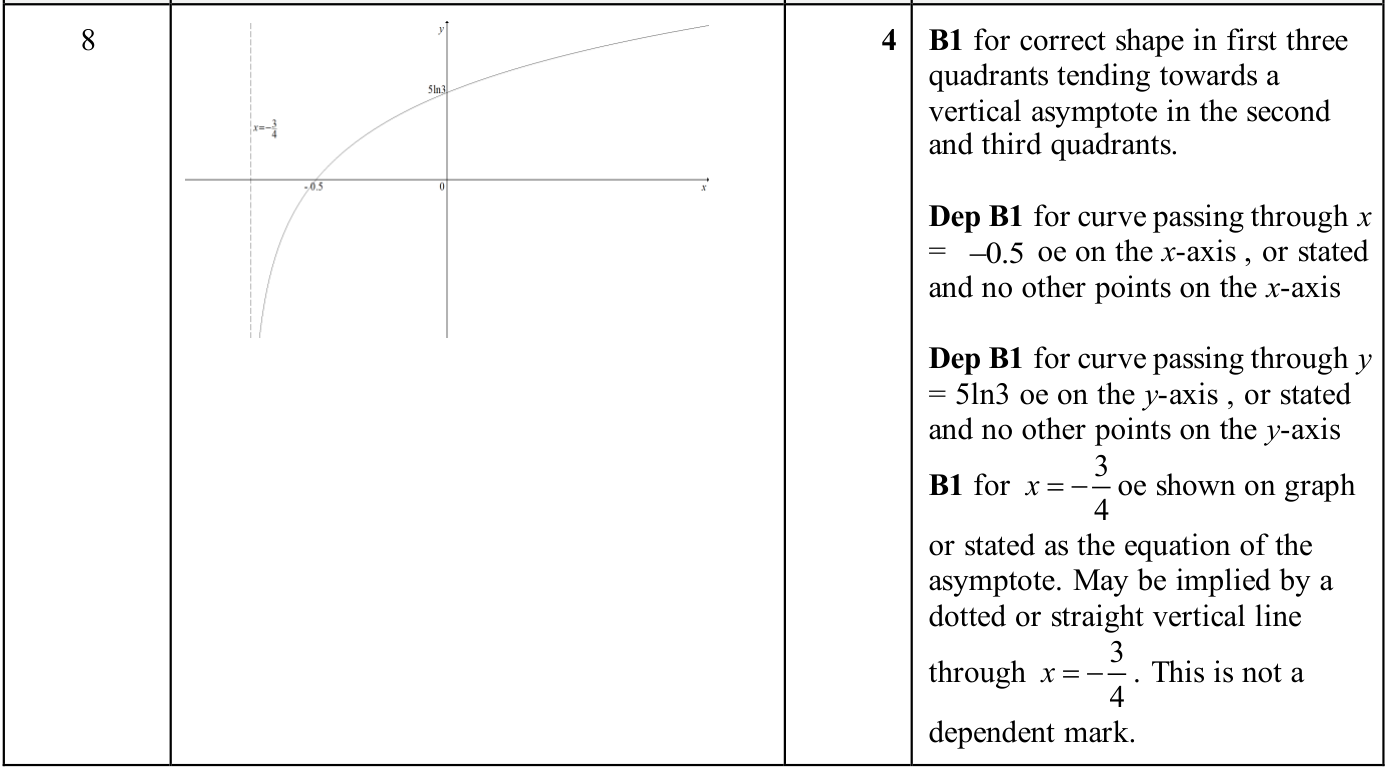
On the axes, sketch the graph of \(y=5\ln(4x+3)\). State the intercepts with the axes. State the equation of any asymptote.
0606 P23 - Jun 2021 - Q7 - 7 marks
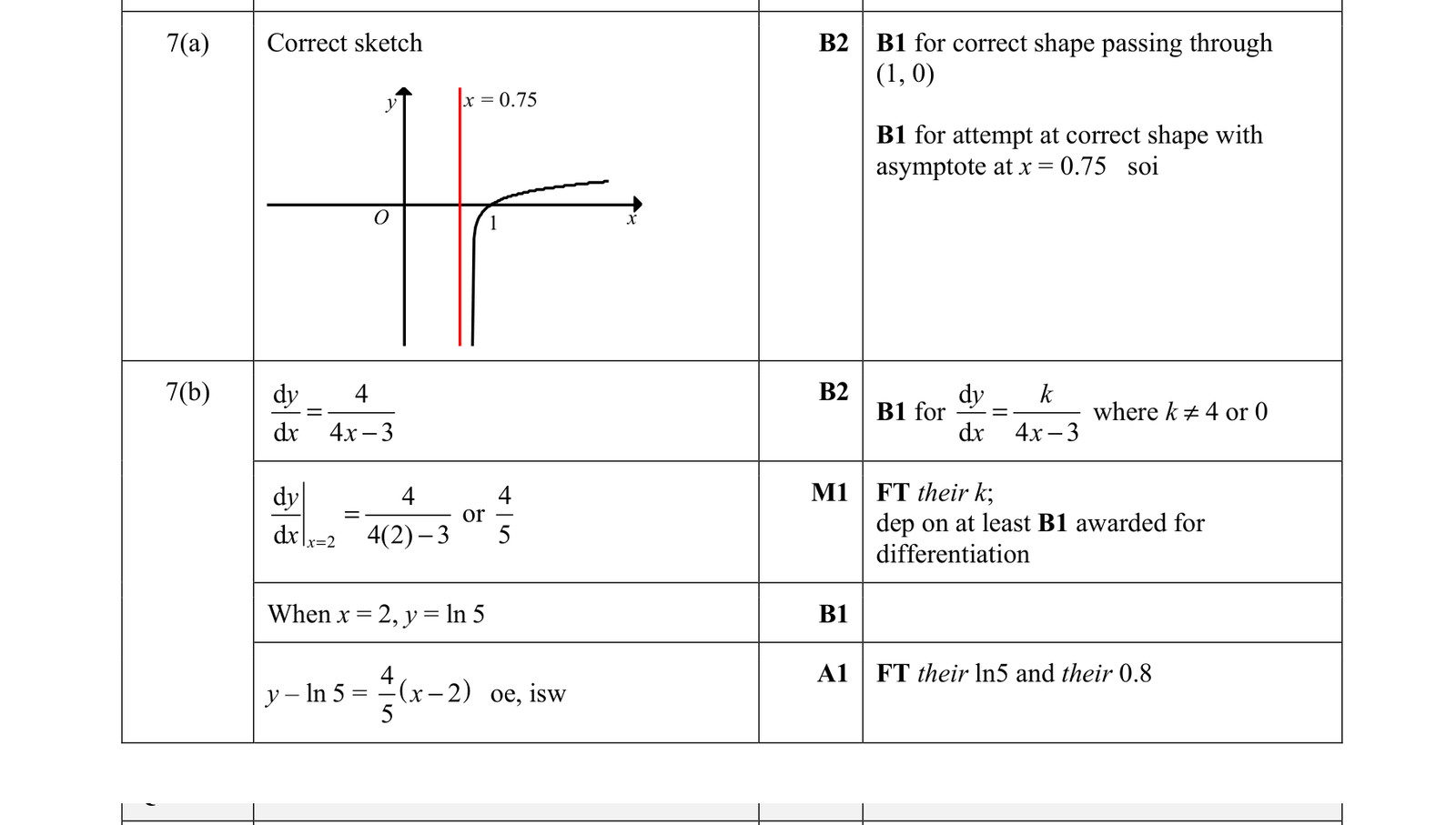
(a) Sketch the graph of the curve
\(y=\ln(4x-3)\)
on the axes, stating the intercept with the \(x\)-axis.
(b) Find the equation of the tangent to the curve \(y=\ln(4x-3)\) at the point where \(x=2\).
0606 P12 - Nov 2024 - Q4 - 13 marks
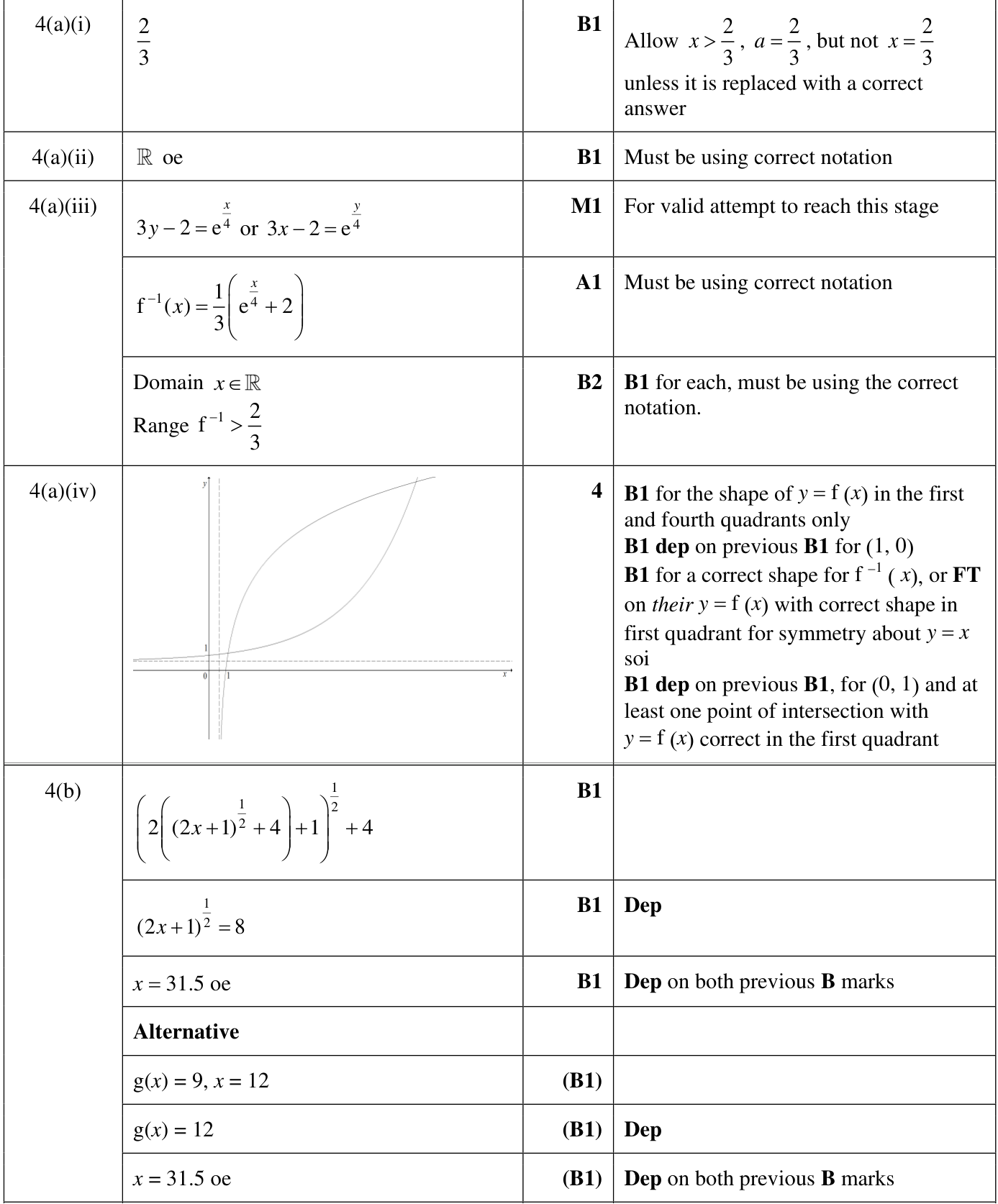
The function f is such that \(\mathrm{f}(x)=4 \ln (3 x-2)\), for \(x\gt a\), where \(a\) is as small as possible. (a) (i) Write down the value of \(a\).
(ii) Write down the range of f .
(iii) Find \(\mathrm{f}^{-1}(x)\), stating its domain and range.
(iv) On the axes sketch the graphs of \(y=\mathrm{f}(x)\) and \(y=\mathrm{f}^{-1}(x)\), stating the intercepts with the axes.
(b) Given that \(\mathrm{g}(x)=(2 x+1)^{\frac{1}{2}}+4\), for \(x\gt 0\), solve the equation \(\mathrm{gg}(x)=9\).
0606 P12 - Jun 2023 - Q8 - 10 marks
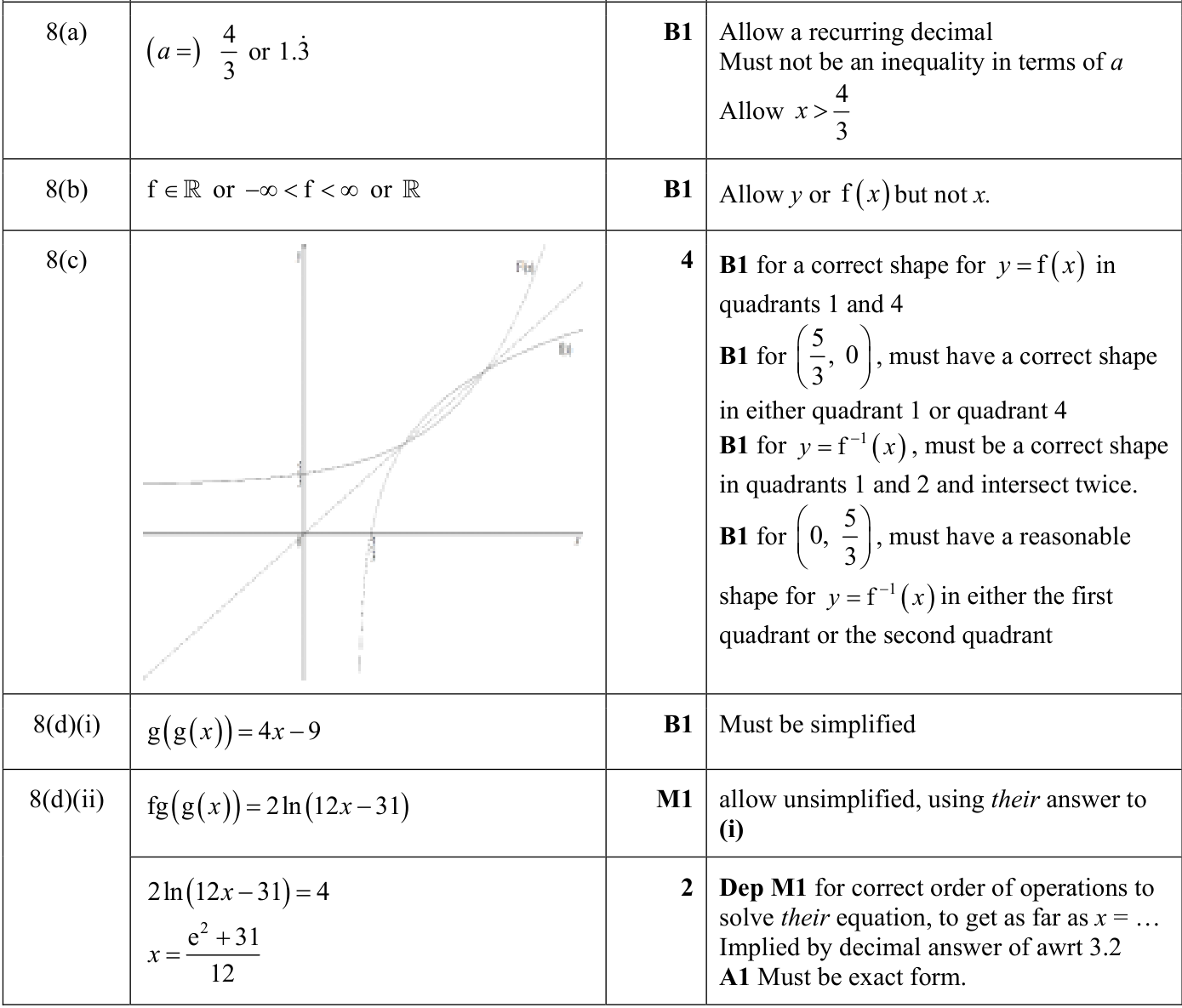
It is given that \(f(x)=2\ln(3x-4)\) for \(x\gt a\).
(a) Write down the least possible value of \(a\).
(b) Write down the range of \(f\).
(c) It is given that the equation \(f(x)=f^{-1}(x)\) has two solutions. Using your answer to part (a), sketch the graphs of \(y=f(x)\) and \(y=f^{-1}(x)\) on the axes, stating the coordinates of the points where the graphs meet the axes.
It is given that \(g(x)=2x-3\) for \(x\geq3\).
(d)(i) Find an expression for \(g(g(x))\).
(d)(ii) Hence solve the equation \(f(g(g(x)))=4\), giving your answer in exact form.
0606 P12 - Nov 2022 - Q8 - 10 marks
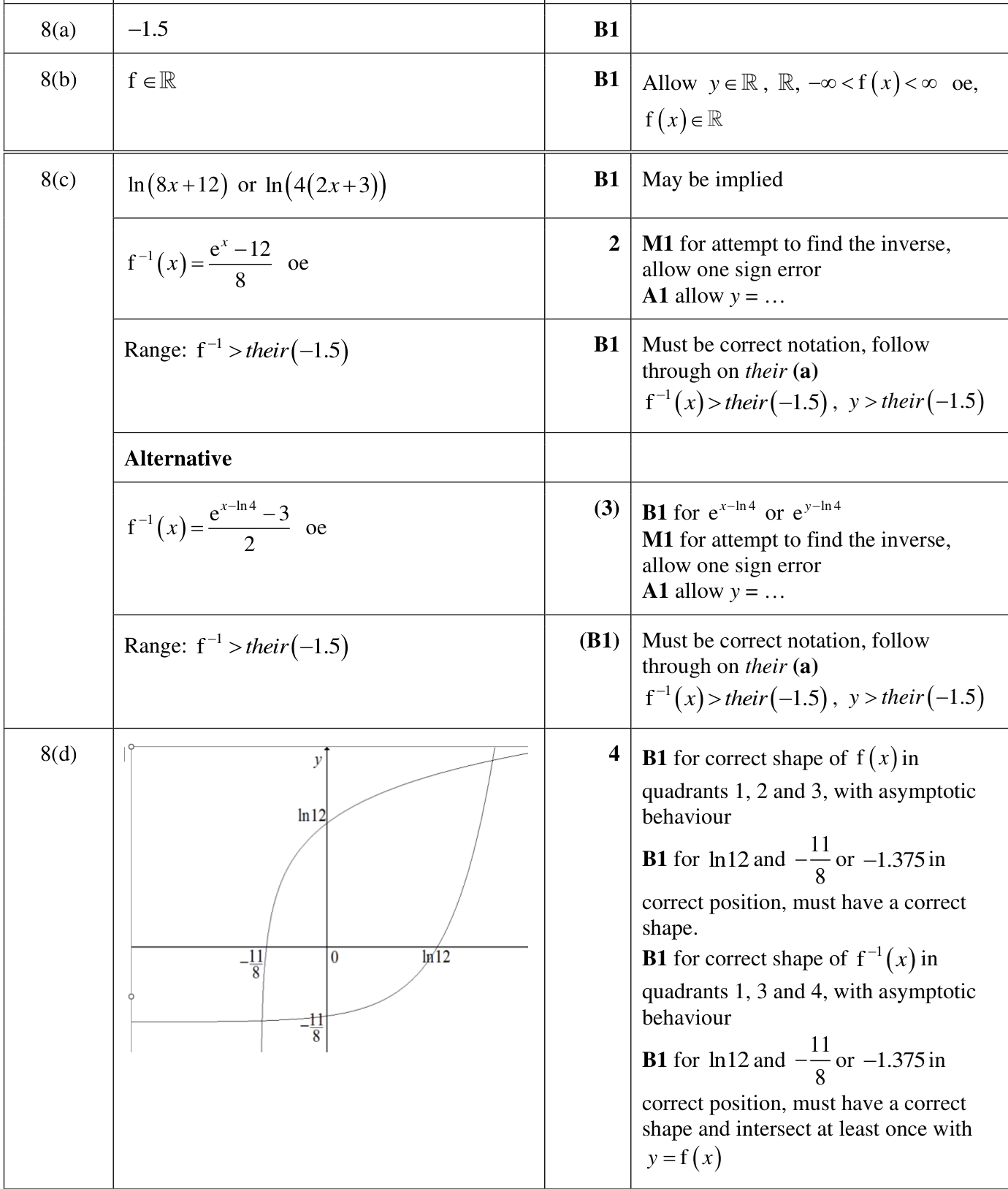
A function \(f(x)\) is such that
\(f(x)=\ln(2x+3)+\ln4,\)
for \(x\gt a\), where \(a\) is a constant.
(a) Write down the least possible value of \(a\).
(b) Using your value of \(a\), write down the range of \(f\).
(c) Using your value of \(a\), find \(f^{-1}(x)\), stating its range.
(d) On the axes below, sketch the graphs of \(y=f(x)\) and \(y=f^{-1}(x)\), stating the exact intercepts of each graph with the coordinate axes. Label each of your graphs.
0606 P13 - Nov 2022 - Q6 - 7 marks
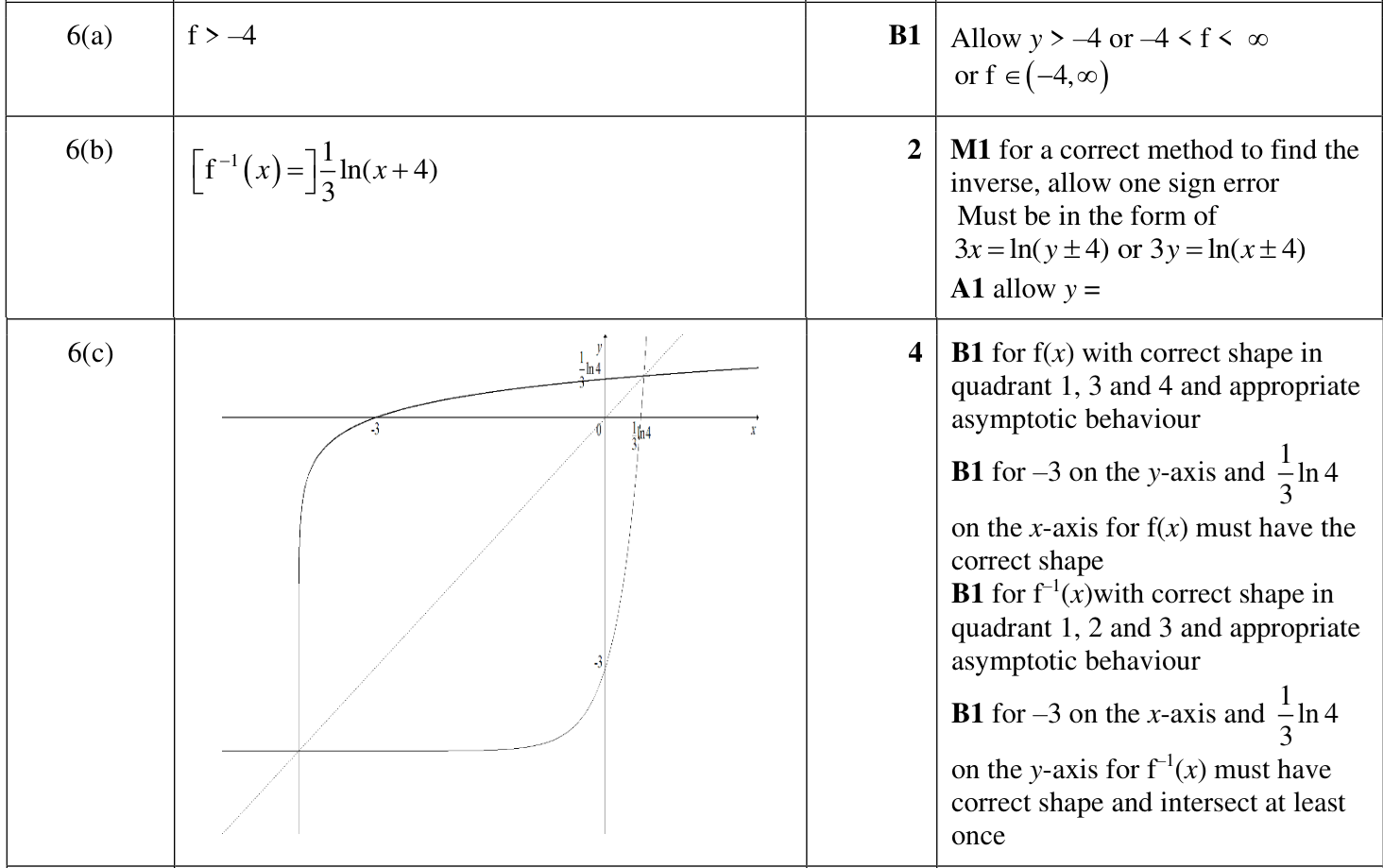
A function \(f(x)\) is such that
\(f(x)=e^{3x}-4,\)
for \(x\in\mathbb R\).
(a) Find the range of \(f\).
(b) Find an expression for \(f^{-1}(x)\).
(c) On the axes, sketch the graphs of \(y=f(x)\) and \(y=f^{-1}(x)\), stating the exact values of the intercepts with the coordinate axes.
0606 P11 - Nov 2020 - Q7 - 9 marks
It is given that \(f(x)=5\ln(2x+3)\) for \(x\gt -\dfrac{3}{2}\).
(a) Write down the range of \(f\).
(b) Find \(f^{-1}\) and state its domain.
(c) Sketch the graph of \(y=f(x)\) and the graph of \(y=f^{-1}(x)\). Label each curve and state the intercepts on the coordinate axes.

0606 P13 - Nov 2020 - Q3 - 7 marks
(a) The function \(\mathrm{f}\) is given by
\(\mathrm{f}(x)=4\ln(2x-1).\)
(i) Write down the largest possible domain for \(\mathrm{f}\).
(ii) Find \(\mathrm{f}^{-1}(x)\) and its domain.
(b) The functions \(\mathrm{g}\) and \(\mathrm{h}\) are given by
\(\mathrm{g}(x)=x+5,\qquad x\in\mathbb{R},\)
and
\(\mathrm{h}(x)=\sqrt{2x-3},\qquad x\geq \frac32.\)
Solve \(\mathrm{gh}(x)=7\).

0606 P11 - Jun 2019 - Q8 - 9 marks
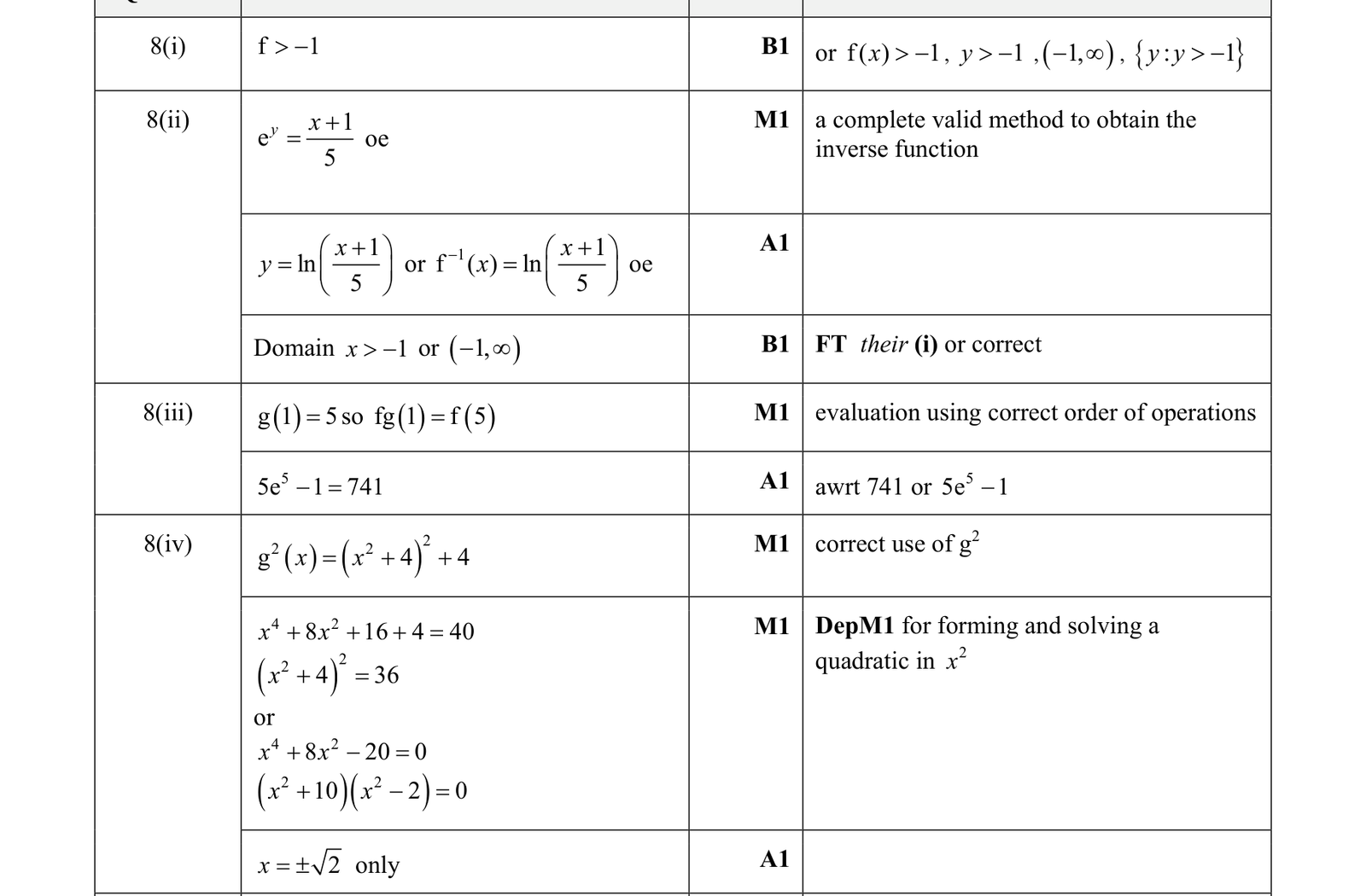
It is given that \(f(x)=5e^x-1\) for \(x\in\mathbb{R}\).
(i) Write down the range of \(f\).
(ii) Find \(f^{-1}\) and state its domain.
It is given also that \(g(x)=x^2+4\) for \(x\in\mathbb{R}\).
(iii) Find the value of \(fg(1)\).
(iv) Find the exact solutions of \(g^2(x)=40\).