Past Exam Questions
← Back9709 P11 - Nov 2015 - Q8
The first term of a progression is \(4x\) and the second term is \(x^2\).
For the case where the progression is arithmetic with a common difference of 12, find the possible values of \(x\) and the corresponding values of the third term.

9709 P13 - Jun 2015 - Q9
The first term of an arithmetic progression is \(-2222\) and the common difference is 17. Find the value of the first positive term.

9709 P12 - Jun 2015 - Q8
The first, second and last terms in an arithmetic progression are 56, 53 and -22 respectively. Find the sum of all the terms in the progression.

9709 P12 - Nov 2022 - Q2
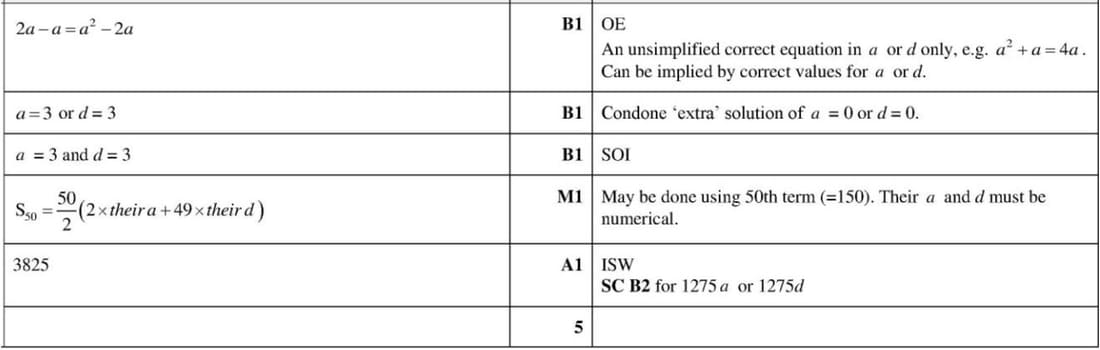
The first, second and third terms of an arithmetic progression are \(a, 2a\) and \(a^2\) respectively, where \(a\) is a positive constant.
Find the sum of the first 50 terms of the progression.
9709 P11 - Jun 2015 - Q7
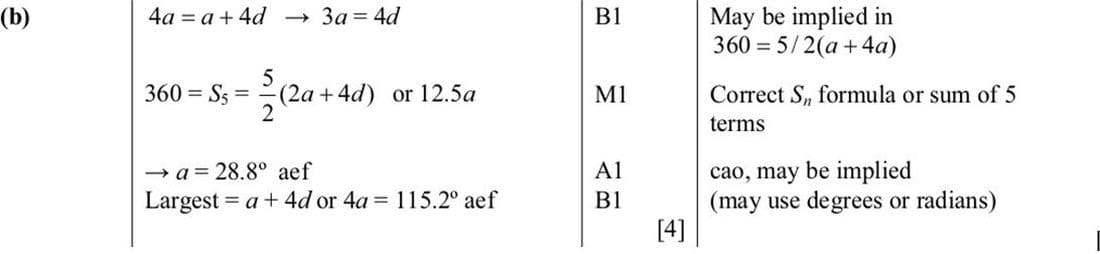
A circle is divided into 5 sectors in such a way that the angles of the sectors are in arithmetic progression. Given that the angle of the largest sector is 4 times the angle of the smallest sector, find the angle of the largest sector.
9709 P12 - Nov 2014 - Q8
The sum, \(S_n\), of the first \(n\) terms of an arithmetic progression is given by \(S_n = 32n - n^2\). Find the first term and the common difference.

9709 P11 - Nov 2014 - Q7
An arithmetic progression has first term 7. The nth term is 84 and the (3n)th term is 245. Find the value of n.

9709 P11 - Jun 2014 - Q5
An arithmetic progression has first term \(a\) and common difference \(d\). It is given that the sum of the first 200 terms is 4 times the sum of the first 100 terms.
(i) Find \(d\) in terms of \(a\).
(ii) Find the 100th term in terms of \(a\).

9709 P13 - Nov 2013 - Q5
In an arithmetic progression, the fifth term is 197 and the sum of the first ten terms is 2040. Find the common difference.

9709 P12 - Nov 2013 - Q7
An athlete runs the first mile of a marathon in 5 minutes. His speed reduces in such a way that each mile takes 12 seconds longer than the preceding mile.
(i) Given that the nth mile takes 9 minutes, find the value of n.
(ii) Assuming that the length of the marathon is 26 miles, find the total time, in hours and minutes, to complete the marathon.

9709 P11 - Nov 2013 - Q9
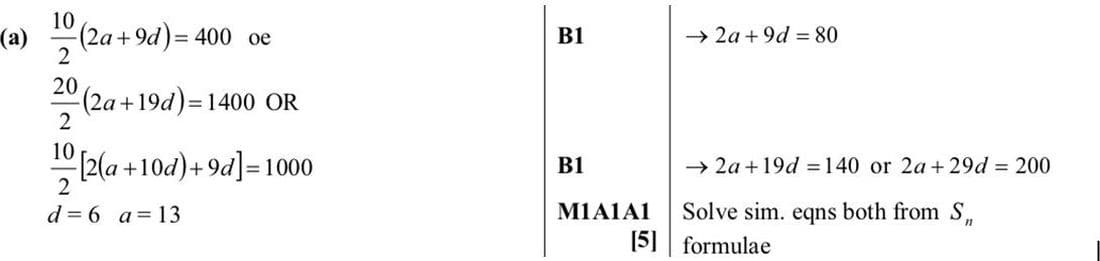
In an arithmetic progression the sum of the first ten terms is 400 and the sum of the next ten terms is 1000. Find the common difference and the first term.
9709 P13 - Jun 2013 - Q9
In an arithmetic progression, the sum, \(S_n\), of the first \(n\) terms is given by \(S_n = 2n^2 + 8n\). Find the first term and the common difference of the progression.

9709 P12 - Jun 2013 - Q10
The first and last terms of an arithmetic progression are 12 and 48 respectively. The sum of the first four terms is 57. Find the number of terms in the progression.

9709 P12 - Nov 2012 - Q8
A circle is divided into n sectors in such a way that the angles of the sectors are in arithmetic progression. The smallest two angles are 3° and 5°. Find the value of n.

9709 P13 - Jun 2022 - Q3
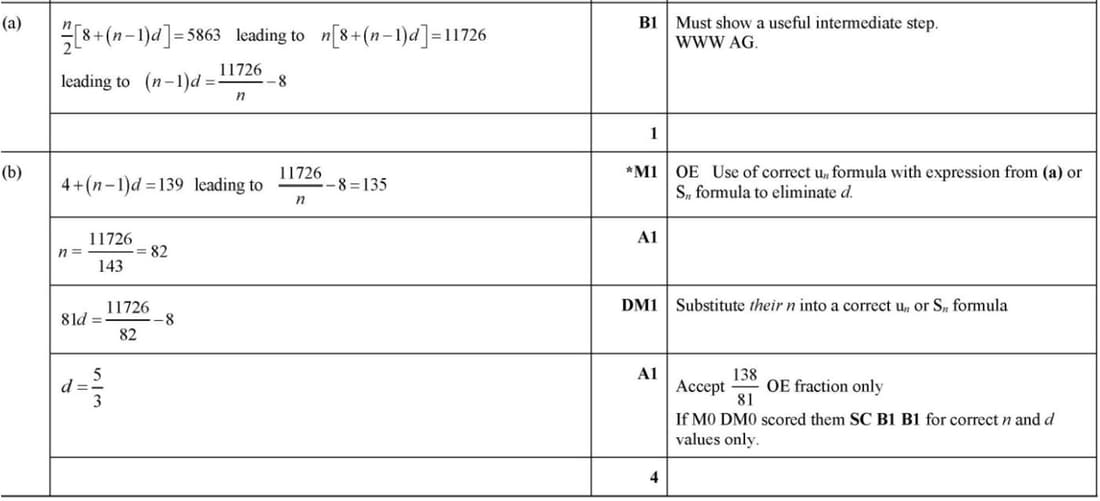
An arithmetic progression has first term 4 and common difference \(d\). The sum of the first \(n\) terms of the progression is 5863.
(a) Show that \((n-1)d = \frac{11726}{n} - 8\).
(b) Given that the \(n\)th term is 139, find the values of \(n\) and \(d\), giving the value of \(d\) as a fraction.
9709 P11 - Nov 2012 - Q1
The first term of an arithmetic progression is 61 and the second term is 57. The sum of the first n terms is n. Find the value of the positive integer n.

9709 P12 - Jun 2012 - Q7
In an arithmetic progression, the sum of the first n terms, denoted by Sn, is given by
\(S_n = n^2 + 8n\).
Find the first term and the common difference.

9709 P12 - Nov 2011 - Q10
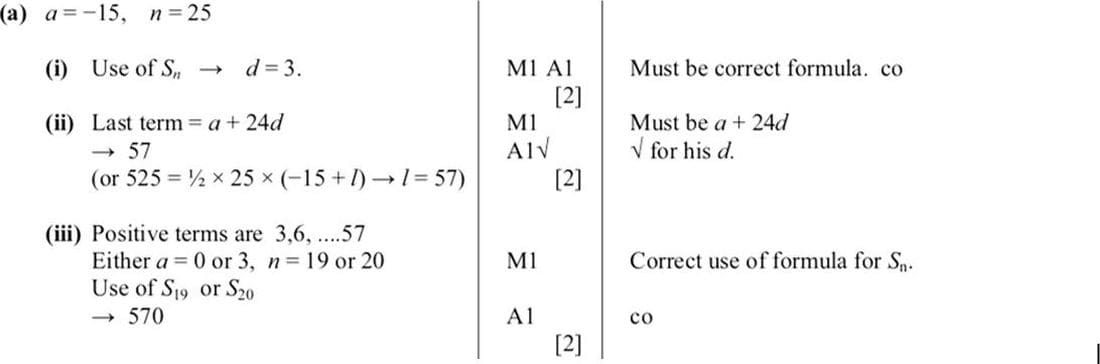
An arithmetic progression contains 25 terms and the first term is -15. The sum of all the terms in the progression is 525. Calculate
(i) the common difference of the progression,
(ii) the last term in the progression,
(iii) the sum of all the positive terms in the progression.
9709 P11 - Nov 2011 - Q6
The sixth term of an arithmetic progression is 23 and the sum of the first ten terms is 200. Find the seventh term.

9709 P13 - Jun 2011 - Q6
An arithmetic progression is such that the eighth term is three times the third term. Show that the sum of the first eight terms is four times the sum of the first four terms.
