Browsing as Guest. Progress, bookmarks and attempts are disabled.
Log in to track your work.
9709 P12 - Jun 2017 - Q7
902
A geometric progression has a first term of 6 and a sum to infinity of 18. A new geometric progression is formed by squaring each of the terms of the original progression. Find the sum to infinity of the new progression.
Solution
The sum to infinity of a geometric progression is given by \(S_\infty = \frac{a}{1-r}\), where \(a\) is the first term and \(r\) is the common ratio.
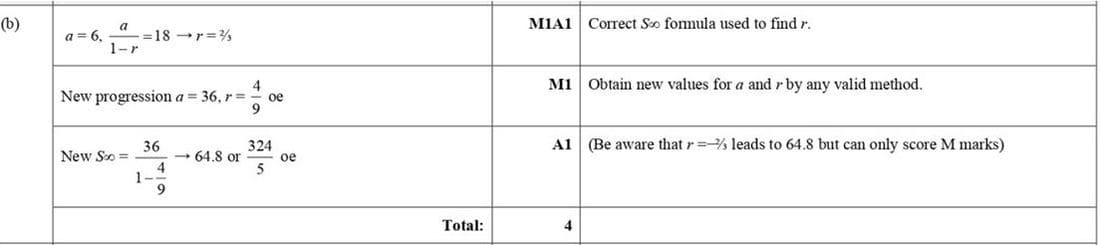
Given \(a = 6\) and \(S_\infty = 18\), we have:
\(\frac{6}{1-r} = 18\)
Solving for \(r\):
\(6 = 18(1-r)\)
\(6 = 18 - 18r\)
\(18r = 12\)
\(r = \frac{2}{3}\)
The new progression is formed by squaring each term of the original progression. The first term of the new progression is \(a^2 = 6^2 = 36\), and the new common ratio is \(r^2 = \left(\frac{2}{3}\right)^2 = \frac{4}{9}\).